Pharmacogenetics
Dr. Prashant Shukla
Junior Resident
Dept of Pharmacology
Contents
Background & Introduction
Importance & Goals of Pharmacogenomics
Pharmacogenetic phenotypes
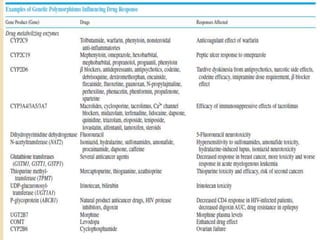
Pharmacogenomic tests
Pharmacogenetics & Drug development
Pharmacogenetics in clinical practice
Advantages and barriers of pharmacogenomics
2
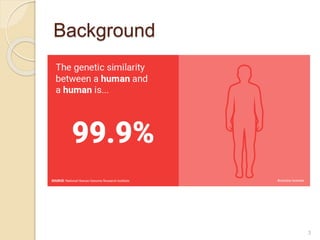
Background
3
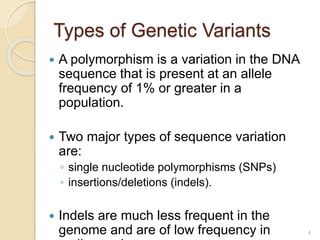
Types of Genetic Variants
๏‚— A polymorphism is a variation in the DNA
sequence that is present at an allele
frequency of 1% or greater in a
population.
๏‚— Two major types of sequence variation
are:
โ—ฆ single nucleotide polymorphisms (SNPs)
โ—ฆ insertions/deletions (indels).
๏‚— Indels are much less frequent in the
genome and are of low frequency in 4
SNPs
5
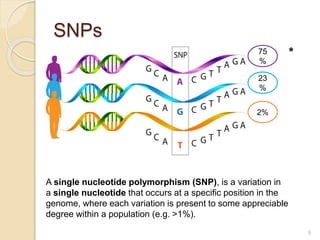
A single nucleotide polymorphism (SNP), is a variation in
a single nucleotide that occurs at a specific position in the
genome, where each variation is present to some appreciable
degree within a population (e.g. >1%).
75
%
23
%
2%
*
SNPs types
6
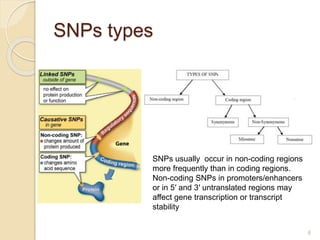
SNPs usually occur in non-coding regions
more frequently than in coding regions.
Non-coding SNPs in promoters/enhancers
or in 5โ€ฒ and 3โ€ฒ untranslated regions may
affect gene transcription or transcript
stability
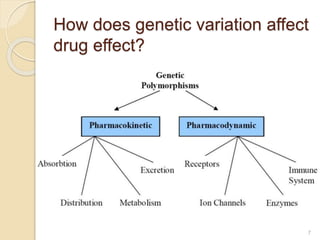
How does genetic variation affect
drug effect?
7
Introduction
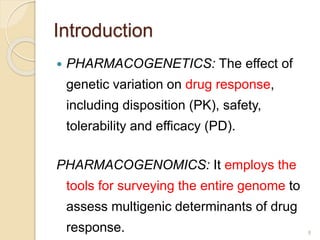
๏‚— PHARMACOGENETICS: The effect of
genetic variation on drug response,
including disposition (PK), safety,
tolerability and efficacy (PD).
PHARMACOGENOMICS: It employs the
tools for surveying the entire genome to
assess multigenic determinants of drug
response. 8
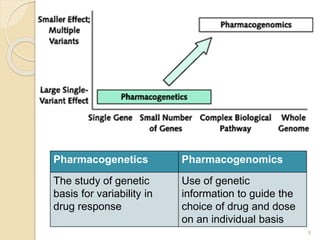
Pharmacogenetics Pharmacogenomics
The study of genetic
basis for variability in
drug response
Use of genetic
information to guide the
choice of drug and dose
on an individual basis
9
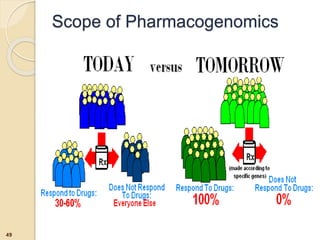
Importance of
Pharmacogenetics
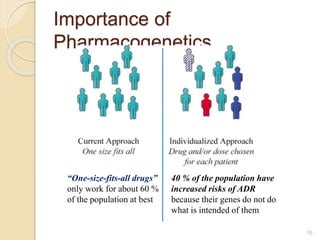
โ€œOne-size-fits-all drugsโ€
only work for about 60 %
of the population at best
40 % of the population have
increased risks of ADR
because their genes do not do
what is intended of them
10
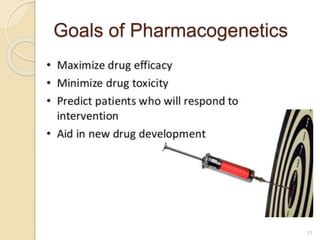
Goals of Pharmacogenetics
11
Pharmacogenetic phenotypes
Genetic variations which affects the
drug response can be divided in 3
categories:
1. Variations affecting Pharmacokinetics
.
2. Variations affecting Drug
receptor/target.
12
13
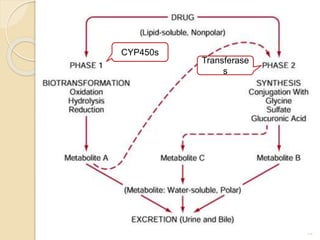
CYP450s
Transferase
s
Variations affecting PK
14
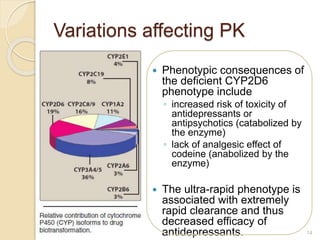
๏‚— Phenotypic consequences of
the deficient CYP2D6
phenotype include
โ—ฆ increased risk of toxicity of
antidepressants or
antipsychotics (catabolized by
the enzyme)
โ—ฆ lack of analgesic effect of
codeine (anabolized by the
enzyme)
๏‚— The ultra-rapid phenotype is
associated with extremely
rapid clearance and thus
decreased efficacy of
antidepressants.
CYP2D6
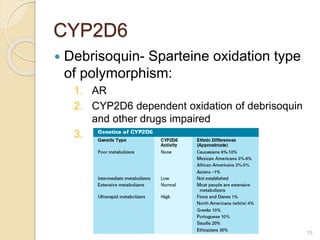
๏‚— Debrisoquin- Sparteine oxidation type
of polymorphism:
1. AR
2. CYP2D6 dependent oxidation of debrisoquin
and other drugs impaired
3.
15
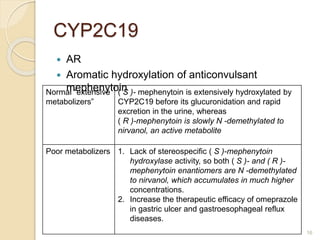
CYP2C19
๏‚— AR
๏‚— Aromatic hydroxylation of anticonvulsant
mephenytoin
16
Normal โ€œextensive
metabolizersโ€
( S )- mephenytoin is extensively hydroxylated by
CYP2C19 before its glucuronidation and rapid
excretion in the urine, whereas
( R )-mephenytoin is slowly N -demethylated to
nirvanol, an active metabolite
Poor metabolizers 1. Lack of stereospecific ( S )-mephenytoin
hydroxylase activity, so both ( S )- and ( R )-
mephenytoin enantiomers are N -demethylated
to nirvanol, which accumulates in much higher
concentrations.
2. Increase the therapeutic efficacy of omeprazole
in gastric ulcer and gastroesophageal reflux
diseases.
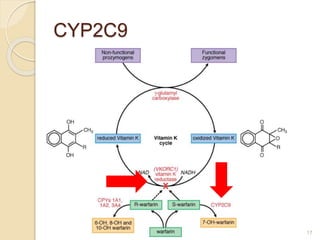
CYP2C9
17
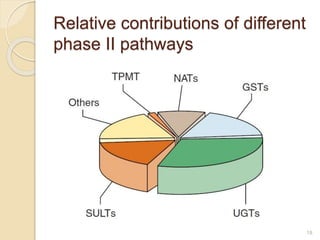
Relative contributions of different
phase II pathways
18
Variations affecting PK
Suxamethonium and
Pseudocholinesterase
deficiency
Genes affecting NAT2
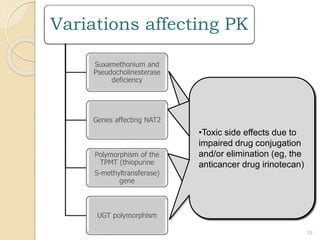
Polymorphism of the
TPMT (thiopurine
S-methyltransferase)
gene
UGT polymorphism
โ€ขDue to mutation, there is
formation of abnormal
cholinesterase.
โ€ขThe individuals fail to
inactivate Suxamethonium
rapidly and experience
prolonged neuro- muscular
blockade.
โ€ขFrequency: 1/3000
19
โ€ขRate of drug acetylation
varied in different
population as a result of
balanced polymorphism.
โ€ขAcetylation by N
acetyltransferase (NAT 2)
enzyme
โ€ขSlow acetylators:
peripheral neuropathy
โ€ขFast acetylators:
Hepatotoxicity (wrt
Isoniazid)
โ€ขAR trait
โ€ขRapidly degraded mutant
enzyme and consequently
deficient S -methylation of
6-MP, thioguanine, and
azathioprine, required for
their detoxification.
โ€ขHigh risk of thiopurine
drug-induced fatal
hematopoietic toxicity.
โ€ขToxic side effects due to
impaired drug conjugation
and/or elimination (eg, the
anticancer drug irinotecan)
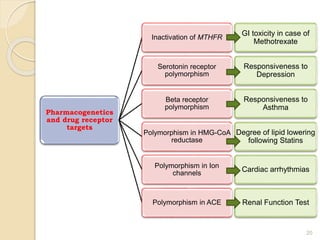
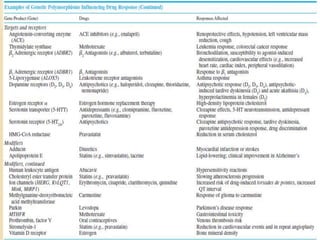
Pharmacogenetics
and drug receptor
targets
Inactivation of MTHFR
Serotonin receptor
polymorphism
Beta receptor
polymorphism
Polymorphism in HMG-CoA
reductase
Polymorphism in Ion
channels
Polymorphism in ACE
20
GI toxicity in case of
Methotrexate
Responsiveness to
Depression
Responsiveness to
Asthma
Degree of lipid lowering
following Statins
Cardiac arrhythmias
Renal Function Test
Polymorphism- modifying
diseases
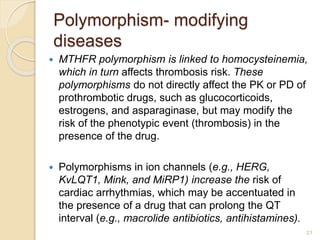
๏‚— MTHFR polymorphism is linked to homocysteinemia,
which in turn affects thrombosis risk. These
polymorphisms do not directly affect the PK or PD of
prothrombotic drugs, such as glucocorticoids,
estrogens, and asparaginase, but may modify the
risk of the phenotypic event (thrombosis) in the
presence of the drug.
๏‚— Polymorphisms in ion channels (e.g., HERG,
KvLQT1, Mink, and MiRP1) increase the risk of
cardiac arrhythmias, which may be accentuated in
the presence of a drug that can prolong the QT
interval (e.g., macrolide antibiotics, antihistamines).
21
Clinically available
Pharmacogenomic tests
22
23
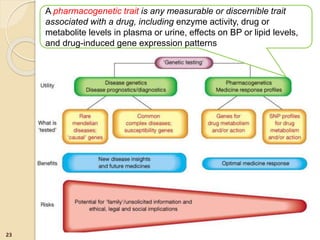
A pharmacogenetic trait is any measurable or discernible trait
associated with a drug, including enzyme activity, drug or
metabolite levels in plasma or urine, effects on BP or lipid levels,
and drug-induced gene expression patterns
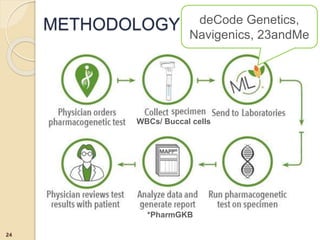
METHODOLOGY
24
deCode Genetics,
Navigenics, 23andMe
WBCs/ Buccal cells
*PharmGKB
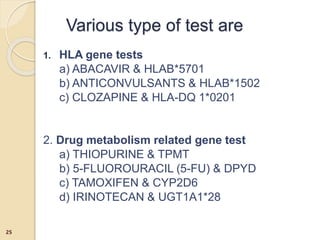
1. HLA gene tests
a) ABACAVIR & HLAB*5701
b) ANTICONVULSANTS & HLAB*1502
c) CLOZAPINE & HLA-DQ 1*0201
2. Drug metabolism related gene test
a) THIOPURINE & TPMT
b) 5-FLUOROURACIL (5-FU) & DPYD
c) TAMOXIFEN & CYP2D6
d) IRINOTECAN & UGT1A1*28
Various type of test are
25
3) Drug target related gene test
a) Trastuzumab & HER 2
b) DASATINIB, IMATINIB & BCR-ABL 1
4) Combined (metabolism & target) gene test
a) WARFARIN & CYP2C9 + VKORC 1
GENOTYPING
26
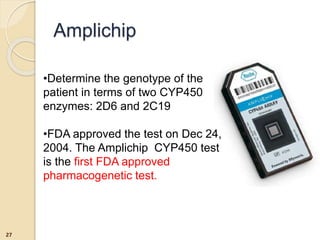
Amplichip
โ€ขDetermine the genotype of the
patient in terms of two CYP450
enzymes: 2D6 and 2C19
โ€ขFDA approved the test on Dec 24,
2004. The Amplichip CYP450 test
is the first FDA approved
pharmacogenetic test.
27
Pharmacogenetics
& Drug development
28
29
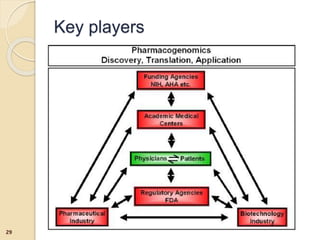
Key players
Role of pharmacogenetics in drug development
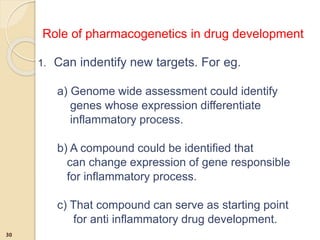
1. Can indentify new targets. For eg.
a) Genome wide assessment could identify
genes whose expression differentiate
inflammatory process.
b) A compound could be identified that
can change expression of gene responsible
for inflammatory process.
c) That compound can serve as starting point
for anti inflammatory drug development.
30
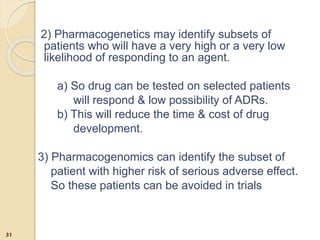
2) Pharmacogenetics may identify subsets of
patients who will have a very high or a very low
likelihood of responding to an agent.
a) So drug can be tested on selected patients
will respond & low possibility of ADRs.
b) This will reduce the time & cost of drug
development.
3) Pharmacogenomics can identify the subset of
patient with higher risk of serious adverse effect.
So these patients can be avoided in trials
31
โ€ข Pharmacogenetic data can be submitted to FDA
during IND & NDA application.
โ€ข If pharmacogenetics studies on animals are
available then pharmacogenetic tests should be
included in clinical trials.
โ€ข During NDA application sponsor should submit the
pharmacogenetic data voluntarily, intended to put
on label of the drug.
32
โ€ข Chemogenomics, or chemical genomics, is the
systematic screening of targeted chemical
libraries of small molecules against individual drug
target families (e.g., GPCRs, nuclear
receptors, kinases, proteases, etc.) with the ultimate
goal of identification of novel drugs and drug targets.
Chemogenomics
Pharmacogenetics
in clinical practice
34
โ€ข Three major types of evidence that should
accumulate to implicate polymorphism in clinical
care.
1. Screens of tissues from individuals linking the
polymorphism to a trait.
2. Complementary preclinical studies.
3. Multiple supportive clinical phenotype/genotype
association studies.
36
โ€ข Despite considerable research activity,
pharmacogenetics are not yet widely utilized in
clinical practice.
โ€ข Dose adjustment on the basis of renal or hepatic
dysfunction can be accepted by clinician.
โ€ข But there is much more hesitation from clinician to
adjust the dose on pharmacogenetic ground.
โ€ข This can be due to resistance to accept or can be
due to unfamiliarity with the principles of genetics.
37
โ€ข Another hurdle in the path of Pharmacogenetics is
Genetic Discrimination.
โ€ข Genetic discrimination occurs if people are
treated unfairly because of differences in their
DNA that increase their chances of getting a
certain disease.
โ€ข For example, a health insurer might refuse to give
coverage to a woman who has a DNA difference
that raises her odds of getting breast cancer .
โ€ข Employers also could use DNA information to
decide whether to hire or fire workers.
38
Genetic Information Non-
discrimination Act (GINA) 2008
๏‚— It is a new federal law that protects
Americans from being treated unfairly
because of differences in their DNA
that may affect their health.
๏‚— The new law prevents discrimination
from health insurers and employers.
39
Advantages of
pharmacogenomics
๏‚— To predict a patientโ€™s response to drugs
๏‚— To develop โ€œcustomizedโ€ prescriptions
๏‚— To minimize or eliminate adverse events
๏‚— To improve efficacy and patient
compliance
๏‚— To improve rational drug development
๏‚— Pharmacogenetic test need only be
conducted once during the life time.
40
Advantages of
pharmacogenomicsโ€ฆ
๏‚— To improve the accuracy of
determining appropriate dosage of
drugs
๏‚— To screen and monitor certain
diseases
๏‚— To develop more powerful, safer
vaccines
๏‚— To allow improvements in drug
discovery and development
41
Barriers of
Pharmacogenomics
1. Complexity of finding gene variations
that affect drug response.
๏‚— Millions of SNPs must be identified
and analyzed to determine their
involvement in drug response
2. Confidentiality, privacy and the use
and storage of genetic information
42
Barriers of
Pharmacogenomics...
3. Educating healthcare providers and
patients
๏‚— Complicates the process of
prescribing and dispensing drugs
๏‚— Physicians must execute an extra
diagnostic step to determine which
drug is best suited to each patient
43
Barriers of
Pharmacogenomics..
4. Disincentives for drug companies to
make multiple pharmacogenomic
products
๏‚— Most pharmaceutical companies have
been successful with their โ€œone size fits
allโ€ approach to drug development
๏‚— For small market- Pharmaceutical
companies hundreds of millions of
dollars on pharmacogenomic based
drug development.
44
โ€ข Pharmacogenomics is in early stages of
development.
โ€ข Much of the excitement regarding the promise of
human genomics hopes on the โ€œPERSONALIZED
MEDICINE OR MAGIC BULLETSโ€.
โ€ข Reality of the added complexity of additional
testing & need for interpretation of results to
individualized dosing has been ignored.
Pharmacogenomics &
Personalized medicine
45
46
Clinomics
๏‚— Clinomics is the study of genomics
data along with its associated clinical
data.
๏‚— As personalized medicine advances,
clinomics will be a bridge between basic
biological data and its effect on human
health.
47
โ€ข Pharmacogenomics has great potential to optimize
drug therapy.
โ€ข Newer molecular diagnostic test will have to be
develop to detect polymorphisms.
โ€ข Pharmacotherapeutics decisions will soon become
fundamental for diagnosing the illness & guiding the
choice & dosage of medications.
CONCLUSION
48
Scope of Pharmacogenomics
49
50
References
51
[1]Relling MV, Giacomini KM. Pharmacogenetics Brunton
Laurence, Chabner Bruce, Knollman Bjorn, editors.
Goodman and Gillmanโ€™s The Pharmacological Basis of
Theraputics.12ed. USA: McGraw Hills; 2011.p145-68.
[2] Rang HP, Dale M M, Ritter JM, Flower RJ, Henderson
G. Pharmacogenetics, Pharmacogenomics &
Personalised medicine. Hyde Madelane, Mortimer
Alexandra, editors. Pharmacology. 7ed.Britain: Elsevier
Churchill Living stone ;2012.p132-8.
[3] http://www.genome.gov/10002077#al-2
[4]http://www.fda.gov/drugs/scienceresearch/researcharea
s/pharmacogenetics/ucm083378.htm
Referencesโ€ฆ
[5]http://www.fda.gov/downloads/regulatoryinformat
ion/guidances/ucm126957.pdf
[6]http://www.fda.gov/downloads/Drugs/ScienceRe
search/ResearchAreas/Pharmacogenetics/ucm1
16702.pdf
[7] Semizarov D, Blomme D.Introduction genomics
& personalised medicine.Genomics in Drug
Discovery and Development .1ed. USA: Wiley;
2009.p1-24.
[8] Dr. Hemant Bangaโ€™s Seminar on
Pharmacogenetics
52
53
54
55

Pharmacogenetics and Pharmacogenomics

  • 1.
    Pharmacogenetics Dr. Prashant Shukla JuniorResident Dept of Pharmacology
  • 2.
    Contents Background & Introduction Importance& Goals of Pharmacogenomics Pharmacogenetic phenotypes Pharmacogenomic tests Pharmacogenetics & Drug development Pharmacogenetics in clinical practice Advantages and barriers of pharmacogenomics 2
  • 3.
  • 4.
    Types of GeneticVariants ๏‚— A polymorphism is a variation in the DNA sequence that is present at an allele frequency of 1% or greater in a population. ๏‚— Two major types of sequence variation are: โ—ฆ single nucleotide polymorphisms (SNPs) โ—ฆ insertions/deletions (indels). ๏‚— Indels are much less frequent in the genome and are of low frequency in 4
  • 5.
    SNPs 5 A single nucleotidepolymorphism (SNP), is a variation in a single nucleotide that occurs at a specific position in the genome, where each variation is present to some appreciable degree within a population (e.g. >1%). 75 % 23 % 2% *
  • 6.
    SNPs types 6 SNPs usuallyoccur in non-coding regions more frequently than in coding regions. Non-coding SNPs in promoters/enhancers or in 5โ€ฒ and 3โ€ฒ untranslated regions may affect gene transcription or transcript stability
  • 7.
    How does geneticvariation affect drug effect? 7
  • 8.
    Introduction ๏‚— PHARMACOGENETICS: Theeffect of genetic variation on drug response, including disposition (PK), safety, tolerability and efficacy (PD). PHARMACOGENOMICS: It employs the tools for surveying the entire genome to assess multigenic determinants of drug response. 8
  • 9.
    Pharmacogenetics Pharmacogenomics The studyof genetic basis for variability in drug response Use of genetic information to guide the choice of drug and dose on an individual basis 9
  • 10.
    Importance of Pharmacogenetics โ€œOne-size-fits-all drugsโ€ onlywork for about 60 % of the population at best 40 % of the population have increased risks of ADR because their genes do not do what is intended of them 10
  • 11.
  • 12.
    Pharmacogenetic phenotypes Genetic variationswhich affects the drug response can be divided in 3 categories: 1. Variations affecting Pharmacokinetics . 2. Variations affecting Drug receptor/target. 12
  • 13.
  • 14.
    Variations affecting PK 14 ๏‚—Phenotypic consequences of the deficient CYP2D6 phenotype include โ—ฆ increased risk of toxicity of antidepressants or antipsychotics (catabolized by the enzyme) โ—ฆ lack of analgesic effect of codeine (anabolized by the enzyme) ๏‚— The ultra-rapid phenotype is associated with extremely rapid clearance and thus decreased efficacy of antidepressants.
  • 15.
    CYP2D6 ๏‚— Debrisoquin- Sparteineoxidation type of polymorphism: 1. AR 2. CYP2D6 dependent oxidation of debrisoquin and other drugs impaired 3. 15
  • 16.
    CYP2C19 ๏‚— AR ๏‚— Aromatichydroxylation of anticonvulsant mephenytoin 16 Normal โ€œextensive metabolizersโ€ ( S )- mephenytoin is extensively hydroxylated by CYP2C19 before its glucuronidation and rapid excretion in the urine, whereas ( R )-mephenytoin is slowly N -demethylated to nirvanol, an active metabolite Poor metabolizers 1. Lack of stereospecific ( S )-mephenytoin hydroxylase activity, so both ( S )- and ( R )- mephenytoin enantiomers are N -demethylated to nirvanol, which accumulates in much higher concentrations. 2. Increase the therapeutic efficacy of omeprazole in gastric ulcer and gastroesophageal reflux diseases.
  • 17.
  • 18.
    Relative contributions ofdifferent phase II pathways 18
  • 19.
    Variations affecting PK Suxamethoniumand Pseudocholinesterase deficiency Genes affecting NAT2 Polymorphism of the TPMT (thiopurine S-methyltransferase) gene UGT polymorphism โ€ขDue to mutation, there is formation of abnormal cholinesterase. โ€ขThe individuals fail to inactivate Suxamethonium rapidly and experience prolonged neuro- muscular blockade. โ€ขFrequency: 1/3000 19 โ€ขRate of drug acetylation varied in different population as a result of balanced polymorphism. โ€ขAcetylation by N acetyltransferase (NAT 2) enzyme โ€ขSlow acetylators: peripheral neuropathy โ€ขFast acetylators: Hepatotoxicity (wrt Isoniazid) โ€ขAR trait โ€ขRapidly degraded mutant enzyme and consequently deficient S -methylation of 6-MP, thioguanine, and azathioprine, required for their detoxification. โ€ขHigh risk of thiopurine drug-induced fatal hematopoietic toxicity. โ€ขToxic side effects due to impaired drug conjugation and/or elimination (eg, the anticancer drug irinotecan)
  • 20.
    Pharmacogenetics and drug receptor targets Inactivationof MTHFR Serotonin receptor polymorphism Beta receptor polymorphism Polymorphism in HMG-CoA reductase Polymorphism in Ion channels Polymorphism in ACE 20 GI toxicity in case of Methotrexate Responsiveness to Depression Responsiveness to Asthma Degree of lipid lowering following Statins Cardiac arrhythmias Renal Function Test
  • 21.
    Polymorphism- modifying diseases ๏‚— MTHFRpolymorphism is linked to homocysteinemia, which in turn affects thrombosis risk. These polymorphisms do not directly affect the PK or PD of prothrombotic drugs, such as glucocorticoids, estrogens, and asparaginase, but may modify the risk of the phenotypic event (thrombosis) in the presence of the drug. ๏‚— Polymorphisms in ion channels (e.g., HERG, KvLQT1, Mink, and MiRP1) increase the risk of cardiac arrhythmias, which may be accentuated in the presence of a drug that can prolong the QT interval (e.g., macrolide antibiotics, antihistamines). 21
  • 22.
  • 23.
    23 A pharmacogenetic traitis any measurable or discernible trait associated with a drug, including enzyme activity, drug or metabolite levels in plasma or urine, effects on BP or lipid levels, and drug-induced gene expression patterns
  • 24.
  • 25.
    1. HLA genetests a) ABACAVIR & HLAB*5701 b) ANTICONVULSANTS & HLAB*1502 c) CLOZAPINE & HLA-DQ 1*0201 2. Drug metabolism related gene test a) THIOPURINE & TPMT b) 5-FLUOROURACIL (5-FU) & DPYD c) TAMOXIFEN & CYP2D6 d) IRINOTECAN & UGT1A1*28 Various type of test are 25
  • 26.
    3) Drug targetrelated gene test a) Trastuzumab & HER 2 b) DASATINIB, IMATINIB & BCR-ABL 1 4) Combined (metabolism & target) gene test a) WARFARIN & CYP2C9 + VKORC 1 GENOTYPING 26
  • 27.
    Amplichip โ€ขDetermine the genotypeof the patient in terms of two CYP450 enzymes: 2D6 and 2C19 โ€ขFDA approved the test on Dec 24, 2004. The Amplichip CYP450 test is the first FDA approved pharmacogenetic test. 27
  • 28.
  • 29.
  • 30.
    Role of pharmacogeneticsin drug development 1. Can indentify new targets. For eg. a) Genome wide assessment could identify genes whose expression differentiate inflammatory process. b) A compound could be identified that can change expression of gene responsible for inflammatory process. c) That compound can serve as starting point for anti inflammatory drug development. 30
  • 31.
    2) Pharmacogenetics mayidentify subsets of patients who will have a very high or a very low likelihood of responding to an agent. a) So drug can be tested on selected patients will respond & low possibility of ADRs. b) This will reduce the time & cost of drug development. 3) Pharmacogenomics can identify the subset of patient with higher risk of serious adverse effect. So these patients can be avoided in trials 31
  • 32.
    โ€ข Pharmacogenetic datacan be submitted to FDA during IND & NDA application. โ€ข If pharmacogenetics studies on animals are available then pharmacogenetic tests should be included in clinical trials. โ€ข During NDA application sponsor should submit the pharmacogenetic data voluntarily, intended to put on label of the drug. 32
  • 33.
    โ€ข Chemogenomics, orchemical genomics, is the systematic screening of targeted chemical libraries of small molecules against individual drug target families (e.g., GPCRs, nuclear receptors, kinases, proteases, etc.) with the ultimate goal of identification of novel drugs and drug targets. Chemogenomics
  • 34.
  • 35.
    โ€ข Three majortypes of evidence that should accumulate to implicate polymorphism in clinical care. 1. Screens of tissues from individuals linking the polymorphism to a trait. 2. Complementary preclinical studies. 3. Multiple supportive clinical phenotype/genotype association studies. 36
  • 36.
    โ€ข Despite considerableresearch activity, pharmacogenetics are not yet widely utilized in clinical practice. โ€ข Dose adjustment on the basis of renal or hepatic dysfunction can be accepted by clinician. โ€ข But there is much more hesitation from clinician to adjust the dose on pharmacogenetic ground. โ€ข This can be due to resistance to accept or can be due to unfamiliarity with the principles of genetics. 37
  • 37.
    โ€ข Another hurdlein the path of Pharmacogenetics is Genetic Discrimination. โ€ข Genetic discrimination occurs if people are treated unfairly because of differences in their DNA that increase their chances of getting a certain disease. โ€ข For example, a health insurer might refuse to give coverage to a woman who has a DNA difference that raises her odds of getting breast cancer . โ€ข Employers also could use DNA information to decide whether to hire or fire workers. 38
  • 38.
    Genetic Information Non- discriminationAct (GINA) 2008 ๏‚— It is a new federal law that protects Americans from being treated unfairly because of differences in their DNA that may affect their health. ๏‚— The new law prevents discrimination from health insurers and employers. 39
  • 39.
    Advantages of pharmacogenomics ๏‚— Topredict a patientโ€™s response to drugs ๏‚— To develop โ€œcustomizedโ€ prescriptions ๏‚— To minimize or eliminate adverse events ๏‚— To improve efficacy and patient compliance ๏‚— To improve rational drug development ๏‚— Pharmacogenetic test need only be conducted once during the life time. 40
  • 40.
    Advantages of pharmacogenomicsโ€ฆ ๏‚— Toimprove the accuracy of determining appropriate dosage of drugs ๏‚— To screen and monitor certain diseases ๏‚— To develop more powerful, safer vaccines ๏‚— To allow improvements in drug discovery and development 41
  • 41.
    Barriers of Pharmacogenomics 1. Complexityof finding gene variations that affect drug response. ๏‚— Millions of SNPs must be identified and analyzed to determine their involvement in drug response 2. Confidentiality, privacy and the use and storage of genetic information 42
  • 42.
    Barriers of Pharmacogenomics... 3. Educatinghealthcare providers and patients ๏‚— Complicates the process of prescribing and dispensing drugs ๏‚— Physicians must execute an extra diagnostic step to determine which drug is best suited to each patient 43
  • 43.
    Barriers of Pharmacogenomics.. 4. Disincentivesfor drug companies to make multiple pharmacogenomic products ๏‚— Most pharmaceutical companies have been successful with their โ€œone size fits allโ€ approach to drug development ๏‚— For small market- Pharmaceutical companies hundreds of millions of dollars on pharmacogenomic based drug development. 44
  • 44.
    โ€ข Pharmacogenomics isin early stages of development. โ€ข Much of the excitement regarding the promise of human genomics hopes on the โ€œPERSONALIZED MEDICINE OR MAGIC BULLETSโ€. โ€ข Reality of the added complexity of additional testing & need for interpretation of results to individualized dosing has been ignored. Pharmacogenomics & Personalized medicine 45
  • 45.
  • 46.
    Clinomics ๏‚— Clinomics isthe study of genomics data along with its associated clinical data. ๏‚— As personalized medicine advances, clinomics will be a bridge between basic biological data and its effect on human health. 47
  • 47.
    โ€ข Pharmacogenomics hasgreat potential to optimize drug therapy. โ€ข Newer molecular diagnostic test will have to be develop to detect polymorphisms. โ€ข Pharmacotherapeutics decisions will soon become fundamental for diagnosing the illness & guiding the choice & dosage of medications. CONCLUSION 48
  • 48.
  • 49.
  • 50.
    References 51 [1]Relling MV, GiacominiKM. Pharmacogenetics Brunton Laurence, Chabner Bruce, Knollman Bjorn, editors. Goodman and Gillmanโ€™s The Pharmacological Basis of Theraputics.12ed. USA: McGraw Hills; 2011.p145-68. [2] Rang HP, Dale M M, Ritter JM, Flower RJ, Henderson G. Pharmacogenetics, Pharmacogenomics & Personalised medicine. Hyde Madelane, Mortimer Alexandra, editors. Pharmacology. 7ed.Britain: Elsevier Churchill Living stone ;2012.p132-8. [3] http://www.genome.gov/10002077#al-2 [4]http://www.fda.gov/drugs/scienceresearch/researcharea s/pharmacogenetics/ucm083378.htm
  • 51.
    Referencesโ€ฆ [5]http://www.fda.gov/downloads/regulatoryinformat ion/guidances/ucm126957.pdf [6]http://www.fda.gov/downloads/Drugs/ScienceRe search/ResearchAreas/Pharmacogenetics/ucm1 16702.pdf [7] Semizarov D,Blomme D.Introduction genomics & personalised medicine.Genomics in Drug Discovery and Development .1ed. USA: Wiley; 2009.p1-24. [8] Dr. Hemant Bangaโ€™s Seminar on Pharmacogenetics 52
  • 52.
  • 53.
  • 54.

Editor's Notes

  • #21ย A polymorphism near a human interferon gene is predictive of the effectiveness of an artificial interferon treatment for Hepatitis C.ย