

Emulator
Vs
Simulator
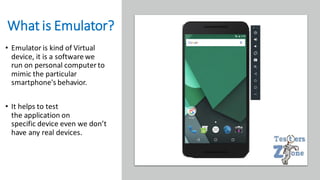
What is Emulator?
• Emulator is kind of Virtual
device, it is a software we
run on personal computer to
mimic the particular
smartphone's behavior.
• It helps to test
the application on
specific device even we don’t
have any real devices.
Why Emulator?
• QA Engineer needs specific devices to test software properly and we
cannot manage all the real devices for the testing so we can take help
of virtual devices.
Note: We have option of Browser stack, where we can use real
devices for our functional testing but again that is not free, we have
to buy plan then only can use.
Pros of
Virtual
Devices
Perfect for early testing.
Quick results.
Easy debugging
Lower exploitation price.
What is Simulator?
• The iOS simulators mimic iOS and run the required
application inside it, by sitting on top of the computer’s
Operating System.But to run the iOS simulator, one needs to
work on the macOS only, as it needs Apple’s native Cocoa API.
This Cocoa API is essential for the GUI, runtime and many
other operations.
Why Emulatorworks very slow?
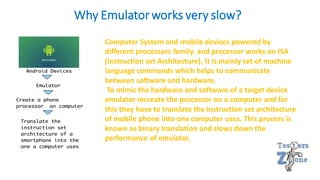
Computer System and mobile devices powered by
different processors family. and processor works on ISA
(Instruction set Architecture). It is mainly set of machine
language commands which helps to communicate
between software and hardware.
To mimic the hardware and software of a target device
emulator recreate the processor on a computer and for
this they have to translate the instruction set architecture
of mobile phone into one computer uses. This process is
known as binary translation and slows down the
performance of emulator.
Differencebetween Emulators and Simulators
Emulators
• Emulators mimic software and
hardware.
• Emulators are written in
machine level assembly
language.
• Emulator is slower due to
binay translation.
Simulators
• Simulators mimic
software only.
• Simulator are written in
high- level Languages.
• Simulator don't need
binary translation.
** If you are not aware with high level language and machine level language plz see next slide.
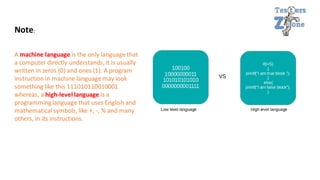
Note:
A machine language is the only language that
a computer directly understands, it is usually
written in zeros (0) and ones (1). A program
instruction in machine language may look
something like this 111010110010001
whereas, a high-level language is a
programming language that uses English and
mathematicalsymbols, like +, -, % and many
others, in its instructions.
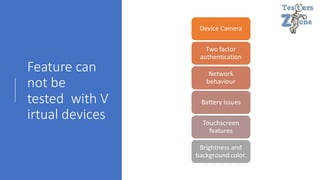
Feature can
not be
tested with V
irtual devices
Device Camera
Two factor
authentication
Network
behaviour
Battery issues
Touchscreen
features
Brightness and
background color.
Key point:
• Emulator imitates features of another device, mimicking hardware and
software of a target device.
• Simulator replicates software by mimicking various product configurations
that exist in the real environment
• We can emulate android phones but cannot do iOS phones
Mithilesh Singh

Emulator vs Simulator

  • 1.
  • 2.
    What is Emulator? •Emulator is kind of Virtual device, it is a software we run on personal computer to mimic the particular smartphone's behavior. • It helps to test the application on specific device even we don’t have any real devices.
  • 3.
    Why Emulator? • QAEngineer needs specific devices to test software properly and we cannot manage all the real devices for the testing so we can take help of virtual devices. Note: We have option of Browser stack, where we can use real devices for our functional testing but again that is not free, we have to buy plan then only can use.
  • 4.
    Pros of Virtual Devices Perfect forearly testing. Quick results. Easy debugging Lower exploitation price.
  • 5.
    What is Simulator? •The iOS simulators mimic iOS and run the required application inside it, by sitting on top of the computer’s Operating System.But to run the iOS simulator, one needs to work on the macOS only, as it needs Apple’s native Cocoa API. This Cocoa API is essential for the GUI, runtime and many other operations.
  • 6.
    Why Emulatorworks veryslow? Computer System and mobile devices powered by different processors family. and processor works on ISA (Instruction set Architecture). It is mainly set of machine language commands which helps to communicate between software and hardware. To mimic the hardware and software of a target device emulator recreate the processor on a computer and for this they have to translate the instruction set architecture of mobile phone into one computer uses. This process is known as binary translation and slows down the performance of emulator.
  • 7.
    Differencebetween Emulators andSimulators Emulators • Emulators mimic software and hardware. • Emulators are written in machine level assembly language. • Emulator is slower due to binay translation. Simulators • Simulators mimic software only. • Simulator are written in high- level Languages. • Simulator don't need binary translation. ** If you are not aware with high level language and machine level language plz see next slide.
  • 8.
    Note: A machine languageis the only language that a computer directly understands, it is usually written in zeros (0) and ones (1). A program instruction in machine language may look something like this 111010110010001 whereas, a high-level language is a programming language that uses English and mathematicalsymbols, like +, -, % and many others, in its instructions.
  • 9.
    Feature can not be testedwith V irtual devices Device Camera Two factor authentication Network behaviour Battery issues Touchscreen features Brightness and background color.
  • 10.
    Key point: • Emulatorimitates features of another device, mimicking hardware and software of a target device. • Simulator replicates software by mimicking various product configurations that exist in the real environment • We can emulate android phones but cannot do iOS phones
  • 11.