Emulator vs Simulator
Presented by
Omnia Ashraf
Both emulator and simulator used to mimic the
real thing in a virtual environment. Although,
the differences between emulation vs.
simulation are quite big for mobile automation.
Before knowing the differences between the
two, let’s learn the definition of both mobile
testing approach.
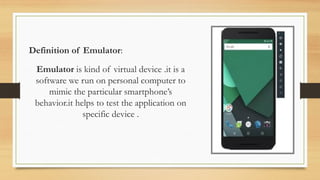
Definition of Emulator:
Click icon to add picture
Emulator is kind of virtual device .it is a
software we run on personal computer to
mimic the particular smartphone’s
behavior.it helps to test the application on
specific device .
Advantages of Emulator
•The emulation technique helps to replicate the hardware and software
atmosphere of a computer system on another machine.
•It provide an authentic environment that does not require the original
system. However, the process of making an emulator is quite tedious and
time-consuming.
•You can achieve the applications or the OS that is emulated. You should
remember that there are not much differences for a user when using the
emulation method
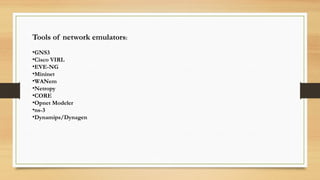
Tools of network emulators:
•GNS3
•Cisco VIRL
•EVE-NG
•Mininet
•WANem
•Netropy
•CORE
•Opnet Modeler
•ns-3
•Dynamips/Dynagen
Definition of simulator:
Simulation is the process of creating a model of a real
world scenario for a variety of reasons including
education, preparing for an anticipated event or
troubleshooting a problem. The models used during a
simulation might be real or dramatized
Advantages of Simulator
•Simulators are highly accurate for ensuring the display of the
interface of an application is the same in various screen
resolutions.
•It also offers quick and simpler means to create a software
environment to test applications without replicating the related
hardware.
•Simulators surely have more uses than application testing, such
as mathematical modeling in medicine, technological
development, etc.
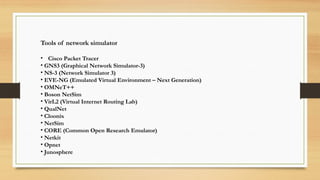
Tools of network simulator
• Cisco Packet Tracer
• GNS3 (Graphical Network Simulator-3)
• NS-3 (Network Simulator 3)
• EVE-NG (Emulated Virtual Environment – Next Generation)
• OMNeT++
• Boson NetSim
• VirL2 (Virtual Internet Routing Lab)
• QualNet
• Cloonix
• NetSim
• CORE (Common Open Research Emulator)
• Netkit
• Opnet
• Junosphere
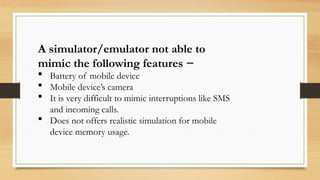
A simulator/emulator not able to
mimic the following features −
 Battery of mobile device
 Mobile device’s camera
 It is very difficult to mimic interruptions like SMS
and incoming calls.
 Does not offers realistic simulation for mobile
device memory usage.
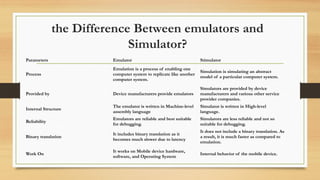
the Difference Between emulators and
Simulator?
Parameters Emulator Stimulator
Process
Emulation is a process of enabling one
computer system to replicate like another
computer system.
Simulation is simulating an abstract
model of a particular computer system.
Provided by Device manufacturers provide emulators
Simulators are provided by device
manufacturers and various other service
provider companies.
Internal Structure
The emulator is written in Machine-level
assembly language
Simulator is written in High-level
language.
Reliability
Emulators are reliable and best suitable
for debugging.
Simulators are less reliable and not so
suitable for debugging.
Binary translation
It includes binary translation as it
becomes much slower due to latency
It does not include a binary translation. As
a result, it is much faster as compared to
emulation.
Work On
It works on Mobile device hardware,
software, and Operating System
Internal behavior of the mobile device.
THANK YOU

Omnya Ashraf.network(Emulator vs Simulator).pptx

  • 1.
  • 2.
    Both emulator andsimulator used to mimic the real thing in a virtual environment. Although, the differences between emulation vs. simulation are quite big for mobile automation. Before knowing the differences between the two, let’s learn the definition of both mobile testing approach.
  • 3.
    Definition of Emulator: Clickicon to add picture Emulator is kind of virtual device .it is a software we run on personal computer to mimic the particular smartphone’s behavior.it helps to test the application on specific device .
  • 4.
    Advantages of Emulator •Theemulation technique helps to replicate the hardware and software atmosphere of a computer system on another machine. •It provide an authentic environment that does not require the original system. However, the process of making an emulator is quite tedious and time-consuming. •You can achieve the applications or the OS that is emulated. You should remember that there are not much differences for a user when using the emulation method
  • 5.
    Tools of networkemulators: •GNS3 •Cisco VIRL •EVE-NG •Mininet •WANem •Netropy •CORE •Opnet Modeler •ns-3 •Dynamips/Dynagen
  • 6.
    Definition of simulator: Simulationis the process of creating a model of a real world scenario for a variety of reasons including education, preparing for an anticipated event or troubleshooting a problem. The models used during a simulation might be real or dramatized
  • 7.
    Advantages of Simulator •Simulatorsare highly accurate for ensuring the display of the interface of an application is the same in various screen resolutions. •It also offers quick and simpler means to create a software environment to test applications without replicating the related hardware. •Simulators surely have more uses than application testing, such as mathematical modeling in medicine, technological development, etc.
  • 8.
    Tools of networksimulator • Cisco Packet Tracer • GNS3 (Graphical Network Simulator-3) • NS-3 (Network Simulator 3) • EVE-NG (Emulated Virtual Environment – Next Generation) • OMNeT++ • Boson NetSim • VirL2 (Virtual Internet Routing Lab) • QualNet • Cloonix • NetSim • CORE (Common Open Research Emulator) • Netkit • Opnet • Junosphere
  • 9.
    A simulator/emulator notable to mimic the following features −  Battery of mobile device  Mobile device’s camera  It is very difficult to mimic interruptions like SMS and incoming calls.  Does not offers realistic simulation for mobile device memory usage.
  • 10.
    the Difference Betweenemulators and Simulator? Parameters Emulator Stimulator Process Emulation is a process of enabling one computer system to replicate like another computer system. Simulation is simulating an abstract model of a particular computer system. Provided by Device manufacturers provide emulators Simulators are provided by device manufacturers and various other service provider companies. Internal Structure The emulator is written in Machine-level assembly language Simulator is written in High-level language. Reliability Emulators are reliable and best suitable for debugging. Simulators are less reliable and not so suitable for debugging. Binary translation It includes binary translation as it becomes much slower due to latency It does not include a binary translation. As a result, it is much faster as compared to emulation. Work On It works on Mobile device hardware, software, and Operating System Internal behavior of the mobile device.
  • 11.