



COMPENSATION
MANAGEMENT
Submitted by: Submitted to:
Vijay Samta mam
15105015
CONTENTS
Introduction
Objectives
Components
Importance
Factor affecting
conclusion
INTRODUCTION
Compensation is a systematic
approach to providing monetary & non
monetary value to employees in
exchange for work performed.
Compensation may be defined as
money received in performance of
work and many kinds of benefits that
an organization provides to their
employees.
OBJECTIVES
 To recruit & retain
qualified
employees.
 To increase or
maintain morale.
 To determine basic
wage & salary.
 To reward for job
performance.
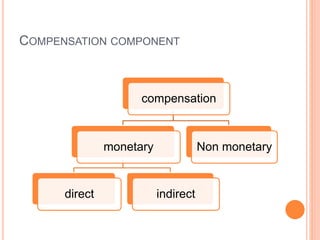
COMPENSATION COMPONENT
compensation
monetary
direct indirect
Non monetary
COMPONENT
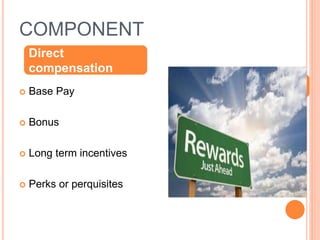
 Base Pay
 Bonus
 Long term incentives
 Perks or perquisites
Direct
compensation
CONT…
 Insurance (health,
eye).
 Leaves (sick,
holiday/personal)
 Clothes
 Company parties
 Phones/laptop
 Retirement programs
Indirect compensation
NON MONETARY
Enhance dignity & satisfaction from
work performed.
Promote social relationship with co-
workers.
Allocate sufficient resources to
perform work assginments.
Offer supportive leadership &
management.
Enhance physiological health,
intellectual growth.
IMPORTANCE
Job description
Job analysis
Job evaluation
Pay structure
Salary surveys
FACTOR AFFECTING
Demand &
supply of labour
Cost of living
Society
Labour unions
The economy
Compensation
policy
The org. ability to
pay
Job analysis &
description
Employee
External Internal
CONCLUSION
We can say that good
compensation can increase the
productivity of an organization
because its provides various
rewards, bonus, schemes etc. and
its compulsary for every
organization.
?
PLEASE

Compensation management