
BORROWING COST
Borrowing costs
Qualifying Assets
Form part of the
cost of the Asset
Other borrowing
Assets
Recognize as an
Expense
CORE PRINCIPLE
 Apply on borrowing cost
 Does not deal with actual or imputed cost of equity.
 Not required to apply on
 a qualifying asset measured at fair value e.g. biological
asset
 Inventories produced on large quantities on a repetitive
basis
SCOPE
Borrowing Cost
Borrowing cost are interest and other costs incurred by
an enterprise in connection with the borrowing of
funds.
Borrowing Costs Include
 Interest on bank overdraft and borrowings
 Finance charges on finance leases
 Exchange differences arises from foreign currency in
borrowing
Definition
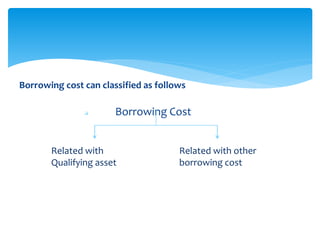
Borrowing cost can classified as follows
Borrowing Cost
Related with Related with other
Qualifying asset borrowing cost
A Qualifying asset is a asset that necessarily take a substantial
period of time to get ready for its intended use or sale.
Depending on the circumstances, any of the following may be qualifying
assets:
• Inventories
• Manufacturing plants
• Power generation facilities
• Intangible assets
• Investment properties
Qualifying Assets
• Capitalize
 Directly attributable to acquisition, construction or
production of a qualifying asset as part of cost
 Capitalizing is adding to the carrying value of the asset
• Expense
 Recognize other borrowing cost as an expense in the
period in which it incurs
Recognition
There are two circumstances under which borrowing costs
will be eligible for capitalization as indicated below.
1. Where funds are borrowed specifically for the purpose
of obtaining a qualifying asset.
Total Borrowing Cost – Temporary Investment Income
Borrowing Costs Eligible for Capitalization
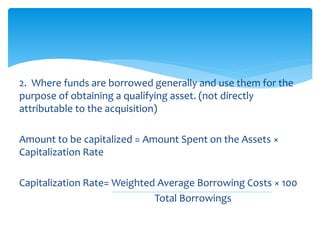
2. Where funds are borrowed generally and use them for the
purpose of obtaining a qualifying asset. (not directly
attributable to the acquisition)
Amount to be capitalized = Amount Spent on the Assets ×
Capitalization Rate
Capitalization Rate= Weighted Average Borrowing Costs × 100
Total Borrowings
 Commencement of capitalization
 Suspension of capitalization
 Cessation of capitalization
Borrowing costs eligible for capitalization
Capitalization of borrowing costs should commence when
all of the following conditions are satisfied.
 it incurs expenditures for the asset;
 it incurs borrowing costs; and
 it undertakes activities that are necessary to prepare the
asset for its intended use or sale.
For example, borrowing costs incurred while land acquired
for building purposes is held without any associated
development activity do not qualify for capitalization.
COMMENCEMENT OF CAPITALIZATION
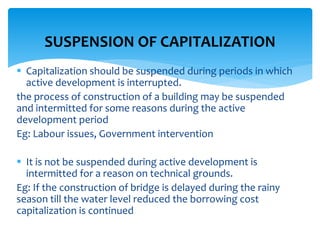
 Capitalization should be suspended during periods in which
active development is interrupted.
the process of construction of a building may be suspended
and intermitted for some reasons during the active
development period
Eg: Labour issues, Government intervention
 It is not be suspended during active development is
intermitted for a reason on technical grounds.
Eg: If the construction of bridge is delayed during the rainy
season till the water level reduced the borrowing cost
capitalization is continued
SUSPENSION OF CAPITALIZATION
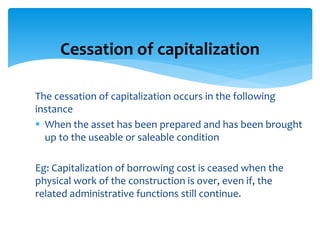
The cessation of capitalization occurs in the following
instance
 When the asset has been prepared and has been brought
up to the useable or saleable condition
Eg: Capitalization of borrowing cost is ceased when the
physical work of the construction is over, even if, the
related administrative functions still continue.
Cessation of capitalization
 Accounting policy on borrowing cost.
 The amount capitalized during the period.
 The capitalization rate used to determine the amount of
borrowing cost capitalized.
Disclosure
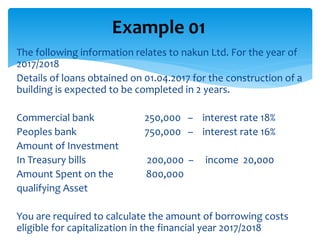
The following information relates to nakun Ltd. For the year of
2017/2018
Details of loans obtained on 01.04.2017 for the construction of a
building is expected to be completed in 2 years.
Commercial bank 250,000 – interest rate 18%
Peoples bank 750,000 – interest rate 16%
Amount of Investment
In Treasury bills 200,000 – income 20,000
Amount Spent on the 800,000
qualifying Asset
You are required to calculate the amount of borrowing costs
eligible for capitalization in the financial year 2017/2018
Example 01
The following information relates to kalam Ltd. For the year of 2017
Details of loans obtained on 01.01.2017 for the construction of power
generation facilities is expected to be completed in 3 years.
HNB 500,000 – interest rate 18%
BOC 1000,000 – interest rate 16%
Amount deposited in bank 400,000 – interest rate 10%
Amount Spent on the 1100,000
qualifying Asset
You are required to calculate the amount of borrowing costs eligible
for capitalization in the financial year 2017.
Its for you!
The following information relates to sanka Ltd. The details of the
loans taken on 1st April 2017 are given below.
Peoples bank 4,000,000 at 15%
NSB 1,000,000 at 18%
It was decided to construct a building using the funds generally raised
from the above loans. The company had spent Rs.2,200,000 on the
above construction as of 31st March 2018.
Assume, repayments have not occurred during the year.
You are required to calculate the amount of borrowing cost eligible
for capitalization for the 2018/2019
Example 02
The following information relates to sharuk Ltd. The details of
the loans taken on 1st january 2017 are given below.
Peoples bank 2,000,000 at 12%
Bank of ceylon 1,500,000 at 20%
It was decided to construct a building using the funds generally
raised from the above loans. The company had spent
Rs.2,000,000 on the above construction as of 1st july 2018.
Assume, repayments have not occurred during the year.
You are required to calculate the amount of borrowing cost
eligible for capitalization for year 2019.
Its for u!
THANK YOU

Slides for borrowing costs

  • 1.
  • 2.
    Borrowing costs Qualifying Assets Formpart of the cost of the Asset Other borrowing Assets Recognize as an Expense CORE PRINCIPLE
  • 3.
     Apply onborrowing cost  Does not deal with actual or imputed cost of equity.  Not required to apply on  a qualifying asset measured at fair value e.g. biological asset  Inventories produced on large quantities on a repetitive basis SCOPE
  • 4.
    Borrowing Cost Borrowing costare interest and other costs incurred by an enterprise in connection with the borrowing of funds. Borrowing Costs Include  Interest on bank overdraft and borrowings  Finance charges on finance leases  Exchange differences arises from foreign currency in borrowing Definition
  • 5.
    Borrowing cost canclassified as follows Borrowing Cost Related with Related with other Qualifying asset borrowing cost
  • 6.
    A Qualifying assetis a asset that necessarily take a substantial period of time to get ready for its intended use or sale. Depending on the circumstances, any of the following may be qualifying assets: • Inventories • Manufacturing plants • Power generation facilities • Intangible assets • Investment properties Qualifying Assets
  • 7.
    • Capitalize  Directlyattributable to acquisition, construction or production of a qualifying asset as part of cost  Capitalizing is adding to the carrying value of the asset • Expense  Recognize other borrowing cost as an expense in the period in which it incurs Recognition
  • 8.
    There are twocircumstances under which borrowing costs will be eligible for capitalization as indicated below. 1. Where funds are borrowed specifically for the purpose of obtaining a qualifying asset. Total Borrowing Cost – Temporary Investment Income Borrowing Costs Eligible for Capitalization
  • 9.
    2. Where fundsare borrowed generally and use them for the purpose of obtaining a qualifying asset. (not directly attributable to the acquisition) Amount to be capitalized = Amount Spent on the Assets × Capitalization Rate Capitalization Rate= Weighted Average Borrowing Costs × 100 Total Borrowings
  • 10.
     Commencement ofcapitalization  Suspension of capitalization  Cessation of capitalization Borrowing costs eligible for capitalization
  • 11.
    Capitalization of borrowingcosts should commence when all of the following conditions are satisfied.  it incurs expenditures for the asset;  it incurs borrowing costs; and  it undertakes activities that are necessary to prepare the asset for its intended use or sale. For example, borrowing costs incurred while land acquired for building purposes is held without any associated development activity do not qualify for capitalization. COMMENCEMENT OF CAPITALIZATION
  • 12.
     Capitalization shouldbe suspended during periods in which active development is interrupted. the process of construction of a building may be suspended and intermitted for some reasons during the active development period Eg: Labour issues, Government intervention  It is not be suspended during active development is intermitted for a reason on technical grounds. Eg: If the construction of bridge is delayed during the rainy season till the water level reduced the borrowing cost capitalization is continued SUSPENSION OF CAPITALIZATION
  • 13.
    The cessation ofcapitalization occurs in the following instance  When the asset has been prepared and has been brought up to the useable or saleable condition Eg: Capitalization of borrowing cost is ceased when the physical work of the construction is over, even if, the related administrative functions still continue. Cessation of capitalization
  • 14.
     Accounting policyon borrowing cost.  The amount capitalized during the period.  The capitalization rate used to determine the amount of borrowing cost capitalized. Disclosure
  • 15.
    The following informationrelates to nakun Ltd. For the year of 2017/2018 Details of loans obtained on 01.04.2017 for the construction of a building is expected to be completed in 2 years. Commercial bank 250,000 – interest rate 18% Peoples bank 750,000 – interest rate 16% Amount of Investment In Treasury bills 200,000 – income 20,000 Amount Spent on the 800,000 qualifying Asset You are required to calculate the amount of borrowing costs eligible for capitalization in the financial year 2017/2018 Example 01
  • 16.
    The following informationrelates to kalam Ltd. For the year of 2017 Details of loans obtained on 01.01.2017 for the construction of power generation facilities is expected to be completed in 3 years. HNB 500,000 – interest rate 18% BOC 1000,000 – interest rate 16% Amount deposited in bank 400,000 – interest rate 10% Amount Spent on the 1100,000 qualifying Asset You are required to calculate the amount of borrowing costs eligible for capitalization in the financial year 2017. Its for you!
  • 17.
    The following informationrelates to sanka Ltd. The details of the loans taken on 1st April 2017 are given below. Peoples bank 4,000,000 at 15% NSB 1,000,000 at 18% It was decided to construct a building using the funds generally raised from the above loans. The company had spent Rs.2,200,000 on the above construction as of 31st March 2018. Assume, repayments have not occurred during the year. You are required to calculate the amount of borrowing cost eligible for capitalization for the 2018/2019 Example 02
  • 18.
    The following informationrelates to sharuk Ltd. The details of the loans taken on 1st january 2017 are given below. Peoples bank 2,000,000 at 12% Bank of ceylon 1,500,000 at 20% It was decided to construct a building using the funds generally raised from the above loans. The company had spent Rs.2,000,000 on the above construction as of 1st july 2018. Assume, repayments have not occurred during the year. You are required to calculate the amount of borrowing cost eligible for capitalization for year 2019. Its for u!
  • 19.