Presented by : Namra Jamil
welcome
Acknowledgement
 In the name of ALLAH who is the most beneficial &
merciful . I would like to thank my teacher who give
me this opportunity to present my self.
Table Of Content
 What is management ?
 What is meant by Development ?
 Definition of management development
 Training & development
 Important reasons for training
 Aim of training & development
 Changing behavior
 Employee motivational process
 Essential steps of employee training
 Main elements of program design
 Component of management development
Table Of content
 Condition for effective management development
 Method of training
 Modes & techniques of training
 Why we need evaluation ?
 Basic principal of evaluation
 Evaluation techniques
 Develop manager
 Teach communication skill
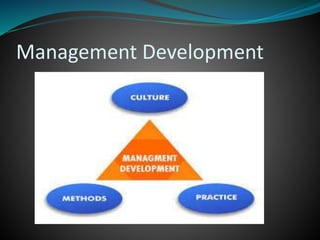
Management Development
What is Management ?
‘’ The process of dealing with & controlling
people & situations ”
What is meant by Development ?
“ The process of growing & changing & increasing
abilities ”
Definition of Management
Development
 Aspect of organizational
development that covers recruitment and assessment
of executive level employees and training
them in leadership to equip them for
higher positions. This process generally
includes development of cognitive (thinking, idea
generation, and decision making), behavioral
(choosing appropriate attitudes and values), and
environmental (suiting management style to the
situation) skills.
Training and Development
 Training & development are planned effort to facilitate the
learning job related behavior on the part of the employee
 Goals of training & development :
 enhance employee quality & motivation
 Improve productivity & meet future need of the
organization
 Objective of training & development :
 Meet organization need
 Meet individual need
 Improve productivity
Important Reasons For Training
 Training your employee is a valuable piece of your
business.
 When you train your employee they become better
people & they are more valuable for you .
 Business grow & you will see higher level of success.
Aim Of Training and
Development
 Training can be teaching employees new skills that are
relevant to their current job position
or refreshing the skills that are relevant that they are
already possess..
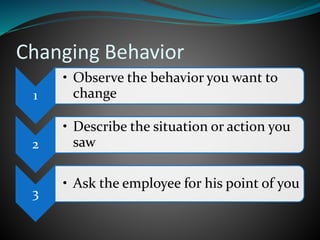
Changing Behavior
1
• Observe the behavior you want to
change
2
• Describe the situation or action you
saw
3
• Ask the employee for his point of you
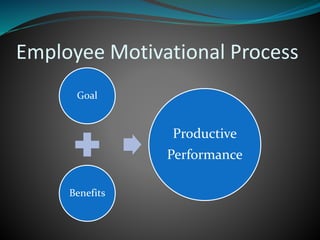
Employee Motivational Process
Goal
Benefits
Productive
Performance
Essentials Steps of Employee
Training
 Focus on individual staff needs
 Create a desire to learn
 Make learning fun
 Develop an evaluation plan
 Help employees apply learning to the Job
Main Elements of Program Design
 Needs analysis
 Learner analysis
 Setting objective
 Designing the training curriculum
 Selection of training & development media
 Evaluation
Components of Management
Development
 Formal education & training
 Action learning
 Career planning
 Learning from experience
 Organization development
 Open & distance learning
 Self development
 Management consulting
Condition For Effective
Management Development
 Management development as a key business activity
 Relation to corporate strategy & change
 Related to individual need & potential for
development
 Evaluation & review
Methods Of Training
 Demonstration :
Just as the name implies the trainee are
shown what to do & how to do it &
the result are known in advance
 Discussion :
Simply stated this provides open
communication between trainees among themselves &
with the trainee
Methods of training
 Lectures :
Another spoon feed method of training with
little if any interaction . The agenda is in outline form
& specific
 Computer based training :
Often through & specific it
can also be one of the best & worst
method of training employees
Modes and Techniques of Training
 Training modes :
 on-job training ( Boss , mentor , colleagues )
 off-job training ( tutor , consultant , friends,
competitor)
 Techniques of training :
 presentation
Demonstration
Role play
Small group discussion
simulation
Why we need Evaluation ?
 Evaluation is need every time when we consider some
kind of change . As all sides of education are in
continuous change now a day . We need to evaluate
our educational projects regularly
Basic Principal Of Evaluation
 Equal treatment
 Transparency
 Mutual recognition
 Confidentially
 Evaluation Techniques :
 Questionnaires
 Post it notes
 Online voting
 Focus group
 Story boards
Develop Managers
 The most productive companies are typically more
proactive then their peers when it comes to identifying
& developing effective manager.
 Managerial Success traits :
 communication
Leadership
Adoptability
Relationship
Personal development
Teach Communication Skills
 Effective manager should be able to understand
,discipline & relate the organization vision back to


their employee in order to maintain productivity.
expand leadership skill
 encourage adaptability
 foster interpersonal skill
Continued
 Expand leadership skills – leadership is a crucial
attributes that many managers lack despite their job
title . True leader able to instill trust & delegate
responsibility amongst team member.
 Encourage adaptability – adaptability also
contribute to a manager effectiveness when a manager
is able to adjust quickly to unexpected circumstances .
He is able to lead him team to adjust as well.
Foster interpersonal skill
 Effective manager should strive to build personal
relationship with their teams. Employee are more
expectation when they trust their manager.
Case Study
Dairy Crest
Introduction
 Who are Dairy Crest ?
Dairy crest is the UK leading chilled dairy foods
company
They manufacturer a range of everyday dairy brands
like spread , butter etc
Dairy crest supply milk to retailer
What was the impact?
 Improved corporation , understanding & team work
between lead team member
 The event build on what had already been achieved
and provided a platform for further development
 Memories that will provide enjoyment insight &
lasting value
Management development at
Dairy crest
 Food manufacturer :
Business benefit of new
management programmes are already being felt at
chilled food manufacturer dairy crest
 Executive education :
Executive education specialist
roffey park is running separate competency based
programmes for dairy crest leader & managers ,
featuring development centers business related
project & 0ne-to-one monitoring
Contt…
 Brand portfolio :
As well as supporting the brand
portfolio & maximizing talent the programmes also
promote cross functional working relationships
 Developed Programmes :
 12 senior manager are now undertaking the 10 days
leader programmes.. Which is delivered in four
modules over a period of 15months
Dairy crest has around 60 senior manager . The
participants are selected for each of the programme
Contt…
The programmes being with a two days management
centre which involves exercise based on dairy crest
management competency framework 360 degree feed
back & personality questionnaire
The 4 modules each of which last 2 days cover
leadership strategy , managing change & business
change
Programmes enable cross functional groups to
network on a personal level & to work together on
business issues
Contt…
 Dairy crest plan to use its presence in UK daily sector
to add further value to its product lines & build its
brand portfolio
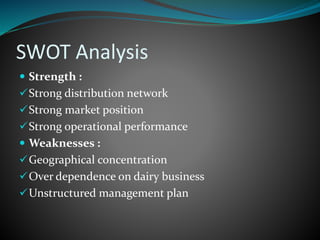
SWOT Analysis
 Strength :
Strong distribution network
Strong market position
Strong operational performance
 Weaknesses :
Geographical concentration
Over dependence on dairy business
Unstructured management plan
Contt…
 Opportunities :
Health awareness
Ongoing investment
 Threats :
Consumer preference
Raw material prices
Conclusion
 Required qualified staff
 Improve management development
 Trained employee for good result
Recommendation
company must held a training programmes & to build
up their product line & brand portfolio
References
 www.avontyrrell.org.UK
 www.triningzone.co.UK
 www.slideshare.net
 www.businessdictionary.com
 Other sources like books
Thank u

training and development

  • 1.
    Presented by :Namra Jamil
  • 2.
  • 3.
    Acknowledgement  In thename of ALLAH who is the most beneficial & merciful . I would like to thank my teacher who give me this opportunity to present my self.
  • 4.
    Table Of Content What is management ?  What is meant by Development ?  Definition of management development  Training & development  Important reasons for training  Aim of training & development  Changing behavior  Employee motivational process  Essential steps of employee training  Main elements of program design  Component of management development
  • 5.
    Table Of content Condition for effective management development  Method of training  Modes & techniques of training  Why we need evaluation ?  Basic principal of evaluation  Evaluation techniques  Develop manager  Teach communication skill
  • 6.
  • 7.
    What is Management? ‘’ The process of dealing with & controlling people & situations ” What is meant by Development ? “ The process of growing & changing & increasing abilities ”
  • 8.
    Definition of Management Development Aspect of organizational development that covers recruitment and assessment of executive level employees and training them in leadership to equip them for higher positions. This process generally includes development of cognitive (thinking, idea generation, and decision making), behavioral (choosing appropriate attitudes and values), and environmental (suiting management style to the situation) skills.
  • 9.
    Training and Development Training & development are planned effort to facilitate the learning job related behavior on the part of the employee  Goals of training & development :  enhance employee quality & motivation  Improve productivity & meet future need of the organization  Objective of training & development :  Meet organization need  Meet individual need  Improve productivity
  • 10.
    Important Reasons ForTraining  Training your employee is a valuable piece of your business.  When you train your employee they become better people & they are more valuable for you .  Business grow & you will see higher level of success.
  • 11.
    Aim Of Trainingand Development  Training can be teaching employees new skills that are relevant to their current job position or refreshing the skills that are relevant that they are already possess..
  • 12.
    Changing Behavior 1 • Observethe behavior you want to change 2 • Describe the situation or action you saw 3 • Ask the employee for his point of you
  • 13.
  • 14.
    Essentials Steps ofEmployee Training  Focus on individual staff needs  Create a desire to learn  Make learning fun  Develop an evaluation plan  Help employees apply learning to the Job
  • 15.
    Main Elements ofProgram Design  Needs analysis  Learner analysis  Setting objective  Designing the training curriculum  Selection of training & development media  Evaluation
  • 16.
    Components of Management Development Formal education & training  Action learning  Career planning  Learning from experience  Organization development  Open & distance learning  Self development  Management consulting
  • 17.
    Condition For Effective ManagementDevelopment  Management development as a key business activity  Relation to corporate strategy & change  Related to individual need & potential for development  Evaluation & review
  • 18.
    Methods Of Training Demonstration : Just as the name implies the trainee are shown what to do & how to do it & the result are known in advance  Discussion : Simply stated this provides open communication between trainees among themselves & with the trainee
  • 19.
    Methods of training Lectures : Another spoon feed method of training with little if any interaction . The agenda is in outline form & specific  Computer based training : Often through & specific it can also be one of the best & worst method of training employees
  • 20.
    Modes and Techniquesof Training  Training modes :  on-job training ( Boss , mentor , colleagues )  off-job training ( tutor , consultant , friends, competitor)  Techniques of training :  presentation Demonstration Role play Small group discussion simulation
  • 21.
    Why we needEvaluation ?  Evaluation is need every time when we consider some kind of change . As all sides of education are in continuous change now a day . We need to evaluate our educational projects regularly
  • 22.
    Basic Principal OfEvaluation  Equal treatment  Transparency  Mutual recognition  Confidentially  Evaluation Techniques :  Questionnaires  Post it notes  Online voting  Focus group  Story boards
  • 23.
    Develop Managers  Themost productive companies are typically more proactive then their peers when it comes to identifying & developing effective manager.  Managerial Success traits :  communication Leadership Adoptability Relationship Personal development
  • 24.
    Teach Communication Skills Effective manager should be able to understand ,discipline & relate the organization vision back to their employee in order to maintain productivity. expand leadership skill  encourage adaptability  foster interpersonal skill
  • 25.
    Continued  Expand leadershipskills – leadership is a crucial attributes that many managers lack despite their job title . True leader able to instill trust & delegate responsibility amongst team member.  Encourage adaptability – adaptability also contribute to a manager effectiveness when a manager is able to adjust quickly to unexpected circumstances . He is able to lead him team to adjust as well.
  • 26.
    Foster interpersonal skill Effective manager should strive to build personal relationship with their teams. Employee are more expectation when they trust their manager.
  • 27.
  • 28.
    Introduction  Who areDairy Crest ? Dairy crest is the UK leading chilled dairy foods company They manufacturer a range of everyday dairy brands like spread , butter etc Dairy crest supply milk to retailer
  • 29.
    What was theimpact?  Improved corporation , understanding & team work between lead team member  The event build on what had already been achieved and provided a platform for further development  Memories that will provide enjoyment insight & lasting value
  • 30.
    Management development at Dairycrest  Food manufacturer : Business benefit of new management programmes are already being felt at chilled food manufacturer dairy crest  Executive education : Executive education specialist roffey park is running separate competency based programmes for dairy crest leader & managers , featuring development centers business related project & 0ne-to-one monitoring
  • 31.
    Contt…  Brand portfolio: As well as supporting the brand portfolio & maximizing talent the programmes also promote cross functional working relationships  Developed Programmes :  12 senior manager are now undertaking the 10 days leader programmes.. Which is delivered in four modules over a period of 15months Dairy crest has around 60 senior manager . The participants are selected for each of the programme
  • 32.
    Contt… The programmes beingwith a two days management centre which involves exercise based on dairy crest management competency framework 360 degree feed back & personality questionnaire The 4 modules each of which last 2 days cover leadership strategy , managing change & business change Programmes enable cross functional groups to network on a personal level & to work together on business issues
  • 33.
    Contt…  Dairy crestplan to use its presence in UK daily sector to add further value to its product lines & build its brand portfolio
  • 34.
    SWOT Analysis  Strength: Strong distribution network Strong market position Strong operational performance  Weaknesses : Geographical concentration Over dependence on dairy business Unstructured management plan
  • 35.
    Contt…  Opportunities : Healthawareness Ongoing investment  Threats : Consumer preference Raw material prices
  • 36.
    Conclusion  Required qualifiedstaff  Improve management development  Trained employee for good result Recommendation company must held a training programmes & to build up their product line & brand portfolio
  • 37.
    References  www.avontyrrell.org.UK  www.triningzone.co.UK www.slideshare.net  www.businessdictionary.com  Other sources like books
  • 38.