Objectives
At the end of the workshop, you will be able to:
 Define Emotional Intelligence
 Understand the importance of EI
 Be aware of the difference between IQ &EI
 Describe your personal and social competencies
 Use emotions effectively to achieve your objectives
What is Emotion?
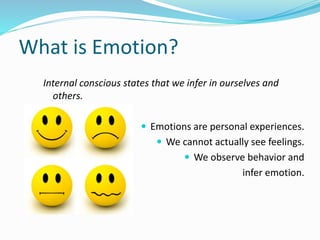
Internal conscious states that we infer in ourselves and
others.
 Emotions are personal experiences.
 We cannot actually see feelings.
 We observe behavior and
infer emotion.
What is Intelligence?
Experts differ on an exact definition of intelligence but most
agree that intelligent behavior has at least two components:
 The ability to learn from experience.
 The ability to adapt to the surrounding environment
What is Emotional Intelligence?
Ability to understand our own feelings and the feelings of
others, for motivating ourselves, and for managing our
emotions effectively in our relationships.
Emotional intelligence is sometimes referred to as “people
smartness”.
Approaches
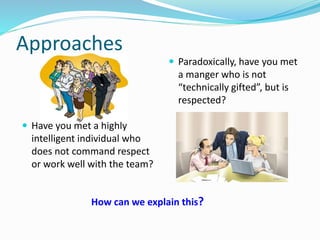
 Have you met a highly
intelligent individual who
does not command respect
or work well with the team?
 Paradoxically, have you met
a manger who is not
“technically gifted”, but is
respected?
How can we explain this?
What is IQ
 An intelligence quotient (IQ) is a score derived from one of
several standardized tests designed to assess human
intelligence
 IQ scores are used for educational placement, assessment of
intellectual disability, and evaluating job applicants
Why Is IQ Not Enough?
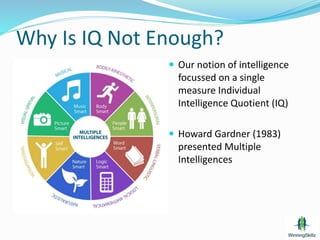
 Our notion of intelligence
focussed on a single
measure Individual
Intelligence Quotient (IQ)
 Howard Gardner (1983)
presented Multiple
Intelligences
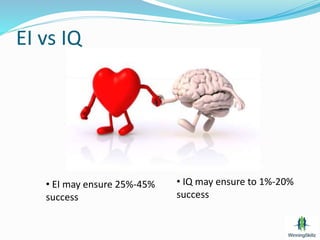
EI vs IQ
• IQ may ensure to 1%-20%
success
• EI may ensure 25%-45%
success
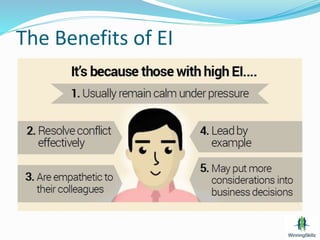
The Benefits of EI
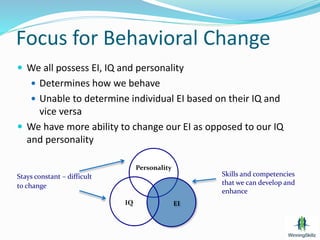
Focus for Behavioral Change
 We all possess EI, IQ and personality
 Determines how we behave
 Unable to determine individual EI based on their IQ and
vice versa
 We have more ability to change our EI as opposed to our IQ
and personality
Personality
EIIQ
Stays constant – difficult
to change
Skills and competencies
that we can develop and
enhance
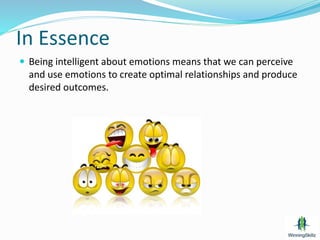
 Being intelligent about emotions means that we can perceive
and use emotions to create optimal relationships and produce
desired outcomes.
In Essence
Test your EI
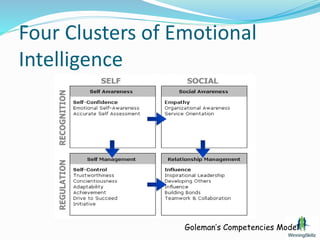
Four Clusters of Emotional
Intelligence
Goleman’s Competencies Model
Self-Awareness
Self-Awareness is the ability to accurately sense and identify
personal feelings, along with the ability to understand and
evaluate them.
Three Competencies within
Self-Awareness
The Self-Awareness cluster contains three basic competencies or
subcategories:
 Emotional self-awareness
 Accurate self-assessment
 Self-confidence
Tips for Developing Self-
Awareness
Emotional Self-Awareness
 Pay attention to the physical reactions aroused in your body
during stressful situations.
 Keep a journal where you write down your behaviors and inner
feelings when faced with stressful situations on a daily basis.
Accurate Self-Assessment
 When interacting with people with whom you feel comfortable,
ask for their constructive feedback about your actions and
behaviors.
 Make a list of what you believe to be your strengths as well as any
areas where development is needed, and then compare your own
list and a similar list prepared by someone else.
Self-Confidence
 Adjust your thinking and behaviors so that they closely
match those of someone whose models that trait of self-
confidence—with that model in mind, act decisively,
instead of self-consciously watching your every move.
 Find someone you trust who would be willing to help you to
objectively analyze your abilities.
Tips for Developing Self-
Awareness
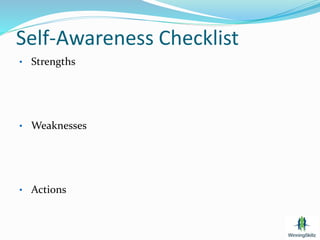
Self-Awareness Checklist
• Strengths
• Weaknesses
• Actions
Self-Management
 Self-Management is the ability to understand your emotions
and then use that understanding to turn situations to your
benefit.
 Self-management is also the ability to use your feelings to
reason well and act intentionally.
For further details please contact:
Aditi Singh
winningskillz@gmail.com
References
 www.yale.edu/21c/arkansas/documents/21C-
EmotionalIntelligence.ppt
 cet.usc.edu/resources/teaching.../docs/EI_CET_jan27_
final_revision.pp t
 Leveraging Emotional Intelligence in the Workplace :
emergingleadersalliance.org/.../Rahul-Dogra-
Leveraging-Emotional-Intel...

Emotional Intelligence

  • 2.
    Objectives At the endof the workshop, you will be able to:  Define Emotional Intelligence  Understand the importance of EI  Be aware of the difference between IQ &EI  Describe your personal and social competencies  Use emotions effectively to achieve your objectives
  • 3.
    What is Emotion? Internalconscious states that we infer in ourselves and others.  Emotions are personal experiences.  We cannot actually see feelings.  We observe behavior and infer emotion.
  • 4.
    What is Intelligence? Expertsdiffer on an exact definition of intelligence but most agree that intelligent behavior has at least two components:  The ability to learn from experience.  The ability to adapt to the surrounding environment
  • 5.
    What is EmotionalIntelligence? Ability to understand our own feelings and the feelings of others, for motivating ourselves, and for managing our emotions effectively in our relationships. Emotional intelligence is sometimes referred to as “people smartness”.
  • 6.
    Approaches  Have youmet a highly intelligent individual who does not command respect or work well with the team?  Paradoxically, have you met a manger who is not “technically gifted”, but is respected? How can we explain this?
  • 7.
    What is IQ An intelligence quotient (IQ) is a score derived from one of several standardized tests designed to assess human intelligence  IQ scores are used for educational placement, assessment of intellectual disability, and evaluating job applicants
  • 8.
    Why Is IQNot Enough?  Our notion of intelligence focussed on a single measure Individual Intelligence Quotient (IQ)  Howard Gardner (1983) presented Multiple Intelligences
  • 9.
    EI vs IQ •IQ may ensure to 1%-20% success • EI may ensure 25%-45% success
  • 10.
  • 11.
    Focus for BehavioralChange  We all possess EI, IQ and personality  Determines how we behave  Unable to determine individual EI based on their IQ and vice versa  We have more ability to change our EI as opposed to our IQ and personality Personality EIIQ Stays constant – difficult to change Skills and competencies that we can develop and enhance
  • 12.
     Being intelligentabout emotions means that we can perceive and use emotions to create optimal relationships and produce desired outcomes. In Essence
  • 13.
  • 14.
    Four Clusters ofEmotional Intelligence Goleman’s Competencies Model
  • 15.
    Self-Awareness Self-Awareness is theability to accurately sense and identify personal feelings, along with the ability to understand and evaluate them.
  • 16.
    Three Competencies within Self-Awareness TheSelf-Awareness cluster contains three basic competencies or subcategories:  Emotional self-awareness  Accurate self-assessment  Self-confidence
  • 17.
    Tips for DevelopingSelf- Awareness Emotional Self-Awareness  Pay attention to the physical reactions aroused in your body during stressful situations.  Keep a journal where you write down your behaviors and inner feelings when faced with stressful situations on a daily basis. Accurate Self-Assessment  When interacting with people with whom you feel comfortable, ask for their constructive feedback about your actions and behaviors.  Make a list of what you believe to be your strengths as well as any areas where development is needed, and then compare your own list and a similar list prepared by someone else.
  • 18.
    Self-Confidence  Adjust yourthinking and behaviors so that they closely match those of someone whose models that trait of self- confidence—with that model in mind, act decisively, instead of self-consciously watching your every move.  Find someone you trust who would be willing to help you to objectively analyze your abilities. Tips for Developing Self- Awareness
  • 19.
  • 20.
    Self-Management  Self-Management isthe ability to understand your emotions and then use that understanding to turn situations to your benefit.  Self-management is also the ability to use your feelings to reason well and act intentionally.
  • 21.
    For further detailsplease contact: Aditi Singh winningskillz@gmail.com
  • 22.
    References  www.yale.edu/21c/arkansas/documents/21C- EmotionalIntelligence.ppt  cet.usc.edu/resources/teaching.../docs/EI_CET_jan27_ final_revision.ppt  Leveraging Emotional Intelligence in the Workplace : emergingleadersalliance.org/.../Rahul-Dogra- Leveraging-Emotional-Intel...