
Introducing EQ:  Relationship Skills for  Optional Performance EQ Building Blocks Author: Joshua Freedman V7-08
Emotional Intelligence Welcome The Case for EQ What is EQ? Next Steps
Welcome โ€œ Emotional Intelligence helps gild adversity with optimism.โ€ โ€“  Anabel Jensen, Ph.D.
Objectives Key reasons for EQ Three practical EQ techniques Know what you can do in six seconds Motivation for more One next step
Learning Process Humor Choice Multisensory Interactive
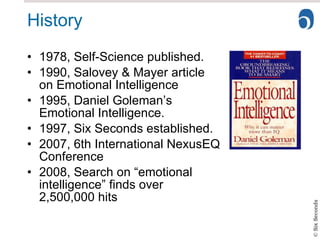
History 1978, Self-Science published. 1990, Salovey & Mayer article on Emotional Intelligence 1995, Daniel Golemanโ€™s Emotional Intelligence. 1997, Six Seconds established. 2007, 6th International NexusEQ Conference 2008, Search on โ€œemotional intelligenceโ€ finds over 2,500,000 hits
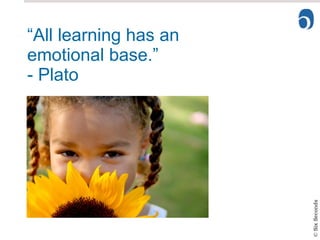
โ€œ All learning has an emotional base.โ€  - Plato
More of What You Want Personal Success Academic Success Business Success
Personal Results Success depends on "mature adaptations" including altruism, humor, self-management, and optimism/anticipation (George Vaillant, Adaptation to Life, 1995). People who learn optimism skills are more motivated, more successful, have higher levels of achievement, plus significantly better physical and mental health (Seligman, 1991). People who accurately perceive othersโ€™ emotions are better able to handle changes and build stronger social networks (Salovey, Bedell, Detweiler, & Mayer, 1999).
Academic Results After EQ training, discipline referrals to the principals dropped by 95% (Johnson & Johnson, 1994). EQ training increases focus, learning, collaboration; decreases both negative "put downs" and violence (Anabel Jensen, Self-Science Pilot Study, 2001). Children with highly developed social skills perform better academically (Grossman, et al, 1997). Children who are able to delay gratification are more popular, earn better grades, and had an average of 210 more points on their SAT tests (Shoda, Mischel, and Peake, 1990).
Business Results US Airforce spent $10,000, saved $2,760,000 in recruitment (Fastcompany June 2000). High EQ consulting partners earned 139% more (Boyatzis, 1999). 2% business increase for American Express Financial Advisors (Fastcompany "How Do You Feel," June 2000). EQ in plant cut accidents 50%, formal grievances 80%, raised topline $250,000 (Pesuric & Byham, 1996).
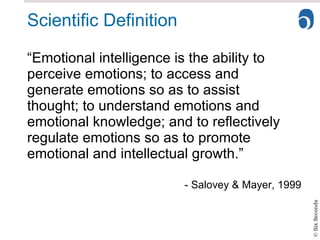
Scientific Definition โ€œEmotional intelligence is the ability to perceive emotions; to access and generate emotions so as to assist thought; to understand emotions and emotional knowledge; and to reflectively regulate emotions so as to promote emotional and intellectual growth.โ€ - Salovey & Mayer, 1999
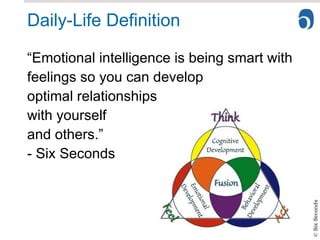
Daily-Life Definition โ€œEmotional intelligence is being smart with feelings so you can develop optimal relationships  with yourself  and others.โ€ - Six Seconds
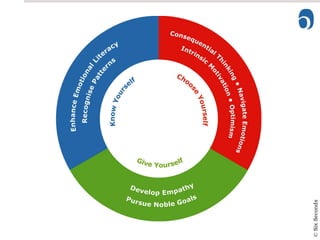
The Six Seconds EQ Model
ย 
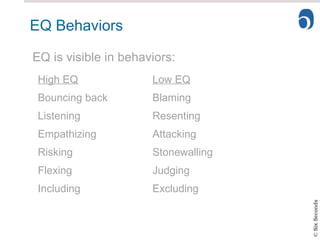
EQ Behaviors EQ is visible in behaviors: High EQ Bouncing back Listening Empathizing Risking Flexing Including Low EQ Blaming Resenting Attacking Stonewalling Judging Excluding
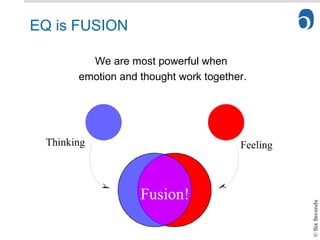
We are most powerful when  emotion and thought work together. EQ is FUSION Thinking Feeling Fusion!
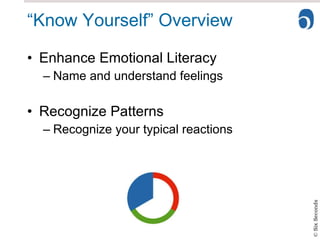
โ€œKnow Yourselfโ€ Overview Enhance Emotional Literacy Name and understand feelings Recognize Patterns Recognize your typical reactions
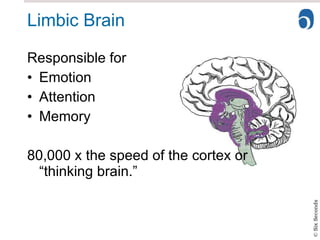
Limbic Brain Responsible for  Emotion Attention Memory 80,000 x the speed of the cortex or โ€œthinking brain.โ€
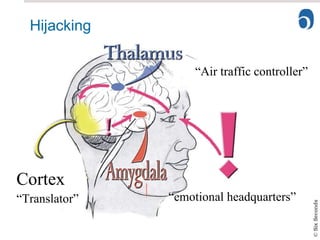
Hijacking Cortex โ€œ Translatorโ€ โ€œ emotional headquartersโ€ โ€œ Air traffic controllerโ€
Six Seconds Pause Remember six favorite places. Think of the first line of six songs. Ponder six favorite romantic moments.
โ€œChoose Yourselfโ€ Overview Apply Consequential Thinking Pause, evaluate costs & benefits. Navigate Emotions Transform feelings to be helpful. Engage Intrinsic Motivation Build internal drivers Shift to Optimism Create new possibilities
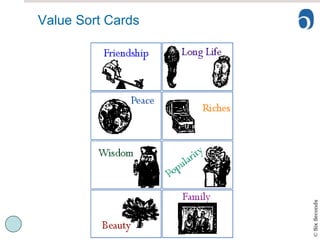
Value Sort Cards
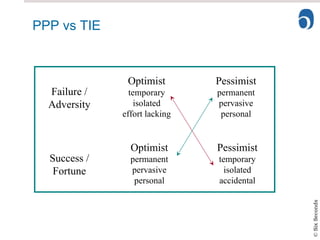
PPP vs TIE Optimist temporary isolated effort lacking Pessimist permanent pervasive personal Failure / Adversity Success / Fortune Optimist permanent pervasive personal Pessimist temporary isolated accidental
โ€œGive Yourselfโ€ Overview Increase Empathy Connect at an emotional level  Pursue Noble Goals Put vision into action
Empathy Empathy means feeling in parallel to someone elseโ€™s feeling. What behaviors does empathy create?
Noble Goals Support Values Universal Values honesty respect responsibility fairness (justice) compassion (love) Institute for Global Ethics www.globalethics.org
Power of Role Modeling โ€œ People seem to do 30% of what we say and 70% of what we do.โ€ -- Anabel Jensen, Ph.D.
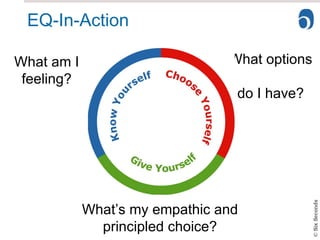
EQ-In-Action What am I feeling? What options  do I have? Whatโ€™s my empathic and principled choice?
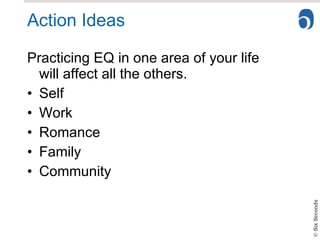
Action Ideas Practicing EQ in one area of your life  will affect all the others. Self Work Romance Family Community
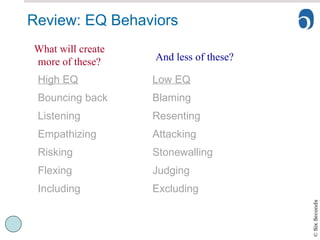
Review: EQ Behaviors What will create more of these? And less of these? High EQ Bouncing back Listening Empathizing Risking Flexing Including Low EQ Blaming Resenting Attacking Stonewalling Judging Excluding
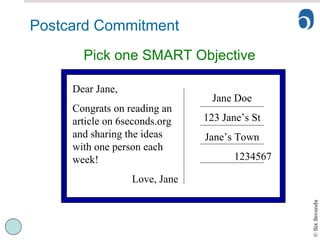
Postcard Commitment Pick one SMART Objective Jane Doe 123 Janeโ€™s St Janeโ€™s Town 1234567 Dear Jane, Congrats on reading an article on 6seconds.org and sharing the ideas with one person each week! Love, Jane
Thank You

EQ Business Case Overview 08

  • 1.
    Introducing EQ: Relationship Skills for Optional Performance EQ Building Blocks Author: Joshua Freedman V7-08
  • 2.
    Emotional Intelligence WelcomeThe Case for EQ What is EQ? Next Steps
  • 3.
    Welcome โ€œ EmotionalIntelligence helps gild adversity with optimism.โ€ โ€“ Anabel Jensen, Ph.D.
  • 4.
    Objectives Key reasonsfor EQ Three practical EQ techniques Know what you can do in six seconds Motivation for more One next step
  • 5.
    Learning Process HumorChoice Multisensory Interactive
  • 6.
    History 1978, Self-Sciencepublished. 1990, Salovey & Mayer article on Emotional Intelligence 1995, Daniel Golemanโ€™s Emotional Intelligence. 1997, Six Seconds established. 2007, 6th International NexusEQ Conference 2008, Search on โ€œemotional intelligenceโ€ finds over 2,500,000 hits
  • 7.
    โ€œ All learninghas an emotional base.โ€ - Plato
  • 8.
    More of WhatYou Want Personal Success Academic Success Business Success
  • 9.
    Personal Results Successdepends on "mature adaptations" including altruism, humor, self-management, and optimism/anticipation (George Vaillant, Adaptation to Life, 1995). People who learn optimism skills are more motivated, more successful, have higher levels of achievement, plus significantly better physical and mental health (Seligman, 1991). People who accurately perceive othersโ€™ emotions are better able to handle changes and build stronger social networks (Salovey, Bedell, Detweiler, & Mayer, 1999).
  • 10.
    Academic Results AfterEQ training, discipline referrals to the principals dropped by 95% (Johnson & Johnson, 1994). EQ training increases focus, learning, collaboration; decreases both negative "put downs" and violence (Anabel Jensen, Self-Science Pilot Study, 2001). Children with highly developed social skills perform better academically (Grossman, et al, 1997). Children who are able to delay gratification are more popular, earn better grades, and had an average of 210 more points on their SAT tests (Shoda, Mischel, and Peake, 1990).
  • 11.
    Business Results USAirforce spent $10,000, saved $2,760,000 in recruitment (Fastcompany June 2000). High EQ consulting partners earned 139% more (Boyatzis, 1999). 2% business increase for American Express Financial Advisors (Fastcompany "How Do You Feel," June 2000). EQ in plant cut accidents 50%, formal grievances 80%, raised topline $250,000 (Pesuric & Byham, 1996).
  • 12.
    Scientific Definition โ€œEmotionalintelligence is the ability to perceive emotions; to access and generate emotions so as to assist thought; to understand emotions and emotional knowledge; and to reflectively regulate emotions so as to promote emotional and intellectual growth.โ€ - Salovey & Mayer, 1999
  • 13.
    Daily-Life Definition โ€œEmotionalintelligence is being smart with feelings so you can develop optimal relationships with yourself and others.โ€ - Six Seconds
  • 14.
  • 15.
  • 16.
    EQ Behaviors EQis visible in behaviors: High EQ Bouncing back Listening Empathizing Risking Flexing Including Low EQ Blaming Resenting Attacking Stonewalling Judging Excluding
  • 17.
    We are mostpowerful when emotion and thought work together. EQ is FUSION Thinking Feeling Fusion!
  • 18.
    โ€œKnow Yourselfโ€ OverviewEnhance Emotional Literacy Name and understand feelings Recognize Patterns Recognize your typical reactions
  • 19.
    Limbic Brain Responsiblefor Emotion Attention Memory 80,000 x the speed of the cortex or โ€œthinking brain.โ€
  • 20.
    Hijacking Cortex โ€œTranslatorโ€ โ€œ emotional headquartersโ€ โ€œ Air traffic controllerโ€
  • 21.
    Six Seconds PauseRemember six favorite places. Think of the first line of six songs. Ponder six favorite romantic moments.
  • 22.
    โ€œChoose Yourselfโ€ OverviewApply Consequential Thinking Pause, evaluate costs & benefits. Navigate Emotions Transform feelings to be helpful. Engage Intrinsic Motivation Build internal drivers Shift to Optimism Create new possibilities
  • 23.
  • 24.
    PPP vs TIEOptimist temporary isolated effort lacking Pessimist permanent pervasive personal Failure / Adversity Success / Fortune Optimist permanent pervasive personal Pessimist temporary isolated accidental
  • 25.
    โ€œGive Yourselfโ€ OverviewIncrease Empathy Connect at an emotional level Pursue Noble Goals Put vision into action
  • 26.
    Empathy Empathy meansfeeling in parallel to someone elseโ€™s feeling. What behaviors does empathy create?
  • 27.
    Noble Goals SupportValues Universal Values honesty respect responsibility fairness (justice) compassion (love) Institute for Global Ethics www.globalethics.org
  • 28.
    Power of RoleModeling โ€œ People seem to do 30% of what we say and 70% of what we do.โ€ -- Anabel Jensen, Ph.D.
  • 29.
    EQ-In-Action What amI feeling? What options do I have? Whatโ€™s my empathic and principled choice?
  • 30.
    Action Ideas PracticingEQ in one area of your life will affect all the others. Self Work Romance Family Community
  • 31.
    Review: EQ BehaviorsWhat will create more of these? And less of these? High EQ Bouncing back Listening Empathizing Risking Flexing Including Low EQ Blaming Resenting Attacking Stonewalling Judging Excluding
  • 32.
    Postcard Commitment Pickone SMART Objective Jane Doe 123 Janeโ€™s St Janeโ€™s Town 1234567 Dear Jane, Congrats on reading an article on 6seconds.org and sharing the ideas with one person each week! Love, Jane
  • 33.

Editor's Notes

  • #2ย Note: Use per license. Do not use graphics or images in other materials without written permission. Always include copyright and source: Six Seconds - Joshua Freedman ยฉ2000 - and pay your royalties!
  • #3ย Objective: Participants will know what is being covered. Donโ€™t read the slides unless you are in a room where people can not read them. Welcome the group, thank them for their interest in this incredible area.
  • #4ย Objective: Participants will feel a personal connection w. presenter. Say something about why you are doing this work, perhaps how you got involved with Six Seconds and EQ.
  • #5ย Objective: Participants will know they are learning something practical. Give one specific benefit of EQ for this group. โ€œIn addition to these other objectives, this work is going to be beneficial in your/our efforts toโ€ฆโ€
  • #6ย Objective: Participants will feel engaged, take some responsibility for learning, and know you are modeling good instruction. This is not a โ€œsit back and listenโ€ presentation -- for the next 2 hours weโ€™re going to be thinking, feeling, and doing EQ. Activity: If you want to use the โ€œinteractive jokeโ€ idea, now is when you pass out jokes. Humor decreases cortisol and stress, increases creative thinking, and boosts immune performance. 240 heart patients saw 30 min of humorous clips per day, disease was reduced, less likely to have heart attack in year following first attack (Lee Burk, 2001) U Maryland study, people w. heart disease 40% less likely to find humor than others. kids laugh 300xday, adults 15 (Elias book: Karen Bullock (UCSD), Robert Adler & Nicholas Cohen, Sandy Levy, Norman Cousins)
  • #7ย Objective: Participants will know EQ is a growing phenomenon In the last decades there have been tremendous advances in learning about how people learn, how they relate to one another, and how the brain works. Some science resources: Joseph LeDoux - The Emotional Brain (http://www.cns.nyu.edu/home/ledoux/) Candace Pert - Molecules of Emotion Debra Niehoff - Biology of Violence (http://www.eqtoday.com/niehoff.html)
  • #8ย Objective: Participants will know EQ is not all new. While there is a great deal of new research behind EQ, the core ideas are not new.
  • #9ย Objective: Participants will know EQ has personal benefit. The green circle means there is an activity to go with this page. Activity: Top Ten In small groups, or people sitting near, create a list of 10 of the skills and capacities that have made you successful. Option: Give different groups different assignments -- 10 of the skills and capacities that make successfulโ€ฆ leaders, students, parents, teachers, administrators, innovators, change-makers, etc. Put the list up on a flip chart. Ask the audience to identify which might be primarily due to emotional intelligence. The vast majority will either be directly part of EQ or strongly influenced by EQ. Conclude by asking: What does this tell you about emotional intelligence?
  • #10ย Objective: Participants will know EQ has personal benefit. These 3 โ€œcase studyโ€ slides will be stronger if they are accompanied by a story -- perhaps a personal life or work example of how EQ has been of benefit to you, or in your organization.
  • #11ย Objective: Participants will know EQ has academic benefit.
  • #12ย Objective: Participants will know EQ has business benefit.
  • #13ย Objective: Participants will know EQ is researched as a intelligence There are many definitions of emotional intelligence. Jack Mayer Ph.D. and Peter Salovey Ph.D. are the premiere researchers on the subject. Together with David Caruso, they created the MSCEIT test.
  • #14ย Objective: Participants will know a simple definition of EQ, and identify that EQ integrates. The Six Secondsโ€™ definition and model have a bias on practice -- teaching and learning. While Peter et al are looking for the internal capacities, we are looking more at what people DO. The premise is, โ€œyou are what you do, not what you say you do.โ€ The triangle model shows how EQ integrates all 3 domains -- there is no thinking without feeling, there is no acting without thinking and feeling, there is no feeling without thinking. While in many ways thought is in the โ€œdriverโ€™s seat,โ€ it does not have primacy! In the EQ context, emotions, thoughts, and actions are part of a reinforcing feedback cycle.
  • #15ย Weโ€™ve found that these three pursuits help people to live and lead with emotional intelligence. Know Yourself is about increasing awareness. Choose Yourself is about being more intentional. Give Yourself is about connecting with your deep sense of purpose. Underneath these three areas are 8 specific competencies.
  • #16ย There are 8 specific competencies in the model - divided among the 3 areas. Note that this model is a circle - as you use these competencies you become better able to use the competencies in the other areas as well.
  • #17ย Objective: Participants will be able to see how EQ affects behavior. This is a selection of behaviors. You could ask for additions.
  • #18ย Objective: Participants will know the goal is synthesis, not โ€œheart over head.โ€ โ€œFusion is the active state of engagement that comes when heart and mind are in synch. It feels awake, powerful, compassionate, and courageous.โ€ - Josh Freedman Remind the audience that this is an integrative model -- the goal is to put people back together, not to just shift the dominance from mind to heart.
  • #19ย Objective: Participants will recall the first part of the model. Know yourself is about self-awareness. Emotional literacy is the ABCs of EQ -- the basic building blocks. Just like โ€œEnglish literacyโ€ prepares you to make meaning of and express through words and writing, emotional literacy prepares you to make meaning of emotions. The brain is wired for patterns. We find a response that sort of works, and repeat it over and over. The brain is simplistic about โ€œworksโ€ -- if it feels good for a moment, or if it does not kill you, it works. So, we usually follow patterns that have very short-term benefit. If you want to use Biodots, this is a good time!
  • #20ย Objective: Participants know that emotions, learning, and attention are related While the โ€œtriune brainโ€ model is not totally accurate, it is a useful metaphor. There is a part of the brain called the limbic ring, and there are several key regions tied to emotional function. The brain is like a swamp or a stew (not like a computer!) -- it is non-linear, confusing, and a bit random. The brain and body are awash in chemicals, the โ€œmolecules of emotion.โ€ Many are generated in the limbic ring -- but also throughout the brain and body, especially around the heart and gut. These โ€œneuropeptidesโ€ form something like a second nervous system.
  • #21ย Objective: Participants know concept of Hijacking. Joseph LeDoux developed this model and presented it in The Emotional Brain. Normally, signals go to the thalamus, then to the cortex for interpretation, then to the amygdala for action. In a state of threat -- perceived risk -- the thalamus bypasses the cortex and signals go right to the amygdala. Reaction occurs without intellectual thought. There is an intelligence at work, but it is not well trained in most people! More: http://www.eqtoday.com/hijack.html
  • #22ย Objective: Participants able to create a six second pause. The Six Seconds pause is a mechanism to shift to conscious thinking so we can return to fusion. More: http://www.eqtoday.com/pause.html Activity: Six Seconds Pause After explaining the idea of the pause, and perhaps telling a story, ask the audience to think of a time when they were hijacked. You could also ask for examples of โ€œhot buttons.โ€ Have them pair-share. Now, repeat that a pause button will engage high-order thinking like language, math, music, synthesis, analysis, or reasoning, and ask them to think of a pause button they could try. Pair share. Ask the audience to share, and write the list. Send the list to staff@6seconds.org for a book! Remind them that they can start practicing this now, it will work much better with practice! It is not just for anger, but any time they want to interrupt an emotional reaction or get out of a pattern.
  • #23ย Objective: Participants will recall the second part of the model. Signpost that you are moving on to the next part of the model. This is a good place for a discussion of how much do we choose. You can ask people to line up on a continuum from โ€œno choiceโ€ to โ€œtotal choice.โ€ Ask them to pair-share how they came to that belief. Perhaps ask each end of the line to share out loud. It is challenging for people to accept that they have choice over their feelings. Especially for teenagers!
  • #24ย Objective: Participants able to assess core values; know โ€œalignment;โ€ begin to learn meaning of optimism Activity: Value Sort Cards Introduce the exercise by putting it in context -- we can not choose ourselves without having some internal compass for making choices! Either hand out value sort cards or blank index cards. A variation is to let people start by writing their own top 8 things they value (you value something if you put time and money toward it). Tell them they can define these cards however they like -- peace, for example, could mean โ€œpeace and quiet,โ€ or โ€œthe end of war.โ€ Ask them to sort the cards in order of importance -- from the one which is most important to them right now, to the least important. Over time, sometimes we have to make choices to give up things -- so take 3 cards out of your hand that you are going to give up. [pause] Life continues to go on, and now you have to give up 2 more. You should be left with 3. Pair share. Repeat, but this time turn cards face down and have neighbor randomly pull discards. When they turn over, ask them to pay attention to thoughts, feelings, and actions. Discuss choices, priorities, alignment, and optimism.
  • #25ย Objective: Participants know meaning of optimism and begin to practice reframing In the Value Sort Cards, many people practice reframing. They redefine the situation or the experience to make it more positive. Optimists reframe in three specific ways. You can share a story about how you experienced this, do the โ€œlive wiresโ€ exercise, or just present the data. More: Learned Optimism , Martin Seligman.
  • #26ย Objective: Participants will recall the third part of the model. Signpost again. Here is where Six Secondsโ€™ model departs more widely from the MSC definition -- this focus on altruism is about being socially conscious. It is also about getting more satisfaction, pleasure, and power. By developing a noble goal, people are better able to tap into their EQ, stay in fusion, and take strong action.
  • #27ย Objective: Participants know the meaning of empathy and begin to value it more. A key to empathy is reading nonverbal communication and paying close attention to what someone is really feeling. You do not have to have had the same experience -- in fact you certainly have not had the same experience -- but you can find an experience that is somehow related.
  • #28ย Objective: Participants introduced to the idea of Noble Goals You probably do not have time to go in-depth on noble goals -- but you might explain that they are a tool to help align our actions and beliefs personally and professionally. A noble goalโ€ฆ - Will not be met in your lifetime - Will benefit you, but the purpose is to benefit others; the arrow points outward; no one is made less or wrong by you pursuing your noble goal - Will integrate the different areas of your life -- work, family, spirituality, community, health, etc. - Will get you out of bed when nothing else will.
  • #29ย Objective: Participants reflect on their own modeling If you want to teach EQ, practice EQ. We are changing the world, each of us starting with ourselves.
  • #31ย Objective: Participants see EQ as integrated Unlike many skill sets, when you begin to practice EQ, you will see an immediate benefit. The benefit seems to cross over between parts of our lives. So even if they are here to talk about EQ at work, for example, practicing at home will provide benefit at work.
  • #32ย Objective: Participants identify actions they could take to increase EQ Activity: Answer the question on the overhead. Brainstorm a list of actions that will create these behaviors -- or ways of practicing. This is a brainstorm -- not a commitment. โ€œI could use the Six Second pause when my kids start fighting.โ€ โ€œSomeone could take the first 5 min of every meeting just to listen.โ€ โ€œI could sit with someone new at lunch.โ€ You could flip back to the previous slide to ensure ideas are coming from all areas.
  • #33ย Objective: Participants will make a simple commitment Activity: Postcard Commitment Pass out postcards (www.EQstore.com !!) Ask each person to make a commitment to at least one SMART objective for the next six weeks. Simple, measurable, actionable, reasonable, timely (see http://www.eqtoolbox.org/project/goal.php). Ask them to look at the list you just made, and also to remember the value sort activity -- maybe there was 1 card they wanted to make more present in their lives? Tell them to address the card to themselves, and that you will mail the card to them. You can ask them to write โ€œno mailโ€ if they do not want to be on your mailing list. You can also ask them to write 1 word on the lower-left corner about the effectiveness of your presentation (though generally the commitments themselves tell you all you need to know about your presentation!) Sometimes it helps to have people read their cards as they finish, as this will give others ideas.
  • #34ย Objective: Participants will leave ready for more. Thank them!