CDGI'S
Chameli Devi School of Engineering
Department of Computer Science and Engineering
Presentation On
Required for Professionals
By:-
Shadab Pasha
Assistant Professor
CSE Dept.
Agenda
 Define emotions and emotional intelligence
 Appreciate importance of EI
 Identify characteristics of EI
 Differentiate between domains of emotional intelligence
 Why EQ is so important
 IQ Vs EQ
What experts say about EI/EQ
Two view points about Emotions
Teaching with EI
Conclusion
What are emotions?
An Emotion is a strong feeling associated with mood,
temperament, personality, and disposition.
Examples of Emotional expressions are Happiness, fear,
anger, affection, shame, disgust, surprise, lust, sadness,
elation, love, frustration, anxiety, failure, achievement
and many more.
Dimensions of emotions:
There are two dimensions of emotions : physiological
side and psychological side.
Physiological side: ‘Emotion’ is a complex state of human
mind, involving bodily changes of widespread character
such as heavy breathing, pounding heart,flushed face,
sweating palms, raised pulse rate, gland secretions.
Psychological side: Strong feelings marked by a state of
excitement or perturbations.
Emotions and Their Blends:
Each emotion is associated with its specific blends
Anger: fury, outrage, resentment, annoyance and hostility.
Love: acceptance, friendliness, trust, kindness and
infatuation.
Shame: guilt, remorse, humiliation and regret.
Fear: anxiety, nervousness, apprehension and terror.
Enjoyment: happiness, joy, relief, contentment and
pleasure.
Sadness: Grief, sorrow, cheerlessness and gloom.
Surprise: Shock, astonishment, amazement and wonder.
Examples of Use of Emotions:
 She is too sensitive.
 He takes everything too personally.
 He is jealous of his colleagues.
 She does not understand the feelings of others.
 He is always nagging others.
 The Manager blurts things out without thinking of others.
 Nobody understands/listens to me.
 Why does it happen to me only in life?
 I am always nice with the people around me.
What Exactly Is EI?
Emotional intelligence is simply defined as:
• Knowing what feels good, what feels bad, and how to
get from bad to good.
• Knowing your emotions and knowing emotions of others.
• It refers to emotional management skills which provide
competency to balance emotions and reason to maximise
long-term happiness.
What Exactly Is EI?
Daniel Goleman is an international
authority on emotional
intelligence. His definition of emotional
intelligence is as
follows.
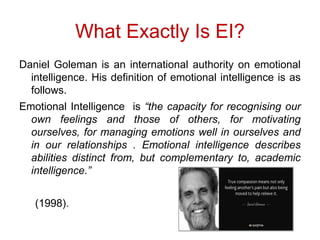
Daniel Goleman is an international authority on emotional
intelligence. His definition of emotional intelligence is as
follows.
Emotional Intelligence is “the capacity for recognising our
own feelings and those of others, for motivating
ourselves, for managing emotions well in ourselves and
in our relationships . Emotional intelligence describes
abilities distinct from, but complementary to, academic
intelligence.”
(1998).
What Exactly Is EI?
Dalip Singh’s is an Indian expert on emotional intelligence.
His explanation on emotional intelligence is as follows.
“Emotional intelligence is the ability of an individual to
appropriately and successfully respond to a vast variety
of emotional inputs being elicited from inner self and
immediate environment. Emotional intelligence
constitutes three psychological dimensions such as
emotional competency, emotional maturity and emotional
sensitivity, which motivate an individual to recognise
truthfully, interpret honestly and handle tactfully the
dynamics of human behaviour”
(Dalip Singh 2003)
What Exactly Is EI?
Domains of emotional
intelligence
Intrapersonal
• Emotional self-awareness
• Assertiveness
• Self-regard
• Self-actualisation
• Independence
Interpersonal
• Empathy
• Interpersonal relationship
• Social responsibility
Domains of emotional
intelligence
Adaptability
• Problem-solving
• Reality testing
• Flexibility
Stress management
• Stress tolerance
• Impulse control
General mood
• Happiness
• Optimism
Let us see the video-1 on EI…
Why is EQ so important?
 With out feeling and emotions we will be like robots.
 It is the feeling and emotions, our likes and dislikes that
give our life meaning that make us happy or unhappy,
fulfilled or dissatisfied and that to a large degree decide
our course of action and even on our health
 EQ predicts higher work performance three times better
than IQ.
 Leadership is largely an emotional intelligence
dimension. All interactions can be gauged along a
continuum from emotionally toxic to nourishing. Two-
thirds of workers say communication problems are the
leading cause preventing them from doing their best at
work.
Why is EQ so important?
 EQ is one of the best predictors of divorce and marital
satisfaction (subject to compatibility issues).
EQ scores help predict:
• Academic drop out tendency
• Ability to cope with severe medical condition
• Aggression in the work place
• Suicide attempts
• Ability to recover from mental illness
.
Why is EQ so important?
Over the past two decades, children have become more:
Depressed and lonely
• Impulsive and disobedient
• Nervous, prone to worry, and irritable
• Prone to eating disorders
What are some possible causes?
Parents have less free-time to spend with their children
• Children have less relatives in their lives these days
• Both parents often work
• There is more TV watching and computer game playing
• One learns EI from a social life, which has been
decreasing.
IQ vs EQ
(Intelligence Quotient vs Emotiona
Quotient)
WHAT IS “SUCCESS”?
 Is it your IQ: Exams passed, competitions cleared,
percentage of marks in schools and colleges, academic
qualifications .
Or
 Is it your EQ: Earning fat salary, top positions in
workplace, being rich and wealthy, powerful, dominating,
being influential and above all else, being HAPPY.
IQ vs EQ
(Intelligence Quotient vs
Emotional Quotient)
20%
IQ
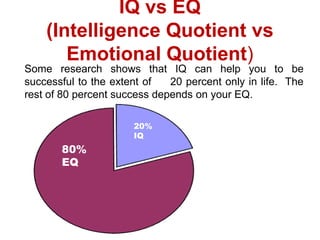
Some research shows that IQ can help you to be
successful to the extent of 20 percent only in life. The
rest of 80 percent success depends on your EQ.
80%
EQ
IQ vs EQ
(Intelligence Quotient vs
Emotional Quotient)
The word "success" is a relative term.
• Living a healthy and happy married life may be an
indicator of success for some.
• Reaching a top position in career may be an indicator of
success for others.
• For some having a satisfying job life or personal
satisfaction may be an indicator of success.
• Only the tangible achievements may not be indicators of
success in life. Many times non-tangible performance or
achievements may be termed as successful.
What Experts Say about EI/EQ
• Psychologists, Psychiatrists, Management consultants
and Medical Doctors have been proving that there are
personal characteristics called emotional intelligence
tendencies, which are responsible for the ways in which
we behave, how we feel, how we relate to others, how
well we do at our jobs and how healthy we are.
• A low level of emotional Intelligence (Low EQ) results in
being uncomfortable with other people, not being happy
with your job, not succeeding at your job and even being
physically and psychologically unhealthy - with stress-
related problems, or not having satisfactory interpersonal
relations.
Two View Points about
Emotions
Traditionalists and High performers disagree about Emotions
Traditionalists say that emotions High performers say that emotions
Distract us Motivate us
Increase our vulnerability Increase our confidence
Cloud our judgment Speed our analysis
Inhibit free flow of data Build trust
Must be controlled Must be managed
Teaching with EI
Teaching with emotional intelligence involves:
• Recognising and responding to the feelings of both
yourself and your learners in the classroom, in order to
make you both more effective in your respective roles
• Encouraging an emotional state in your learners that is
conducive to learning
The use of emotional intelligent in teaching should:
• Be essential not optional
• Be deliberate not just intuitive
• Receive a greater share of our energy
Teaching with EI
subject
expertise
learning
and teaching
approaches
emotional
intelligence
Teaching with EI
Teaching with emotional intelligence means:
• Planning for the emotional environment
• Planning for the physical experience of learners
• Dealing with your learners’ expectations
• Acknowledging individual learners
• Listening to your learners
• Reading and responding to the feelings of individuals
and groups
• Considering the effect of your responses to learners’
comments and questions
Teaching with EI
Teaching with emotional intelligence means:
• Developing self-awareness as a teacher
• Recognising your prejudices and preferences
• Checking your nonverbal communication
• Acknowledging and handling your feelings as a teacher
• Revealing your feelings to learners, as appropriate
Conclusion
• EI includes knowing what your feelings are and
using your feelings to make good decisions in
life.
• It’s being able to manage distressing moods
well and control impulses. It’s being motivated
and remaining hopeful and optimistic when you
have setbacks in working toward goals.
• It’s empathy; knowing what the people around
you are feeling. And it’s social skill—getting
along well with other people, managing
emotions in relationships, being able to
persuade or lead others,”
“Embrace life with
Emotional Intelligence..”
Thank You

Required for Professionals.pdf

  • 1.
    CDGI'S Chameli Devi Schoolof Engineering Department of Computer Science and Engineering Presentation On Required for Professionals By:- Shadab Pasha Assistant Professor CSE Dept.
  • 2.
    Agenda  Define emotionsand emotional intelligence  Appreciate importance of EI  Identify characteristics of EI  Differentiate between domains of emotional intelligence  Why EQ is so important  IQ Vs EQ What experts say about EI/EQ Two view points about Emotions Teaching with EI Conclusion
  • 3.
    What are emotions? AnEmotion is a strong feeling associated with mood, temperament, personality, and disposition. Examples of Emotional expressions are Happiness, fear, anger, affection, shame, disgust, surprise, lust, sadness, elation, love, frustration, anxiety, failure, achievement and many more.
  • 4.
    Dimensions of emotions: Thereare two dimensions of emotions : physiological side and psychological side. Physiological side: ‘Emotion’ is a complex state of human mind, involving bodily changes of widespread character such as heavy breathing, pounding heart,flushed face, sweating palms, raised pulse rate, gland secretions. Psychological side: Strong feelings marked by a state of excitement or perturbations.
  • 5.
    Emotions and TheirBlends: Each emotion is associated with its specific blends Anger: fury, outrage, resentment, annoyance and hostility. Love: acceptance, friendliness, trust, kindness and infatuation. Shame: guilt, remorse, humiliation and regret. Fear: anxiety, nervousness, apprehension and terror. Enjoyment: happiness, joy, relief, contentment and pleasure. Sadness: Grief, sorrow, cheerlessness and gloom. Surprise: Shock, astonishment, amazement and wonder.
  • 6.
    Examples of Useof Emotions:  She is too sensitive.  He takes everything too personally.  He is jealous of his colleagues.  She does not understand the feelings of others.  He is always nagging others.  The Manager blurts things out without thinking of others.  Nobody understands/listens to me.  Why does it happen to me only in life?  I am always nice with the people around me.
  • 7.
    What Exactly IsEI? Emotional intelligence is simply defined as: • Knowing what feels good, what feels bad, and how to get from bad to good. • Knowing your emotions and knowing emotions of others. • It refers to emotional management skills which provide competency to balance emotions and reason to maximise long-term happiness.
  • 8.
    What Exactly IsEI? Daniel Goleman is an international authority on emotional intelligence. His definition of emotional intelligence is as follows. Daniel Goleman is an international authority on emotional intelligence. His definition of emotional intelligence is as follows. Emotional Intelligence is “the capacity for recognising our own feelings and those of others, for motivating ourselves, for managing emotions well in ourselves and in our relationships . Emotional intelligence describes abilities distinct from, but complementary to, academic intelligence.” (1998).
  • 9.
    What Exactly IsEI? Dalip Singh’s is an Indian expert on emotional intelligence. His explanation on emotional intelligence is as follows. “Emotional intelligence is the ability of an individual to appropriately and successfully respond to a vast variety of emotional inputs being elicited from inner self and immediate environment. Emotional intelligence constitutes three psychological dimensions such as emotional competency, emotional maturity and emotional sensitivity, which motivate an individual to recognise truthfully, interpret honestly and handle tactfully the dynamics of human behaviour” (Dalip Singh 2003)
  • 10.
  • 11.
    Domains of emotional intelligence Intrapersonal •Emotional self-awareness • Assertiveness • Self-regard • Self-actualisation • Independence Interpersonal • Empathy • Interpersonal relationship • Social responsibility
  • 12.
    Domains of emotional intelligence Adaptability •Problem-solving • Reality testing • Flexibility Stress management • Stress tolerance • Impulse control General mood • Happiness • Optimism Let us see the video-1 on EI…
  • 13.
    Why is EQso important?  With out feeling and emotions we will be like robots.  It is the feeling and emotions, our likes and dislikes that give our life meaning that make us happy or unhappy, fulfilled or dissatisfied and that to a large degree decide our course of action and even on our health  EQ predicts higher work performance three times better than IQ.  Leadership is largely an emotional intelligence dimension. All interactions can be gauged along a continuum from emotionally toxic to nourishing. Two- thirds of workers say communication problems are the leading cause preventing them from doing their best at work.
  • 14.
    Why is EQso important?  EQ is one of the best predictors of divorce and marital satisfaction (subject to compatibility issues). EQ scores help predict: • Academic drop out tendency • Ability to cope with severe medical condition • Aggression in the work place • Suicide attempts • Ability to recover from mental illness .
  • 15.
    Why is EQso important? Over the past two decades, children have become more: Depressed and lonely • Impulsive and disobedient • Nervous, prone to worry, and irritable • Prone to eating disorders What are some possible causes? Parents have less free-time to spend with their children • Children have less relatives in their lives these days • Both parents often work • There is more TV watching and computer game playing • One learns EI from a social life, which has been decreasing.
  • 16.
    IQ vs EQ (IntelligenceQuotient vs Emotiona Quotient) WHAT IS “SUCCESS”?  Is it your IQ: Exams passed, competitions cleared, percentage of marks in schools and colleges, academic qualifications . Or  Is it your EQ: Earning fat salary, top positions in workplace, being rich and wealthy, powerful, dominating, being influential and above all else, being HAPPY.
  • 17.
    IQ vs EQ (IntelligenceQuotient vs Emotional Quotient) 20% IQ Some research shows that IQ can help you to be successful to the extent of 20 percent only in life. The rest of 80 percent success depends on your EQ. 80% EQ
  • 18.
    IQ vs EQ (IntelligenceQuotient vs Emotional Quotient) The word "success" is a relative term. • Living a healthy and happy married life may be an indicator of success for some. • Reaching a top position in career may be an indicator of success for others. • For some having a satisfying job life or personal satisfaction may be an indicator of success. • Only the tangible achievements may not be indicators of success in life. Many times non-tangible performance or achievements may be termed as successful.
  • 19.
    What Experts Sayabout EI/EQ • Psychologists, Psychiatrists, Management consultants and Medical Doctors have been proving that there are personal characteristics called emotional intelligence tendencies, which are responsible for the ways in which we behave, how we feel, how we relate to others, how well we do at our jobs and how healthy we are. • A low level of emotional Intelligence (Low EQ) results in being uncomfortable with other people, not being happy with your job, not succeeding at your job and even being physically and psychologically unhealthy - with stress- related problems, or not having satisfactory interpersonal relations.
  • 21.
    Two View Pointsabout Emotions Traditionalists and High performers disagree about Emotions Traditionalists say that emotions High performers say that emotions Distract us Motivate us Increase our vulnerability Increase our confidence Cloud our judgment Speed our analysis Inhibit free flow of data Build trust Must be controlled Must be managed
  • 22.
    Teaching with EI Teachingwith emotional intelligence involves: • Recognising and responding to the feelings of both yourself and your learners in the classroom, in order to make you both more effective in your respective roles • Encouraging an emotional state in your learners that is conducive to learning The use of emotional intelligent in teaching should: • Be essential not optional • Be deliberate not just intuitive • Receive a greater share of our energy
  • 23.
    Teaching with EI subject expertise learning andteaching approaches emotional intelligence
  • 24.
    Teaching with EI Teachingwith emotional intelligence means: • Planning for the emotional environment • Planning for the physical experience of learners • Dealing with your learners’ expectations • Acknowledging individual learners • Listening to your learners • Reading and responding to the feelings of individuals and groups • Considering the effect of your responses to learners’ comments and questions
  • 25.
    Teaching with EI Teachingwith emotional intelligence means: • Developing self-awareness as a teacher • Recognising your prejudices and preferences • Checking your nonverbal communication • Acknowledging and handling your feelings as a teacher • Revealing your feelings to learners, as appropriate
  • 28.
    Conclusion • EI includesknowing what your feelings are and using your feelings to make good decisions in life. • It’s being able to manage distressing moods well and control impulses. It’s being motivated and remaining hopeful and optimistic when you have setbacks in working toward goals. • It’s empathy; knowing what the people around you are feeling. And it’s social skill—getting along well with other people, managing emotions in relationships, being able to persuade or lead others,”
  • 29.
    “Embrace life with EmotionalIntelligence..” Thank You