EMOTIONAL INTELLIGENCE
S.C.S(A) COLLEGE, PURI
SUBMITTED BY:
Debashree Jena
B.A Final Year
Roll No.: BA14-477
Exam Roll.:11614002
Sarmistha Parida
B.A Final Year
Roll No.: BA14-542
Exam Roll.:11614028
GUIDED BY:
Prof. Renubala Mahakud
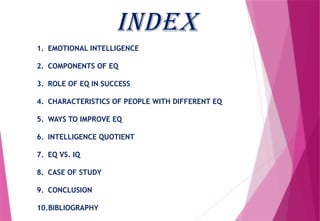
INDEX
1. EMOTIONAL INTELLIGENCE
2. COMPONENTS OF EQ
3. ROLE OF EQ IN SUCCESS
4. CHARACTERISTICS OF PEOPLE WITH DIFFERENT EQ
5. WAYS TO IMPROVE EQ
6. INTELLIGENCE QUOTIENT
7. EQ VS. IQ
8. CASE OF STUDY
9. CONCLUSION
10.BIBLIOGRAPHY
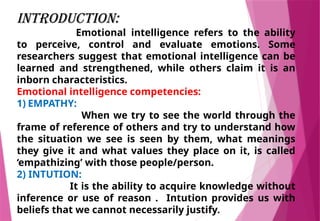
INTRODUCTION:
Emotional intelligence refers to the ability
to perceive, control and evaluate emotions. Some
researchers suggest that emotional intelligence can be
learned and strengthened, while others claim it is an
inborn characteristics.
Emotional intelligence competencies:
1) EMPATHY:
When we try to see the world through the
frame of reference of others and try to understand how
the situation we see is seen by them, what meanings
they give it and what values they place on it, is called
‘empathizing’ with those people/person.
2) INTUTION:
It is the ability to acquire knowledge without
inference or use of reason . Intution provides us with
beliefs that we cannot necessarily justify.
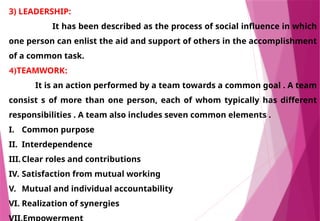
3) LEADERSHIP:
It has been described as the process of social influence in which
one person can enlist the aid and support of others in the accomplishment
of a common task.
4)TEAMWORK:
It is an action performed by a team towards a common goal . A team
consist s of more than one person, each of whom typically has different
responsibilities . A team also includes seven common elements .
I. Common purpose
II. Interdependence
III.Clear roles and contributions
IV. Satisfaction from mutual working
V. Mutual and individual accountability
VI. Realization of synergies
VII.Empowerment
5) SELF-CONTROL:
It is the ability to control one’s emotions, behaviour and
desires in order to obtain some reward, or avoid some
punishment, later . Presumably, some (smaller) reward or
punishment is operating in the short term which precludes, or
reduces, the later reward or punishment.
6) SELF-CONFIDENCE:
It is a socio-psychological concept which relates to self-
assuredness in one’s personal, judgment, ability, power
etc. ,sometimes manifested excessively.
Branches of Emotional Intelligence:
Salovey and Mayer proposed a model that identified four different
factors of emotional intelligence: the perception of emotion , the ability
reason using emotions , the ability to understand emotion and the ability
to manage emotions.
1. Perceiving Emotions:
The first step in understanding emotions is to accurately
perceive them.
2. Reasoning With Emotions:
The next step involves using emotions to promote thinking
and cognitive activity.
3. Understanding Emotions:
The emotions that we perceive can carry a wide variety of
meanings.
4. Managing Emotions:
The ability to manage emotions effectively is a key part of
emotional intelligence.
Who Is Emotionally Intelligent – And Does It
Matter ?
Emotional intelligence is an intelligence having to do with
discerning and understanding emotional information.
Emotional information is crucial . It is one of the primary
forms of information that human beings process.
They’re particularly good at establishing positive social
relationships with others, and avoiding conflicts, fights,
and other social altercations . They’re particularly good at
understanding psychologically healthy living and
avoiding such problems as drugs and drug abuse.
This is the information age . All of us are dependent on
information and using it wisely . The advent of the ability
model of emotional intelligence enriches our knowledge
of the information surrounding us .
Why Study Emotional Intelligence Together With
Personality Psychology?
There are several reasons to understand emotional
intelligence and personality together . Emotional Intelligence is a part
of human personality, and personality provides the context in which
emotional intelligence operates . Emotional Intelligence can be
considered a mental ability that involves the ability to reason validly
with emotional information, and the action of emotions to enhance
thought.
There are several reasons to understand this
relationship:
1. Understanding “where” and “what” EI is (e.g., a mental ability
inside, or, a part of, personality)can help identify the type of data
necessary to collect to study the idea2 . Placing emotional
intelligence in its psychological context allows one to compare and
contrast it with different parts of personality.
 Those that are similar
 Those that are related, and,
 Those that is different.
2. If a person’s ultimate aim is to understand a target
variable—such as aggression or problem behaviour –
understanding the personality system as a whole can
help link EI with other relevant parts of personality for
empirical study .
3. Understanding EI as a part of the broader personality
system also can alert researchers as to what parts of
personality may influence EI, increase its effects, or
lower them.
4. Considerable research exists as to how personality’s
parts are expressed . Understanding that EI is part of
personality indicates a great deal about how it will be
How EQ Helps In Success?
Emotional Intelligence is increasingly relevant to
organizational development and developing people, because the
EQ principles provide a new way to understand and assess
people’s behaviours, management styles, attitudes, interpersonal
skills, and potential .
EQ proves to be a powerful strategic tool in
accomplishing your business goals in the following areas:
 Hiring / Screening:
By incorporating EQ competencies in your hiring
strategies, you are ensuring that the people who come to work for
your company will already possess a high degree of emotional
intelligence that will help them perform their job .
 Performance development reviews:
Performance and development reviews that reflect
EQ competencies will ensure that employees are aware of
development needs in the emotional intelligence area.
 Profit to the business :
Emotional Intelligence leads to
o Reduction of lost-time accidents
o Reduction in formal grievances.
o Increase in productivity.
Can EQ be Improved?
1.Understand the importance of emotional intelligence in all
aspects of your life:
Being intellectually capable is important in life, but being
emotionally intelligent can be considered even more so, as there
are many benefits associated with high emotional intelligence .
Having high emotional intelligence can help you
to lead a happier life because it is easier to talk with and
understand others, acting rationally and calmly in difficult
situations becomes second nature and it can also lead to better
relationships and job opportunities .
There are four core elements to emotional intelligence
that help you lead to a balanced life:
 Self awareness:
This is the ability to recognise your own emotions for
what they are and to understand their origins . It is also about
knowing your strengths and limitations and self-system
 Self management:
This is the ability to delay gratification, balance your
needs with those of others, take initiative and to pull back on
impulsivity .
 Social awareness:
This is about being attuned to other people’s emotions
and concerns, as well as being able to noticed and adapt to social
cues .
 Relationship management:
This is about the ability to get along well with others,
manage conflict, inspire and influence people and to
communicate clearly .
A very important part of improving your emotional intelligence is
about being able to spot stress triggers and recognise them for
what they are and to bring yourself back to feeling calm and
relaxed.
While changing your mindset can be difficult ih you’re
stuck on seeing everything in your life in terms of absolutes,
opening up a bit can lead to new insights and less personal angst .
 Be optimistic:
Those who are optimistic tend to live a happy, successful
life, when you’re optimistic, it’s easier to see the beauty in life and
everyday objects . In a way, being optimistic results in an open
mind, making it a crucial element of improving your emotional
intelligence .
If you have a negative outlook on everything, how can you expect
to be emotionally intelligent ? Negativity encourages us to say
wrapped up . In ourselves, focused only on what can go wrong in
our lives rather than building our resilience and shoring ourselves
against the vicissitudes of life .
Optimism results in emotional well being and greater
opportunities – people want to be around the optimistic person
and this draws them to you, with all the possibilities that more
connections bring you . Be sure to take some time out to practice
optimism by:
• Identifying your good features and appreciating them .
INTELLIGENCE QUOTIENT
What is Iq ?
The term “IQ” comes from the German Intelligenz-
Quotient . When modern IQ tests are constructed, the mean
(average) score within an age group is set to 100 and the
standard deviation (SD) to 15 .In 1912, a German psychologist,
William Stern, noticed that even though the gap between
mental age and chronological age widens as a child matures,
the ratio of mental age to chronological age remains
constant, through out the life of a person.
EMOTIONAL QUOTIENT VS INTELLIGENCE QUOTIENT
1.Measure of ability to manage emotions(EQ) and measure
of intelligence:
EQ or Emotional Quotient is a measure of your ability to
notice and then manage your interior and exterior
perceptions of your feelings and then control your
reactions.
IQ or Intelligence Quotient is a measure of intelligence .A
way to rate this for any individual is by taking an IQ test .
An IQ test measure different types of abilities: verbal,
memory, mathematical, spatial, and reasoning.
The nature of EI as an ability can be clarified by understanding
that many kinds of effective, successful people may score low
on ability scales of emotional intelligence . It is also the case
that other, less effective people may score high on the test .
CONCLUSION:
From the following case study done above, we can
conclude that both IQ and EQ are very important for success;
though a person having a low EQ can also be successful.
It is not necessary that the only people having a
high level of EQ are successful , people with average or Low EQ
can be successful , provided , they utilize this ability really
well.
EMOTIONAL INTELLIGENCE PROJECT REPORT PPT

EMOTIONAL INTELLIGENCE PROJECT REPORT PPT

  • 2.
    EMOTIONAL INTELLIGENCE S.C.S(A) COLLEGE,PURI SUBMITTED BY: Debashree Jena B.A Final Year Roll No.: BA14-477 Exam Roll.:11614002 Sarmistha Parida B.A Final Year Roll No.: BA14-542 Exam Roll.:11614028 GUIDED BY: Prof. Renubala Mahakud
  • 3.
    INDEX 1. EMOTIONAL INTELLIGENCE 2.COMPONENTS OF EQ 3. ROLE OF EQ IN SUCCESS 4. CHARACTERISTICS OF PEOPLE WITH DIFFERENT EQ 5. WAYS TO IMPROVE EQ 6. INTELLIGENCE QUOTIENT 7. EQ VS. IQ 8. CASE OF STUDY 9. CONCLUSION 10.BIBLIOGRAPHY
  • 4.
    INTRODUCTION: Emotional intelligence refersto the ability to perceive, control and evaluate emotions. Some researchers suggest that emotional intelligence can be learned and strengthened, while others claim it is an inborn characteristics. Emotional intelligence competencies: 1) EMPATHY: When we try to see the world through the frame of reference of others and try to understand how the situation we see is seen by them, what meanings they give it and what values they place on it, is called ‘empathizing’ with those people/person. 2) INTUTION: It is the ability to acquire knowledge without inference or use of reason . Intution provides us with beliefs that we cannot necessarily justify.
  • 5.
    3) LEADERSHIP: It hasbeen described as the process of social influence in which one person can enlist the aid and support of others in the accomplishment of a common task. 4)TEAMWORK: It is an action performed by a team towards a common goal . A team consist s of more than one person, each of whom typically has different responsibilities . A team also includes seven common elements . I. Common purpose II. Interdependence III.Clear roles and contributions IV. Satisfaction from mutual working V. Mutual and individual accountability VI. Realization of synergies VII.Empowerment
  • 6.
    5) SELF-CONTROL: It isthe ability to control one’s emotions, behaviour and desires in order to obtain some reward, or avoid some punishment, later . Presumably, some (smaller) reward or punishment is operating in the short term which precludes, or reduces, the later reward or punishment. 6) SELF-CONFIDENCE: It is a socio-psychological concept which relates to self- assuredness in one’s personal, judgment, ability, power etc. ,sometimes manifested excessively.
  • 7.
    Branches of EmotionalIntelligence: Salovey and Mayer proposed a model that identified four different factors of emotional intelligence: the perception of emotion , the ability reason using emotions , the ability to understand emotion and the ability to manage emotions. 1. Perceiving Emotions: The first step in understanding emotions is to accurately perceive them. 2. Reasoning With Emotions: The next step involves using emotions to promote thinking and cognitive activity. 3. Understanding Emotions: The emotions that we perceive can carry a wide variety of meanings. 4. Managing Emotions: The ability to manage emotions effectively is a key part of emotional intelligence.
  • 8.
    Who Is EmotionallyIntelligent – And Does It Matter ? Emotional intelligence is an intelligence having to do with discerning and understanding emotional information. Emotional information is crucial . It is one of the primary forms of information that human beings process. They’re particularly good at establishing positive social relationships with others, and avoiding conflicts, fights, and other social altercations . They’re particularly good at understanding psychologically healthy living and avoiding such problems as drugs and drug abuse. This is the information age . All of us are dependent on information and using it wisely . The advent of the ability model of emotional intelligence enriches our knowledge of the information surrounding us .
  • 9.
    Why Study EmotionalIntelligence Together With Personality Psychology? There are several reasons to understand emotional intelligence and personality together . Emotional Intelligence is a part of human personality, and personality provides the context in which emotional intelligence operates . Emotional Intelligence can be considered a mental ability that involves the ability to reason validly with emotional information, and the action of emotions to enhance thought. There are several reasons to understand this relationship: 1. Understanding “where” and “what” EI is (e.g., a mental ability inside, or, a part of, personality)can help identify the type of data necessary to collect to study the idea2 . Placing emotional intelligence in its psychological context allows one to compare and contrast it with different parts of personality.  Those that are similar  Those that are related, and,  Those that is different.
  • 10.
    2. If aperson’s ultimate aim is to understand a target variable—such as aggression or problem behaviour – understanding the personality system as a whole can help link EI with other relevant parts of personality for empirical study . 3. Understanding EI as a part of the broader personality system also can alert researchers as to what parts of personality may influence EI, increase its effects, or lower them. 4. Considerable research exists as to how personality’s parts are expressed . Understanding that EI is part of personality indicates a great deal about how it will be
  • 11.
    How EQ HelpsIn Success? Emotional Intelligence is increasingly relevant to organizational development and developing people, because the EQ principles provide a new way to understand and assess people’s behaviours, management styles, attitudes, interpersonal skills, and potential . EQ proves to be a powerful strategic tool in accomplishing your business goals in the following areas:  Hiring / Screening: By incorporating EQ competencies in your hiring strategies, you are ensuring that the people who come to work for your company will already possess a high degree of emotional intelligence that will help them perform their job .
  • 12.
     Performance developmentreviews: Performance and development reviews that reflect EQ competencies will ensure that employees are aware of development needs in the emotional intelligence area.  Profit to the business : Emotional Intelligence leads to o Reduction of lost-time accidents o Reduction in formal grievances. o Increase in productivity.
  • 13.
    Can EQ beImproved? 1.Understand the importance of emotional intelligence in all aspects of your life: Being intellectually capable is important in life, but being emotionally intelligent can be considered even more so, as there are many benefits associated with high emotional intelligence . Having high emotional intelligence can help you to lead a happier life because it is easier to talk with and understand others, acting rationally and calmly in difficult situations becomes second nature and it can also lead to better relationships and job opportunities .
  • 14.
    There are fourcore elements to emotional intelligence that help you lead to a balanced life:  Self awareness: This is the ability to recognise your own emotions for what they are and to understand their origins . It is also about knowing your strengths and limitations and self-system  Self management: This is the ability to delay gratification, balance your needs with those of others, take initiative and to pull back on impulsivity .  Social awareness: This is about being attuned to other people’s emotions and concerns, as well as being able to noticed and adapt to social cues .  Relationship management: This is about the ability to get along well with others, manage conflict, inspire and influence people and to communicate clearly .
  • 15.
    A very importantpart of improving your emotional intelligence is about being able to spot stress triggers and recognise them for what they are and to bring yourself back to feeling calm and relaxed. While changing your mindset can be difficult ih you’re stuck on seeing everything in your life in terms of absolutes, opening up a bit can lead to new insights and less personal angst .  Be optimistic: Those who are optimistic tend to live a happy, successful life, when you’re optimistic, it’s easier to see the beauty in life and everyday objects . In a way, being optimistic results in an open mind, making it a crucial element of improving your emotional intelligence .
  • 16.
    If you havea negative outlook on everything, how can you expect to be emotionally intelligent ? Negativity encourages us to say wrapped up . In ourselves, focused only on what can go wrong in our lives rather than building our resilience and shoring ourselves against the vicissitudes of life . Optimism results in emotional well being and greater opportunities – people want to be around the optimistic person and this draws them to you, with all the possibilities that more connections bring you . Be sure to take some time out to practice optimism by: • Identifying your good features and appreciating them .
  • 17.
    INTELLIGENCE QUOTIENT What isIq ? The term “IQ” comes from the German Intelligenz- Quotient . When modern IQ tests are constructed, the mean (average) score within an age group is set to 100 and the standard deviation (SD) to 15 .In 1912, a German psychologist, William Stern, noticed that even though the gap between mental age and chronological age widens as a child matures, the ratio of mental age to chronological age remains constant, through out the life of a person.
  • 18.
    EMOTIONAL QUOTIENT VSINTELLIGENCE QUOTIENT 1.Measure of ability to manage emotions(EQ) and measure of intelligence: EQ or Emotional Quotient is a measure of your ability to notice and then manage your interior and exterior perceptions of your feelings and then control your reactions. IQ or Intelligence Quotient is a measure of intelligence .A way to rate this for any individual is by taking an IQ test . An IQ test measure different types of abilities: verbal, memory, mathematical, spatial, and reasoning.
  • 19.
    The nature ofEI as an ability can be clarified by understanding that many kinds of effective, successful people may score low on ability scales of emotional intelligence . It is also the case that other, less effective people may score high on the test . CONCLUSION: From the following case study done above, we can conclude that both IQ and EQ are very important for success; though a person having a low EQ can also be successful. It is not necessary that the only people having a high level of EQ are successful , people with average or Low EQ can be successful , provided , they utilize this ability really well.