Unlocking the future with Deep Learning
1
— Graduate - B. Tech.
Computer Science &
Engineering - 2018
— Data Scientist
EdTech and Healthcare
— Hackathon Enthusiast
@AashishLChaubey
chaubey.aashish
https://aashishchaubey.com
chaubey.aashish@gmail.com
ACLDigital
Design led Digital Experience,
Product Innovation, Solutions,
and Consulting Offering
Leader
an Alten group company
Building Foundation
Neural Networks
Deep Learning
Face Recognition
Demonstration
Interactive Session
Q&A’s
Agenda
What are Neural Networks?
5
Neural Networks
What is a neural network?
— Definition
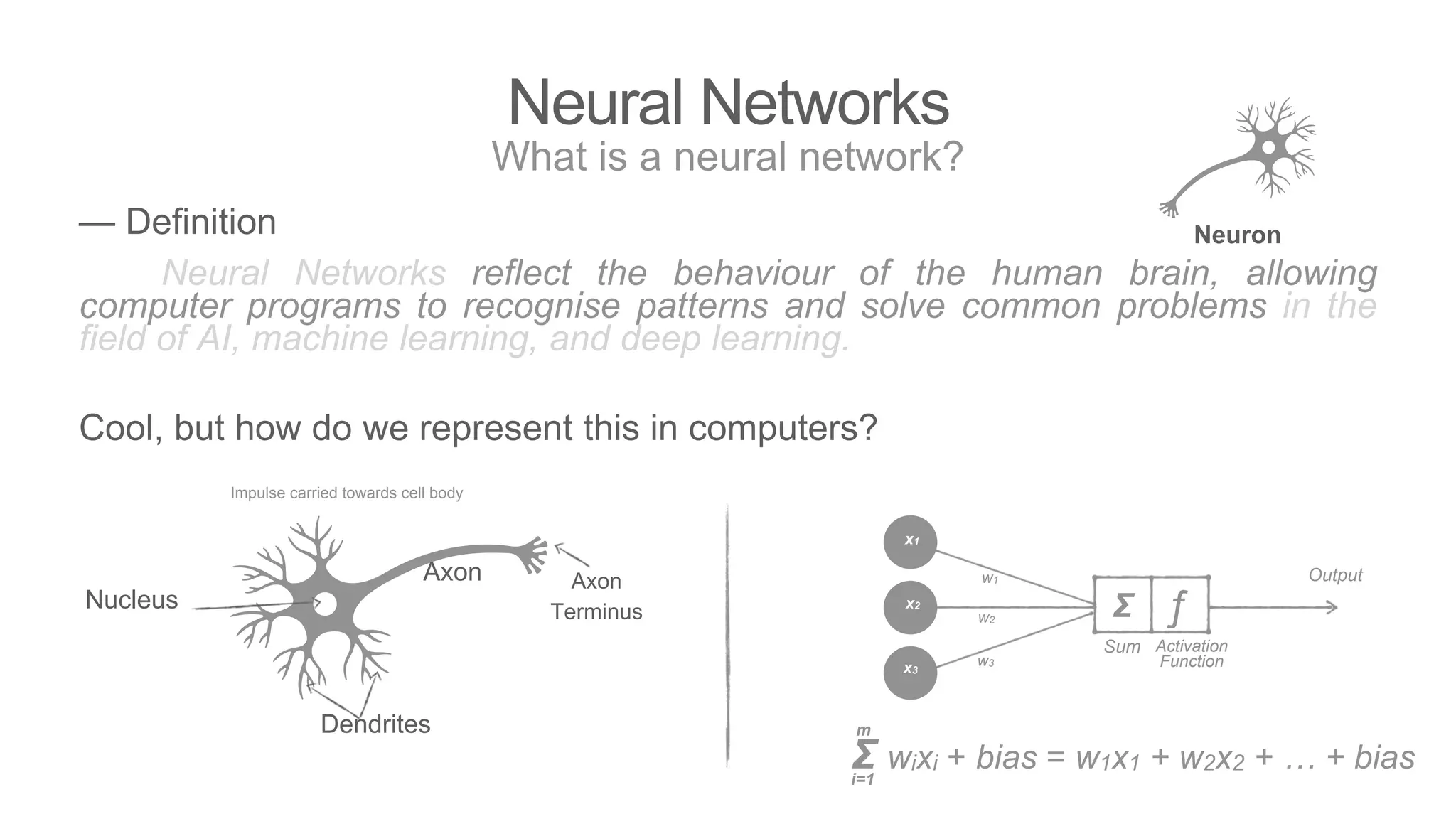
Neural Networks reflect the behaviour of the human brain, allowing
computer programs to recognise patterns and solve common problems in the
field of AI, machine learning, and deep learning.
Cool, but how do we represent this in computers?
Neuron
Dendrites
Nucleus
Axon Axon
Terminus
Impulse carried towards cell body
w1
w2
w3
x1
x2
x3
Σ ƒ
Sum Activation
Function
Output
Σ wixi + bias = w1x1 + w2x2 + … + bias
i=1
m
Neural Networks
What are neural networks?
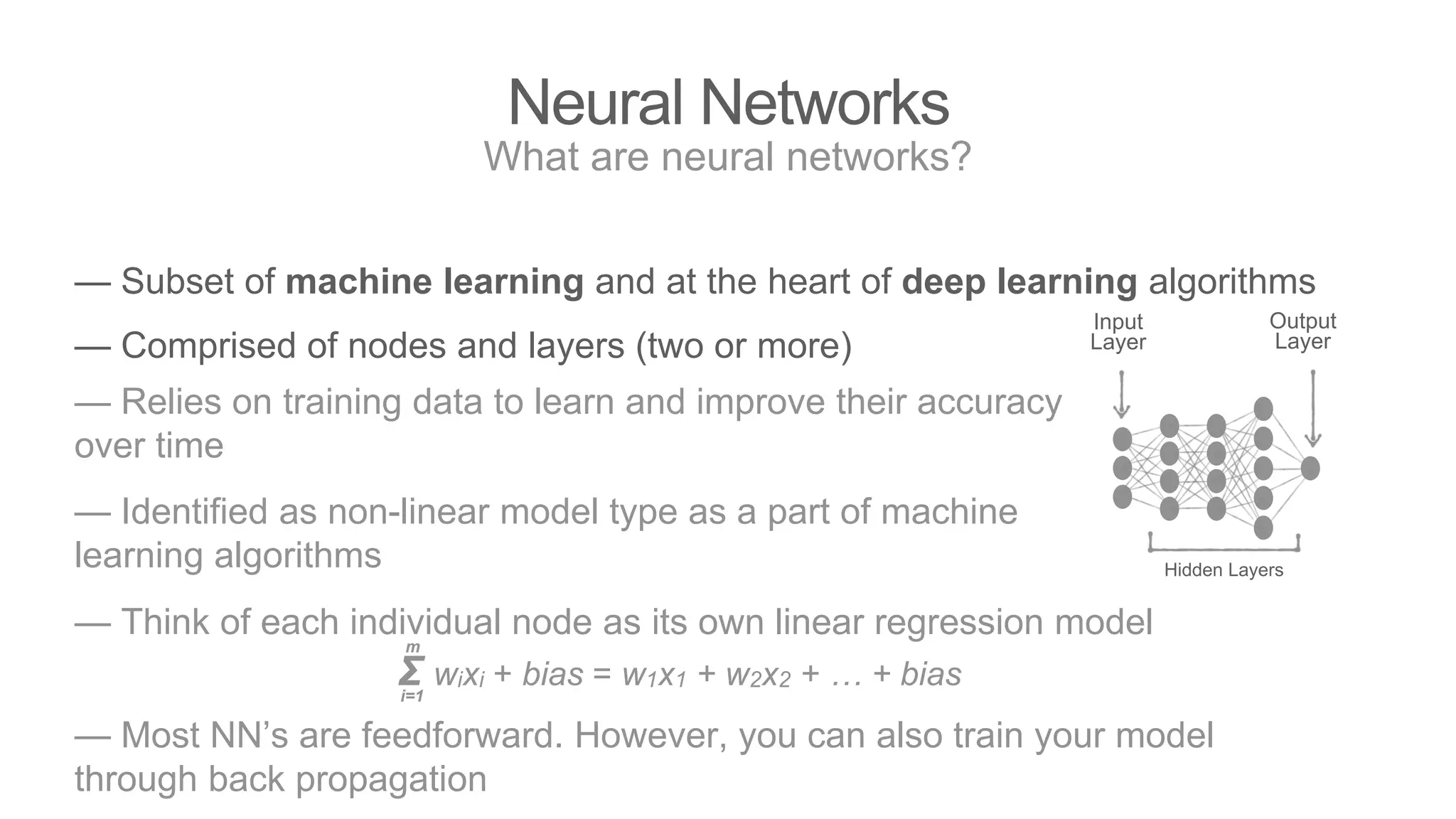
— Subset of machine learning and at the heart of deep learning algorithms
Output
Layer
Input
Layer
Hidden Layers
— Comprised of nodes and layers (two or more)
— Relies on training data to learn and improve their accuracy
over time
— Identified as non-linear model type as a part of machine
learning algorithms
— Think of each individual node as its own linear regression model
Σ wixi + bias = w1x1 + w2x2 + … + bias
i=1
m
— Most NN’s are feedforward. However, you can also train your model
through back propagation
Then, what is Deep Learning?
8
Deep Learning
What is deep learning?
— Definition
Deep learning attempts to mimic the human brain - albeit far from matching
its ability - enabling systems to cluster data and make predictions/inference with
incredible accuracy.
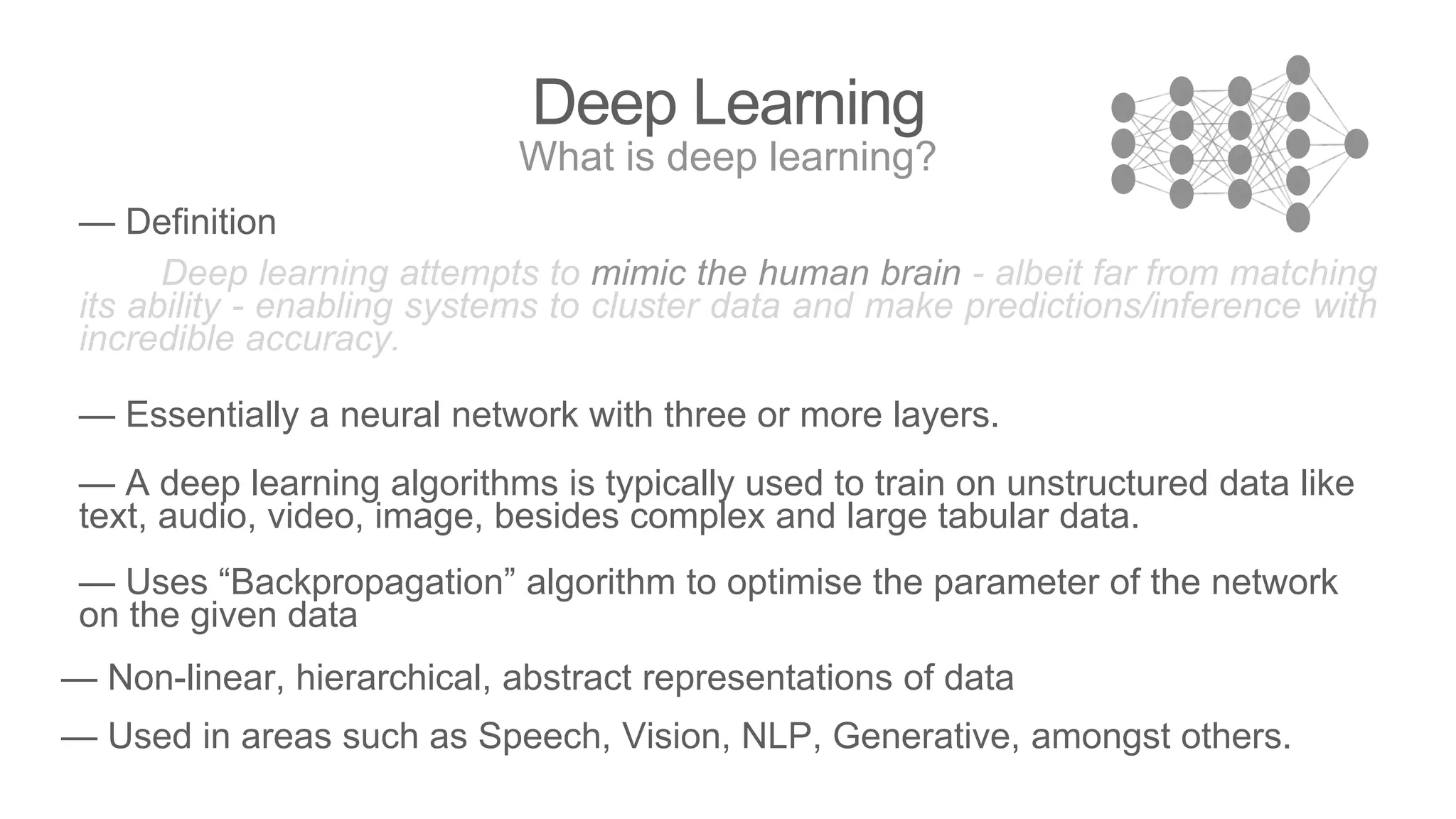
— Essentially a neural network with three or more layers.
— A deep learning algorithms is typically used to train on unstructured data like
text, audio, video, image, besides complex and large tabular data.
— Uses “Backpropagation” algorithm to optimise the parameter of the network
on the given data
— Non-linear, hierarchical, abstract representations of data
— Used in areas such as Speech, Vision, NLP, Generative, amongst others.
Deep Learning
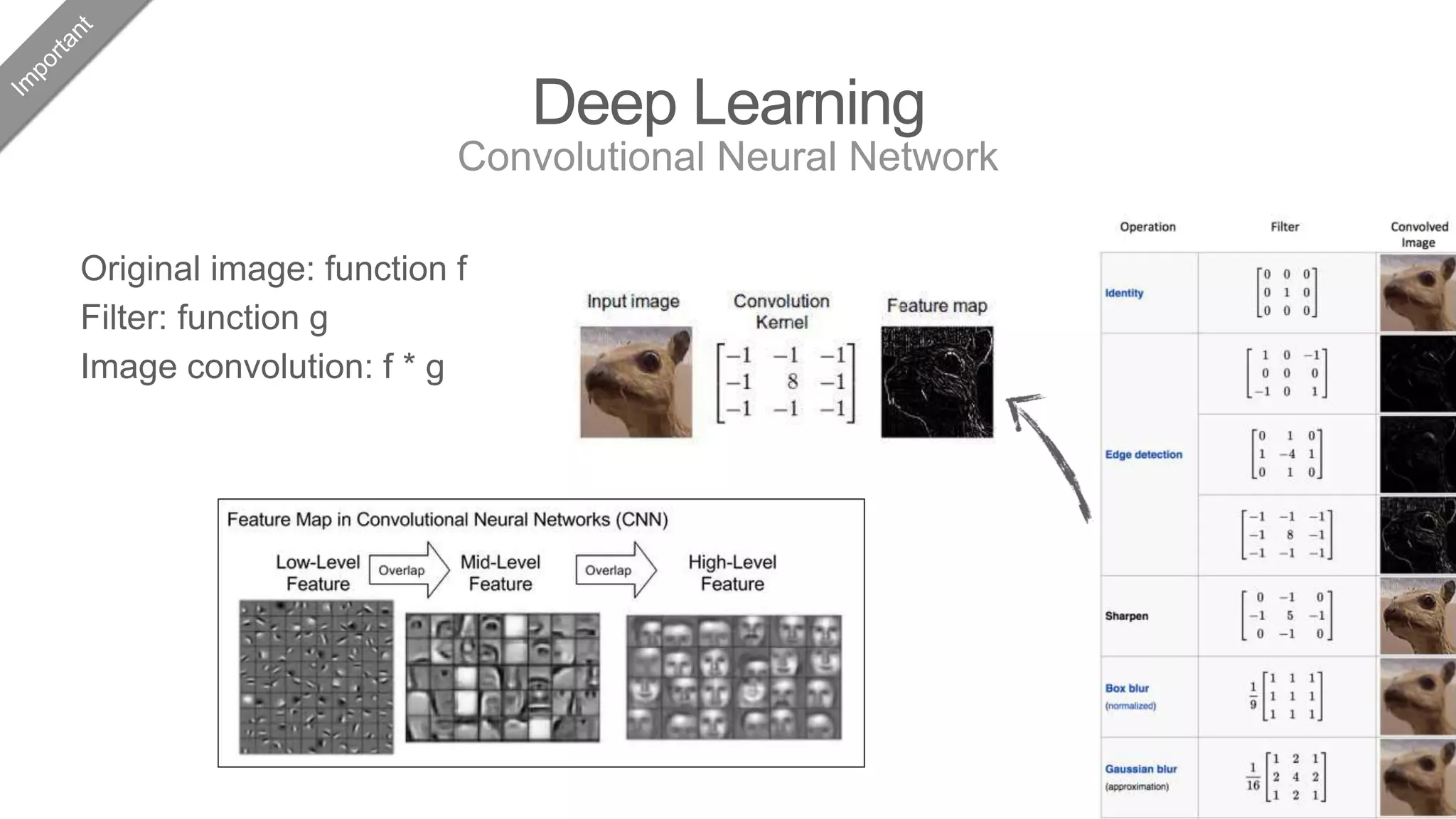
Convolutional Neural Network
• Specific type of neural network used generally when working with vision based
data, e.g., images and videos.
• CNN is just one type of Deep Neural Network.
• Reduce number of weights required for training.
• Use filter to capture local information
• More meaningful search, move from pixel recognition to pattern recognition
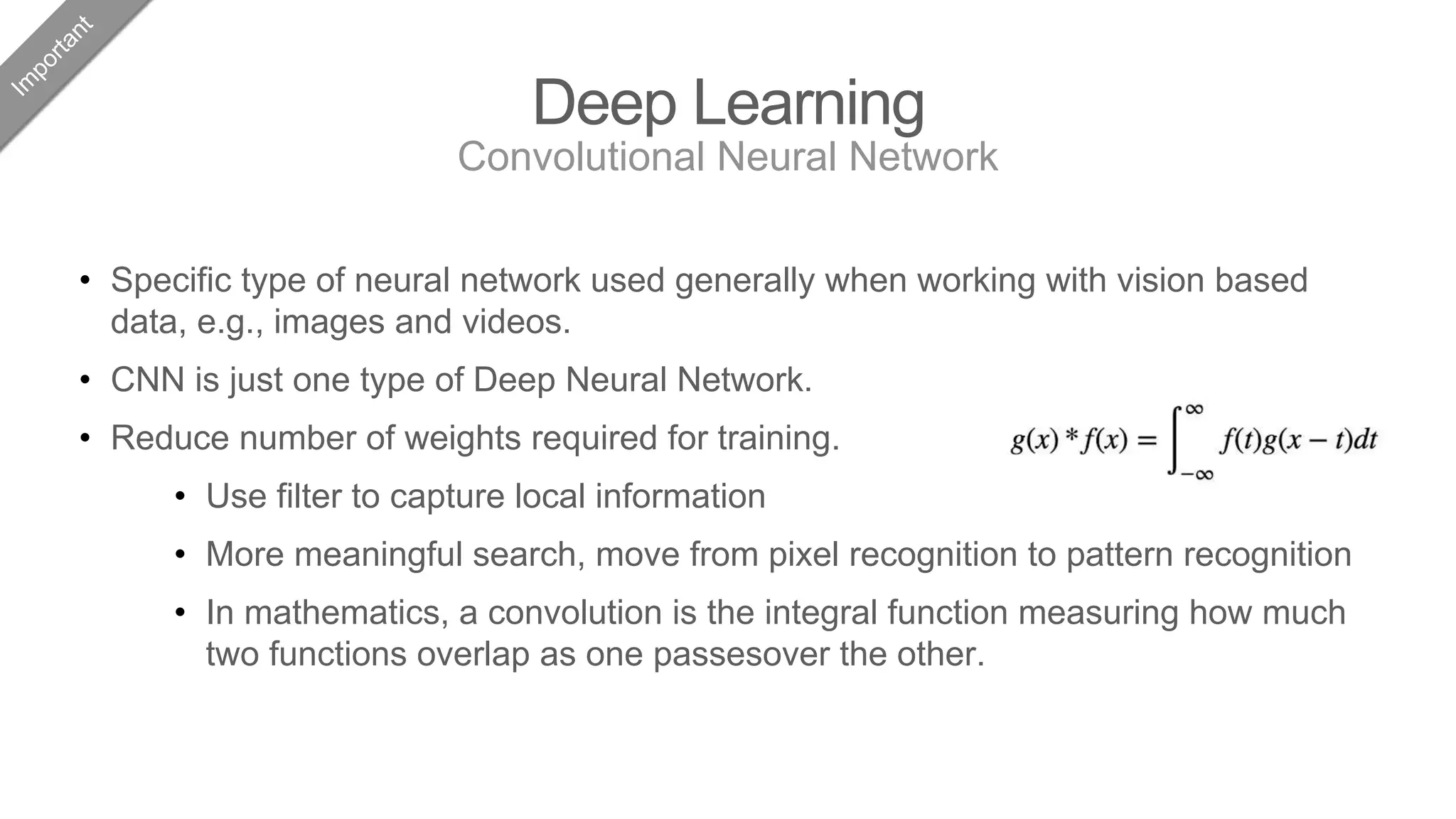
• In mathematics, a convolution is the integral function measuring how much
two functions overlap as one passesover the other.
Deep Learning
Convolutional Neural Network
Original image: function f
Filter: function g
Image convolution: f * g
Deep Learning
Libraries
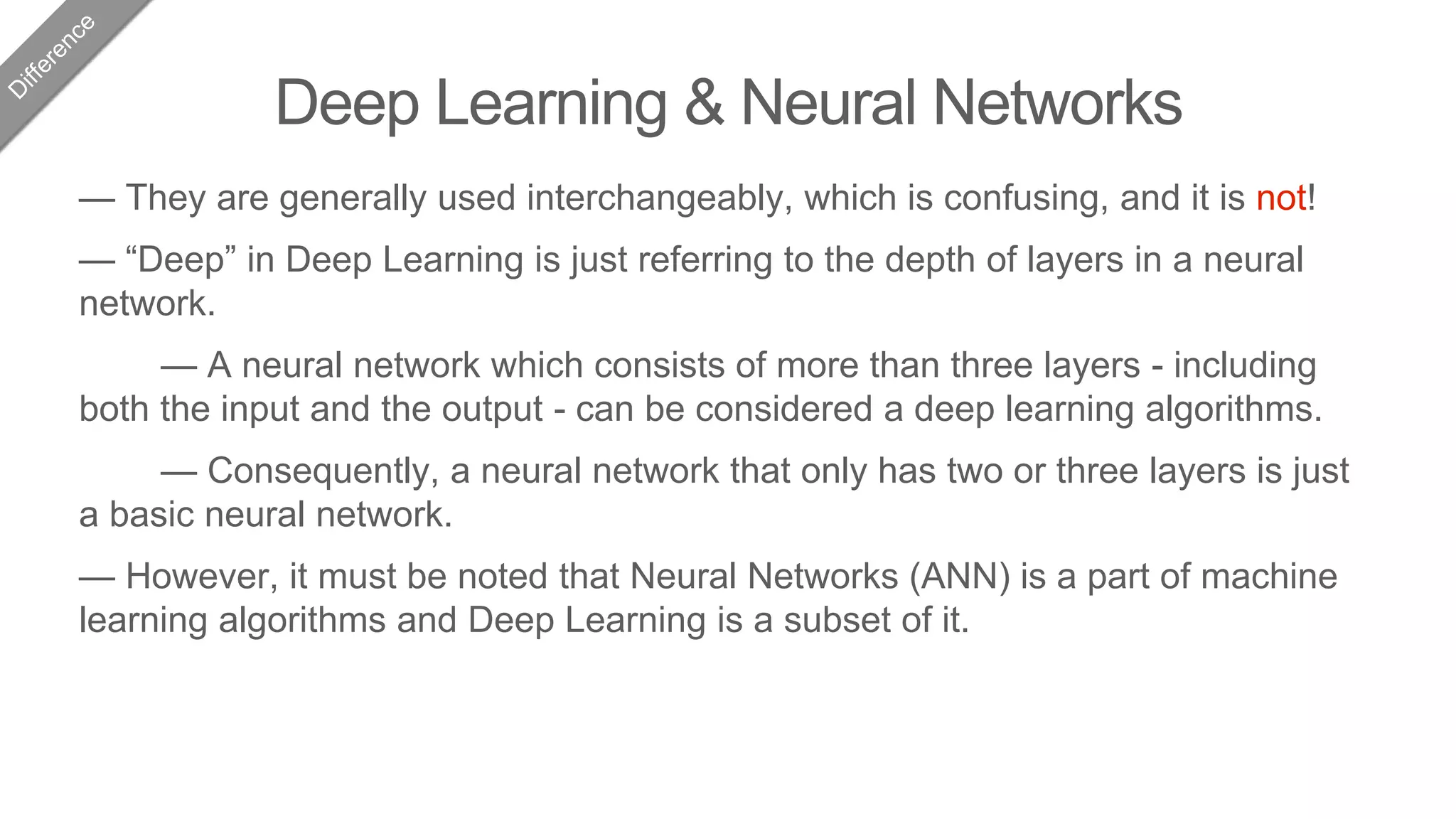
Deep Learning & Neural Networks
— They are generally used interchangeably, which is confusing, and it is not!
— “Deep” in Deep Learning is just referring to the depth of layers in a neural
network.
— A neural network which consists of more than three layers - including
both the input and the output - can be considered a deep learning algorithms.
— Consequently, a neural network that only has two or three layers is just
a basic neural network.
— However, it must be noted that Neural Networks (ANN) is a part of machine
learning algorithms and Deep Learning is a subset of it.
What is Face Recognition?
14
Face Recognition
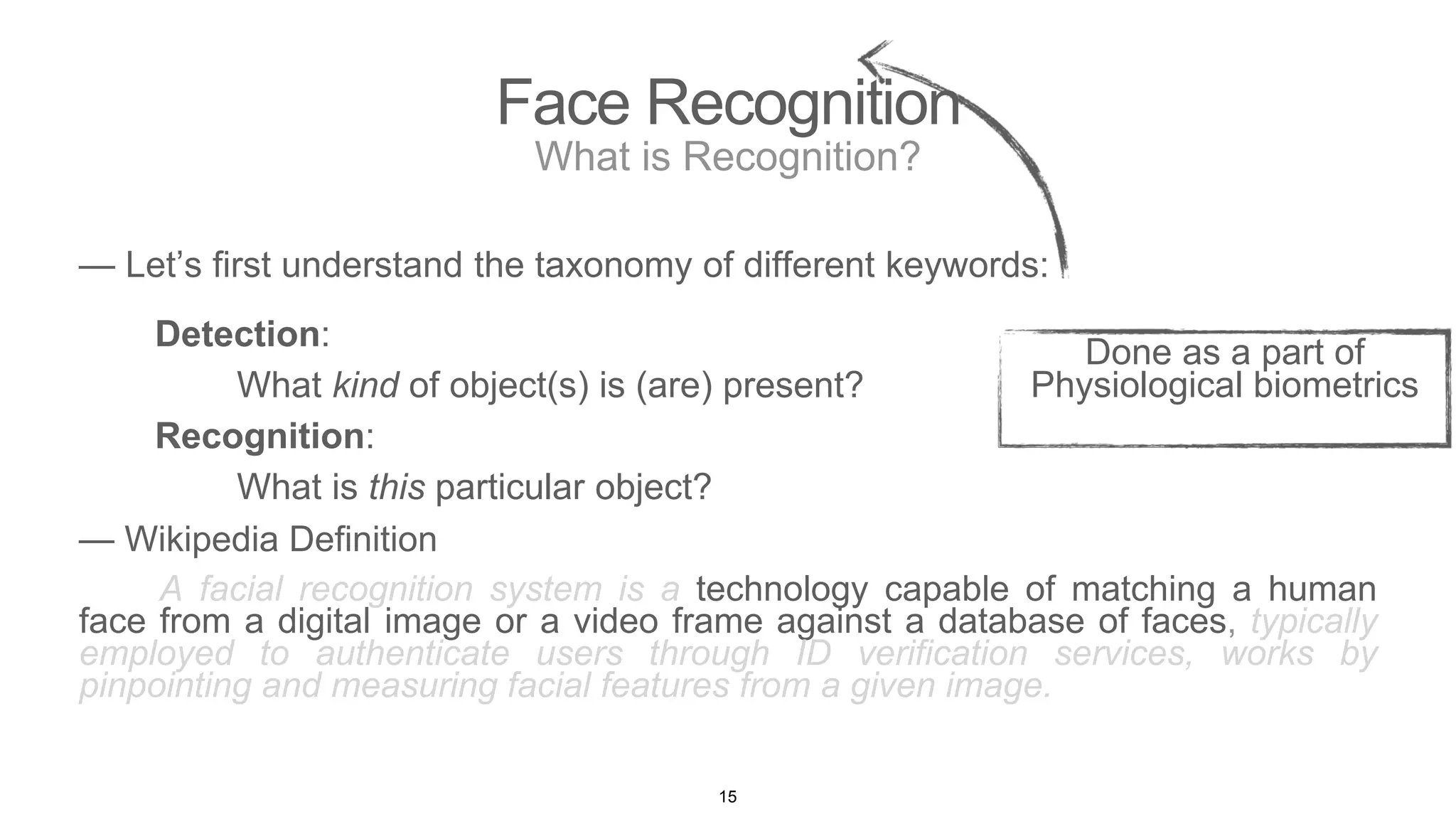
What is Recognition?
— Let’s first understand the taxonomy of different keywords:
Detection:
What kind of object(s) is (are) present?
Recognition:
What is this particular object?
15
— Wikipedia Definition
A facial recognition system is a technology capable of matching a human
face from a digital image or a video frame against a database of faces, typically
employed to authenticate users through ID verification services, works by
pinpointing and measuring facial features from a given image.
Done as a part of
Physiological biometrics
Face Recognition
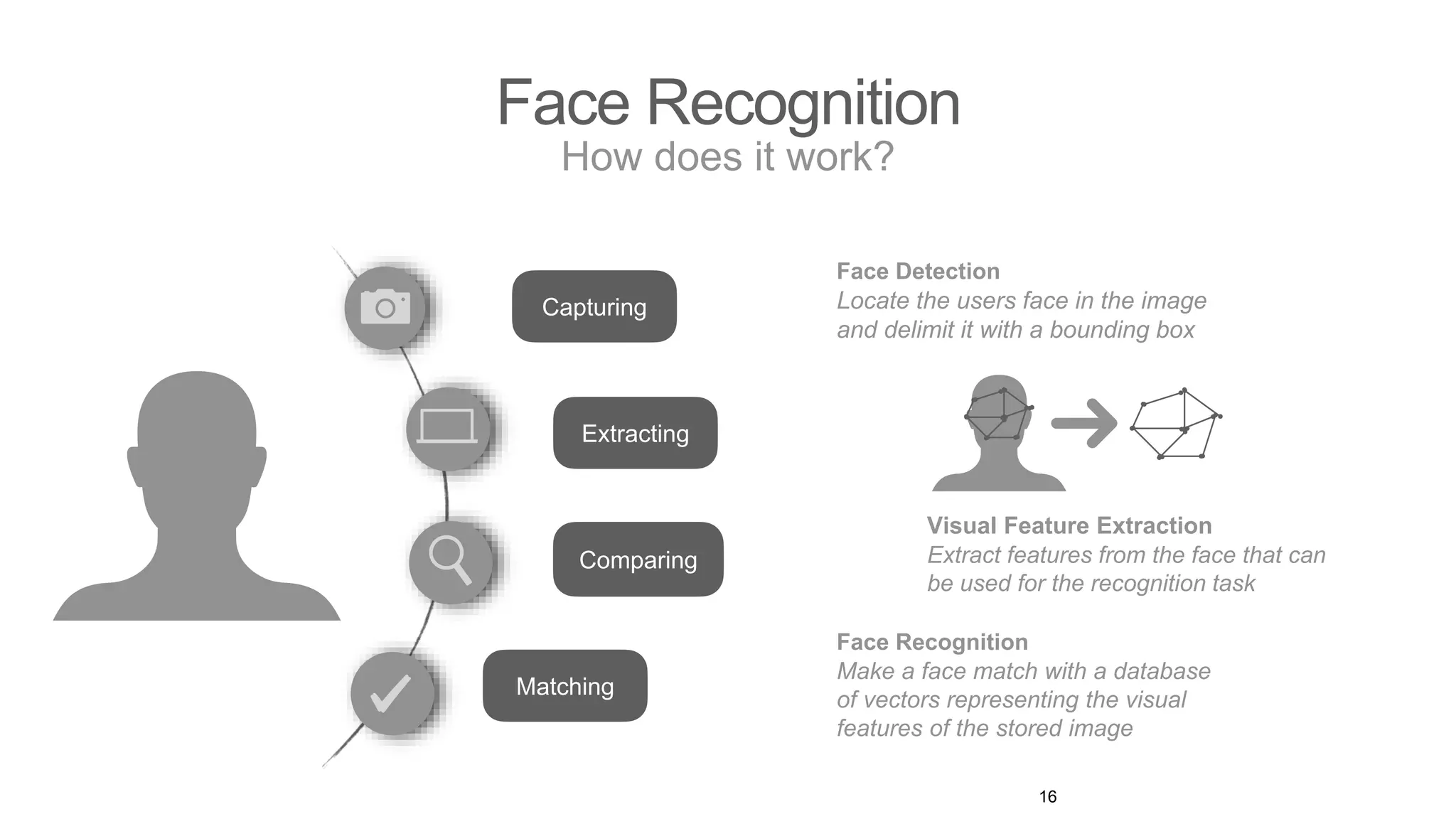
How does it work?
16
Capturing
Extracting
Comparing
Matching
Locate the users face in the image
and delimit it with a bounding box
Face Detection
Make a face match with a database
of vectors representing the visual
features of the stored image
Face Recognition
Extract features from the face that can
be used for the recognition task
Visual Feature Extraction
Face Recognition
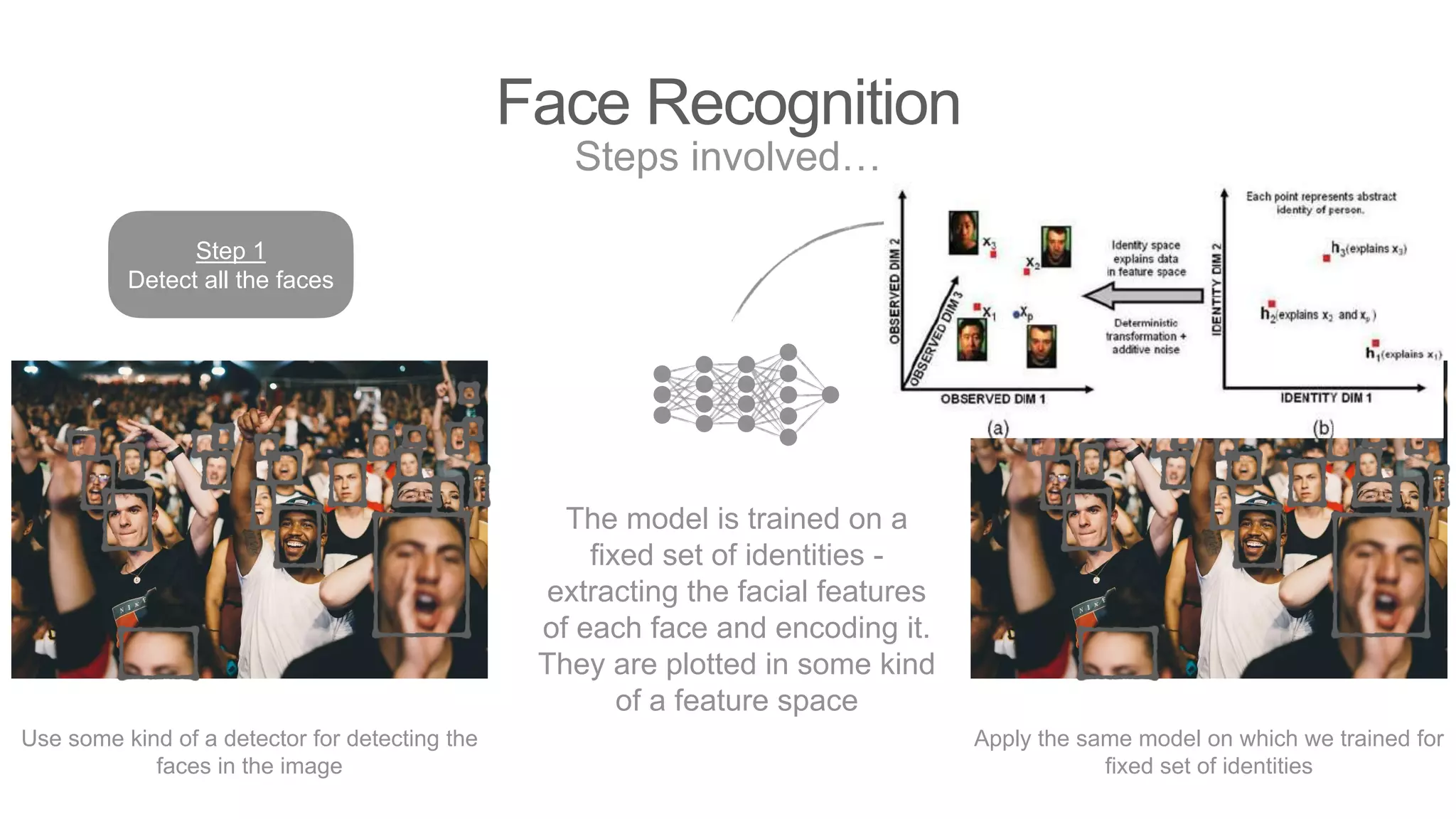
Steps involved…
Step 1
Detect all the faces
Use some kind of a detector for detecting the
faces in the image
Step 2
Identify all the faces
Apply the same model on which we trained for
fixed set of identities
The model is trained on a
fixed set of identities -
extracting the facial features
of each face and encoding it.
They are plotted in some kind
of a feature space
Face Recognition
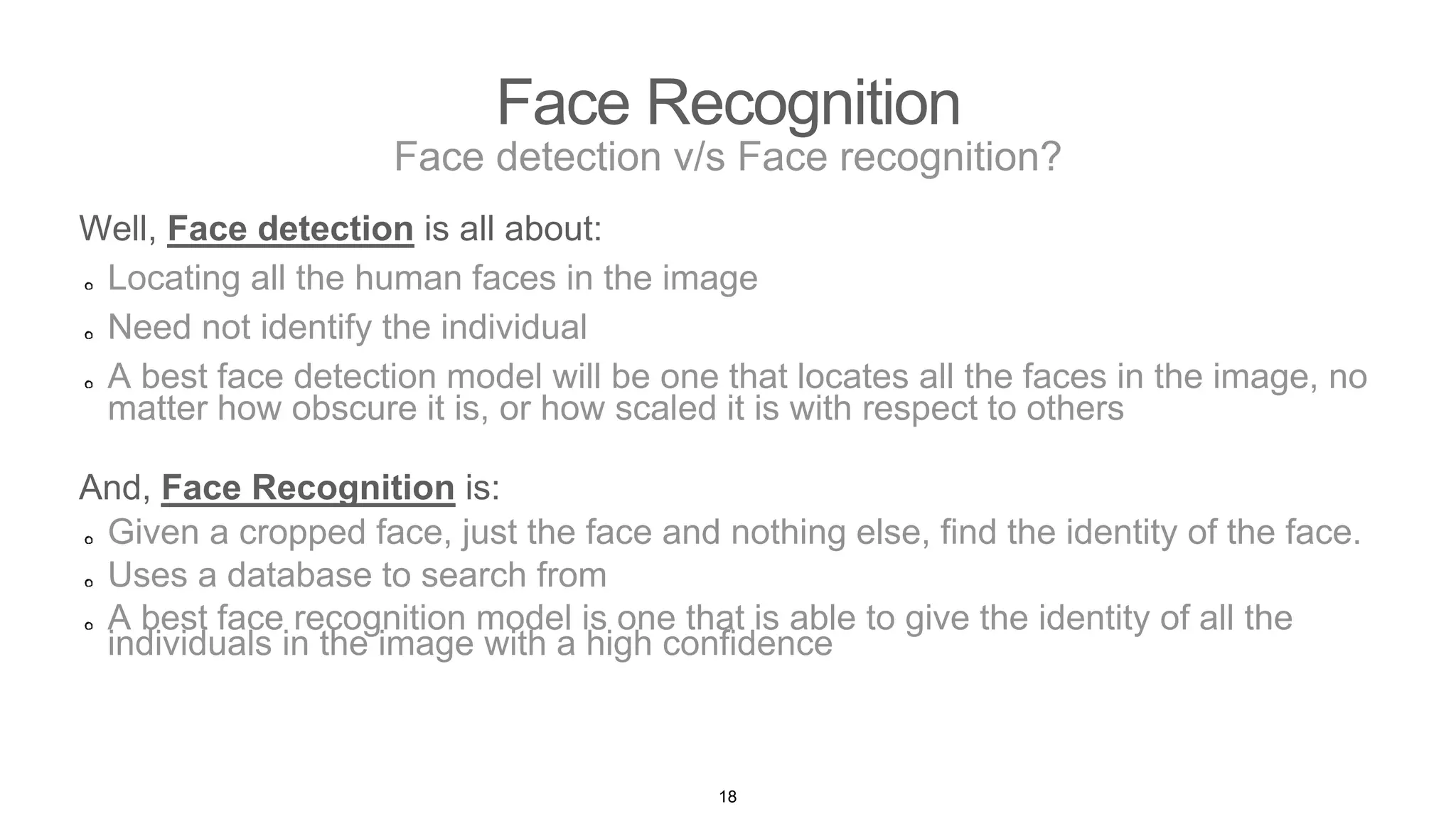
Face detection v/s Face recognition?
Well, Face detection is all about:
Locating all the human faces in the image
Need not identify the individual
A best face detection model will be one that locates all the faces in the image, no
matter how obscure it is, or how scaled it is with respect to others
And, Face Recognition is:
Given a cropped face, just the face and nothing else, find the identity of the face.
Uses a database to search from
A best face recognition model is one that is able to give the identity of all the
individuals in the image with a high confidence
18
Face Recognition
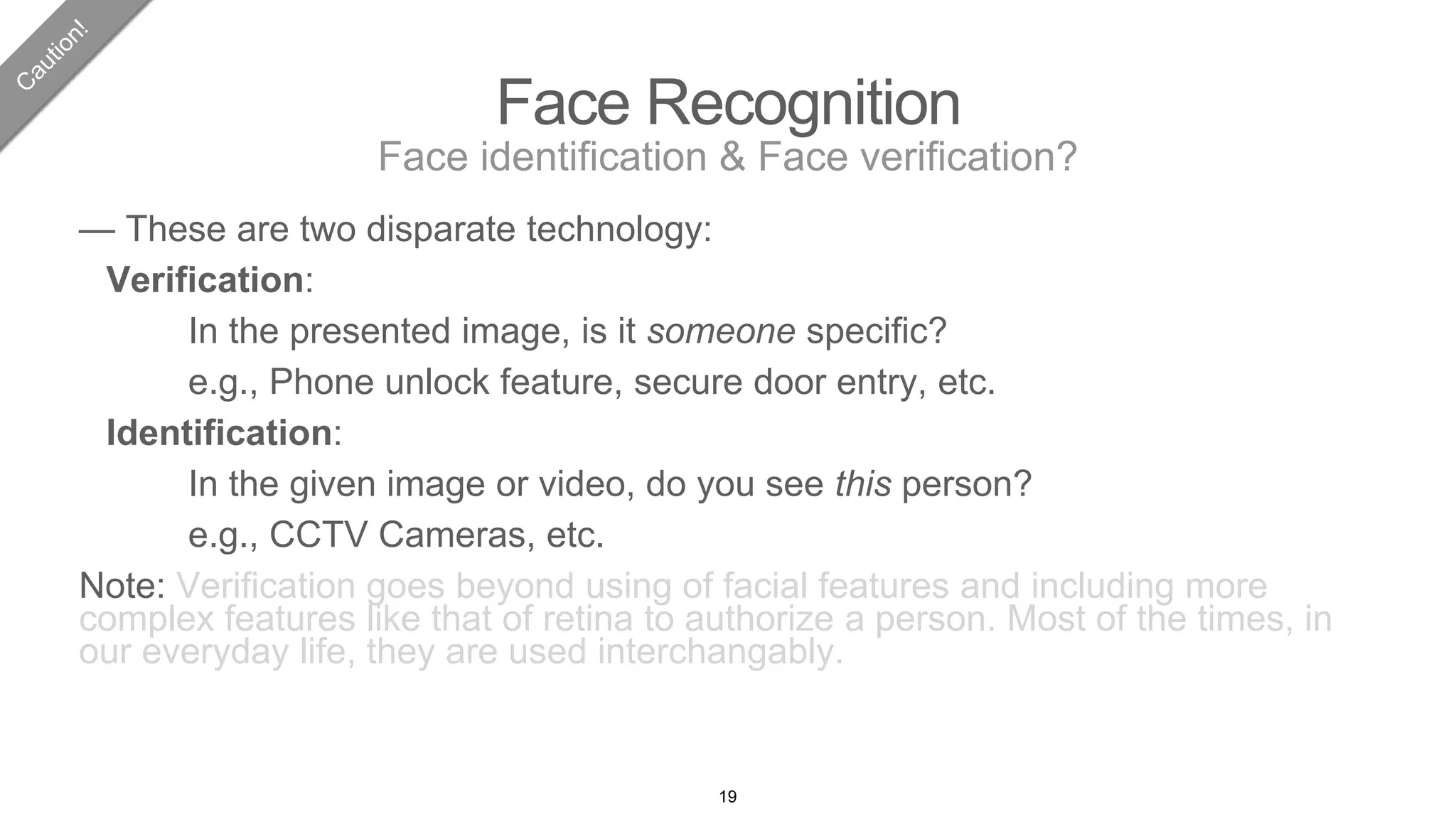
Face identification & Face verification?
— These are two disparate technology:
Verification:
In the presented image, is it someone specific?
e.g., Phone unlock feature, secure door entry, etc.
Identification:
In the given image or video, do you see this person?
e.g., CCTV Cameras, etc.
Note: Verification goes beyond using of facial features and including more
complex features like that of retina to authorize a person. Most of the times, in
our everyday life, they are used interchangably.
19
Please about this webinar using #TechTalkWithAashish
@AashishLChaubey
20

Face Recognition - Deep Learning

  • 1.
    Unlocking the futurewith Deep Learning 1
  • 2.
    — Graduate -B. Tech. Computer Science & Engineering - 2018 — Data Scientist EdTech and Healthcare — Hackathon Enthusiast @AashishLChaubey chaubey.aashish https://aashishchaubey.com chaubey.aashish@gmail.com
  • 3.
    ACLDigital Design led DigitalExperience, Product Innovation, Solutions, and Consulting Offering Leader an Alten group company
  • 4.
    Building Foundation Neural Networks DeepLearning Face Recognition Demonstration Interactive Session Q&A’s Agenda
  • 5.
    What are NeuralNetworks? 5
  • 6.
    Neural Networks What isa neural network? — Definition Neural Networks reflect the behaviour of the human brain, allowing computer programs to recognise patterns and solve common problems in the field of AI, machine learning, and deep learning. Cool, but how do we represent this in computers? Neuron Dendrites Nucleus Axon Axon Terminus Impulse carried towards cell body w1 w2 w3 x1 x2 x3 Σ ƒ Sum Activation Function Output Σ wixi + bias = w1x1 + w2x2 + … + bias i=1 m
  • 7.
    Neural Networks What areneural networks? — Subset of machine learning and at the heart of deep learning algorithms Output Layer Input Layer Hidden Layers — Comprised of nodes and layers (two or more) — Relies on training data to learn and improve their accuracy over time — Identified as non-linear model type as a part of machine learning algorithms — Think of each individual node as its own linear regression model Σ wixi + bias = w1x1 + w2x2 + … + bias i=1 m — Most NN’s are feedforward. However, you can also train your model through back propagation
  • 8.
    Then, what isDeep Learning? 8
  • 9.
    Deep Learning What isdeep learning? — Definition Deep learning attempts to mimic the human brain - albeit far from matching its ability - enabling systems to cluster data and make predictions/inference with incredible accuracy. — Essentially a neural network with three or more layers. — A deep learning algorithms is typically used to train on unstructured data like text, audio, video, image, besides complex and large tabular data. — Uses “Backpropagation” algorithm to optimise the parameter of the network on the given data — Non-linear, hierarchical, abstract representations of data — Used in areas such as Speech, Vision, NLP, Generative, amongst others.
  • 10.
    Deep Learning Convolutional NeuralNetwork • Specific type of neural network used generally when working with vision based data, e.g., images and videos. • CNN is just one type of Deep Neural Network. • Reduce number of weights required for training. • Use filter to capture local information • More meaningful search, move from pixel recognition to pattern recognition • In mathematics, a convolution is the integral function measuring how much two functions overlap as one passesover the other.
  • 11.
    Deep Learning Convolutional NeuralNetwork Original image: function f Filter: function g Image convolution: f * g
  • 12.
  • 13.
    Deep Learning &Neural Networks — They are generally used interchangeably, which is confusing, and it is not! — “Deep” in Deep Learning is just referring to the depth of layers in a neural network. — A neural network which consists of more than three layers - including both the input and the output - can be considered a deep learning algorithms. — Consequently, a neural network that only has two or three layers is just a basic neural network. — However, it must be noted that Neural Networks (ANN) is a part of machine learning algorithms and Deep Learning is a subset of it.
  • 14.
    What is FaceRecognition? 14
  • 15.
    Face Recognition What isRecognition? — Let’s first understand the taxonomy of different keywords: Detection: What kind of object(s) is (are) present? Recognition: What is this particular object? 15 — Wikipedia Definition A facial recognition system is a technology capable of matching a human face from a digital image or a video frame against a database of faces, typically employed to authenticate users through ID verification services, works by pinpointing and measuring facial features from a given image. Done as a part of Physiological biometrics
  • 16.
    Face Recognition How doesit work? 16 Capturing Extracting Comparing Matching Locate the users face in the image and delimit it with a bounding box Face Detection Make a face match with a database of vectors representing the visual features of the stored image Face Recognition Extract features from the face that can be used for the recognition task Visual Feature Extraction
  • 17.
    Face Recognition Steps involved… Step1 Detect all the faces Use some kind of a detector for detecting the faces in the image Step 2 Identify all the faces Apply the same model on which we trained for fixed set of identities The model is trained on a fixed set of identities - extracting the facial features of each face and encoding it. They are plotted in some kind of a feature space
  • 18.
    Face Recognition Face detectionv/s Face recognition? Well, Face detection is all about: Locating all the human faces in the image Need not identify the individual A best face detection model will be one that locates all the faces in the image, no matter how obscure it is, or how scaled it is with respect to others And, Face Recognition is: Given a cropped face, just the face and nothing else, find the identity of the face. Uses a database to search from A best face recognition model is one that is able to give the identity of all the individuals in the image with a high confidence 18
  • 19.
    Face Recognition Face identification& Face verification? — These are two disparate technology: Verification: In the presented image, is it someone specific? e.g., Phone unlock feature, secure door entry, etc. Identification: In the given image or video, do you see this person? e.g., CCTV Cameras, etc. Note: Verification goes beyond using of facial features and including more complex features like that of retina to authorize a person. Most of the times, in our everyday life, they are used interchangably. 19
  • 20.
    Please about thiswebinar using #TechTalkWithAashish @AashishLChaubey 20

Editor's Notes

  • #8 Talk about nodes, connections, weights and biases, also about the ____ function used to changed the output from the output neuron Talk about the types of neural networks Perceptrons Mutli-Layer Perceptrons (MLPs) Feedforward neural network Convolutional Neural Networks (CNNs) Recurrent Neural Networks (RNNs)