Facial Expression Recognition
(FER) using Deep Learning
Emmeline Tsen
Medium article: https://medium.com/@emmelinetsen/facial-expression-recognition-using-deep-learning-
3ec1d7426604?sk=72c845275071df13dccc97bd07a73830
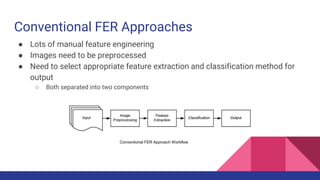
Conventional FER Approaches
● Lots of manual feature engineering
● Images need to be preprocessed
● Need to select appropriate feature extraction and classification method for
output
○ Both separated into two components
Conventional FER Approach Workflow
Deep Learning Approaches
● More dependent on data and hardware
● More robust to its environments
● Three proposed ways for FER
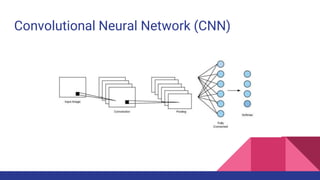
○ Convolutional Neural Network (CNN)
○ Long Short Term Memory (LSTM)
○ Generative Adversarial Network (GAN)
Convolutional Neural Network (CNN)
Long Short Term Memory (LSTM)
● Recurrent neural network (RNN)
● Extracts temporal features within consecutive frames
● Recommended for video sequences
Generative Adversarial Network (GAN)
● Consists of a generative network and discriminative network
● Generates images
● Synthesizes facial images to make them look realistic
● Able to increase FER training dataset
○ Automatically generating images
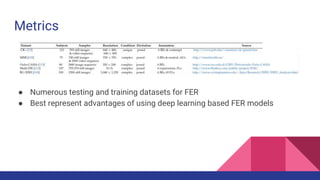
Metrics
● Numerous testing and training datasets for FER
● Best represent advantages of using deep learning based FER models
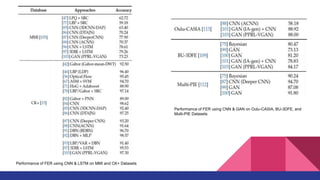
Performance of FER using CNN & LSTM on MMI and CK+ Datasets
Performance of FER using CNN & GAN on Oulu-CASIA, BU-3DFE, and
Multi-PIE Datasets
Final Thoughts
● FER has been receiving a lot of attention
● Different approaches of FER
● There are still challenges & lots of opportunities to evaluate different
algorithms
References
● Huang, Y., Chen, F., Lv, S., & Wang, X. (2019, September 20). Facial Expression Recognition: A Survey. Retrieved May 8, 2020,
from https://www.mdpi.com/2073-8994/11/10/1189
● Divya, M., Reddy, R. O., & Raghavendra, C. (2019). Effective Facial Emotion Recognition using Convolutional Neural Network
Algorithm. International Journal of Recent Technology and Engineering Regular Issue, 8(4), 4351–4354.
doi:10.35940/ijrte.d8275.118419
● Amidi, A., & Amidi, S. (n.d.). Convolutional Neural Networks cheatsheet Star. Retrieved May 8, 2020, from
https://stanford.edu/~shervine/teaching/cs-230/cheatsheet-convolutional-neural-networks

Facial Expression Recognition (FER) using Deep Learning

  • 1.
    Facial Expression Recognition (FER)using Deep Learning Emmeline Tsen Medium article: https://medium.com/@emmelinetsen/facial-expression-recognition-using-deep-learning- 3ec1d7426604?sk=72c845275071df13dccc97bd07a73830
  • 2.
    Conventional FER Approaches ●Lots of manual feature engineering ● Images need to be preprocessed ● Need to select appropriate feature extraction and classification method for output ○ Both separated into two components Conventional FER Approach Workflow
  • 3.
    Deep Learning Approaches ●More dependent on data and hardware ● More robust to its environments ● Three proposed ways for FER ○ Convolutional Neural Network (CNN) ○ Long Short Term Memory (LSTM) ○ Generative Adversarial Network (GAN)
  • 4.
  • 5.
    Long Short TermMemory (LSTM) ● Recurrent neural network (RNN) ● Extracts temporal features within consecutive frames ● Recommended for video sequences
  • 6.
    Generative Adversarial Network(GAN) ● Consists of a generative network and discriminative network ● Generates images ● Synthesizes facial images to make them look realistic ● Able to increase FER training dataset ○ Automatically generating images
  • 7.
    Metrics ● Numerous testingand training datasets for FER ● Best represent advantages of using deep learning based FER models
  • 8.
    Performance of FERusing CNN & LSTM on MMI and CK+ Datasets Performance of FER using CNN & GAN on Oulu-CASIA, BU-3DFE, and Multi-PIE Datasets
  • 9.
    Final Thoughts ● FERhas been receiving a lot of attention ● Different approaches of FER ● There are still challenges & lots of opportunities to evaluate different algorithms
  • 10.
    References ● Huang, Y.,Chen, F., Lv, S., & Wang, X. (2019, September 20). Facial Expression Recognition: A Survey. Retrieved May 8, 2020, from https://www.mdpi.com/2073-8994/11/10/1189 ● Divya, M., Reddy, R. O., & Raghavendra, C. (2019). Effective Facial Emotion Recognition using Convolutional Neural Network Algorithm. International Journal of Recent Technology and Engineering Regular Issue, 8(4), 4351–4354. doi:10.35940/ijrte.d8275.118419 ● Amidi, A., & Amidi, S. (n.d.). Convolutional Neural Networks cheatsheet Star. Retrieved May 8, 2020, from https://stanford.edu/~shervine/teaching/cs-230/cheatsheet-convolutional-neural-networks