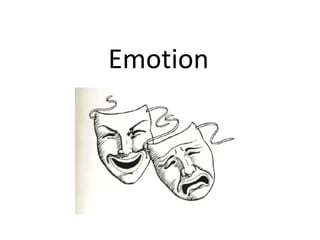
Emotion
–Subjective
–Physiological
–Behavioral
–Social
Aspects of Emotion
Components of Emotion
Cognitive component
• subjective conscious feelings—thoughts,
values and expectations
Components of Emotion
Physiological (arousal) component
• controlled by certain brain structures and
autonomic nervous system
“Fight or Flight” Restore Calm
Components of Emotion
Behavioural component
(emotional expression—facial expressions,
gestures, body position, use of eye gaze, touch
and tone of voice)
• Why do we feel emotion?
• What purpose does it serve?
• Are humans the only animals that feel
emotion?
• How many emotions are there?
James-Lange Theory
• A stimulus directly produces physiological
changes and behavior, and then these events
produce the feeling of an emotion.
stimulus
Physiological
response
Emotion
James-Lange Theory
• Smiling makes you feel happy
• Crying makes you feel sad
Class experiment
Hold a pen/pencil in your mouth
Group 1: hold pen with lips
Group 2: hold pen with teeth
Group 3: hold pen in
non-dominant hand
Rate the following cartoons for the
level of humour 1 – 5
1 not humourous
2 a bit humourous
3 moderately humourous
4 very humourous
5 extremely humourous
Facial Feedback Hypothesis
• Facial feedback is interpreted by the brain as
being a certain emotion.
• Once an emotion is activated, the
whole body becomes aroused.
• Arousal and external stimuli maintain the
emotion after facial feedback initiates it.
Facial Feedback Hypothesis:
The modern version of James-Lange theory
Facial
expressions
Emotional
experience
Passive Facial Feedback
Participants and apparatus (do not note)
One hundred and eight-nine Japanese
undergraduates (101 males and 88
females) participated.
One hundred and thirteen were
assigned to the experimental condition,
and 76 to the control condition.
Small plastic pipettes
and warmed water
were used.
Method
Water dripped on the
participants cheeks or
temples.
Then, the raters rated
their subjective emotion
on a seven point scale.
Experimental
Condition
Control
Condition
0
10
20
30
40
50
Sad Neutral Cheerful Mixed
Cheeks
Temples
Water dropping on the cheeks tended to cause the
sad emotion more often than the cheerfulness.
Cannon-Bard Theory
Theory in which the physiological reaction and
the emotion occur at the same time.
Stimulus
Emotion
Physiological
Response
Theory of Cognitive Appraisal
(Schachter-Singer 2 factor theory of
emotion)
A two-stage theory stating that for an
emotion to occur, there must be
1.physiological arousal and
2.an explanation for the arousal
Two key variables manipulated-
1. Arousal
2. Emotional Explanation for the Arousal were the two
• Participants injected with “suproxin”
– Placebo or Epinephrine
– Participants either informed or misinformed about the
effects of the drug
• Confederate acted angry or euphoric
Schachter and Singer (1962)
Experiment
Epinephrine uninformed more angry/happy than
informed because they attributed their arousal
(which was drug induced) to the situation.
• Implication:
Emotions are somewhat arbitrary, depending on
what the most plausible explanation for the
arousal happens to be.
Evaluation of Emotion Theories
Emotional responses vary more than any one
theory allows depending on the situation.
Currently no emotional theory is accepted as
completely correct .
Three Ways to Measure Emotion
1. Body/Physical
2. Thoughts
3. Behavior
Culture and Emotional Expression
Basic emotions are similar
Social rules about display of emotions vary
from culture to culture eg Japanese vs
Italian
Three Ways to Measure Emotion
• Body/Physical
– blood pressure
– heart rate
– epinephrine levels
– muscle activity when smiling, frowning, etc.
– neural images
– posture
– tears,
– perspiration
– lie detector readings
Three Ways to Measure Emotion
• Thoughts (observed indirectly through)
– spoken and written words on rating scales
– answers to open-ended questions on surveys and
during interviews
– self-assessments or perceptions regarding the
behavior and intentions of others
– other cognitive operations such as rational/logical
thinking
Three Ways to Measure Emotion
• Behavior
– facial expressions
– activity level
– alertness
– screaming
– laughing
– smiling
– aggression
– approach/avoidance
– attention/distraction
– insomnia
Ethical Issues of Polygraphs
• Lie detectors only 75% reliable
• Some people better at hiding facial/body
expression of emotion
Overview of General Theories of Emotion
• James-Lange Theory (arousal and expression
produce emotion)
• ii. Cannon-Bard Theory (cognitions, arousal
and expression are simultaneous)
• iii. Facial-Feedback Hypothesis (expression
produces emotion)
• iv. Schachter’s Two-Factor Theory (emotions
depend on 2 factors—physical arousal and
cognitive labelling of that arousal)
Ms Collins Psychology Class Semester 2 2009
Facial Feedback Experiment
Results show that facial expression has an affect on how
humorous a participant found a series of cartoons.
3.1
3.2
3.3
3.4
3.5
3.6
3.7
3.8
3.9
4.0
Frown Group Control Group Smile Group

Emotion annesley 2010

  • 1.
  • 3.
  • 4.
    Components of Emotion Cognitivecomponent • subjective conscious feelings—thoughts, values and expectations
  • 5.
    Components of Emotion Physiological(arousal) component • controlled by certain brain structures and autonomic nervous system
  • 6.
  • 7.
    Components of Emotion Behaviouralcomponent (emotional expression—facial expressions, gestures, body position, use of eye gaze, touch and tone of voice)
  • 8.
    • Why dowe feel emotion? • What purpose does it serve? • Are humans the only animals that feel emotion? • How many emotions are there?
  • 9.
    James-Lange Theory • Astimulus directly produces physiological changes and behavior, and then these events produce the feeling of an emotion. stimulus Physiological response Emotion
  • 10.
    James-Lange Theory • Smilingmakes you feel happy • Crying makes you feel sad
  • 11.
    Class experiment Hold apen/pencil in your mouth Group 1: hold pen with lips Group 2: hold pen with teeth Group 3: hold pen in non-dominant hand
  • 12.
    Rate the followingcartoons for the level of humour 1 – 5 1 not humourous 2 a bit humourous 3 moderately humourous 4 very humourous 5 extremely humourous
  • 17.
    Facial Feedback Hypothesis •Facial feedback is interpreted by the brain as being a certain emotion. • Once an emotion is activated, the whole body becomes aroused. • Arousal and external stimuli maintain the emotion after facial feedback initiates it.
  • 18.
    Facial Feedback Hypothesis: Themodern version of James-Lange theory Facial expressions Emotional experience
  • 19.
    Passive Facial Feedback Participantsand apparatus (do not note) One hundred and eight-nine Japanese undergraduates (101 males and 88 females) participated. One hundred and thirteen were assigned to the experimental condition, and 76 to the control condition. Small plastic pipettes and warmed water were used.
  • 20.
    Method Water dripped onthe participants cheeks or temples. Then, the raters rated their subjective emotion on a seven point scale. Experimental Condition Control Condition
  • 21.
    0 10 20 30 40 50 Sad Neutral CheerfulMixed Cheeks Temples Water dropping on the cheeks tended to cause the sad emotion more often than the cheerfulness.
  • 22.
    Cannon-Bard Theory Theory inwhich the physiological reaction and the emotion occur at the same time. Stimulus Emotion Physiological Response
  • 23.
    Theory of CognitiveAppraisal (Schachter-Singer 2 factor theory of emotion) A two-stage theory stating that for an emotion to occur, there must be 1.physiological arousal and 2.an explanation for the arousal
  • 24.
    Two key variablesmanipulated- 1. Arousal 2. Emotional Explanation for the Arousal were the two • Participants injected with “suproxin” – Placebo or Epinephrine – Participants either informed or misinformed about the effects of the drug • Confederate acted angry or euphoric Schachter and Singer (1962) Experiment
  • 26.
    Epinephrine uninformed moreangry/happy than informed because they attributed their arousal (which was drug induced) to the situation. • Implication: Emotions are somewhat arbitrary, depending on what the most plausible explanation for the arousal happens to be.
  • 27.
    Evaluation of EmotionTheories Emotional responses vary more than any one theory allows depending on the situation. Currently no emotional theory is accepted as completely correct .
  • 28.
    Three Ways toMeasure Emotion 1. Body/Physical 2. Thoughts 3. Behavior
  • 29.
    Culture and EmotionalExpression Basic emotions are similar Social rules about display of emotions vary from culture to culture eg Japanese vs Italian
  • 30.
    Three Ways toMeasure Emotion • Body/Physical – blood pressure – heart rate – epinephrine levels – muscle activity when smiling, frowning, etc. – neural images – posture – tears, – perspiration – lie detector readings
  • 31.
    Three Ways toMeasure Emotion • Thoughts (observed indirectly through) – spoken and written words on rating scales – answers to open-ended questions on surveys and during interviews – self-assessments or perceptions regarding the behavior and intentions of others – other cognitive operations such as rational/logical thinking
  • 32.
    Three Ways toMeasure Emotion • Behavior – facial expressions – activity level – alertness – screaming – laughing – smiling – aggression – approach/avoidance – attention/distraction – insomnia
  • 33.
    Ethical Issues ofPolygraphs • Lie detectors only 75% reliable • Some people better at hiding facial/body expression of emotion
  • 34.
    Overview of GeneralTheories of Emotion • James-Lange Theory (arousal and expression produce emotion) • ii. Cannon-Bard Theory (cognitions, arousal and expression are simultaneous) • iii. Facial-Feedback Hypothesis (expression produces emotion) • iv. Schachter’s Two-Factor Theory (emotions depend on 2 factors—physical arousal and cognitive labelling of that arousal)
  • 35.
    Ms Collins PsychologyClass Semester 2 2009 Facial Feedback Experiment Results show that facial expression has an affect on how humorous a participant found a series of cartoons. 3.1 3.2 3.3 3.4 3.5 3.6 3.7 3.8 3.9 4.0 Frown Group Control Group Smile Group