EMOTION AND
MOODS
NAME OR LOGO
WHAT WILL WE
LEARN?
2
Differentiate between emotions and moods
Identify the sources of emotions and
moods
Show the impact emotional labor has on
employees
Describe affective events theory
Describe emotional intelligence
Identify strategies for emotion regulation
Apply concepts about emotions and moods
to spesific OB issues
NAME OR LOGO
WHAT ARE EMOTIONS AND MOODS?
3
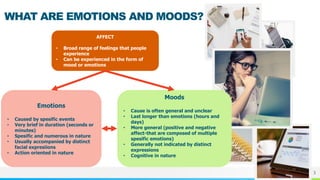
AFFECT
• Broad range of feelings that people
experience
• Can be experienced in the form of
mood or emotions
Emotions
• Caused by spesific events
• Very brief in duration (seconds or
minutes)
• Spesific and numerous in nature
• Usually accompanied by distinct
facial expresiions
• Action oriented in nature
Moods
• Cause is often general and unclear
• Last longer than emotions (hours and
days)
• More general (positive and negative
affect-that are composed of multiple
spesific emotions)
• Generally not indicated by distinct
expressions
• Cognitive in nature
NAME OR LOGO
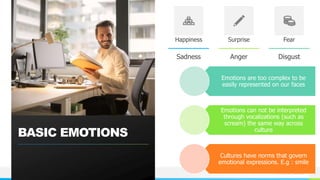
BASIC EMOTIONS
Happiness
Sadness
Surprise
Anger
Fear
Disgust
4
Emotions are too complex to be
easily represented on our faces
Emotions can not be interpreted
through vocalizations (such as
scream) the same way across
culture
Cultures have norms that govern
emotional expressions. E.g : smile
NAME OR LOGO
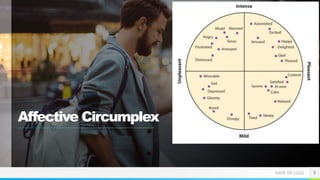
Affective Circumplex
5
NAME OR LOGO
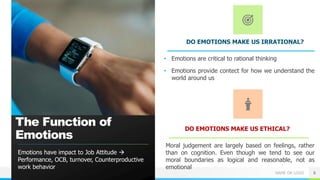
The Function of
Emotions
Emotions have impact to Job Attitude 
Performance, OCB, turnover, Counterproductive
work behavior
DO EMOTIONS MAKE US IRRATIONAL?
• Emotions are critical to rational thinking
• Emotions provide contect for how we understand the
world around us
DO EMOTIONS MAKE US ETHICAL?
Moral judgement are largely based on feelings, rather
than on cognition. Even though we tend to see our
moral boundaries as logical and reasonable, not as
emotional
6
NAME OR LOGO
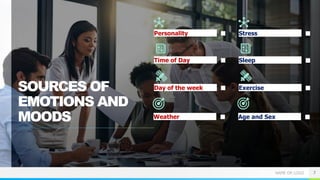
SOURCES OF
EMOTIONS AND
MOODS
7
Personality
Time of Day
Day of the week
Weather
Stress
Sleep
Exercise
Age and Sex
NAME OR LOGO
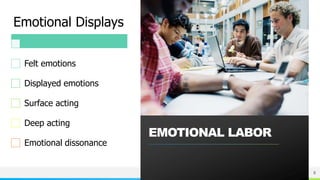
EMOTIONAL LABOR
8
Emotional Displays
Felt emotions
Displayed emotions
Surface acting
Deep acting
Emotional dissonance
NAME OR LOGO 9
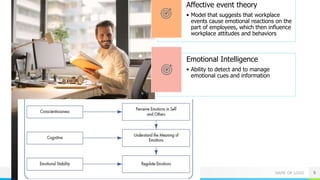
Affective event theory
• Model that suggests that workplace
events cause emotional reactions on the
part of employees, which then influence
workplace attitudes and behaviors
Emotional Intelligence
• Ability to detect and to manage
emotional cues and information
NAME OR LOGO
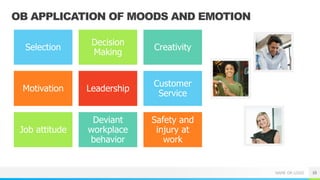
OB APPLICATION OF MOODS AND EMOTION
10
Selection
Decision
Making
Creativity
Motivation Leadership
Customer
Service
Job attitude
Deviant
workplace
behavior
Safety and
injury at
work
Thank
You
Faizatul Hiqmah
faizatul@perbanas.ac.id

Emotion and moods

  • 1.
  • 2.
    NAME OR LOGO WHATWILL WE LEARN? 2 Differentiate between emotions and moods Identify the sources of emotions and moods Show the impact emotional labor has on employees Describe affective events theory Describe emotional intelligence Identify strategies for emotion regulation Apply concepts about emotions and moods to spesific OB issues
  • 3.
    NAME OR LOGO WHATARE EMOTIONS AND MOODS? 3 AFFECT • Broad range of feelings that people experience • Can be experienced in the form of mood or emotions Emotions • Caused by spesific events • Very brief in duration (seconds or minutes) • Spesific and numerous in nature • Usually accompanied by distinct facial expresiions • Action oriented in nature Moods • Cause is often general and unclear • Last longer than emotions (hours and days) • More general (positive and negative affect-that are composed of multiple spesific emotions) • Generally not indicated by distinct expressions • Cognitive in nature
  • 4.
    NAME OR LOGO BASICEMOTIONS Happiness Sadness Surprise Anger Fear Disgust 4 Emotions are too complex to be easily represented on our faces Emotions can not be interpreted through vocalizations (such as scream) the same way across culture Cultures have norms that govern emotional expressions. E.g : smile
  • 5.
  • 6.
    NAME OR LOGO TheFunction of Emotions Emotions have impact to Job Attitude  Performance, OCB, turnover, Counterproductive work behavior DO EMOTIONS MAKE US IRRATIONAL? • Emotions are critical to rational thinking • Emotions provide contect for how we understand the world around us DO EMOTIONS MAKE US ETHICAL? Moral judgement are largely based on feelings, rather than on cognition. Even though we tend to see our moral boundaries as logical and reasonable, not as emotional 6
  • 7.
    NAME OR LOGO SOURCESOF EMOTIONS AND MOODS 7 Personality Time of Day Day of the week Weather Stress Sleep Exercise Age and Sex
  • 8.
    NAME OR LOGO EMOTIONALLABOR 8 Emotional Displays Felt emotions Displayed emotions Surface acting Deep acting Emotional dissonance
  • 9.
    NAME OR LOGO9 Affective event theory • Model that suggests that workplace events cause emotional reactions on the part of employees, which then influence workplace attitudes and behaviors Emotional Intelligence • Ability to detect and to manage emotional cues and information
  • 10.
    NAME OR LOGO OBAPPLICATION OF MOODS AND EMOTION 10 Selection Decision Making Creativity Motivation Leadership Customer Service Job attitude Deviant workplace behavior Safety and injury at work
  • 11.