Teaching Reading
Sudarmono
157835053
English Master Program
Point to discuss
• Introduction
• Research on Reading A second Language
• Types of Written Language
• Characteristics of Written Language
• Strategies for Reading Comprehension
• Types of Classroom Reading Performance
• Principles for Designing Interactive Reading
Techniques
Introduction
• Reading ability will be developed best in
association with writing, listening, and
speaking.
• Even in those courses that may be labeled
“reading,” your goals will be best achieved by
capitalizing on the interrelationship of skills,
especially the reading-writing connection.
Research on Reading A second
Language
1. Bottom-up and Top-down processing
A combination of both processes is called interactive
reading, is almost always a primary ingredient &
important ingredient in successful teaching
methodology
2. Schema theory & Background knowledge
The hallmark of which is that a text does not by itself
carry meaning. Readers bring information,
knowledge, emotion, experience and culture.
Schemata is plural.
Cont.
3. The role of affect and culture
Reading is subject to variability the affective domain. Culture
plays an active role in motivating and rewarding people for
literacy.
4. The power of extensive reading
A key to student gains in reading ability, linguistics competence,
vocabulary, spelling, and writing
5. Adult literacy training
Methods continue to apply both bottom-up (skill-based) and
top-down (strategies-based)
Types of Written Language
• A genre of written language. there are literally
hundreds of different types of written texts.
• Non-fiction (report, dictionary, essay, article)
• Fiction (novel, shirt stories, jokes, drama)
• Academic writing
• Journals
• Memos
• Ads and etc
Characteristics of Written
Language
1. Permanence
Such as paper and computer disks
2. Processing time
A corollary is the processing time, is time-conscious
society, which is good or bad news.
3. Distance
Two dimensions: physical distance and temporal
distance. It was written in some other place at
some other time.
Cont.
4. Orthography
Writing’s graphemes. Readers must do their
best to infer, to interpret, and to “read between
the lines.”
5. Complexity
Writing is more complex than speech. It has
longer clauses and more subordination.
Cont.
6. Vocabulary
Written English utilizes a greater of variety of
lexical items. Learners should refrain from the
frequent use of a bilingual dictionary.
7. Formality
Writing is quite formal frequently more formal
than speech. Formality refers to prescribed
forms.
Strategies for Reading
Comprehension
1. Identify the purpose of reading
Make sure the students know their purpose in
reading something
2. Use graphemic rules and patterns to aid in
bottom-up decoding (especially for beginning
level learners). One of difficulties students
encounter in learning to read is making
correspondence between spoken and written
English.
3.
Cont.
3. Use efficient silent reading techniques for
relatively rapid comprehension (for
intermediate to advanced levels). Academic
reading, for example, is something most
learners manage to accomplish the material.
4. Skim the text for main ideas
It consists of quickly running one’s eye across a
whole text.
Cont.
5. Scan the text for specific information
It is quickly searching for some particular piece
of information in a text. such as looking for
names, dates, definition, and key concept.
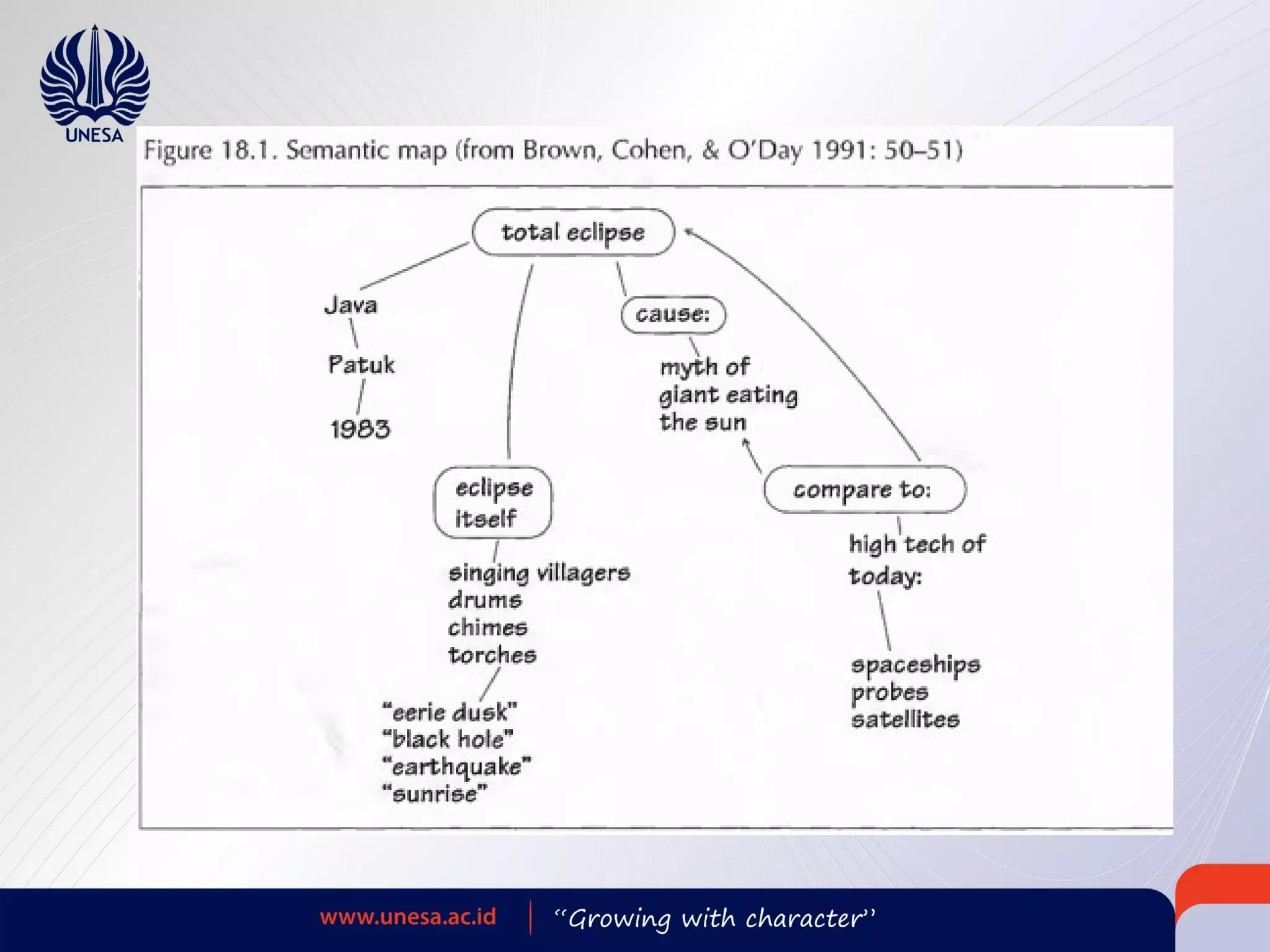
6. Use semantic mapping or clustering
The strategy of semantic mapping or grouping
ideas into meaningful clusters helps reader to
provide some order to the chaos.
Cont.
7. Guess when you aren’t certain
The key to successful guessing is to make it
reasonably accurate. They fill in the gaps in their
competence by intelligent attempts to use
whatever clues.
8. Analyze Vocabulary
One way for learners to make guessing pay off.
Cont.
9. Distinguish between literal and implied
meanings
Literal meaning is syntactically surface structure.
Implied meaning is derived from pragmatics
information.
10. Capitalize on discourse markers to process
relationships. English signal relationships among
ideas as expressed through phrases, clauses,
and sentences.
Types of Classroom Reading
Performance
Cont.
1. Oral and Silent reading
2. Intensive and Extensive reading
Intensive reading, analogous to intensive listening
which students focus on the linguistic or
semantic details of a passage.
Extensive reading is carried out to achieve a general
understanding of a usually somewhat longer
text such as pleasure reading (book, long article,
essays, etc)
Principles for Designing Interactive Reading
Techniques
1. In an interactive curriculum, make sure that
you don’t overlook the importance of specific
instruction in reading skills.
2. Use techniques that are intrinsically
motivating. When students create their own
material for reading and select reading
material offer
3. Balance authenticity and readability in
choosing texts
Cont.
4. Encourage the development of reading
strategies
5. Include both bottom-up and top-down
techniques
6. Follow the “SQ3R”
-Survey: skim the text
-Question: ask question
-Read: read the text
Cont.
- Recite: reprocess the salient points of the text
- Review: assess the importance of what one
has just read
7. Subdivide your technique into pre-reading,
during reading, and after-reading phases.
8. Build in some evaluative aspect to your
techniques.
Any comments or questions?
Thank You
For Your
Attention

Teaching Reading

  • 1.
  • 2.
    Point to discuss •Introduction • Research on Reading A second Language • Types of Written Language • Characteristics of Written Language • Strategies for Reading Comprehension • Types of Classroom Reading Performance • Principles for Designing Interactive Reading Techniques
  • 3.
    Introduction • Reading abilitywill be developed best in association with writing, listening, and speaking. • Even in those courses that may be labeled “reading,” your goals will be best achieved by capitalizing on the interrelationship of skills, especially the reading-writing connection.
  • 4.
    Research on ReadingA second Language 1. Bottom-up and Top-down processing A combination of both processes is called interactive reading, is almost always a primary ingredient & important ingredient in successful teaching methodology 2. Schema theory & Background knowledge The hallmark of which is that a text does not by itself carry meaning. Readers bring information, knowledge, emotion, experience and culture. Schemata is plural.
  • 5.
    Cont. 3. The roleof affect and culture Reading is subject to variability the affective domain. Culture plays an active role in motivating and rewarding people for literacy. 4. The power of extensive reading A key to student gains in reading ability, linguistics competence, vocabulary, spelling, and writing 5. Adult literacy training Methods continue to apply both bottom-up (skill-based) and top-down (strategies-based)
  • 6.
    Types of WrittenLanguage • A genre of written language. there are literally hundreds of different types of written texts. • Non-fiction (report, dictionary, essay, article) • Fiction (novel, shirt stories, jokes, drama) • Academic writing • Journals • Memos • Ads and etc
  • 7.
    Characteristics of Written Language 1.Permanence Such as paper and computer disks 2. Processing time A corollary is the processing time, is time-conscious society, which is good or bad news. 3. Distance Two dimensions: physical distance and temporal distance. It was written in some other place at some other time.
  • 8.
    Cont. 4. Orthography Writing’s graphemes.Readers must do their best to infer, to interpret, and to “read between the lines.” 5. Complexity Writing is more complex than speech. It has longer clauses and more subordination.
  • 9.
    Cont. 6. Vocabulary Written Englishutilizes a greater of variety of lexical items. Learners should refrain from the frequent use of a bilingual dictionary. 7. Formality Writing is quite formal frequently more formal than speech. Formality refers to prescribed forms.
  • 10.
    Strategies for Reading Comprehension 1.Identify the purpose of reading Make sure the students know their purpose in reading something 2. Use graphemic rules and patterns to aid in bottom-up decoding (especially for beginning level learners). One of difficulties students encounter in learning to read is making correspondence between spoken and written English. 3.
  • 11.
    Cont. 3. Use efficientsilent reading techniques for relatively rapid comprehension (for intermediate to advanced levels). Academic reading, for example, is something most learners manage to accomplish the material. 4. Skim the text for main ideas It consists of quickly running one’s eye across a whole text.
  • 12.
    Cont. 5. Scan thetext for specific information It is quickly searching for some particular piece of information in a text. such as looking for names, dates, definition, and key concept. 6. Use semantic mapping or clustering The strategy of semantic mapping or grouping ideas into meaningful clusters helps reader to provide some order to the chaos.
  • 14.
    Cont. 7. Guess whenyou aren’t certain The key to successful guessing is to make it reasonably accurate. They fill in the gaps in their competence by intelligent attempts to use whatever clues. 8. Analyze Vocabulary One way for learners to make guessing pay off.
  • 15.
    Cont. 9. Distinguish betweenliteral and implied meanings Literal meaning is syntactically surface structure. Implied meaning is derived from pragmatics information. 10. Capitalize on discourse markers to process relationships. English signal relationships among ideas as expressed through phrases, clauses, and sentences.
  • 17.
    Types of ClassroomReading Performance
  • 18.
    Cont. 1. Oral andSilent reading 2. Intensive and Extensive reading Intensive reading, analogous to intensive listening which students focus on the linguistic or semantic details of a passage. Extensive reading is carried out to achieve a general understanding of a usually somewhat longer text such as pleasure reading (book, long article, essays, etc)
  • 19.
    Principles for DesigningInteractive Reading Techniques 1. In an interactive curriculum, make sure that you don’t overlook the importance of specific instruction in reading skills. 2. Use techniques that are intrinsically motivating. When students create their own material for reading and select reading material offer 3. Balance authenticity and readability in choosing texts
  • 20.
    Cont. 4. Encourage thedevelopment of reading strategies 5. Include both bottom-up and top-down techniques 6. Follow the “SQ3R” -Survey: skim the text -Question: ask question -Read: read the text
  • 21.
    Cont. - Recite: reprocessthe salient points of the text - Review: assess the importance of what one has just read 7. Subdivide your technique into pre-reading, during reading, and after-reading phases. 8. Build in some evaluative aspect to your techniques.
  • 22.
    Any comments orquestions? Thank You For Your Attention