Reading Comprehension Strategies: 
How to Activate Background Knowledge 
Presented By: 
Tri Ilma Septiana
What is Comprehension? 
• Literally, based on Longman Dictionary of Contemporary English (2001:369) the meaning 
of comprehension can be defined as “the ability to understand something”. 
• Tierney (1990) pointed out that comprehension as a creative or complex process in which 
children engage with and think about the text. 
• Judith Irwin (1991) defined comprehension as a reader’s process of using “prior 
knowledge” experience and the author’s text to construct meaning that’s useful to 
that reader for a specific purpose. 
• Successful reading  the Reader & the Text.
What Is Comprehension Strategies? 
• Comprehension strategies are thoughtful behaviors that readers use to facilitate their 
understanding. (Afflerbach, Pearson & Paris, 2008). 
• Readers apply these strategies to deepen their understanding, determine whether 
they’re comprehending successfully, and solve problems as they arise. 
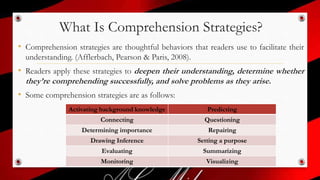
• Some comprehension strategies are as follows: 
Activating background knowledge Predicting 
Connecting Questioning 
Determining importance Repairing 
Drawing Inference Setting a purpose 
Evaluating Summarizing 
Monitoring Visualizing
The significance of activating background knowledge 
• Gail E. Tompkins (2011:202) emphasized that while reading, reader must 
activate background knowledge and think about what they’re reading; they 
apply cognitive and metacognitive strategies. 
• Van Den Broek & Kremer (2000) also stressed that the comprehension 
process is started when readers activate their background knowledge and it 
develops as they read aloud or listen and then respond to it. Readers 
construct a “mental picture” or representation of the text through the 
comprehension text.
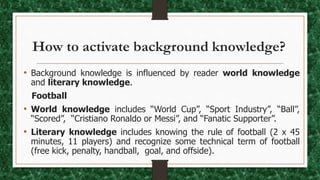
How to activate background knowledge? 
• Background knowledge is influenced by reader world knowledge 
and literary knowledge. 
Football 
• World knowledge includes “World Cup”, “Sport Industry”, “Ball”, 
“Scored”, “Cristiano Ronaldo or Messi”, and “Fanatic Supporter”. 
• Literary knowledge includes knowing the rule of football (2 x 45 
minutes, 11 players) and recognize some technical term of football 
(free kick, penalty, handball, goal, and offside).
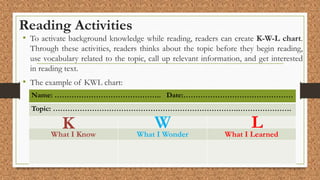
Reading Activities 
• To activate background knowledge while reading, readers can create K-W-L chart. 
Through these activities, readers thinks about the topic before they begin reading, 
use vocabulary related to the topic, call up relevant information, and get interested 
in reading text. 
• The example of KWL chart: 
Name: …………………………………….. Date:……………………………………… 
Topic: ………………………………………………………………….…………………. 
K W L 
What I Know What I Wonder What I Learned
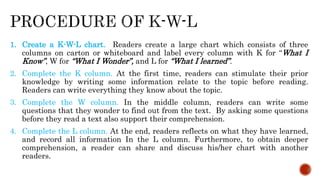
1. Create a K-W-L chart. Readers create a large chart which consists of three 
columns on carton or whiteboard and label every column with K for “What I 
Know”, W for “What I Wonder”, and L for “What I learned”. 
2. Complete the K column. At the first time, readers can stimulate their prior 
knowledge by writing some information relate to the topic before reading. 
Readers can write everything they know about the topic. 
3. Complete the W column. In the middle column, readers can write some 
questions that they wonder to find out from the text. By asking some questions 
before they read a text also support their comprehension. 
4. Complete the L column. At the end, readers reflects on what they have learned, 
and record all information In the L column. Furthermore, to obtain deeper 
comprehension, a reader can share and discuss his/her chart with another 
readers.
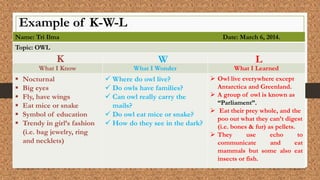
Example of K-W-L 
Name: Tri Ilma Date: March 6, 2014. 
Topic: OWL 
K W L 
What I Know What I Wonder What I Learned 
 Nocturnal 
 Big eyes 
 Fly, have wings 
 Eat mice or snake 
 Symbol of education 
 Trendy in girl’s fashion 
(i.e. bag jewelry, ring 
and necklets) 
 Where do owl live? 
 Do owls have families? 
 Can owl really carry the 
mails? 
 Do owl eat mice or snake? 
 How do they see in the dark? 
 Owl live everywhere except 
Antarctica and Greenland. 
 A group of owl is known as 
“Parliament”. 
 Eat their prey whole, and the 
poo out what they can’t digest 
(i.e. bones & fur) as pellets. 
 They use echo to 
communicate and eat 
mammals but some also eat 
insects or fish.

1.ilma activating background knowledge

  • 1.
    Reading Comprehension Strategies: How to Activate Background Knowledge Presented By: Tri Ilma Septiana
  • 2.
    What is Comprehension? • Literally, based on Longman Dictionary of Contemporary English (2001:369) the meaning of comprehension can be defined as “the ability to understand something”. • Tierney (1990) pointed out that comprehension as a creative or complex process in which children engage with and think about the text. • Judith Irwin (1991) defined comprehension as a reader’s process of using “prior knowledge” experience and the author’s text to construct meaning that’s useful to that reader for a specific purpose. • Successful reading  the Reader & the Text.
  • 3.
    What Is ComprehensionStrategies? • Comprehension strategies are thoughtful behaviors that readers use to facilitate their understanding. (Afflerbach, Pearson & Paris, 2008). • Readers apply these strategies to deepen their understanding, determine whether they’re comprehending successfully, and solve problems as they arise. • Some comprehension strategies are as follows: Activating background knowledge Predicting Connecting Questioning Determining importance Repairing Drawing Inference Setting a purpose Evaluating Summarizing Monitoring Visualizing
  • 4.
    The significance ofactivating background knowledge • Gail E. Tompkins (2011:202) emphasized that while reading, reader must activate background knowledge and think about what they’re reading; they apply cognitive and metacognitive strategies. • Van Den Broek & Kremer (2000) also stressed that the comprehension process is started when readers activate their background knowledge and it develops as they read aloud or listen and then respond to it. Readers construct a “mental picture” or representation of the text through the comprehension text.
  • 5.
    How to activatebackground knowledge? • Background knowledge is influenced by reader world knowledge and literary knowledge. Football • World knowledge includes “World Cup”, “Sport Industry”, “Ball”, “Scored”, “Cristiano Ronaldo or Messi”, and “Fanatic Supporter”. • Literary knowledge includes knowing the rule of football (2 x 45 minutes, 11 players) and recognize some technical term of football (free kick, penalty, handball, goal, and offside).
  • 6.
    Reading Activities •To activate background knowledge while reading, readers can create K-W-L chart. Through these activities, readers thinks about the topic before they begin reading, use vocabulary related to the topic, call up relevant information, and get interested in reading text. • The example of KWL chart: Name: …………………………………….. Date:……………………………………… Topic: ………………………………………………………………….…………………. K W L What I Know What I Wonder What I Learned
  • 7.
    1. Create aK-W-L chart. Readers create a large chart which consists of three columns on carton or whiteboard and label every column with K for “What I Know”, W for “What I Wonder”, and L for “What I learned”. 2. Complete the K column. At the first time, readers can stimulate their prior knowledge by writing some information relate to the topic before reading. Readers can write everything they know about the topic. 3. Complete the W column. In the middle column, readers can write some questions that they wonder to find out from the text. By asking some questions before they read a text also support their comprehension. 4. Complete the L column. At the end, readers reflects on what they have learned, and record all information In the L column. Furthermore, to obtain deeper comprehension, a reader can share and discuss his/her chart with another readers.
  • 8.
    Example of K-W-L Name: Tri Ilma Date: March 6, 2014. Topic: OWL K W L What I Know What I Wonder What I Learned  Nocturnal  Big eyes  Fly, have wings  Eat mice or snake  Symbol of education  Trendy in girl’s fashion (i.e. bag jewelry, ring and necklets)  Where do owl live?  Do owls have families?  Can owl really carry the mails?  Do owl eat mice or snake?  How do they see in the dark?  Owl live everywhere except Antarctica and Greenland.  A group of owl is known as “Parliament”.  Eat their prey whole, and the poo out what they can’t digest (i.e. bones & fur) as pellets.  They use echo to communicate and eat mammals but some also eat insects or fish.