Reading Strategies
The American Language Institute
Professional Development
February 5, 2016
Why Use Reading Strategies?
By using reading strategies, students will be able to:
Identify & remember important concepts
Read more accurately
Follow a text or story more closely
Feel confident they understand the material
Prepare effectively for assessments
Feel motivated to read in school and for pleasure.
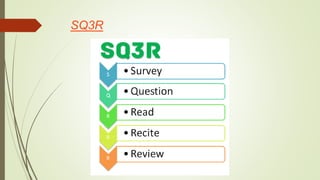
SQ3R
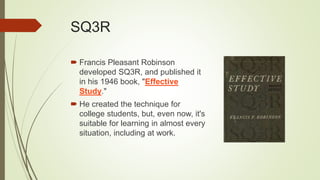
 Francis Pleasant Robinson
developed SQ3R, and published it
in his 1946 book, "Effective
Study."
 He created the technique for
college students, but, even now, it's
suitable for learning in almost every
situation, including at work.
SQ3R
 SQ3R helps students to:
Read actively with a purpose
Think about what they want to get from a document
Remember concepts & information
SQ3R
The Three Stages of Critical Reading
 A new model of critical reading
 CATESOL, Oakland
Heidi Wright, Northern Arizona University
The Three Stages of Critical Reading
 Stages move from basic understanding to reader analysis and
interaction
Stage 1: Identify and Describe
Stage 2: Question, Critique and Conclude
Stage 3: Appropriate/Consolidate and
Construct/Transform
 https://prezi.com/jktfi9wimekd/model-of-critical-reading/
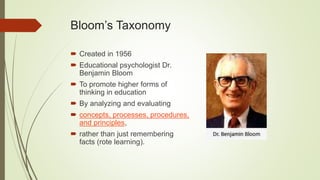
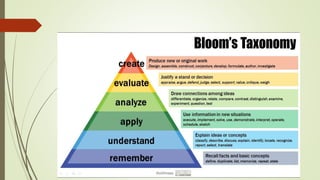
Bloom’s Taxonomy
 Created in 1956
 Educational psychologist Dr.
Benjamin Bloom
 To promote higher forms of
thinking in education
 By analyzing and evaluating
 concepts, processes, procedures,
and principles,
 rather than just remembering
facts (rote learning).
Read / Pair / Share
 In pairs: each pair reads silently for 30 seconds.
 Then students close their books and share with their partners
everything they remember about what they just read
 Students again open their books and read from the beginning
for another 30 seconds and have them share their corrected
and more complete ideas.
 Repeat until they have finished the reading.
Close Comprehension Questions
 When reading aloud (either by you or the students), make
sure your students are understanding the text as you go along
by asking simple questions that can be answered in the
sentence they just read.
 By keeping the questions as simple as possible, the students
gain a sense of ownership over the material and a belief that
they do indeed understand.
 If there is a new vocabulary word, now is a good time to go
over it.
Close Comprehension Questions
 “My hometown is famous for several amazing features.”
 Q: Why is the author’s hometown famous?
 Q: Where can we find amazing natural features?
 Do not ask questions that cannot be answered by the text:
 Q: Where is the author’s hometown?
Think Aloud
 Read a passage aloud to students and stop frequently to
make comments about what you are thinking as you read.
 The idea is to reveal thought processes to the students so
that they can emulate them when they read a similar
passage.
 For more information on this, click here
Team Summarizing
 In pairs, students write a summary of a paragraph. Each
team writes a summary of the same passage.
 Or students in pairs summarize different paragraphs and write
their summaries on the board. They become the experts on
that paragraph and explain it to the class.
 At the end, review the summaries in order, then have them all
write a summary of the summaries.
GIST
 A way to make sense of a passage is to summarize it.
 GIST (Generating Interaction between Schemata and Text) is
a technique for letting students internalize a passage by
selecting important words from the text and writing a summary
using those words.
 When reading, students pick 8 or 10 of the most important
words and underline them. Then they write a summary of the
passage using those words.
 For further information, click here
Discuss:
Describe the various reading strategies.
Which ones would you feel most
comfortable using? Why?

Reading Strategies

  • 1.
    Reading Strategies The AmericanLanguage Institute Professional Development February 5, 2016
  • 2.
    Why Use ReadingStrategies? By using reading strategies, students will be able to: Identify & remember important concepts Read more accurately Follow a text or story more closely Feel confident they understand the material Prepare effectively for assessments Feel motivated to read in school and for pleasure.
  • 3.
    SQ3R  Francis PleasantRobinson developed SQ3R, and published it in his 1946 book, "Effective Study."  He created the technique for college students, but, even now, it's suitable for learning in almost every situation, including at work.
  • 4.
    SQ3R  SQ3R helpsstudents to: Read actively with a purpose Think about what they want to get from a document Remember concepts & information
  • 5.
  • 6.
    The Three Stagesof Critical Reading
  • 7.
    The Three Stagesof Critical Reading  A new model of critical reading  CATESOL, Oakland Heidi Wright, Northern Arizona University
  • 8.
    The Three Stagesof Critical Reading  Stages move from basic understanding to reader analysis and interaction Stage 1: Identify and Describe Stage 2: Question, Critique and Conclude Stage 3: Appropriate/Consolidate and Construct/Transform  https://prezi.com/jktfi9wimekd/model-of-critical-reading/
  • 9.
    Bloom’s Taxonomy  Createdin 1956  Educational psychologist Dr. Benjamin Bloom  To promote higher forms of thinking in education  By analyzing and evaluating  concepts, processes, procedures, and principles,  rather than just remembering facts (rote learning).
  • 11.
    Read / Pair/ Share  In pairs: each pair reads silently for 30 seconds.  Then students close their books and share with their partners everything they remember about what they just read  Students again open their books and read from the beginning for another 30 seconds and have them share their corrected and more complete ideas.  Repeat until they have finished the reading.
  • 12.
    Close Comprehension Questions When reading aloud (either by you or the students), make sure your students are understanding the text as you go along by asking simple questions that can be answered in the sentence they just read.  By keeping the questions as simple as possible, the students gain a sense of ownership over the material and a belief that they do indeed understand.  If there is a new vocabulary word, now is a good time to go over it.
  • 13.
    Close Comprehension Questions “My hometown is famous for several amazing features.”  Q: Why is the author’s hometown famous?  Q: Where can we find amazing natural features?  Do not ask questions that cannot be answered by the text:  Q: Where is the author’s hometown?
  • 14.
    Think Aloud  Reada passage aloud to students and stop frequently to make comments about what you are thinking as you read.  The idea is to reveal thought processes to the students so that they can emulate them when they read a similar passage.  For more information on this, click here
  • 15.
    Team Summarizing  Inpairs, students write a summary of a paragraph. Each team writes a summary of the same passage.  Or students in pairs summarize different paragraphs and write their summaries on the board. They become the experts on that paragraph and explain it to the class.  At the end, review the summaries in order, then have them all write a summary of the summaries.
  • 16.
    GIST  A wayto make sense of a passage is to summarize it.  GIST (Generating Interaction between Schemata and Text) is a technique for letting students internalize a passage by selecting important words from the text and writing a summary using those words.  When reading, students pick 8 or 10 of the most important words and underline them. Then they write a summary of the passage using those words.  For further information, click here
  • 17.
    Discuss: Describe the variousreading strategies. Which ones would you feel most comfortable using? Why?