Schema Building A Scaffolding Approach to Learning and Teaching By Stephanie Paris EDU 506-DLB-2
Schema Building? A process in which new information is integrated into a network of prior knowledge, or a schema, so that students recognize connections to previously learned material and see how they can apply prior knowledge to new situations. The tasks involved should be culturally ambiguous.
Making the Connection Students are connecting by Synthesizing new information Deepening existing information Broadening beliefs Informing misconceptions
How? Text-to-text:  connections between different books and different authors. Text-to-me:  connections between books and the reader’s current personal background knowledge and experience base. text-to-the-world:  connections between books and information about the world around us.
Tasks: Anticipatory Chart Before reading, hearing or viewing students should: Students are given a series of statements. Students indicate whether they agree/disagree or compare what he/she may already know to what is expected to be learned (K,W,L). After reviewing material, students will: Check to see if their initial answers were correct. Compare expectations to what was actually learned. Responses are typically shared with a partner.
Tasks:  Compare and Contrast Matrix Students determine similarities and differences between two people, things, solutions, organisms, stories, ideas, or cultures.  Excellent for thinking, writing and discussion tool. Effective in groups.
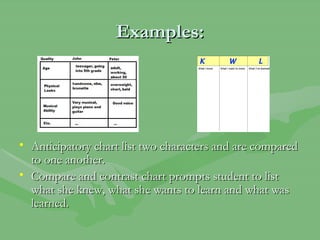
Examples: Anticipatory chart list two characters and are compared to one another. Compare and contrast chart prompts student to list what she knew, what she wants to learn and what was learned.

Schema building presentation

  • 1.
    Schema Building AScaffolding Approach to Learning and Teaching By Stephanie Paris EDU 506-DLB-2
  • 2.
    Schema Building? Aprocess in which new information is integrated into a network of prior knowledge, or a schema, so that students recognize connections to previously learned material and see how they can apply prior knowledge to new situations. The tasks involved should be culturally ambiguous.
  • 3.
    Making the ConnectionStudents are connecting by Synthesizing new information Deepening existing information Broadening beliefs Informing misconceptions
  • 4.
    How? Text-to-text: connections between different books and different authors. Text-to-me: connections between books and the reader’s current personal background knowledge and experience base. text-to-the-world: connections between books and information about the world around us.
  • 5.
    Tasks: Anticipatory ChartBefore reading, hearing or viewing students should: Students are given a series of statements. Students indicate whether they agree/disagree or compare what he/she may already know to what is expected to be learned (K,W,L). After reviewing material, students will: Check to see if their initial answers were correct. Compare expectations to what was actually learned. Responses are typically shared with a partner.
  • 6.
    Tasks: Compareand Contrast Matrix Students determine similarities and differences between two people, things, solutions, organisms, stories, ideas, or cultures. Excellent for thinking, writing and discussion tool. Effective in groups.
  • 7.
    Examples: Anticipatory chartlist two characters and are compared to one another. Compare and contrast chart prompts student to list what she knew, what she wants to learn and what was learned.