K
W
L
Instructional Literacy Strategy
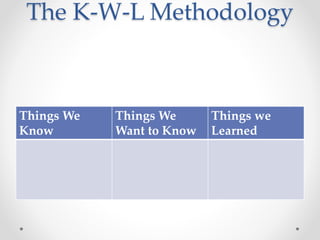
The K-W-L Methodology
Things We
Know
Things We
Want to Know
Things we
Learned
What are they?
• KWL charts are instructional tools designed to
be initialized at the start of a unit and utilized
throughout. They consist of 3 components:
o KNOW- Students use prior knowledge about a new topic and share
information that they already know for the first column.
o WANT to learn- Students brainstorm information that they would like to
learn in the new unit.
o LEARNED- At the conclusion of the unit, the KWL is revisited and
students check off items that they learned and add items to the final
column
The Instructional Strengths of
KWL
• Used as graphic organizers to help students assemble
information before, during, and after a lesson.
• Visual and interactive representation that brings in prior
knowledge
• Creates strong buy-in and ownership of learning by making
learning interactive
• Involves self-awareness, self-assessment, and self-regulation.
• Enforces critical thinking skills.
• Great tool to assess prior knowledge
• Many opportunities for individualized instruction and
scaffolding.
The Limitations of KWL
• KWL charts utilize prior knowledge. If the student lacks
prior knowledge, the KWL will fall short.
• Students with low reading and comprehension skills can
be encouraged to copy from the text or pass over
information that they do not understand.
• Student prior knowledge can be helpful but may
potentially be inaccurate, leading to confusion and
struggle.
• Academic vocabulary can be an issue with a reading
assignment if steps are not taken to scaffold.
Adaptations
• KWLs are versatile teaching instruments that can be
adapted to fit any content area.
• As long as the 3 components are present, any topic can
be broken down into a KWL.
• Works well with academic vocabulary in social studies,
might stumble with ELA vocabulary.
• 2 examples follow:
o Social Studies
o ELA
KWL Social Studies
What we Know about
the Civil War
What we Want to Know What we Learned
• America was involved
• Many deaths
• Involved slavery
• Lincoln was President
• Fought between
American states
• Occurred after
Revolutionary War
• End of the war ended
slavery
• What were the many
causes?
• Who were the
important leaders?
• How many states
were involved?
• Why did states pick
their sides in the war?
• When did the war
occur? When did it
end?
• How many battles
occurred?
• Lasted until 1865
• Emancipation
Proclamation was
released during the
Civil War
• Slaves were freed as a
wartime necessity.
• Only 1 President
during the Civil War
• The Confederates had
their own President
and government
• The South won most
battles at the
beginning due to
leadership
• The draft was
unpopular
KWL Literature
What we Know about
Animal Farm and 1984
What we want to know What we learned
• They are books!
• Written by George
Orwell in the 1940s
• Animal Farm is shorter
• They are very famous
• Animal Farm is about
farm animals that speak
English
• Why do the animals
speak English?
• How do they pick their
leaders?
• Why do they rebel?
• What is life like on the
farm?
• What do these books
have in common?
• Why are they so famous?
• What are these books
telling us about
government?
• What themes exist in
both books?
• Animal Farm is a book
about governments and
communism
• Communism is a type of
government that tries to
treat everyone equally
• Leaders in communist
governments treat their
people unfairly
• Citizens in communist
governments are often
abused and discarded
• History is often changed
in communist
governments
Vocabulary
• Depending on your source, KWL charts can enhance or
limit vocabulary growth.
o In subjects like social studies and science, students need to grow their
academic vocabulary during the unit in order to comprehend the lesson
objectives.
o Vocabulary is often a vital part of unit plans in these subjects.
o In ELA, many sources claim that students who are missing essential
vocabulary will skip over unknown words, resulting in lower
comprehension, or require additional scaffolding.
• To combat this, teachers must intentionally plan to
incorporate essential vocabulary into the beginning of
units to avoid these issues and limit difficulties.
Instructional Framework:
Before
• Before a lesson, KWL charts work with the
Instructional Framework
o The KNOW column accesses and addresses prior knowledge before
the lesson begins.
o Students take a self-guided approach to the lesson in the WANT
column, allowing the to dictate items of interest and control their
outcomes.
o The WANT column stimulates interest in the material since students are
actively involved in the regulation process of learning.
Instructional Framework:
During and After
• During the lesson, KWL charts are useful tools:
o Teachers and students continue to refer back to the KWL in order to
organize, focus, and direct learning
o Students are focused on specific objectives during the lesson.
• At the conclusion of the lesson, KWL charts are
brought out and reviewed.
o Classrooms revisit prior knowledge, make changes, and determine what
they have learned.
o Teachers can use adjacent concepts to further learning and lead into
future topics, demonstrating connectivity with the learning process,
solidifying past objectives and building into new learning.
o KWL charts can easily be used again for review if saved.
Bibliography
• Ogle, D. (1986). K-W-L: A Teaching Model That Develops Active
Reading of Expository Text. The Reading Teacher, 39(6), 564-
570. Retrieved from
http://www.jstor.org/stable/20199156
• Building the Foundations of Literacy: The Importance of
Vocabulary and Spelling
Development http://www.eduplace.com/rdg/hmsv/expert/research.ht
ml
• Jared, J. Elizabeth, Jared, H. Alva (1997). Launching into
Improved comprehension. The Technology Teacher, 56(6),
24–31.
• Glazer, M. Susan. (1998). Using kwl folders. Teaching Diverse
Learners, 29(4), 106-107

Edld kwl

  • 1.
  • 2.
    The K-W-L Methodology ThingsWe Know Things We Want to Know Things we Learned
  • 3.
    What are they? •KWL charts are instructional tools designed to be initialized at the start of a unit and utilized throughout. They consist of 3 components: o KNOW- Students use prior knowledge about a new topic and share information that they already know for the first column. o WANT to learn- Students brainstorm information that they would like to learn in the new unit. o LEARNED- At the conclusion of the unit, the KWL is revisited and students check off items that they learned and add items to the final column
  • 4.
    The Instructional Strengthsof KWL • Used as graphic organizers to help students assemble information before, during, and after a lesson. • Visual and interactive representation that brings in prior knowledge • Creates strong buy-in and ownership of learning by making learning interactive • Involves self-awareness, self-assessment, and self-regulation. • Enforces critical thinking skills. • Great tool to assess prior knowledge • Many opportunities for individualized instruction and scaffolding.
  • 5.
    The Limitations ofKWL • KWL charts utilize prior knowledge. If the student lacks prior knowledge, the KWL will fall short. • Students with low reading and comprehension skills can be encouraged to copy from the text or pass over information that they do not understand. • Student prior knowledge can be helpful but may potentially be inaccurate, leading to confusion and struggle. • Academic vocabulary can be an issue with a reading assignment if steps are not taken to scaffold.
  • 6.
    Adaptations • KWLs areversatile teaching instruments that can be adapted to fit any content area. • As long as the 3 components are present, any topic can be broken down into a KWL. • Works well with academic vocabulary in social studies, might stumble with ELA vocabulary. • 2 examples follow: o Social Studies o ELA
  • 7.
    KWL Social Studies Whatwe Know about the Civil War What we Want to Know What we Learned • America was involved • Many deaths • Involved slavery • Lincoln was President • Fought between American states • Occurred after Revolutionary War • End of the war ended slavery • What were the many causes? • Who were the important leaders? • How many states were involved? • Why did states pick their sides in the war? • When did the war occur? When did it end? • How many battles occurred? • Lasted until 1865 • Emancipation Proclamation was released during the Civil War • Slaves were freed as a wartime necessity. • Only 1 President during the Civil War • The Confederates had their own President and government • The South won most battles at the beginning due to leadership • The draft was unpopular
  • 8.
    KWL Literature What weKnow about Animal Farm and 1984 What we want to know What we learned • They are books! • Written by George Orwell in the 1940s • Animal Farm is shorter • They are very famous • Animal Farm is about farm animals that speak English • Why do the animals speak English? • How do they pick their leaders? • Why do they rebel? • What is life like on the farm? • What do these books have in common? • Why are they so famous? • What are these books telling us about government? • What themes exist in both books? • Animal Farm is a book about governments and communism • Communism is a type of government that tries to treat everyone equally • Leaders in communist governments treat their people unfairly • Citizens in communist governments are often abused and discarded • History is often changed in communist governments
  • 9.
    Vocabulary • Depending onyour source, KWL charts can enhance or limit vocabulary growth. o In subjects like social studies and science, students need to grow their academic vocabulary during the unit in order to comprehend the lesson objectives. o Vocabulary is often a vital part of unit plans in these subjects. o In ELA, many sources claim that students who are missing essential vocabulary will skip over unknown words, resulting in lower comprehension, or require additional scaffolding. • To combat this, teachers must intentionally plan to incorporate essential vocabulary into the beginning of units to avoid these issues and limit difficulties.
  • 10.
    Instructional Framework: Before • Beforea lesson, KWL charts work with the Instructional Framework o The KNOW column accesses and addresses prior knowledge before the lesson begins. o Students take a self-guided approach to the lesson in the WANT column, allowing the to dictate items of interest and control their outcomes. o The WANT column stimulates interest in the material since students are actively involved in the regulation process of learning.
  • 11.
    Instructional Framework: During andAfter • During the lesson, KWL charts are useful tools: o Teachers and students continue to refer back to the KWL in order to organize, focus, and direct learning o Students are focused on specific objectives during the lesson. • At the conclusion of the lesson, KWL charts are brought out and reviewed. o Classrooms revisit prior knowledge, make changes, and determine what they have learned. o Teachers can use adjacent concepts to further learning and lead into future topics, demonstrating connectivity with the learning process, solidifying past objectives and building into new learning. o KWL charts can easily be used again for review if saved.
  • 12.
    Bibliography • Ogle, D.(1986). K-W-L: A Teaching Model That Develops Active Reading of Expository Text. The Reading Teacher, 39(6), 564- 570. Retrieved from http://www.jstor.org/stable/20199156 • Building the Foundations of Literacy: The Importance of Vocabulary and Spelling Development http://www.eduplace.com/rdg/hmsv/expert/research.ht ml • Jared, J. Elizabeth, Jared, H. Alva (1997). Launching into Improved comprehension. The Technology Teacher, 56(6), 24–31. • Glazer, M. Susan. (1998). Using kwl folders. Teaching Diverse Learners, 29(4), 106-107