Improving Access to Language In Mathematics Emily Fagan & Amy Brodesky, EDC Welcome!  Please complete the warm-up (HO 1)
Our PD Projects Addressing Accessibility in Mathematics 	http: //edc . org/accessMath/ Mathematics Improvement Toolkit http://www.mgforum.org/ (June or July 2009)
Our PD Goals for Language in Math Build teachers’ knowledge of… the kinds of language demands in math lessons common difficulties that students with learning disabilities  strategies for addressing these difficulties ways to plan accessible math lessons that incorporate active language strategies
Lessons Learned about PD on Language Strategies for Math Tends to be a motivating and engaging topic for math teachers & special educators Helpful to unpack language demands & difficulties Provides an opportunity for special educators to share expertise and to foster collaboration between special educators & math teachers Needs to go beyond “activities” to integrating language strategies into math instruction
Session Agenda Language Demands in Mathematics Sample Lesson Writing in Math Math Vocabulary Planning for Language Accessibility We hope you will leave with PD ideas to use with teachers in your schools/districts.
#1: Examine  the Language Demands in Mathematics Lessons In this section, we will: Discuss the kinds of language demands in mathematics lessons Learn about the complexities of reading in mathematics Consider language challenges for students with disabilities
Communication Standard: Goals for Students Organize and consolidate their mathematical thinking through communication; Communicate their mathematical thinking coherently and clearly to peers, teachers, and others; Analyze and evaluate the mathematical thinking and strategies of others; Use the language of mathematics to express mathematics ideas precisely.   Source:  Principles and Standards for School Mathematics (NCTM), 2002
Types of  Language Demands Receptive Reading Listening Expressive Writing Speaking Examples for students with disabilities: Reading :  Decoding; Comprehension Listening : Auditory Processing Writing : Organizing ideas in writing Speaking : Expressing ideas orally
  Student’s Perspective Source:  “Faking It” by C. Lee and R. Jackson “ When I am listening or reading a word problem, I sometimes leave out or reverse important information.  When I am struggling through the words, I lose the meaning of the problem.” Source:  “Faking It” by C. Lee and R. Jackson
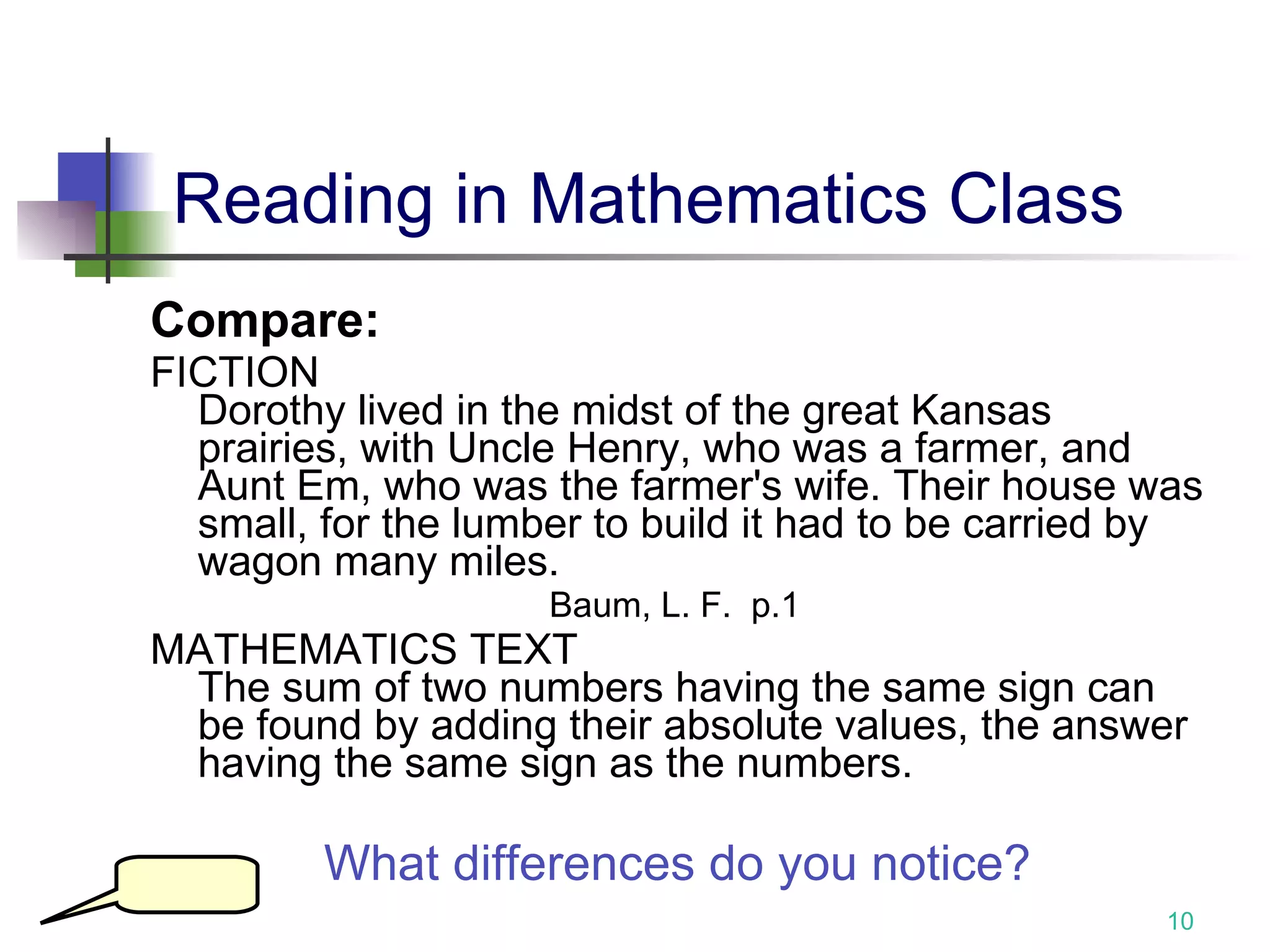
Reading in Mathematics Class Compare: FICTION Dorothy lived in the midst of the great Kansas prairies, with Uncle Henry, who was a farmer, and Aunt Em, who was the farmer's wife. Their house was small, for the lumber to build it had to be carried by wagon many miles.  Baum, L. F.  p.1 MATHEMATICS TEXT The sum of two numbers having the same sign can be found by adding their absolute values, the answer having the same sign as the numbers. What differences do you notice?
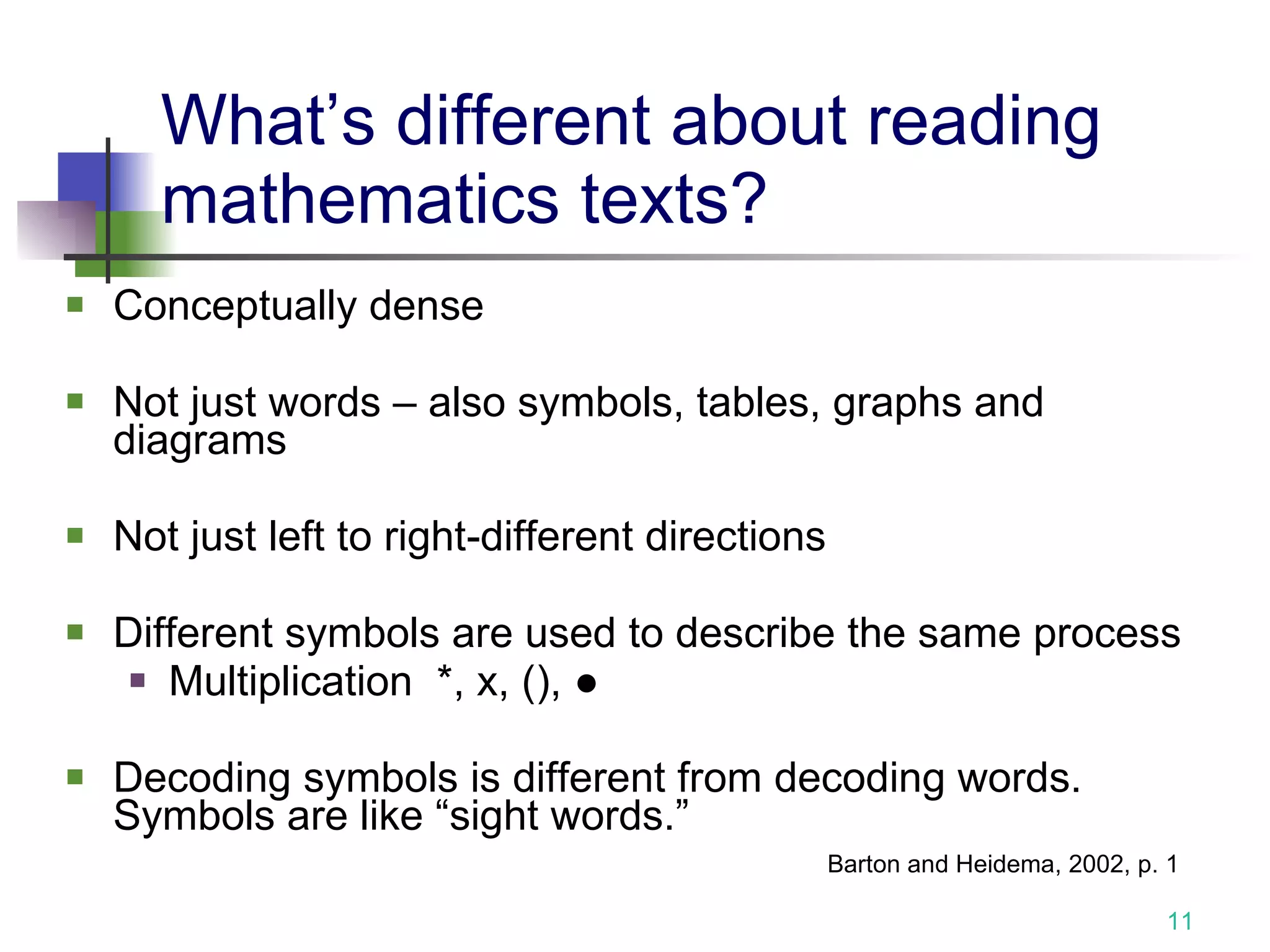
What’s different about reading mathematics texts? Conceptually dense Not just words – also symbols, tables, graphs and diagrams Not just left to right-different directions  Different symbols are used to describe the same process Multiplication  *, x, (),  ● Decoding symbols is different from decoding words.  Symbols are like “sight words.” Barton and Heidema, 2002, p. 1
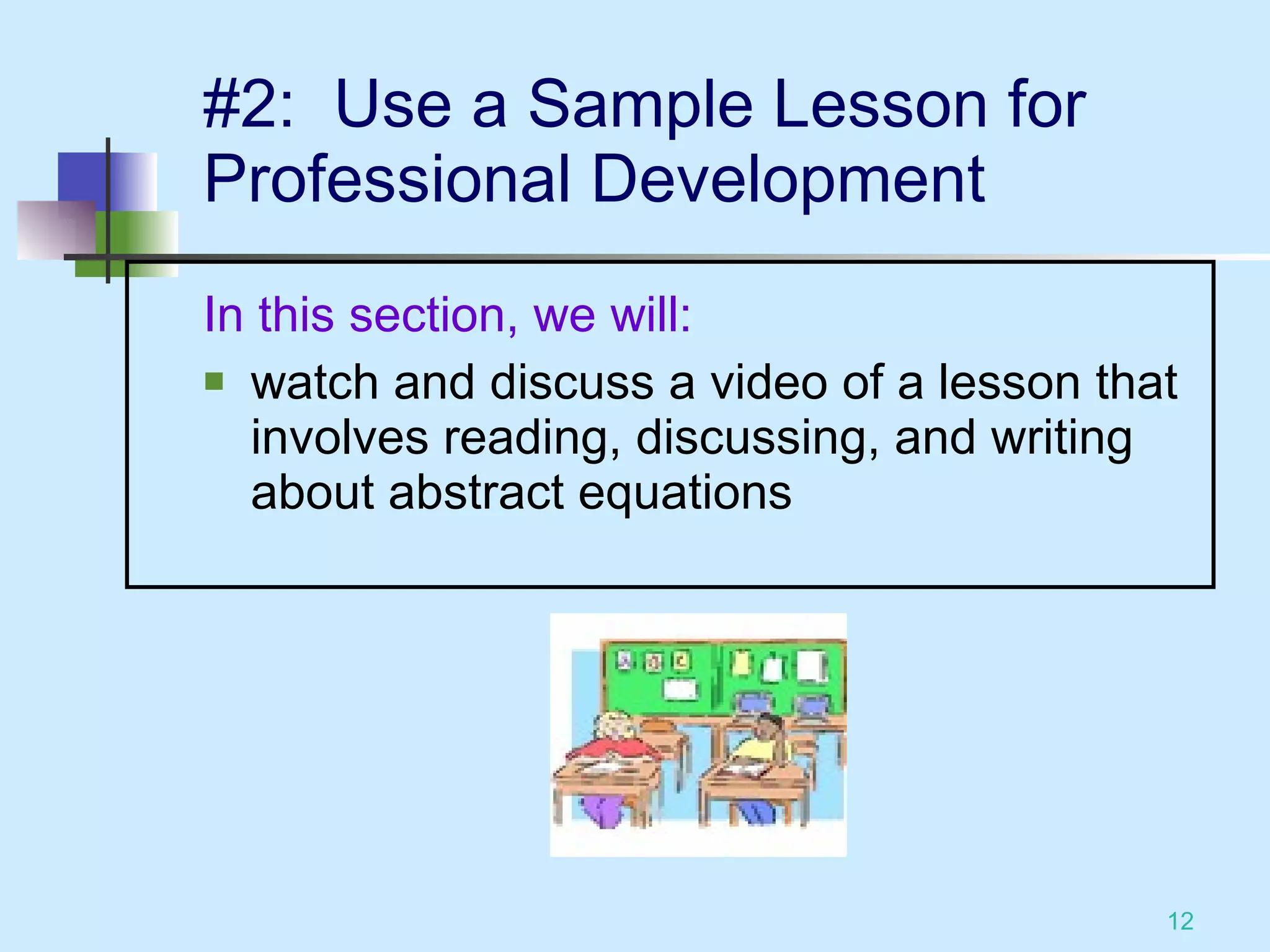
#2:  Use a Sample Lesson for Professional Development In this section, we will: watch and discuss a video of a lesson that involves reading, discussing, and writing about abstract equations
PD Simulation:  View and Discuss a Video Goals: Provide examples of strategies in action Provide a shared experience to generate discussion
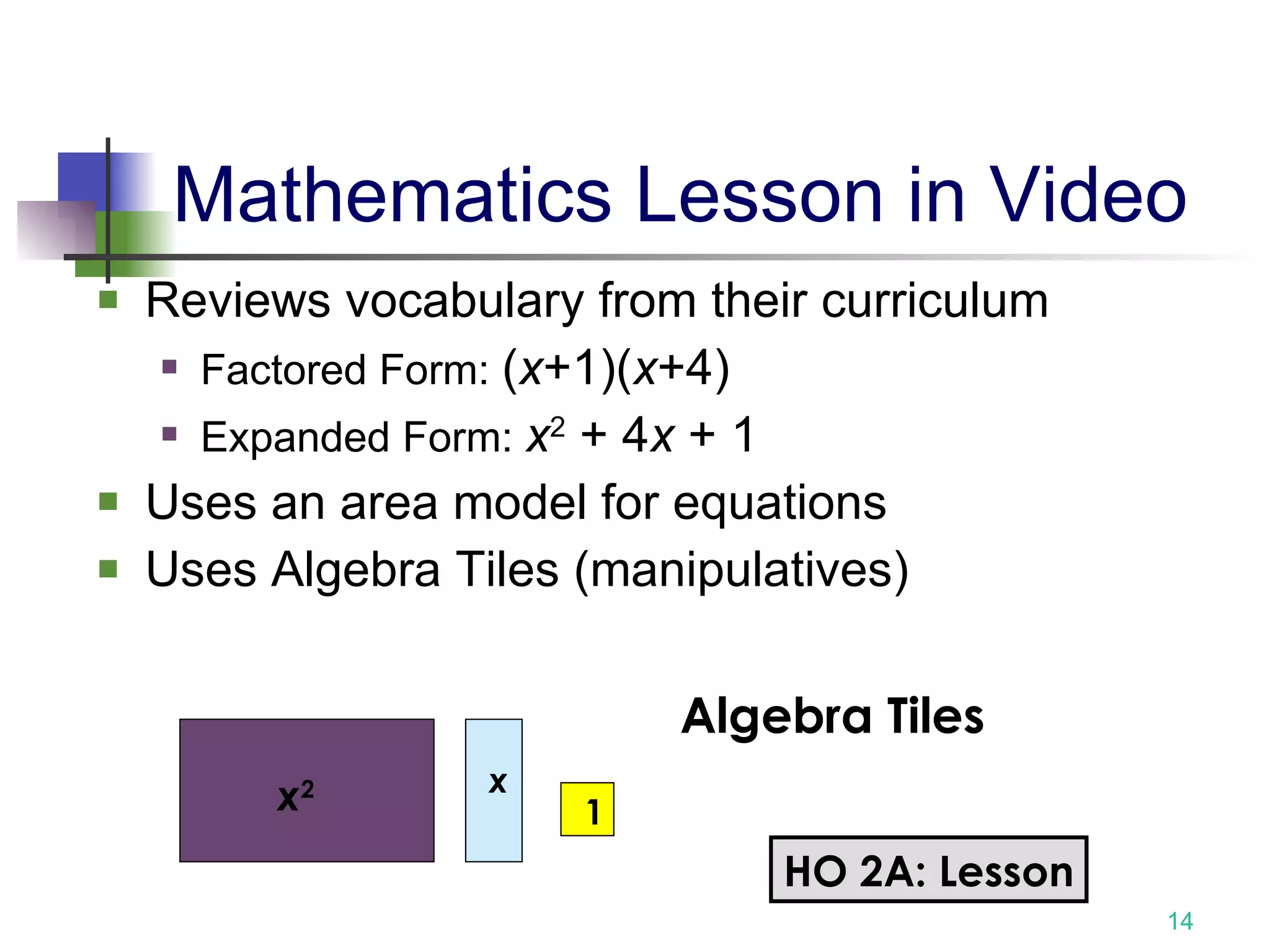
Mathematics Lesson in Video Reviews vocabulary from their curriculum Factored Form:  ( x +1)( x +4) Expanded Form:  x 2  + 4 x  + 1  Uses an area model for equations  Uses Algebra Tiles (manipulatives)  x 2 x Algebra Tiles 1 HO 2A: Lesson
Video: Background Students Six 8 th  grade students, including students with disabilities and English Language Learners Identified for additional support because they were having difficulties in regular mathematics class As a group, these students tend to be reluctant to participate Teacher   Title I Mathematics Coach Co-teaches 8 th  grade mathematics class AND provides additional mathematics support to these students
As You Watch,  Keep in Mind… One teacher, one day An example to spark discussion Focus Question What kinds of strategies does the teacher use to make the language of the mathematics accessible? HO 2: Video Notes
Discuss: What kinds of difficulties did the students have? What strategies did the teacher use to make the language of mathematics more accessible? What strategies do you find helpful for encouraging reluctant students to participate?
#3: Focus on Writing Strategies for Mathematics Class In this section, we will simulate a professional development experience in which teacher participants: Write a response to a mathematics problem Examine student work samples Discuss writing strategies
Why Write in  Mathematics? Writing can help students to: build understanding of mathematics  organize and clarify ideas deepen their thinking communicate coherently and clearly remember mathematics content Writing has many benefits. But, it also poses barriers for some students.
PD Simulation: Looking at Student Work What do teachers do? Write a response to a math problem. Discuss their experiences. Analyze the problem from accessibility lens. Examine student work samples. HO 3: Jumping Jacks
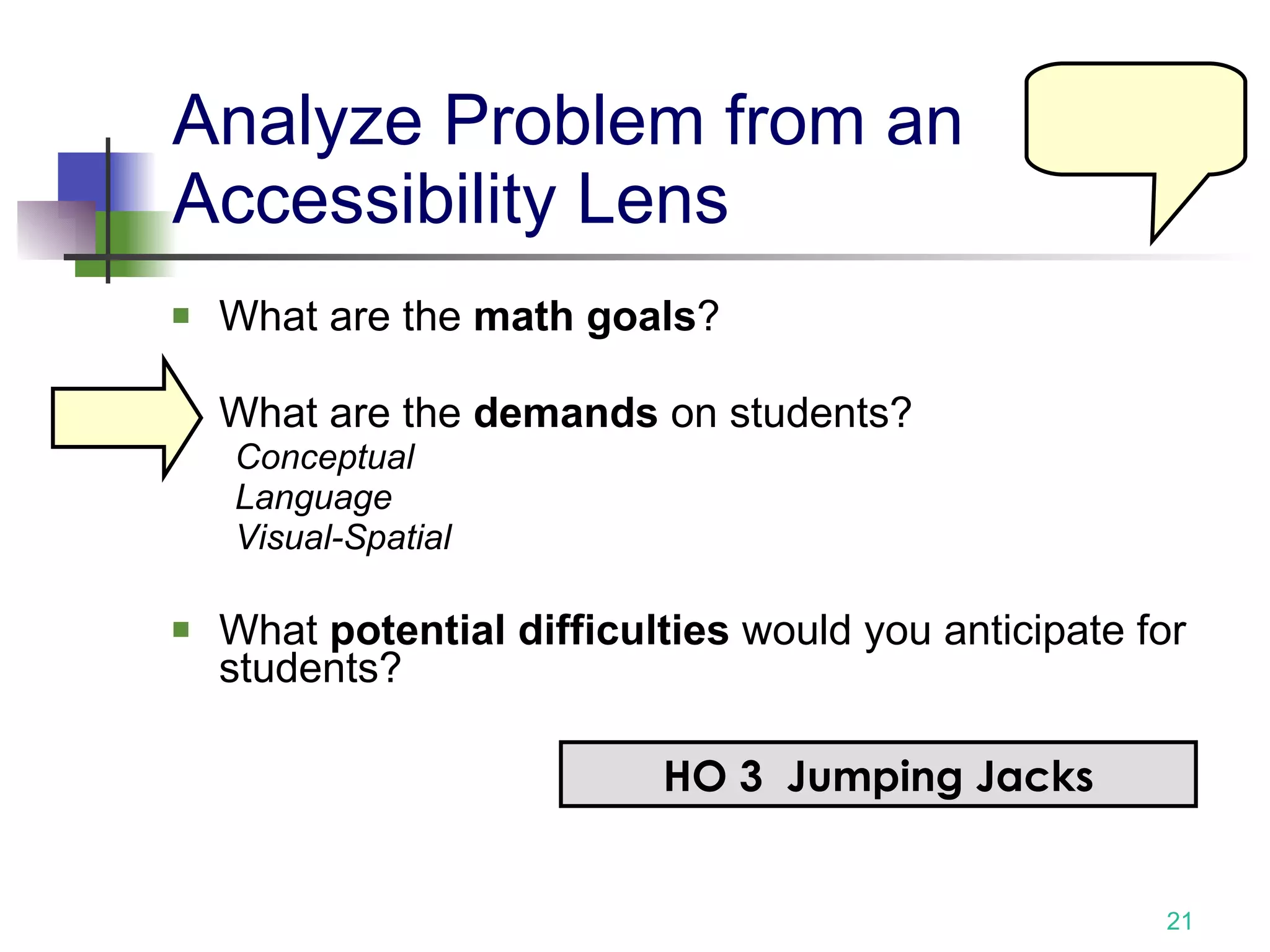
Analyze Problem from an Accessibility Lens  What are the  math goals ? What are the  demands  on students? Conceptual Language Visual-Spatial   What  potential difficulties  would you anticipate for students? HO 3  Jumping Jacks
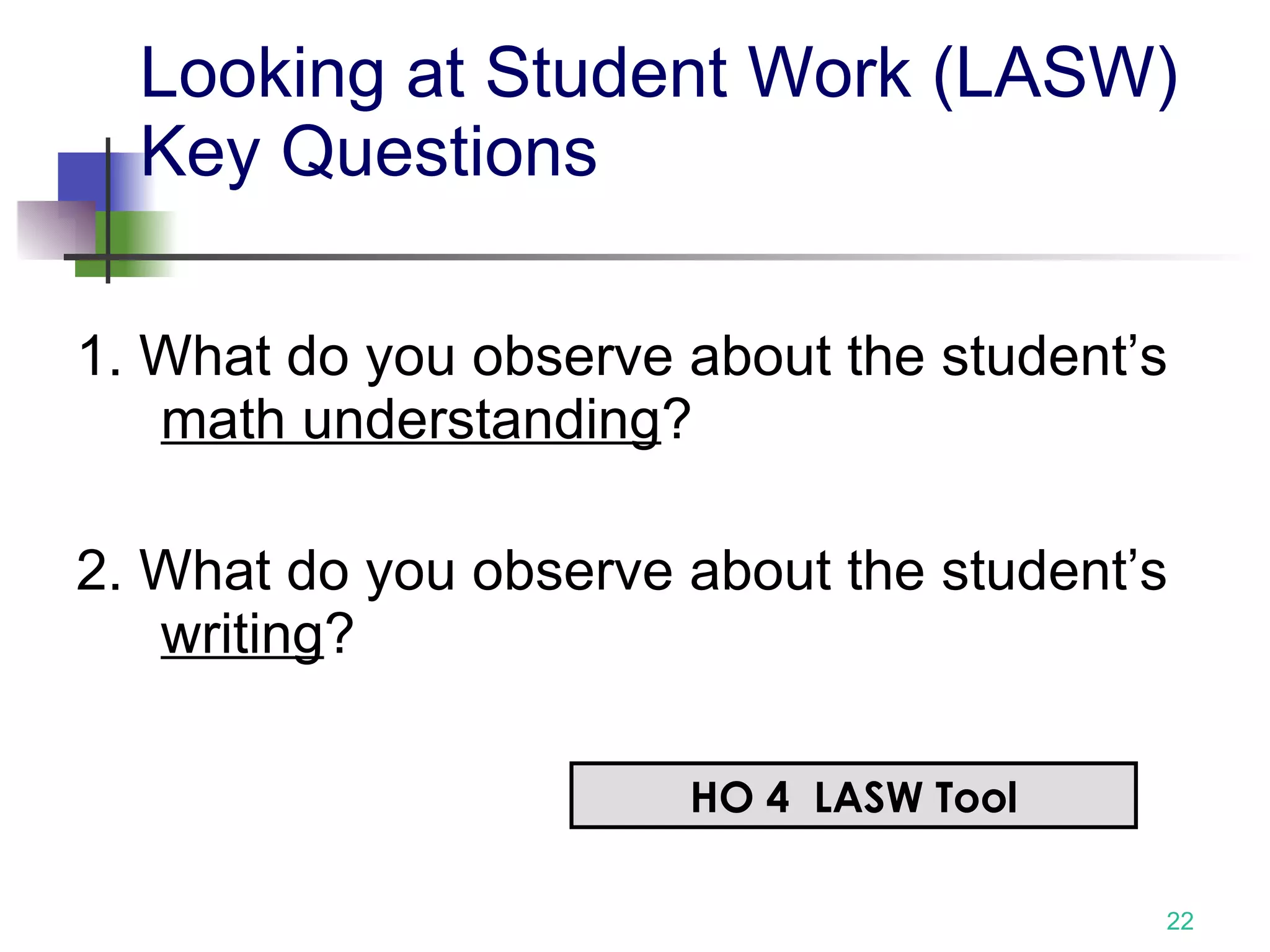
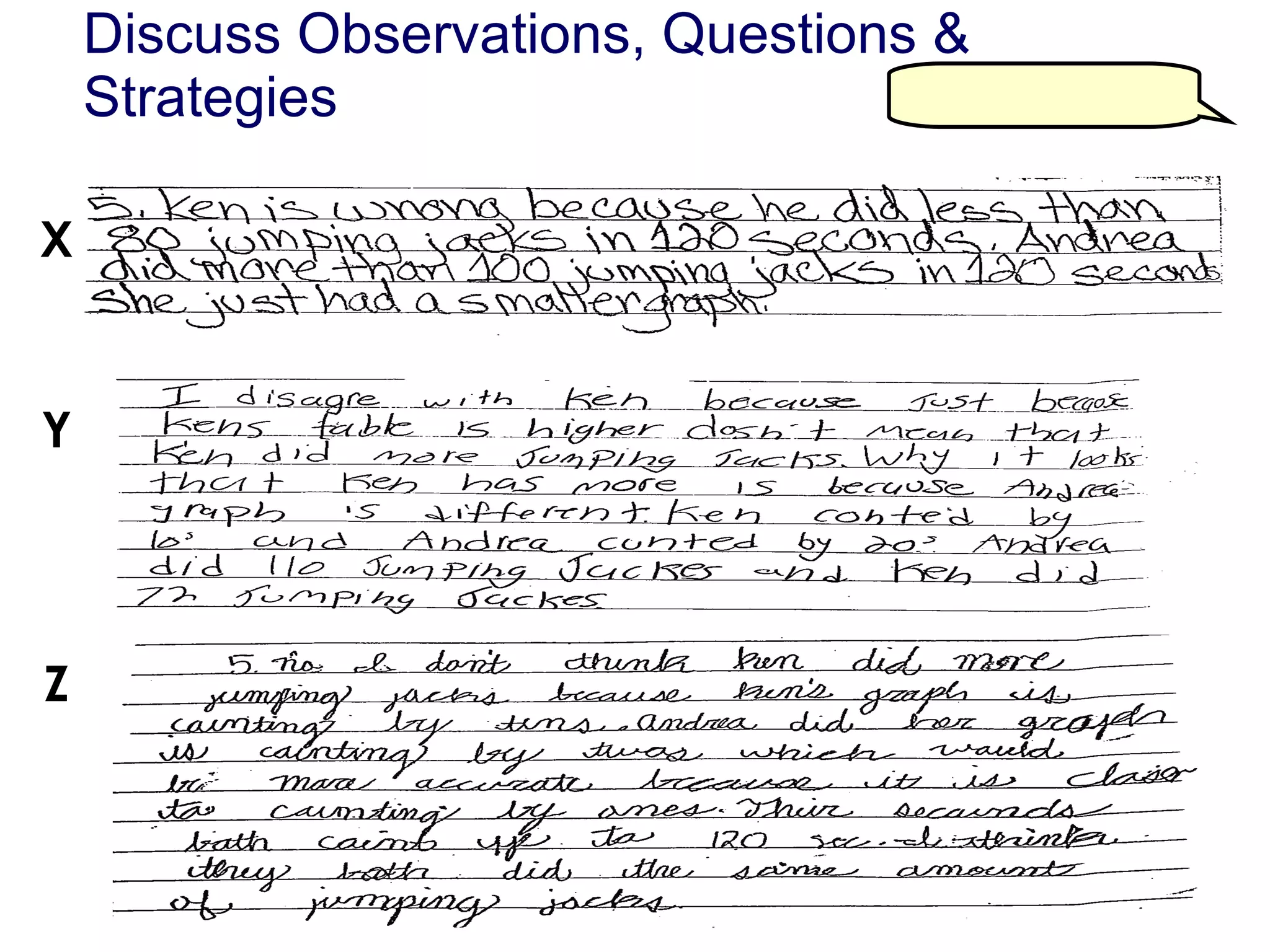
Looking at Student Work (LASW)  Key Questions 1. What do you observe about the student’s  math understanding ? 2. What do you observe about the student’s  writing ?   HO 4  LASW Tool
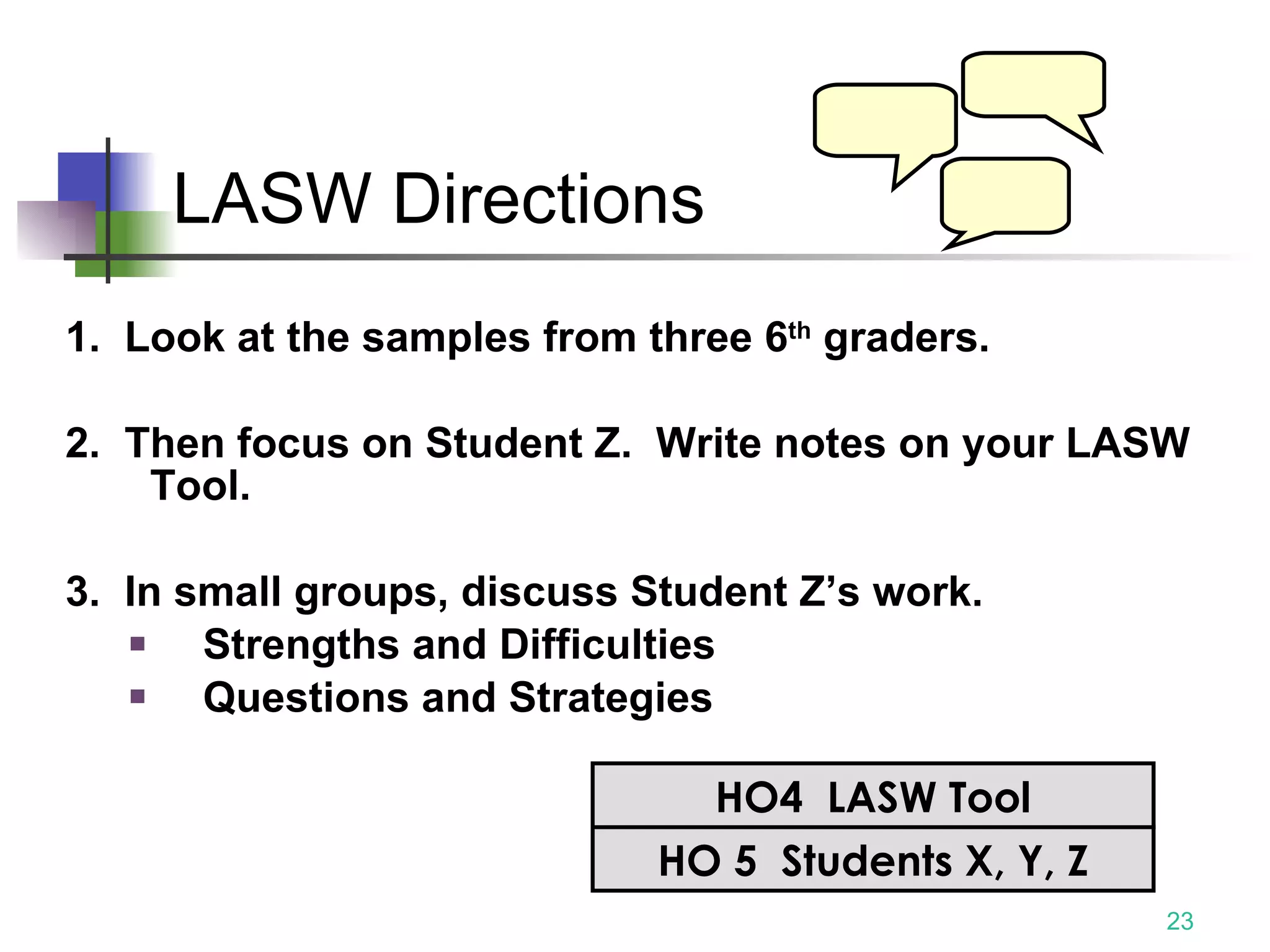
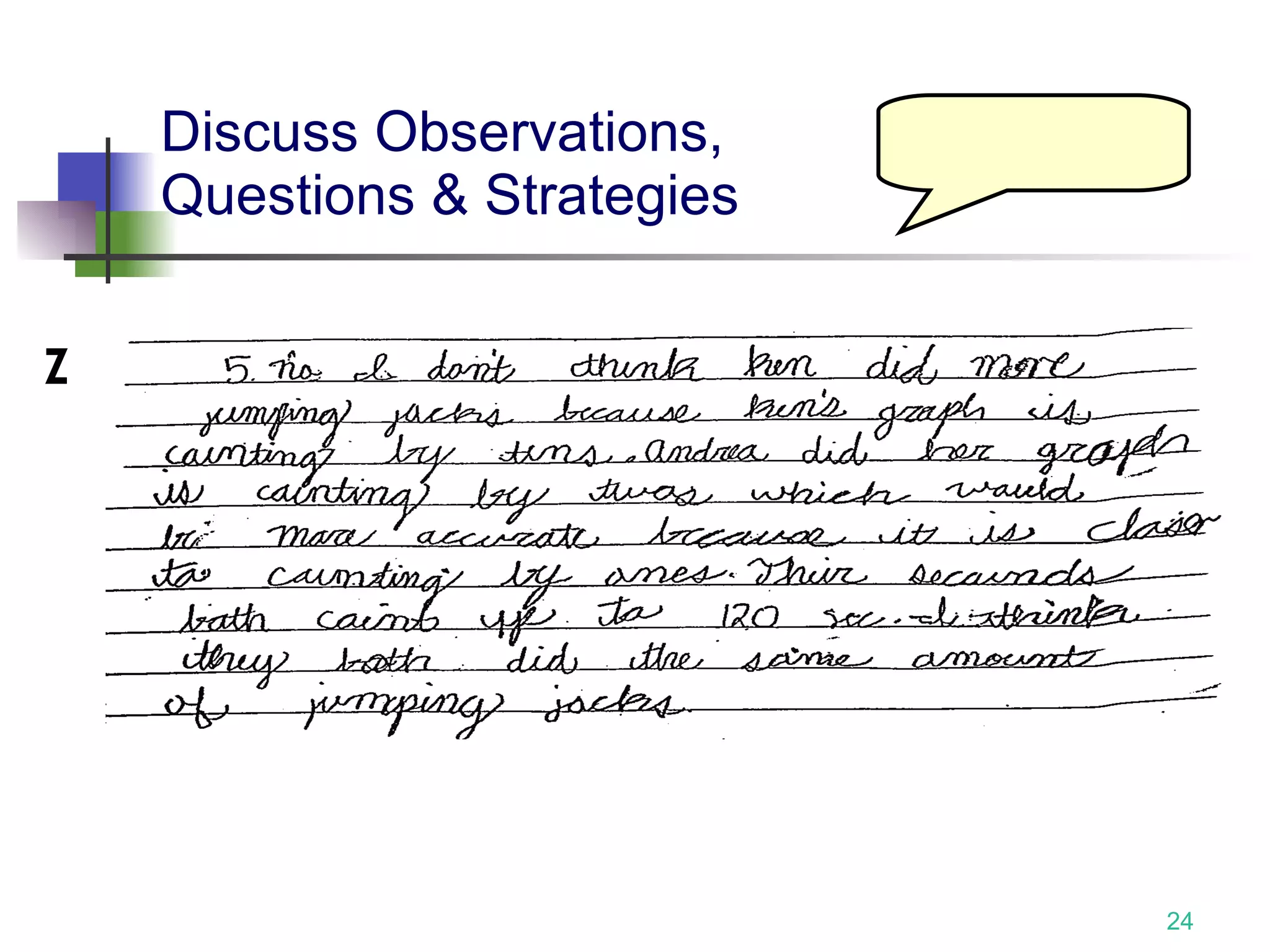
LASW Directions 1.  Look at the samples from three 6 th  graders.  2.  Then focus on Student Z.  Write notes on your LASW Tool. 3.  In small groups, discuss Student Z’s work. Strengths and Difficulties Questions and Strategies HO 5  Students X, Y, Z HO4  LASW Tool
Discuss Observations,  Questions & Strategies Z
Discuss Observations, Questions & Strategies X Y Z
Teachers Discuss  Writing Strategies for Math Look over the list of strategies. What strategies might be helpful to your students, especially those with disabilities? Why? What’s one strategy that you currently use? How do you use it? HO6 Writing Strategies
#4: Expand Teachers’ Repertoires of Vocabulary Strategies In this section, we will examine pd activities designed to: View video to spark reflection & discussion Explore vocabulary challenges Provide & practice strategies
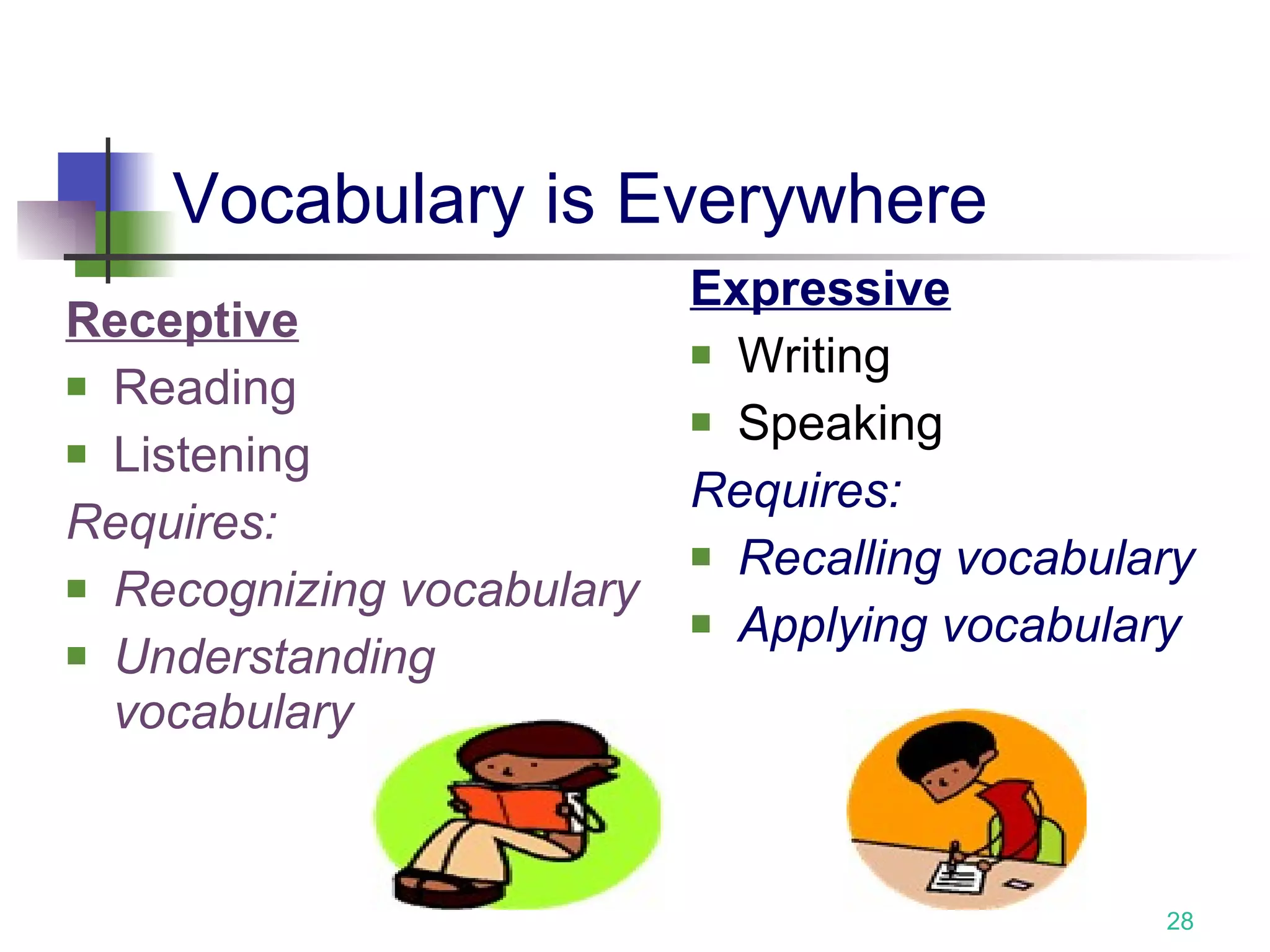
Vocabulary is Everywhere Receptive Reading Listening Requires: Recognizing vocabulary Understanding vocabulary Expressive Writing Speaking Requires: Recalling vocabulary Applying vocabulary
Complexities of  Mathematics Vocabulary   Some terms… are shared with everyday English but have distinct meanings in mathematics Right, volume, expression sound like everyday English words Sum and Some have more than one meaning in mathematics Square, round are related and often confused Mean and median Source: Rubenstein, R. 2007 HO 7: Math Vocabulary
Vocabulary in the Geometry & Data Strands 2 Video Clips: 7th grade class: Data 6th grade class: Geometry Video Reminder One teacher/one day An example to spark reflection and discussion
As You Watch, Keep in Mind Focus Question What strategies does each teacher use to help students to understand the vocabulary in the lesson? HO 8: Video Notes
Discuss with  a Partner What strategies did you observe the teachers use to help students understand vocabulary?
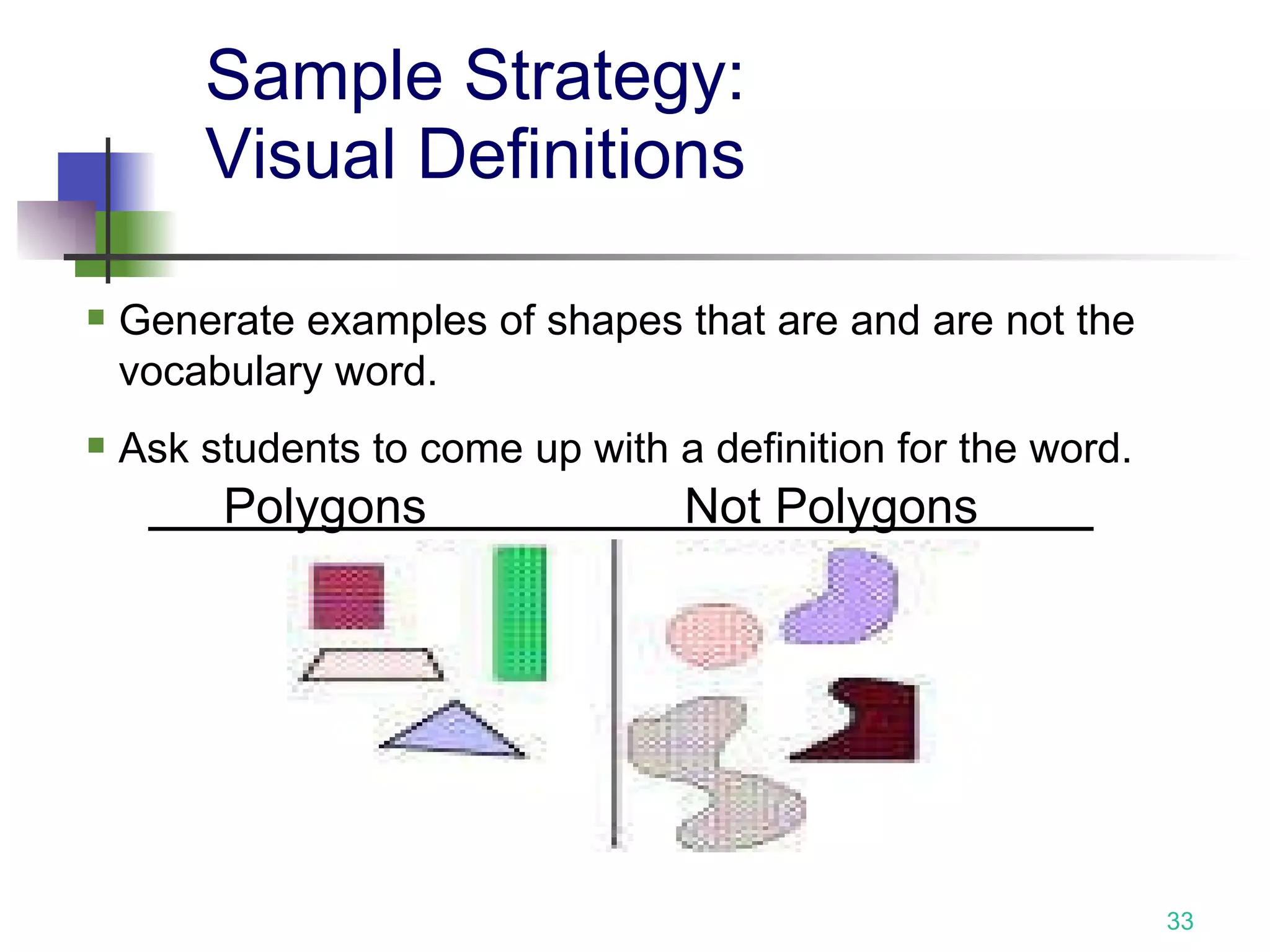
Sample Strategy:  Visual Definitions Polygons     Not Polygons Generate examples of shapes that are and are not the vocabulary word. Ask students to come up with a definition for the word.
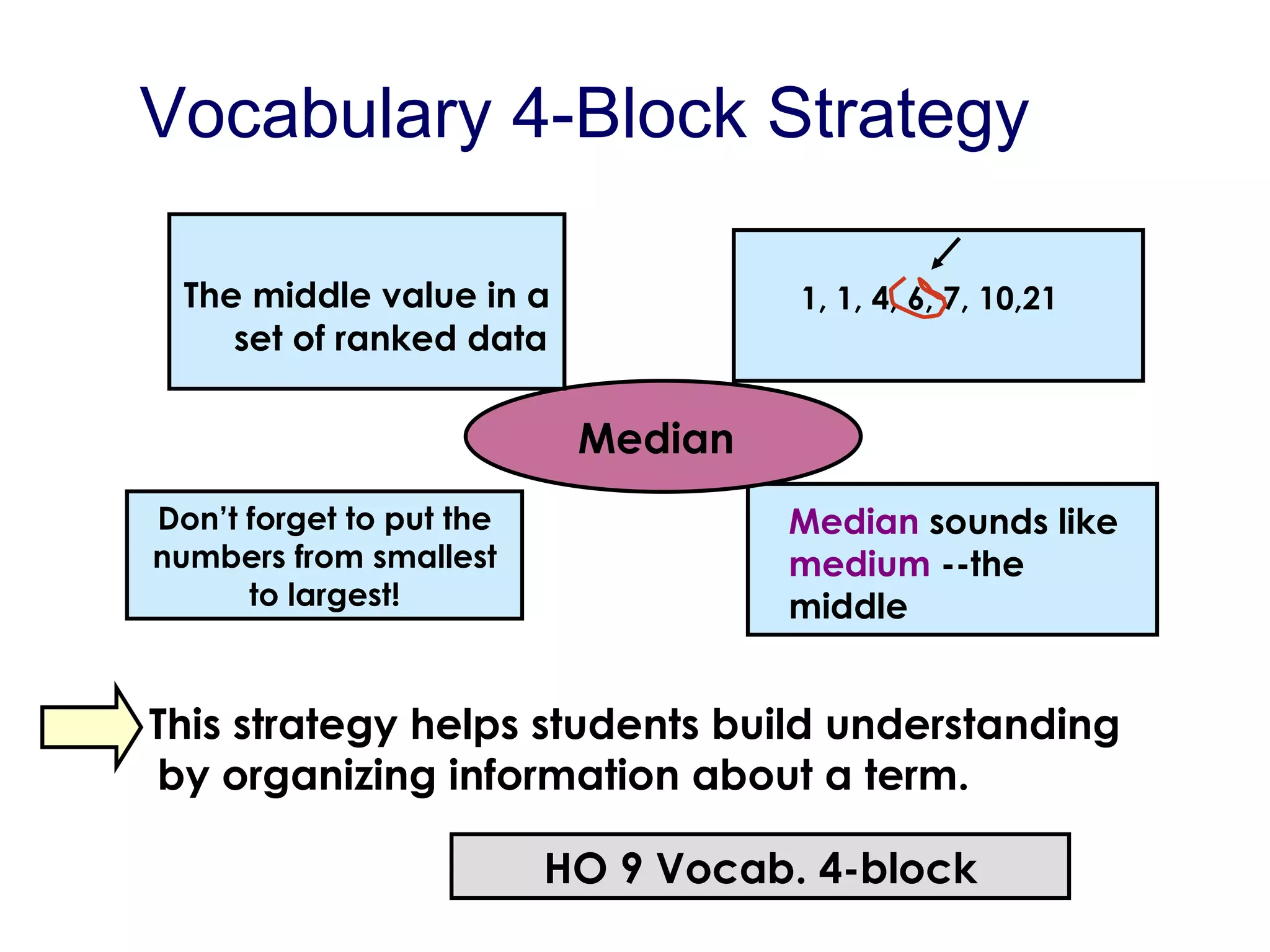
Vocabulary 4-Block Strategy The middle value in a set of ranked data Median 1, 1, 4, 6, 7, 10,21 Median  sounds like  medium  --the middle Don’t forget to put the numbers from smallest to largest! This strategy helps students build understanding by organizing information about a term. HO 9 Vocab. 4-block
Discussion Questions for Teachers Reflect on Your Experience In what ways did you find filling the 4-block to be helpful to you? Were some blocks harder to fill in than others? Discuss Ways for Using the 4-Block with Students Which words would you want your students to use? After students complete the cards, what are ways they could continue to use them in active ways?
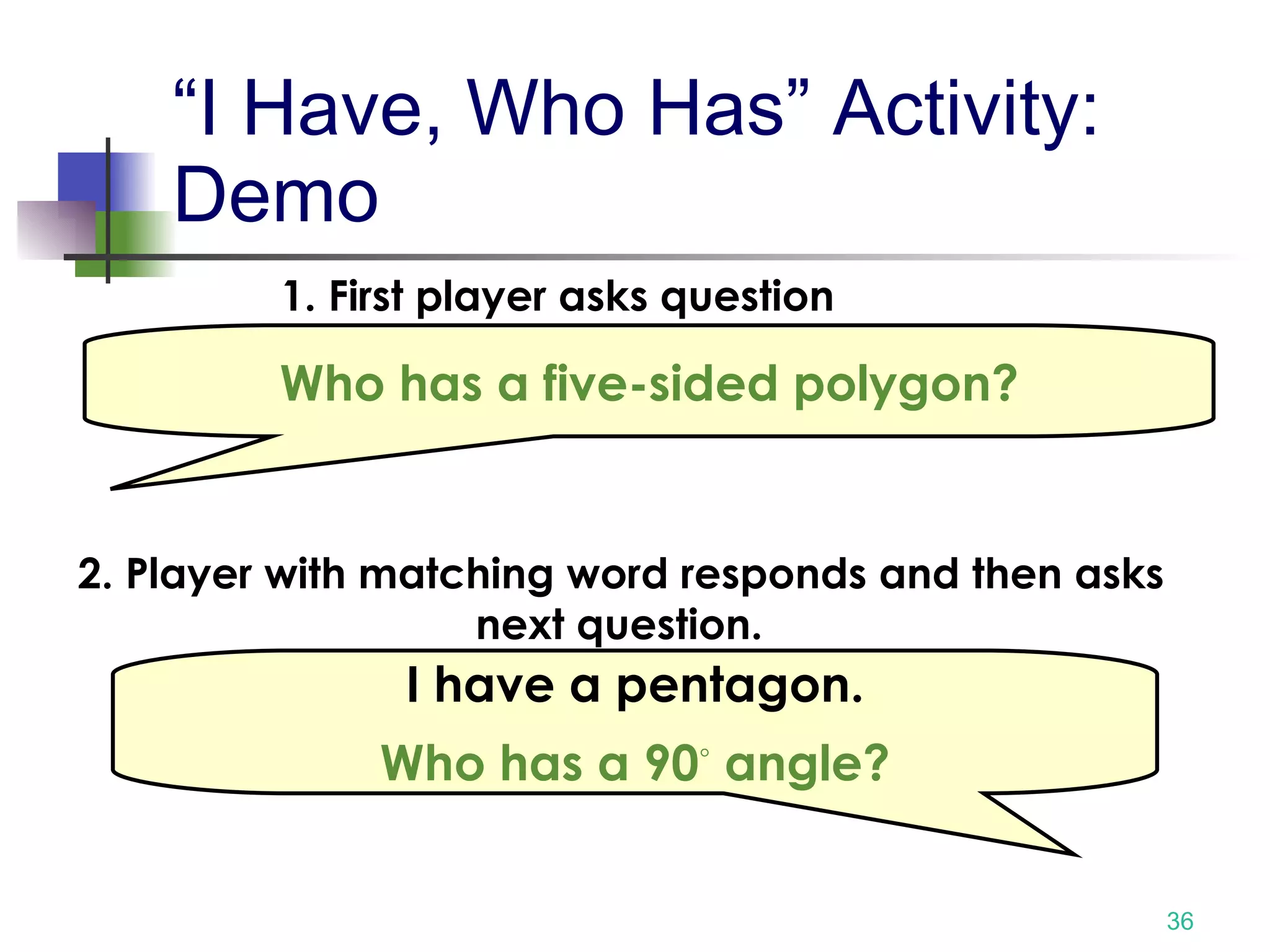
“I Have, Who Has” Activity: Demo Who has a five-sided polygon? 1. First player asks question I have a pentagon. Who has a 90 ◦  angle? 2. Player with matching word responds and then asks next question.
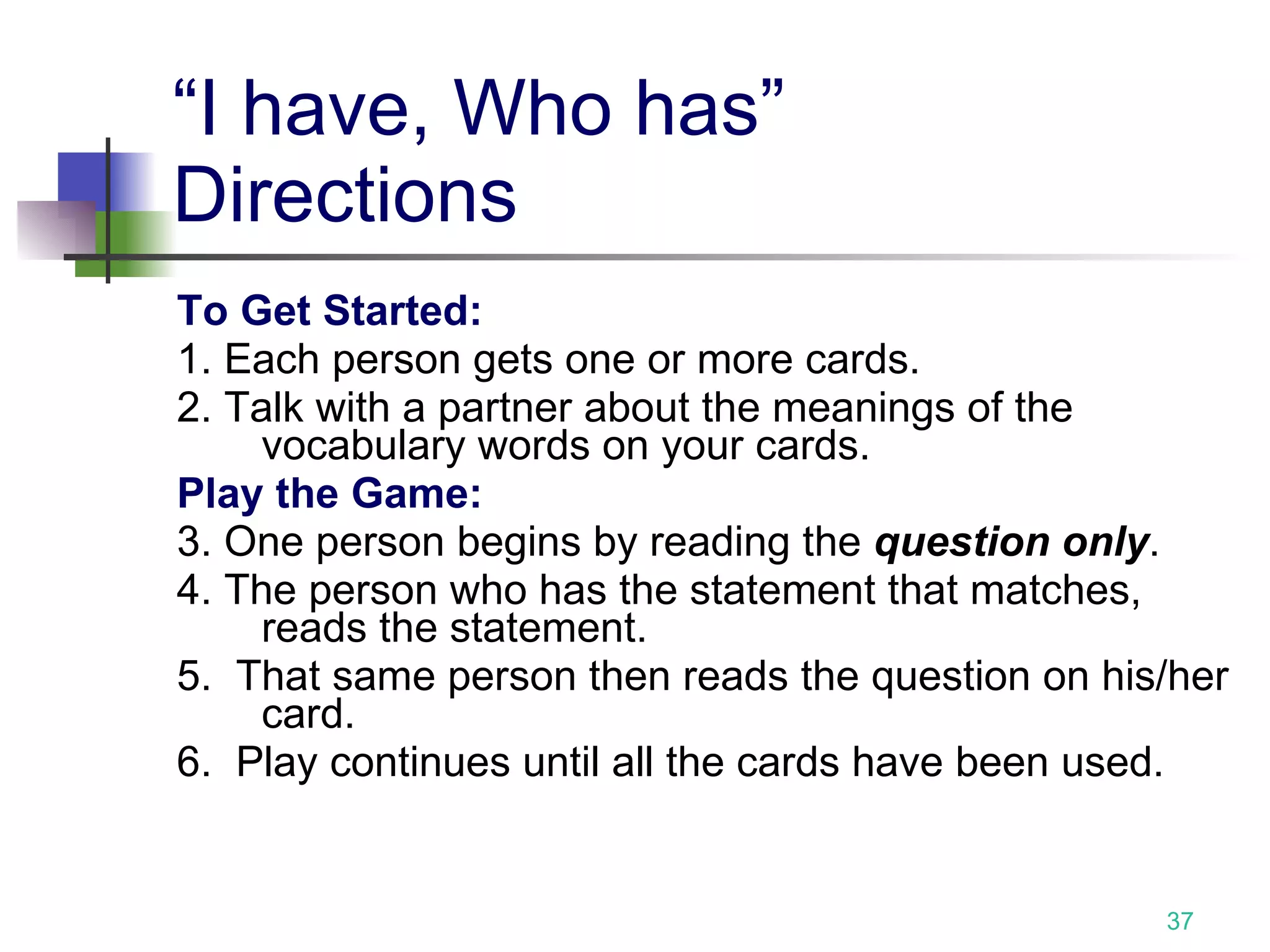
“I have, Who has” Directions To Get Started: 1. Each person gets one or more cards. 2. Talk with a partner about the meanings of the vocabulary words on your cards. Play the Game: 3. One person begins by reading the  question only . 4. The person who has the statement that matches, reads the statement. 5.  That same person then reads the question on his/her card. 6.  Play continues until all the cards have been used.
Discussion Questions  for Teachers How do you or would you use the “I have, who has” vocabulary activity with students? How would you make it more accessible to students with learning disabilities?
Things to Keep in Mind:  Vocabulary in Mathematics Identify critical terms and phrases (5-7 is better than 20-25). Students need  many  opportunities to speak, read, write and listen to mathematics vocabulary. Sometimes the words that prevent students from solving a task are not mathematical terms. Handout 10: Analyzing a Math Task
#5: Provide Planning Processes  and Tools In this section, we will: Consider the challenges for teachers in addressing language and vocabulary in instruction Share ideas for facing these challenges Examine sample planning processes and tools
Common Challenges Vocabulary strategies, such as word walls and index card dictionaries, are created but then are not used in active or ongoing ways Math teachers may lack knowledge of language strategies and/or ways to incorporate strategies in lessons Limited time in math lessons
Suggestions for Math Supervisors Incorporate language and vocabulary planning as a regular feature of lesson planning Provide a structure for planning Encourage collaboration to share ideas and resources Set and clarify expectations for incorporating language strategies Handout 11: Sample Planner
Share Your Experience What are your suggestions for helping mathematics teachers with language and vocabulary strategies?
Closing  Questions and Comments [email_address] .org [email_address]
Optional Slides
Suggestions: Using LASW in PD Caution : teachers may jump to strategies. Use an organizer and provide ample time to discuss student’s strengths and difficulties first.  Consider questions to ask to gather more information before choosing strategies Emphasize  aligning  strategies with math goals and student Consider ways to build on student’s strengths to help address difficulties Provide work from a range of learners

Language in the Math Classroom

  • 1.
    Improving Access toLanguage In Mathematics Emily Fagan & Amy Brodesky, EDC Welcome! Please complete the warm-up (HO 1)
  • 2.
    Our PD ProjectsAddressing Accessibility in Mathematics http: //edc . org/accessMath/ Mathematics Improvement Toolkit http://www.mgforum.org/ (June or July 2009)
  • 3.
    Our PD Goalsfor Language in Math Build teachers’ knowledge of… the kinds of language demands in math lessons common difficulties that students with learning disabilities strategies for addressing these difficulties ways to plan accessible math lessons that incorporate active language strategies
  • 4.
    Lessons Learned aboutPD on Language Strategies for Math Tends to be a motivating and engaging topic for math teachers & special educators Helpful to unpack language demands & difficulties Provides an opportunity for special educators to share expertise and to foster collaboration between special educators & math teachers Needs to go beyond “activities” to integrating language strategies into math instruction
  • 5.
    Session Agenda LanguageDemands in Mathematics Sample Lesson Writing in Math Math Vocabulary Planning for Language Accessibility We hope you will leave with PD ideas to use with teachers in your schools/districts.
  • 6.
    #1: Examine the Language Demands in Mathematics Lessons In this section, we will: Discuss the kinds of language demands in mathematics lessons Learn about the complexities of reading in mathematics Consider language challenges for students with disabilities
  • 7.
    Communication Standard: Goalsfor Students Organize and consolidate their mathematical thinking through communication; Communicate their mathematical thinking coherently and clearly to peers, teachers, and others; Analyze and evaluate the mathematical thinking and strategies of others; Use the language of mathematics to express mathematics ideas precisely. Source: Principles and Standards for School Mathematics (NCTM), 2002
  • 8.
    Types of Language Demands Receptive Reading Listening Expressive Writing Speaking Examples for students with disabilities: Reading : Decoding; Comprehension Listening : Auditory Processing Writing : Organizing ideas in writing Speaking : Expressing ideas orally
  • 9.
    Student’sPerspective Source: “Faking It” by C. Lee and R. Jackson “ When I am listening or reading a word problem, I sometimes leave out or reverse important information. When I am struggling through the words, I lose the meaning of the problem.” Source: “Faking It” by C. Lee and R. Jackson
  • 10.
    Reading in MathematicsClass Compare: FICTION Dorothy lived in the midst of the great Kansas prairies, with Uncle Henry, who was a farmer, and Aunt Em, who was the farmer's wife. Their house was small, for the lumber to build it had to be carried by wagon many miles. Baum, L. F. p.1 MATHEMATICS TEXT The sum of two numbers having the same sign can be found by adding their absolute values, the answer having the same sign as the numbers. What differences do you notice?
  • 11.
    What’s different aboutreading mathematics texts? Conceptually dense Not just words – also symbols, tables, graphs and diagrams Not just left to right-different directions Different symbols are used to describe the same process Multiplication *, x, (), ● Decoding symbols is different from decoding words. Symbols are like “sight words.” Barton and Heidema, 2002, p. 1
  • 12.
    #2: Usea Sample Lesson for Professional Development In this section, we will: watch and discuss a video of a lesson that involves reading, discussing, and writing about abstract equations
  • 13.
    PD Simulation: View and Discuss a Video Goals: Provide examples of strategies in action Provide a shared experience to generate discussion
  • 14.
    Mathematics Lesson inVideo Reviews vocabulary from their curriculum Factored Form: ( x +1)( x +4) Expanded Form: x 2 + 4 x + 1 Uses an area model for equations Uses Algebra Tiles (manipulatives) x 2 x Algebra Tiles 1 HO 2A: Lesson
  • 15.
    Video: Background StudentsSix 8 th grade students, including students with disabilities and English Language Learners Identified for additional support because they were having difficulties in regular mathematics class As a group, these students tend to be reluctant to participate Teacher Title I Mathematics Coach Co-teaches 8 th grade mathematics class AND provides additional mathematics support to these students
  • 16.
    As You Watch, Keep in Mind… One teacher, one day An example to spark discussion Focus Question What kinds of strategies does the teacher use to make the language of the mathematics accessible? HO 2: Video Notes
  • 17.
    Discuss: What kindsof difficulties did the students have? What strategies did the teacher use to make the language of mathematics more accessible? What strategies do you find helpful for encouraging reluctant students to participate?
  • 18.
    #3: Focus onWriting Strategies for Mathematics Class In this section, we will simulate a professional development experience in which teacher participants: Write a response to a mathematics problem Examine student work samples Discuss writing strategies
  • 19.
    Why Write in Mathematics? Writing can help students to: build understanding of mathematics organize and clarify ideas deepen their thinking communicate coherently and clearly remember mathematics content Writing has many benefits. But, it also poses barriers for some students.
  • 20.
    PD Simulation: Lookingat Student Work What do teachers do? Write a response to a math problem. Discuss their experiences. Analyze the problem from accessibility lens. Examine student work samples. HO 3: Jumping Jacks
  • 21.
    Analyze Problem froman Accessibility Lens What are the math goals ? What are the demands on students? Conceptual Language Visual-Spatial What potential difficulties would you anticipate for students? HO 3 Jumping Jacks
  • 22.
    Looking at StudentWork (LASW) Key Questions 1. What do you observe about the student’s math understanding ? 2. What do you observe about the student’s writing ? HO 4 LASW Tool
  • 23.
    LASW Directions 1. Look at the samples from three 6 th graders. 2. Then focus on Student Z. Write notes on your LASW Tool. 3. In small groups, discuss Student Z’s work. Strengths and Difficulties Questions and Strategies HO 5 Students X, Y, Z HO4 LASW Tool
  • 24.
    Discuss Observations, Questions & Strategies Z
  • 25.
  • 26.
    Teachers Discuss Writing Strategies for Math Look over the list of strategies. What strategies might be helpful to your students, especially those with disabilities? Why? What’s one strategy that you currently use? How do you use it? HO6 Writing Strategies
  • 27.
    #4: Expand Teachers’Repertoires of Vocabulary Strategies In this section, we will examine pd activities designed to: View video to spark reflection & discussion Explore vocabulary challenges Provide & practice strategies
  • 28.
    Vocabulary is EverywhereReceptive Reading Listening Requires: Recognizing vocabulary Understanding vocabulary Expressive Writing Speaking Requires: Recalling vocabulary Applying vocabulary
  • 29.
    Complexities of Mathematics Vocabulary Some terms… are shared with everyday English but have distinct meanings in mathematics Right, volume, expression sound like everyday English words Sum and Some have more than one meaning in mathematics Square, round are related and often confused Mean and median Source: Rubenstein, R. 2007 HO 7: Math Vocabulary
  • 30.
    Vocabulary in theGeometry & Data Strands 2 Video Clips: 7th grade class: Data 6th grade class: Geometry Video Reminder One teacher/one day An example to spark reflection and discussion
  • 31.
    As You Watch,Keep in Mind Focus Question What strategies does each teacher use to help students to understand the vocabulary in the lesson? HO 8: Video Notes
  • 32.
    Discuss with a Partner What strategies did you observe the teachers use to help students understand vocabulary?
  • 33.
    Sample Strategy: Visual Definitions Polygons Not Polygons Generate examples of shapes that are and are not the vocabulary word. Ask students to come up with a definition for the word.
  • 34.
    Vocabulary 4-Block StrategyThe middle value in a set of ranked data Median 1, 1, 4, 6, 7, 10,21 Median sounds like medium --the middle Don’t forget to put the numbers from smallest to largest! This strategy helps students build understanding by organizing information about a term. HO 9 Vocab. 4-block
  • 35.
    Discussion Questions forTeachers Reflect on Your Experience In what ways did you find filling the 4-block to be helpful to you? Were some blocks harder to fill in than others? Discuss Ways for Using the 4-Block with Students Which words would you want your students to use? After students complete the cards, what are ways they could continue to use them in active ways?
  • 36.
    “I Have, WhoHas” Activity: Demo Who has a five-sided polygon? 1. First player asks question I have a pentagon. Who has a 90 ◦ angle? 2. Player with matching word responds and then asks next question.
  • 37.
    “I have, Whohas” Directions To Get Started: 1. Each person gets one or more cards. 2. Talk with a partner about the meanings of the vocabulary words on your cards. Play the Game: 3. One person begins by reading the question only . 4. The person who has the statement that matches, reads the statement. 5. That same person then reads the question on his/her card. 6. Play continues until all the cards have been used.
  • 38.
    Discussion Questions for Teachers How do you or would you use the “I have, who has” vocabulary activity with students? How would you make it more accessible to students with learning disabilities?
  • 39.
    Things to Keepin Mind: Vocabulary in Mathematics Identify critical terms and phrases (5-7 is better than 20-25). Students need many opportunities to speak, read, write and listen to mathematics vocabulary. Sometimes the words that prevent students from solving a task are not mathematical terms. Handout 10: Analyzing a Math Task
  • 40.
    #5: Provide PlanningProcesses and Tools In this section, we will: Consider the challenges for teachers in addressing language and vocabulary in instruction Share ideas for facing these challenges Examine sample planning processes and tools
  • 41.
    Common Challenges Vocabularystrategies, such as word walls and index card dictionaries, are created but then are not used in active or ongoing ways Math teachers may lack knowledge of language strategies and/or ways to incorporate strategies in lessons Limited time in math lessons
  • 42.
    Suggestions for MathSupervisors Incorporate language and vocabulary planning as a regular feature of lesson planning Provide a structure for planning Encourage collaboration to share ideas and resources Set and clarify expectations for incorporating language strategies Handout 11: Sample Planner
  • 43.
    Share Your ExperienceWhat are your suggestions for helping mathematics teachers with language and vocabulary strategies?
  • 44.
    Closing Questionsand Comments [email_address] .org [email_address]
  • 45.
  • 46.
    Suggestions: Using LASWin PD Caution : teachers may jump to strategies. Use an organizer and provide ample time to discuss student’s strengths and difficulties first. Consider questions to ask to gather more information before choosing strategies Emphasize aligning strategies with math goals and student Consider ways to build on student’s strengths to help address difficulties Provide work from a range of learners