Critical Assignment 2
Flipchart
Before, During, and After Reading Strategies
Kimberly Demusz
Due Date: 11/19/15
RED 4348
Professor Engle
Before Reading Strategies
 Picture Walk
 K-W-L
 List-Group-Label
 Ask Questions
 Vocabulary Preview
Picture Walk
 Students will look through the pictures of a book.
 Done before reading an unfamiliar story
 Allows students to make predictions about what the text will
be about.
 Familiarizes students with the story prior to reading or
introducing the text.
K-W-L
 A chart that has three columns
 K-W-L stands for what you know, what you want to know,
and what you learned.
 This strategy will allow students to activate their prior
knowledge before reading.
 Students will create a chart and write what they know about
a topic before we read.
List-Group-Label
 Step one: Select a topic and brainstorm a list of related words about the
topic
 Step two: Group the words into subcategories
 Step three: Label the groupings with descriptive titles
 Helps students learn new vocabulary and content by using their critical
thinking skills.
 Develops categorizing skills and builds background knowledge about a
topic
 Increases brainstorming skills about a topic and helps students create
categories with their list and state why they fit into that category.
Ask Questions
 Asking questions before reading increases interest about a topic and
prepares students to read.
 When students ask questions before reading they will read selectively
through the text to find their answers and review important points in
the text.
 Allows the reader to think about what the text will be about before they
read.
 Example Questions:
“What is the story about?”
“What does the character want?”
“Will she get it?” “If so, how?”
Vocabulary Preview
 Students will preview unknown words so the following can
improve together; background information, new word
understanding, and comprehension of the text.
 List all words that will be important for students to
understand and quiz them on their meaning before moving
on.
 Students will become familiar with new words.
During Reading Strategies
 ReQuest
 Story Map
 Reciprocal Teaching
 Think aloud
 Mark the text
ReQuest
 Means reciprocal questioning
 Strategy that reverses roles from the teacher asking students
questions to the students asking questions of the teacher.
 Allows the students to brainstorm questions that they think are
important.
 Increases reading comprehension of the text because the
students will need to know what the text is about or what is going
on in the story to ask the teacher questions.
 Teacher will ask follow-up questions, and model effective
questioning for readers
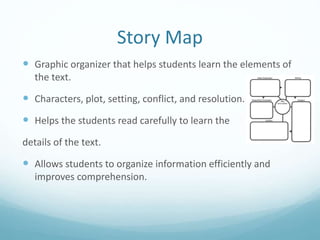
Story Map
 Graphic organizer that helps students learn the elements of
the text.
 Characters, plot, setting, conflict, and resolution.
 Helps the students read carefully to learn the
details of the text.
 Allows students to organize information efficiently and
improves comprehension.
Reciprocal Teaching
 Students become the teacher in
small groups
 Encourages students to think
about their own thought process
during reading.
 Helps students to be actively
involved and monitor their own
comprehension as they read.
 Students will learn to ask
questions during reading.
 Group of students will have one
of the following roles;
summarizer, questioner, clarifier,
and predictor.
 Summarizer: highlights key ideas
 Questioner: creates questions
about the text having to do with
unclear parts or puzzling
information.
 Clarifier: addresses confusing
parts and answers any questions
that were just posed.
 Predictor: predicts what the
author will tell the group next, or
what event will happen next.
Think aloud
 Teacher models what the students should be thinking about,
while they are reading.
 Teacher will stop at any point to ask a question about the
text during reading and students will answer questions
posed by the teacher.
 Helps students slow down their reading process and monitor
to make meaning of the text.
 Students will learn to re-read a sentence, read ahead to
clarify, or look for context clues to make sense of what they
have read by the teacher monitoring this behavior.
Mark the text
 Students identify important concepts in the text that they
should know about or refer back to.
 Taking notes on the text like writing down the setting or
characters in the margin, circling unknown words,
underlining the main idea, or highlighting important
information.
 Improves students comprehension and recall.
 Students will be able to better summarize the text and make
meaning of what they have read.
After Reading Strategies
 Summarizing
 Exit Slips
 Sequence Chart
 Umbrella
 Team Review
Summarizing
 Students are able to focus on key ideas and phrases of a text
that are important to remember and take note of.
 Teaches students to take large sections of a text and reduce
it down to the main points for more simplified information.
 Summarizing is a great way to teach students to look for the
major concepts in a piece of text and consolidate important
details that support those ideas.
 This is a skill to be learned over time, not acquired.
Exit Slips
 Students fill out a slip of paper with questions on it to show
what they have gained from the lesson.
 These slips get turned into the teacher for he/she to review.
The teacher will be able to determine if he/she needs to go
back for the students who are below level or give any
students enrichment.
 Quick informal assessments enable teachers to assess
students understanding of the material.
Sequence chart
 Helps students recognize organizational patterns in the text,
steps in a process, and the importance of sequential order.
 Students will learn the order that events occurred.
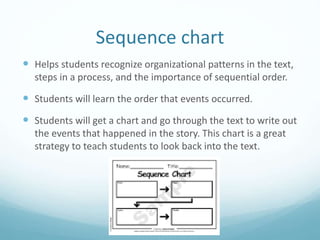
 Students will get a chart and go through the text to write out
the events that happened in the story. This chart is a great
strategy to teach students to look back into the text.
Umbrella
 Graphic organizer to address the main idea in a type of text.
 Used to help students identify the main idea and the related
supporting details of a text.
 A specific topic goes on top of the umbrella and students will
need to write the details under the umbrella that connect with
this topic.
 Details would be located in the text.
 The teacher will be able to determine how much the student
understands by pulling the main idea and supporting details from
the text.
Team review
 Students will be placed in groups and given the opportunity to
review the text that they have been working on and share their
knowledge with other students.
 Students will learn about what others think and add those ideas
to theirs.
 Teaches students how to express themselves to convey ideas to
others. It will also improve students speaking skills in front of the
class and discussion.
 Students will understand more
when they discuss with others what
they have learned.
References
 After Reading. (n.d.). Retrieved November 19, 2015, from
http://www.scps.k12.fl.us/curriculum/AcademicCore/LanguageArtsandReading/
SecondaryReading/AfterReading.aspx
 Bursuck, W., (2011). Teaching Reading to Students Who Are At Risk or Have
Disabilities: A Multi-Tier Approach (2nd ed.). Upper Saddle River, N.J.:Pearson
 List-Group-Label. (n.d.). Retrieved November 19, 2015, from
http://www.readingrockets.org/strategies/list_group_label
 Taking a Picture Walk. (n.d.). Retrieved November 19, 2015, from
http://www.handsandvoices.org/articles/education/ed/V11-2_picturewalk.htm
 Think-alouds. (n.d.). Retrieved November 19, 2015, from
http://www.readingrockets.org/strategies/think_alouds

Critical assignment 2 Kimberly Demusz

  • 1.
    Critical Assignment 2 Flipchart Before,During, and After Reading Strategies Kimberly Demusz Due Date: 11/19/15 RED 4348 Professor Engle
  • 2.
  • 3.
     Picture Walk K-W-L  List-Group-Label  Ask Questions  Vocabulary Preview
  • 4.
    Picture Walk  Studentswill look through the pictures of a book.  Done before reading an unfamiliar story  Allows students to make predictions about what the text will be about.  Familiarizes students with the story prior to reading or introducing the text.
  • 5.
    K-W-L  A chartthat has three columns  K-W-L stands for what you know, what you want to know, and what you learned.  This strategy will allow students to activate their prior knowledge before reading.  Students will create a chart and write what they know about a topic before we read.
  • 6.
    List-Group-Label  Step one:Select a topic and brainstorm a list of related words about the topic  Step two: Group the words into subcategories  Step three: Label the groupings with descriptive titles  Helps students learn new vocabulary and content by using their critical thinking skills.  Develops categorizing skills and builds background knowledge about a topic  Increases brainstorming skills about a topic and helps students create categories with their list and state why they fit into that category.
  • 7.
    Ask Questions  Askingquestions before reading increases interest about a topic and prepares students to read.  When students ask questions before reading they will read selectively through the text to find their answers and review important points in the text.  Allows the reader to think about what the text will be about before they read.  Example Questions: “What is the story about?” “What does the character want?” “Will she get it?” “If so, how?”
  • 8.
    Vocabulary Preview  Studentswill preview unknown words so the following can improve together; background information, new word understanding, and comprehension of the text.  List all words that will be important for students to understand and quiz them on their meaning before moving on.  Students will become familiar with new words.
  • 9.
  • 10.
     ReQuest  StoryMap  Reciprocal Teaching  Think aloud  Mark the text
  • 11.
    ReQuest  Means reciprocalquestioning  Strategy that reverses roles from the teacher asking students questions to the students asking questions of the teacher.  Allows the students to brainstorm questions that they think are important.  Increases reading comprehension of the text because the students will need to know what the text is about or what is going on in the story to ask the teacher questions.  Teacher will ask follow-up questions, and model effective questioning for readers
  • 12.
    Story Map  Graphicorganizer that helps students learn the elements of the text.  Characters, plot, setting, conflict, and resolution.  Helps the students read carefully to learn the details of the text.  Allows students to organize information efficiently and improves comprehension.
  • 13.
    Reciprocal Teaching  Studentsbecome the teacher in small groups  Encourages students to think about their own thought process during reading.  Helps students to be actively involved and monitor their own comprehension as they read.  Students will learn to ask questions during reading.  Group of students will have one of the following roles; summarizer, questioner, clarifier, and predictor.  Summarizer: highlights key ideas  Questioner: creates questions about the text having to do with unclear parts or puzzling information.  Clarifier: addresses confusing parts and answers any questions that were just posed.  Predictor: predicts what the author will tell the group next, or what event will happen next.
  • 14.
    Think aloud  Teachermodels what the students should be thinking about, while they are reading.  Teacher will stop at any point to ask a question about the text during reading and students will answer questions posed by the teacher.  Helps students slow down their reading process and monitor to make meaning of the text.  Students will learn to re-read a sentence, read ahead to clarify, or look for context clues to make sense of what they have read by the teacher monitoring this behavior.
  • 15.
    Mark the text Students identify important concepts in the text that they should know about or refer back to.  Taking notes on the text like writing down the setting or characters in the margin, circling unknown words, underlining the main idea, or highlighting important information.  Improves students comprehension and recall.  Students will be able to better summarize the text and make meaning of what they have read.
  • 16.
  • 17.
     Summarizing  ExitSlips  Sequence Chart  Umbrella  Team Review
  • 18.
    Summarizing  Students areable to focus on key ideas and phrases of a text that are important to remember and take note of.  Teaches students to take large sections of a text and reduce it down to the main points for more simplified information.  Summarizing is a great way to teach students to look for the major concepts in a piece of text and consolidate important details that support those ideas.  This is a skill to be learned over time, not acquired.
  • 19.
    Exit Slips  Studentsfill out a slip of paper with questions on it to show what they have gained from the lesson.  These slips get turned into the teacher for he/she to review. The teacher will be able to determine if he/she needs to go back for the students who are below level or give any students enrichment.  Quick informal assessments enable teachers to assess students understanding of the material.
  • 20.
    Sequence chart  Helpsstudents recognize organizational patterns in the text, steps in a process, and the importance of sequential order.  Students will learn the order that events occurred.  Students will get a chart and go through the text to write out the events that happened in the story. This chart is a great strategy to teach students to look back into the text.
  • 21.
    Umbrella  Graphic organizerto address the main idea in a type of text.  Used to help students identify the main idea and the related supporting details of a text.  A specific topic goes on top of the umbrella and students will need to write the details under the umbrella that connect with this topic.  Details would be located in the text.  The teacher will be able to determine how much the student understands by pulling the main idea and supporting details from the text.
  • 22.
    Team review  Studentswill be placed in groups and given the opportunity to review the text that they have been working on and share their knowledge with other students.  Students will learn about what others think and add those ideas to theirs.  Teaches students how to express themselves to convey ideas to others. It will also improve students speaking skills in front of the class and discussion.  Students will understand more when they discuss with others what they have learned.
  • 23.
    References  After Reading.(n.d.). Retrieved November 19, 2015, from http://www.scps.k12.fl.us/curriculum/AcademicCore/LanguageArtsandReading/ SecondaryReading/AfterReading.aspx  Bursuck, W., (2011). Teaching Reading to Students Who Are At Risk or Have Disabilities: A Multi-Tier Approach (2nd ed.). Upper Saddle River, N.J.:Pearson  List-Group-Label. (n.d.). Retrieved November 19, 2015, from http://www.readingrockets.org/strategies/list_group_label  Taking a Picture Walk. (n.d.). Retrieved November 19, 2015, from http://www.handsandvoices.org/articles/education/ed/V11-2_picturewalk.htm  Think-alouds. (n.d.). Retrieved November 19, 2015, from http://www.readingrockets.org/strategies/think_alouds