Literacy Practice: PromotingLiteracy Practice: Promoting
Content Area ReadingContent Area Reading
Designed byDesigned by
Brenda StephensonBrenda Stephenson
The University of TennesseeThe University of Tennessee
At the end of thisAt the end of this
presentation studentspresentation students
should:should:
 Define the concepts for promoting readingDefine the concepts for promoting reading
comprehension through content areacomprehension through content area
reading materials.reading materials.
 Identify ways of using content area readingIdentify ways of using content area reading
materials to promote readingmaterials to promote reading
comprehension in the classroom.comprehension in the classroom.
 List materials and resources available toList materials and resources available to
accomplish this practice.accomplish this practice.
Content Area ReadingContent Area Reading
……refers to therefers to the challenge ofchallenge of
readingreading in thein the academic areasacademic areas
such as science, socialsuch as science, social
studies, mathematics,studies, mathematics,
literature, and the arts.literature, and the arts.
Content Area ReadingContent Area Reading
 ScaffoldingScaffolding
provides aprovides a
systematicsystematic
approachapproach toto
address theaddress the
challenges ofchallenges of
Content AreaContent Area
Reading.Reading.
Content Area Reading:Content Area Reading:
ScaffoldingScaffolding
 instructional technique using teacher
modeling to introduce the desired learning
strategy or task, then gradually shifts
responsibility to the students
 Scaffolding Graph
Content Area Reading:Content Area Reading:
ScaffoldingScaffolding
 supports students beforebefore, duringduring, and afterafter they
read.
 enablesenables students to accomplish what is
normally beyond their abilitiesbeyond their abilities.
 provides enough helphelp so students can succeedsucceed
with a task that otherwiseotherwise would be impossibleimpossible.
(Graves & Graves, 1994)
Video ClipVideo Clip
 Biology Content VideoBiology Content Video
Content Area Reading:Content Area Reading:
ScaffoldingScaffolding
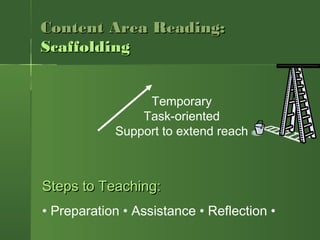
Temporary
Task-oriented
Support to extend reach
Steps to Teaching:Steps to Teaching:
• Preparation • Assistance • Reflection •
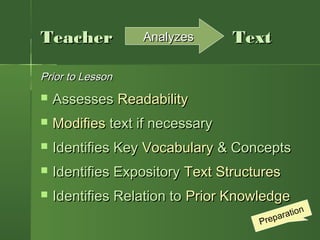
TeacherTeacher TextText
Prior to LessonPrior to Lesson
 AssessesAssesses ReadabilityReadability
 ModifiesModifies text if necessarytext if necessary
 Identifies KeyIdentifies Key VocabularyVocabulary & Concepts& Concepts
 Identifies ExpositoryIdentifies Expository Text StructuresText Structures
 Identifies Relation toIdentifies Relation to Prior KnowledgePrior Knowledge
AnalyzesAnalyzes
Preparation
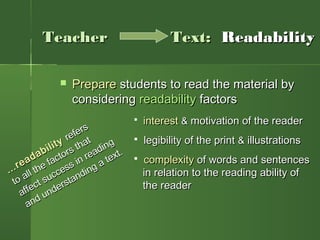
 PreparePrepare students to read the material bystudents to read the material by
consideringconsidering readabilityreadability factorsfactors
……readability
readability refers
refers
to all the factors that
affect success in reading
and understanding a text.
 interestinterest && motivation of the readermotivation of the reader
 legibility of the printlegibility of the print && illustrationsillustrations
 complexitycomplexity of words and sentencesof words and sentences
in relation to the reading ability ofin relation to the reading ability of
the readerthe reader
TeacherTeacher Text:Text: ReadabilityReadability
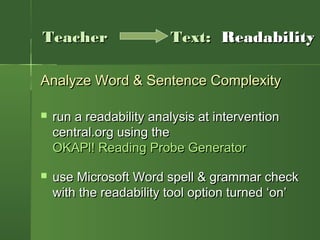
Analyze Word & Sentence ComplexityAnalyze Word & Sentence Complexity
 run a readability analysis at interventionrun a readability analysis at intervention
central.org using thecentral.org using the
OKAPl! Reading Probe GeneratorOKAPl! Reading Probe Generator
 use Microsoft Word spell & grammar checkuse Microsoft Word spell & grammar check
with the readability tool option turned ‘on’with the readability tool option turned ‘on’
TeacherTeacher Text:Text: ReadabilityReadability
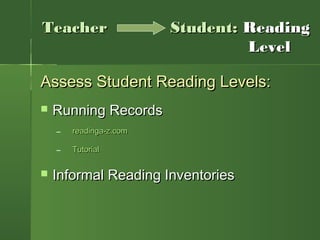
Assess Student Reading Levels:Assess Student Reading Levels:
 Running RecordsRunning Records
– readinga-z.comreadinga-z.com
– TutorialTutorial
 Informal Reading InventoriesInformal Reading Inventories
TeacherTeacher Student:Student: ReadingReading
LevelLevel
If…If…
 Text Level is higher than InstructionalText Level is higher than Instructional
LevelLevel
Then…Then…
 ParaphraseParaphrase (rewrite)(rewrite)
TeacherTeacher Text:Text: ModifyModify
Many textbooks now have companion readers/study guides developed
specifically as content area reading supplements. These are often ordered by
schools for the ELL students. Check. It will save you a lot of time and work!
Limit the number of words introduced…Limit the number of words introduced…
 Choose wordsChoose words
– critical to understanding the main ideascritical to understanding the main ideas
– not likely to be learned independentlynot likely to be learned independently
TeacherTeacher Text:Text: VocabularyVocabulary
Analyze Word & SentenceAnalyze Word & Sentence
ComplexityComplexity
Researchers have found thatResearchers have found that instructioninstruction
in expositoryin expository text structuretext structure has ahas a
positive effect on recall andpositive effect on recall and
comprehension.comprehension.
(Armbruster, Anderson, & Ostertag, 1987; Roller & Schreimer, 1985; Taylor(Armbruster, Anderson, & Ostertag, 1987; Roller & Schreimer, 1985; Taylor
& Beach, 1984).& Beach, 1984).
TeacherTeacher Text:Text: Text StructuresText Structures
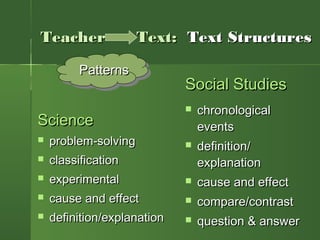
Social StudiesSocial Studies
 chronologicalchronological
eventsevents
 definition/definition/
explanationexplanation
 cause and effectcause and effect
 compare/contrastcompare/contrast
 question & answerquestion & answer
ScienceScience
 problem-solvingproblem-solving
 classificationclassification
 experimentalexperimental
 cause and effectcause and effect
 definition/explanationdefinition/explanation
PatternsPatterns
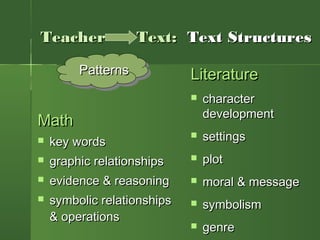
TeacherTeacher Text:Text: Text StructuresText Structures
LiteratureLiterature
 charactercharacter
developmentdevelopment
 settingssettings
 plotplot
 moral & messagemoral & message
 symbolismsymbolism
 genregenre
MathMath
 key wordskey words
 graphic relationshipsgraphic relationships
 evidence & reasoningevidence & reasoning
 symbolic relationshipssymbolic relationships
& operations& operations
PatternsPatterns
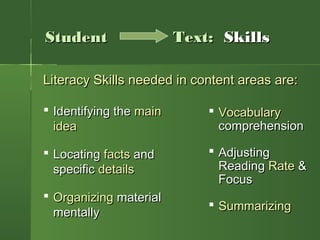
 Identifying theIdentifying the mainmain
ideaidea
 LocatingLocating factsfacts andand
specificspecific detailsdetails
 OrganizingOrganizing materialmaterial
mentallymentally
Literacy Skills needed in content areas are:Literacy Skills needed in content areas are:
 VocabularyVocabulary
comprehensioncomprehension
 AdjustingAdjusting
ReadingReading RateRate &&
FocusFocus
 SummarizingSummarizing
StudentStudent Text:Text: SkillsSkills
Graphic Organizer VideoGraphic Organizer Video
 Content Writing ClipContent Writing Clip
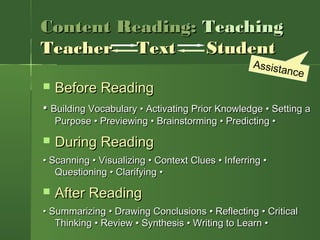
Content Reading:Content Reading: TeachingTeaching
TeacherTeacher TextText StudentStudent
 Before ReadingBefore Reading
•• Building VocabularyBuilding Vocabulary •• Activating Prior KnowledgeActivating Prior Knowledge •• Setting aSetting a
PurposePurpose •• PreviewingPreviewing •• BrainstormingBrainstorming •• PredictingPredicting ••
 During ReadingDuring Reading
•• ScanningScanning •• VisualizingVisualizing •• Context CluesContext Clues •• InferringInferring ••
QuestioningQuestioning •• ClarifyingClarifying ••
 After ReadingAfter Reading
•• SummarizingSummarizing •• Drawing ConclusionsDrawing Conclusions •• ReflectingReflecting •• CriticalCritical
ThinkingThinking •• ReviewReview •• SynthesisSynthesis • Writing to Learn •• Writing to Learn •
Assistance
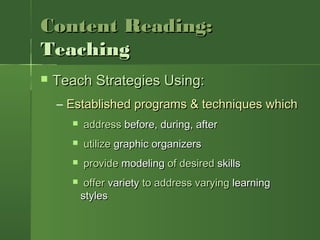
Content Reading:Content Reading:
TeachingTeaching
 Teach Strategies Using:Teach Strategies Using:
– Established programs & techniques whichEstablished programs & techniques which
 addressaddress before, during, afterbefore, during, after
 utilizeutilize graphic organizersgraphic organizers
 provideprovide modelingmodeling of desiredof desired skillsskills
 offeroffer varietyvariety to address varyingto address varying learninglearning
stylesstyles
Content Reading:Content Reading:
TechniquesTechniques
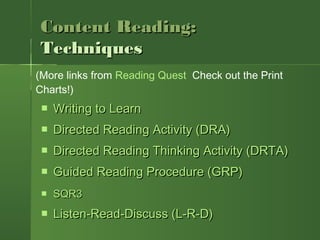
(More links from Reading Quest Check out the Print
Charts!)
 Writing to LearnWriting to Learn
 Directed Reading Activity (DRA)Directed Reading Activity (DRA)
 Directed Reading Thinking Activity (DRTA)Directed Reading Thinking Activity (DRTA)
 Guided Reading Procedure (GRP)Guided Reading Procedure (GRP)
 SQR3SQR3
 Listen-Read-Discuss (L-R-D)Listen-Read-Discuss (L-R-D)
Content Reading:Content Reading:
TechniquesTechniques
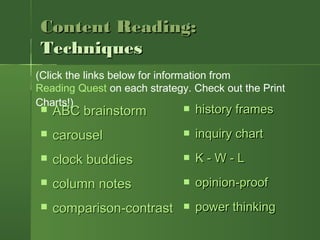
 ABC brainstormABC brainstorm
 carouselcarousel
 clock buddiesclock buddies
 column notescolumn notes
 comparison-contrastcomparison-contrast
 history frameshistory frames
 inquiry chartinquiry chart
 K - W - LK - W - L  
 opinion-proofopinion-proof
 power thinkingpower thinking
(Click the links below for information from
Reading Quest on each strategy. Check out the Print
Charts!)
Content Reading:Content Reading:
TechniquesTechniques
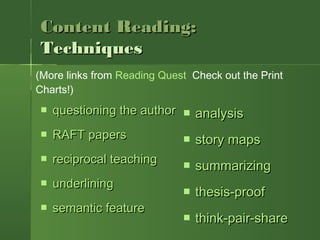
 questioning the authorquestioning the author
 RAFT papersRAFT papers
 reciprocal teachingreciprocal teaching
 underliningunderlining
 semantic featuresemantic feature
 analysisanalysis
 story mapsstory maps
 summarizingsummarizing
 thesis-proofthesis-proof
 think-pair-sharethink-pair-share
(More links from Reading Quest Check out the Print
Charts!)
Content Reading:Content Reading:
TechniquesTechniques
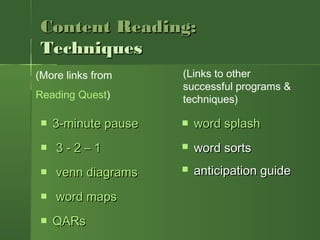
 3-minute pause3-minute pause
   3 - 2 – 13 - 2 – 1
   venn diagramsvenn diagrams
   word mapsword maps
 QARsQARs
(More links from
Reading Quest)
 word splashword splash
 word sortsword sorts
 anticipation guideanticipation guide
(Links to other
successful programs &
techniques)
Materials and MediaMaterials and Media
 http://www.timetabler.com/reading.htmlhttp://www.timetabler.com/reading.html
 http://www.gopdg.com/plainlanguage/readability.htmlhttp://www.gopdg.com/plainlanguage/readability.html
 http://www.ncrel.org/sdrs/areas/issues/students/learning/lr2grap.htmhttp://www.ncrel.org/sdrs/areas/issues/students/learning/lr2grap.htm
BibliographyBibliography
 Mora, Jill Kerper. “Content Area Reading for English LanguageMora, Jill Kerper. “Content Area Reading for English Language
Learners” March 16, 2006.Learners” March 16, 2006.
http://coe.sdsu.edu/people/jmora/ContentReadMM/>http://coe.sdsu.edu/people/jmora/ContentReadMM/>
 ““Reading in the Content Areas: Strategies for Success”Reading in the Content Areas: Strategies for Success” March 21,March 21,
2006.2006.
http://www.glencoe.com/sec/teachingtoday/educationupclose.phtml/12http://www.glencoe.com/sec/teachingtoday/educationupclose.phtml/12
 ““Literacy Strategies” March 21, 2006Literacy Strategies” March 21, 2006
http://www.litandlearn.lpb.org/strategies.htmlhttp://www.litandlearn.lpb.org/strategies.html

Power point communication

  • 1.
    Literacy Practice: PromotingLiteracyPractice: Promoting Content Area ReadingContent Area Reading Designed byDesigned by Brenda StephensonBrenda Stephenson The University of TennesseeThe University of Tennessee
  • 2.
    At the endof thisAt the end of this presentation studentspresentation students should:should:  Define the concepts for promoting readingDefine the concepts for promoting reading comprehension through content areacomprehension through content area reading materials.reading materials.  Identify ways of using content area readingIdentify ways of using content area reading materials to promote readingmaterials to promote reading comprehension in the classroom.comprehension in the classroom.  List materials and resources available toList materials and resources available to accomplish this practice.accomplish this practice.
  • 3.
    Content Area ReadingContentArea Reading ……refers to therefers to the challenge ofchallenge of readingreading in thein the academic areasacademic areas such as science, socialsuch as science, social studies, mathematics,studies, mathematics, literature, and the arts.literature, and the arts.
  • 4.
    Content Area ReadingContentArea Reading  ScaffoldingScaffolding provides aprovides a systematicsystematic approachapproach toto address theaddress the challenges ofchallenges of Content AreaContent Area Reading.Reading.
  • 5.
    Content Area Reading:ContentArea Reading: ScaffoldingScaffolding  instructional technique using teacher modeling to introduce the desired learning strategy or task, then gradually shifts responsibility to the students  Scaffolding Graph
  • 6.
    Content Area Reading:ContentArea Reading: ScaffoldingScaffolding  supports students beforebefore, duringduring, and afterafter they read.  enablesenables students to accomplish what is normally beyond their abilitiesbeyond their abilities.  provides enough helphelp so students can succeedsucceed with a task that otherwiseotherwise would be impossibleimpossible. (Graves & Graves, 1994)
  • 7.
    Video ClipVideo Clip Biology Content VideoBiology Content Video
  • 8.
    Content Area Reading:ContentArea Reading: ScaffoldingScaffolding Temporary Task-oriented Support to extend reach Steps to Teaching:Steps to Teaching: • Preparation • Assistance • Reflection •
  • 9.
    TeacherTeacher TextText Prior toLessonPrior to Lesson  AssessesAssesses ReadabilityReadability  ModifiesModifies text if necessarytext if necessary  Identifies KeyIdentifies Key VocabularyVocabulary & Concepts& Concepts  Identifies ExpositoryIdentifies Expository Text StructuresText Structures  Identifies Relation toIdentifies Relation to Prior KnowledgePrior Knowledge AnalyzesAnalyzes Preparation
  • 10.
     PreparePrepare studentsto read the material bystudents to read the material by consideringconsidering readabilityreadability factorsfactors ……readability readability refers refers to all the factors that to all the factors that affect success in reading affect success in reading and understanding a text. and understanding a text.  interestinterest && motivation of the readermotivation of the reader  legibility of the printlegibility of the print && illustrationsillustrations  complexitycomplexity of words and sentencesof words and sentences in relation to the reading ability ofin relation to the reading ability of the readerthe reader TeacherTeacher Text:Text: ReadabilityReadability
  • 11.
    Analyze Word &Sentence ComplexityAnalyze Word & Sentence Complexity  run a readability analysis at interventionrun a readability analysis at intervention central.org using thecentral.org using the OKAPl! Reading Probe GeneratorOKAPl! Reading Probe Generator  use Microsoft Word spell & grammar checkuse Microsoft Word spell & grammar check with the readability tool option turned ‘on’with the readability tool option turned ‘on’ TeacherTeacher Text:Text: ReadabilityReadability
  • 12.
    Assess Student ReadingLevels:Assess Student Reading Levels:  Running RecordsRunning Records – readinga-z.comreadinga-z.com – TutorialTutorial  Informal Reading InventoriesInformal Reading Inventories TeacherTeacher Student:Student: ReadingReading LevelLevel
  • 13.
    If…If…  Text Levelis higher than InstructionalText Level is higher than Instructional LevelLevel Then…Then…  ParaphraseParaphrase (rewrite)(rewrite) TeacherTeacher Text:Text: ModifyModify Many textbooks now have companion readers/study guides developed specifically as content area reading supplements. These are often ordered by schools for the ELL students. Check. It will save you a lot of time and work!
  • 14.
    Limit the numberof words introduced…Limit the number of words introduced…  Choose wordsChoose words – critical to understanding the main ideascritical to understanding the main ideas – not likely to be learned independentlynot likely to be learned independently TeacherTeacher Text:Text: VocabularyVocabulary
  • 15.
    Analyze Word &SentenceAnalyze Word & Sentence ComplexityComplexity Researchers have found thatResearchers have found that instructioninstruction in expositoryin expository text structuretext structure has ahas a positive effect on recall andpositive effect on recall and comprehension.comprehension. (Armbruster, Anderson, & Ostertag, 1987; Roller & Schreimer, 1985; Taylor(Armbruster, Anderson, & Ostertag, 1987; Roller & Schreimer, 1985; Taylor & Beach, 1984).& Beach, 1984). TeacherTeacher Text:Text: Text StructuresText Structures
  • 16.
    TeacherTeacher Text:Text: TextStructuresText Structures Social StudiesSocial Studies  chronologicalchronological eventsevents  definition/definition/ explanationexplanation  cause and effectcause and effect  compare/contrastcompare/contrast  question & answerquestion & answer ScienceScience  problem-solvingproblem-solving  classificationclassification  experimentalexperimental  cause and effectcause and effect  definition/explanationdefinition/explanation PatternsPatterns
  • 17.
    TeacherTeacher Text:Text: TextStructuresText Structures LiteratureLiterature  charactercharacter developmentdevelopment  settingssettings  plotplot  moral & messagemoral & message  symbolismsymbolism  genregenre MathMath  key wordskey words  graphic relationshipsgraphic relationships  evidence & reasoningevidence & reasoning  symbolic relationshipssymbolic relationships & operations& operations PatternsPatterns
  • 18.
     Identifying theIdentifyingthe mainmain ideaidea  LocatingLocating factsfacts andand specificspecific detailsdetails  OrganizingOrganizing materialmaterial mentallymentally Literacy Skills needed in content areas are:Literacy Skills needed in content areas are:  VocabularyVocabulary comprehensioncomprehension  AdjustingAdjusting ReadingReading RateRate && FocusFocus  SummarizingSummarizing StudentStudent Text:Text: SkillsSkills
  • 19.
    Graphic Organizer VideoGraphicOrganizer Video  Content Writing ClipContent Writing Clip
  • 20.
    Content Reading:Content Reading:TeachingTeaching TeacherTeacher TextText StudentStudent  Before ReadingBefore Reading •• Building VocabularyBuilding Vocabulary •• Activating Prior KnowledgeActivating Prior Knowledge •• Setting aSetting a PurposePurpose •• PreviewingPreviewing •• BrainstormingBrainstorming •• PredictingPredicting ••  During ReadingDuring Reading •• ScanningScanning •• VisualizingVisualizing •• Context CluesContext Clues •• InferringInferring •• QuestioningQuestioning •• ClarifyingClarifying ••  After ReadingAfter Reading •• SummarizingSummarizing •• Drawing ConclusionsDrawing Conclusions •• ReflectingReflecting •• CriticalCritical ThinkingThinking •• ReviewReview •• SynthesisSynthesis • Writing to Learn •• Writing to Learn • Assistance
  • 21.
    Content Reading:Content Reading: TeachingTeaching Teach Strategies Using:Teach Strategies Using: – Established programs & techniques whichEstablished programs & techniques which  addressaddress before, during, afterbefore, during, after  utilizeutilize graphic organizersgraphic organizers  provideprovide modelingmodeling of desiredof desired skillsskills  offeroffer varietyvariety to address varyingto address varying learninglearning stylesstyles
  • 22.
    Content Reading:Content Reading: TechniquesTechniques (Morelinks from Reading Quest Check out the Print Charts!)  Writing to LearnWriting to Learn  Directed Reading Activity (DRA)Directed Reading Activity (DRA)  Directed Reading Thinking Activity (DRTA)Directed Reading Thinking Activity (DRTA)  Guided Reading Procedure (GRP)Guided Reading Procedure (GRP)  SQR3SQR3  Listen-Read-Discuss (L-R-D)Listen-Read-Discuss (L-R-D)
  • 23.
    Content Reading:Content Reading: TechniquesTechniques ABC brainstormABC brainstorm  carouselcarousel  clock buddiesclock buddies  column notescolumn notes  comparison-contrastcomparison-contrast  history frameshistory frames  inquiry chartinquiry chart  K - W - LK - W - L    opinion-proofopinion-proof  power thinkingpower thinking (Click the links below for information from Reading Quest on each strategy. Check out the Print Charts!)
  • 24.
    Content Reading:Content Reading: TechniquesTechniques questioning the authorquestioning the author  RAFT papersRAFT papers  reciprocal teachingreciprocal teaching  underliningunderlining  semantic featuresemantic feature  analysisanalysis  story mapsstory maps  summarizingsummarizing  thesis-proofthesis-proof  think-pair-sharethink-pair-share (More links from Reading Quest Check out the Print Charts!)
  • 25.
    Content Reading:Content Reading: TechniquesTechniques 3-minute pause3-minute pause    3 - 2 – 13 - 2 – 1    venn diagramsvenn diagrams    word mapsword maps  QARsQARs (More links from Reading Quest)  word splashword splash  word sortsword sorts  anticipation guideanticipation guide (Links to other successful programs & techniques)
  • 26.
    Materials and MediaMaterialsand Media  http://www.timetabler.com/reading.htmlhttp://www.timetabler.com/reading.html  http://www.gopdg.com/plainlanguage/readability.htmlhttp://www.gopdg.com/plainlanguage/readability.html  http://www.ncrel.org/sdrs/areas/issues/students/learning/lr2grap.htmhttp://www.ncrel.org/sdrs/areas/issues/students/learning/lr2grap.htm
  • 27.
    BibliographyBibliography  Mora, JillKerper. “Content Area Reading for English LanguageMora, Jill Kerper. “Content Area Reading for English Language Learners” March 16, 2006.Learners” March 16, 2006. http://coe.sdsu.edu/people/jmora/ContentReadMM/>http://coe.sdsu.edu/people/jmora/ContentReadMM/>  ““Reading in the Content Areas: Strategies for Success”Reading in the Content Areas: Strategies for Success” March 21,March 21, 2006.2006. http://www.glencoe.com/sec/teachingtoday/educationupclose.phtml/12http://www.glencoe.com/sec/teachingtoday/educationupclose.phtml/12  ““Literacy Strategies” March 21, 2006Literacy Strategies” March 21, 2006 http://www.litandlearn.lpb.org/strategies.htmlhttp://www.litandlearn.lpb.org/strategies.html