COMMON PROBLEMS IN READING
POOR COMPREHENSION DECODING
SPEED
Also known as sounding out
words, decoding is when
children are able to put sounds
to letters in order to sound out
written language.
1. ACTIVATING BACKGROUND KNOWLEDGE
Research has shown that better comprehension occurs when
students are engaged in activities that bridge their old
knowledge with the new. For example, a simple question like
“what do you know about … (a particular topic)” will stimulate
students’ previous knowledge of that topic. This will help you
connect the current reading to your existing knowledge and
make the new reading more stimulating and engaging.
The strategy allows students to work their way up from an
already existing schema, instead of starting a new one.
2. QUESTIONING
Each student should be able to reflect on three main questions, namely,
a right now question, an analytical question, and a research question.
A ‘right now question’ focuses on the material presented. What is
the essence of the material read? What are the facts that are being
mentioned?
An ‘analytical question’ requires students to ponder over what they
have learnt. What does the author want me to understand from this
material?
A ‘research question’ encourages the students to look for
information beyond what is in the text. This allows for more
comprehensive active learning to occur.
3. ANALYZING TEXT STRUCTURE
This requires students to learn how to analyze or comprehend
the structure of a text. Students are taught to identify the
pattern by which writers organize their material. This may be in
the form of cause-effect pattern, problem-solution pattern, or a
descriptive pattern like a list, web or a matrix pattern.
Understanding the pattern in which the material is presented
allows the students to comprehend the information better.
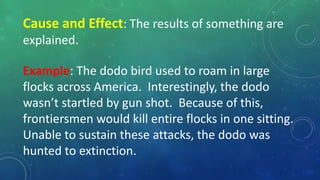
Cause and Effect: The results of something are
explained.
Example: The dodo bird used to roam in large
flocks across America. Interestingly, the dodo
wasn’t startled by gun shot. Because of this,
frontiersmen would kill entire flocks in one sitting.
Unable to sustain these attacks, the dodo was
hunted to extinction.
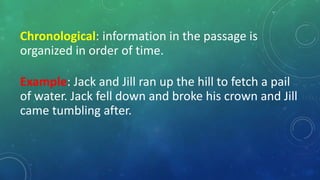
Chronological: information in the passage is
organized in order of time.
Example: Jack and Jill ran up the hill to fetch a pail
of water. Jack fell down and broke his crown and Jill
came tumbling after.
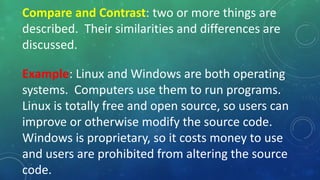
Compare and Contrast: two or more things are
described. Their similarities and differences are
discussed.
Example: Linux and Windows are both operating
systems. Computers use them to run programs.
Linux is totally free and open source, so users can
improve or otherwise modify the source code.
Windows is proprietary, so it costs money to use
and users are prohibited from altering the source
code.
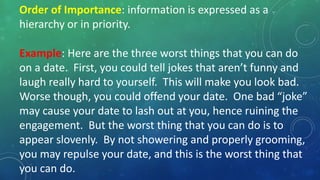
Order of Importance: information is expressed as a
hierarchy or in priority.
Example: Here are the three worst things that you can do
on a date. First, you could tell jokes that aren’t funny and
laugh really hard to yourself. This will make you look bad.
Worse though, you could offend your date. One bad “joke”
may cause your date to lash out at you, hence ruining the
engagement. But the worst thing that you can do is to
appear slovenly. By not showering and properly grooming,
you may repulse your date, and this is the worst thing that
you can do.
Problem and Solution: a problem is described and
a response or solution is proposed or explained.
Example: thousand of people die each year in car
accidents involving drugs or alcohol. Lives could be
saved if our town adopts a free public taxi service.
By providing such a service, we could prevent
intoxicated drivers from endangering themselves
or others.
Sequence / Process Writing: information is
organized in steps or a process is explained in
the order in which it occurs.
Example: Eating cereal is easy. First, get out
your materials. Next, pour your cereal in the
bowl, add milk, and enjoy.
Spatial / Descriptive Writing: information is
organized in order of space (top to bottom, left to
right).
Example: when you walk into my bedroom there
is a window facing you. To the right of that is a
dresser and television and on the other side of the
window is my bed.
4. VISUALIZATION
The fourth strategy stresses on the importance of
visualizing the material. Students should be encouraged to
form visual images in their head as they read the text,
which will help in better comprehension. Research
suggests that students should visualize them as structural
images or diagrams instead of mere pictures, as pictures
have a tendency to fade.
5. SUMMARIZING
Research has indicated that the ability to summarize enhances
comprehension. Block and Pressley defined summarize as “the
ability to delete irrelevant details, combine similar
ideas, condense main ideas, and connect major themes
into concise statements that capture the purpose of a
reading for the reader.” A student making use of the other four
strategies will find it easier to summarize the material. They can
summarize the material in the form of diagrams, either visually
or in writing.

STRATEGIES-TO-PROCESS-INFORMATION-ON-A-TEXT-Copy.pptx

  • 2.
    COMMON PROBLEMS INREADING POOR COMPREHENSION DECODING SPEED Also known as sounding out words, decoding is when children are able to put sounds to letters in order to sound out written language.
  • 3.
    1. ACTIVATING BACKGROUNDKNOWLEDGE Research has shown that better comprehension occurs when students are engaged in activities that bridge their old knowledge with the new. For example, a simple question like “what do you know about … (a particular topic)” will stimulate students’ previous knowledge of that topic. This will help you connect the current reading to your existing knowledge and make the new reading more stimulating and engaging. The strategy allows students to work their way up from an already existing schema, instead of starting a new one.
  • 4.
    2. QUESTIONING Each studentshould be able to reflect on three main questions, namely, a right now question, an analytical question, and a research question. A ‘right now question’ focuses on the material presented. What is the essence of the material read? What are the facts that are being mentioned? An ‘analytical question’ requires students to ponder over what they have learnt. What does the author want me to understand from this material? A ‘research question’ encourages the students to look for information beyond what is in the text. This allows for more comprehensive active learning to occur.
  • 5.
    3. ANALYZING TEXTSTRUCTURE This requires students to learn how to analyze or comprehend the structure of a text. Students are taught to identify the pattern by which writers organize their material. This may be in the form of cause-effect pattern, problem-solution pattern, or a descriptive pattern like a list, web or a matrix pattern. Understanding the pattern in which the material is presented allows the students to comprehend the information better.
  • 6.
    Cause and Effect:The results of something are explained. Example: The dodo bird used to roam in large flocks across America. Interestingly, the dodo wasn’t startled by gun shot. Because of this, frontiersmen would kill entire flocks in one sitting. Unable to sustain these attacks, the dodo was hunted to extinction.
  • 7.
    Chronological: information inthe passage is organized in order of time. Example: Jack and Jill ran up the hill to fetch a pail of water. Jack fell down and broke his crown and Jill came tumbling after.
  • 8.
    Compare and Contrast:two or more things are described. Their similarities and differences are discussed. Example: Linux and Windows are both operating systems. Computers use them to run programs. Linux is totally free and open source, so users can improve or otherwise modify the source code. Windows is proprietary, so it costs money to use and users are prohibited from altering the source code.
  • 9.
    Order of Importance:information is expressed as a hierarchy or in priority. Example: Here are the three worst things that you can do on a date. First, you could tell jokes that aren’t funny and laugh really hard to yourself. This will make you look bad. Worse though, you could offend your date. One bad “joke” may cause your date to lash out at you, hence ruining the engagement. But the worst thing that you can do is to appear slovenly. By not showering and properly grooming, you may repulse your date, and this is the worst thing that you can do.
  • 10.
    Problem and Solution:a problem is described and a response or solution is proposed or explained. Example: thousand of people die each year in car accidents involving drugs or alcohol. Lives could be saved if our town adopts a free public taxi service. By providing such a service, we could prevent intoxicated drivers from endangering themselves or others.
  • 11.
    Sequence / ProcessWriting: information is organized in steps or a process is explained in the order in which it occurs. Example: Eating cereal is easy. First, get out your materials. Next, pour your cereal in the bowl, add milk, and enjoy.
  • 12.
    Spatial / DescriptiveWriting: information is organized in order of space (top to bottom, left to right). Example: when you walk into my bedroom there is a window facing you. To the right of that is a dresser and television and on the other side of the window is my bed.
  • 13.
    4. VISUALIZATION The fourthstrategy stresses on the importance of visualizing the material. Students should be encouraged to form visual images in their head as they read the text, which will help in better comprehension. Research suggests that students should visualize them as structural images or diagrams instead of mere pictures, as pictures have a tendency to fade.
  • 14.
    5. SUMMARIZING Research hasindicated that the ability to summarize enhances comprehension. Block and Pressley defined summarize as “the ability to delete irrelevant details, combine similar ideas, condense main ideas, and connect major themes into concise statements that capture the purpose of a reading for the reader.” A student making use of the other four strategies will find it easier to summarize the material. They can summarize the material in the form of diagrams, either visually or in writing.