Reading
                             Comprehension
                             Using Visual
                             Strategies

‚There is an old saying that a picture is worth a thousand
words. When it comes to comprehension, this saying might be
paraphrased, ‘a visual display helps readers understand,
organize, and remember some of those thousand words.’‛
~Duke & Pearson, 2002
                                                        Katie
                                                        Leslie
                                                      Whitney
Reading Comprehension


"Researchers have found that good readers are
active or strategic readers who use a variety of
comprehension strategies before, during, and
after reading a text.‚
                     ~Perfection Learning Corporation
Visual Strategies
• What is it?
 Reading comprehension using visual strategies is understanding the text
 through the use of pictures, imagery, and graphic organizers. This means
 the reader connects their thoughts into visual representations to better
 understand the literature.


• How can these strategies help?
 ‚There is an old saying that a picture is worth a thousand words. When it
 comes to comprehension, this saying might be paraphrased, ‘a visual
 display helps readers understand, organize, and remember some of those
 thousand words.’‛¹—Duke & Pearson, 2002
Visual BEFORE Reading
            Strategies
• Build Prior Knowledge
  – Prior knowledge is using previous experiences to connect
    or predict upcoming events
• Predict
  – Use prior knowledge to talk about what is going to happen
    in the story or text
     • Example: While looking at the image of the book below, what do
       you think is going to happen in the story?
Visual BEFORE Reading
           Strategies
• Picture Walks
  – Going through images only from the text to familiarize your
    student with the story's contents
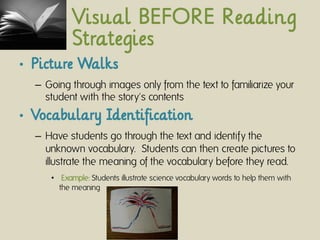
• Vocabulary Identification
  – Have students go through the text and identify the
    unknown vocabulary. Students can then create pictures to
    illustrate the meaning of the vocabulary before they read.
     • Example: Students illustrate science vocabulary words to help them with
       the meaning
Visual DURING
           Reading Strategies
• Highlight Important Facts
  – As students read, have them underline or highlight
    the important facts of the text
     • Literature: color code the highlighting for the story elements
     • Textbook: highlight important vocabulary and main topics of the text under
       each heading
     • If you are unable to write in a book, use post-its by putting the post-it
       along the edge of the page to mark the important facts

• Graphic Organizer
  – Using graphic organizers can help students
    sequence and organize thoughts about a story as
    they read it
Visual DURING
          Reading Strategies
• Picture Cues
  – As the student is reading, have them look at the pictures to
    help them understand what is going on in the text
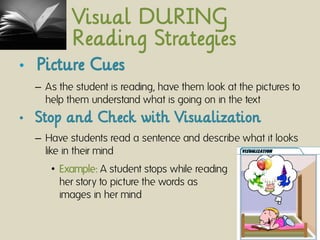
• Stop and Check with Visualization
  – Have students read a sentence and describe what it looks
    like in their mind
     • Example: A student stops while reading
       her story to picture the words as
       images in her mind
Visual AFTER
          Reading Strategies
• Sequencing
  – Have students create visual drawings or story maps of
    what occurred during the story after they have read it.
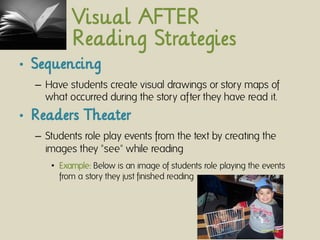
• Readers Theater
  – Students role play events from the text by creating the
    images they "see" while reading
     • Example: Below is an image of students role playing the events
       from a story they just finished reading
Visual AFTER
          Reading Strategies
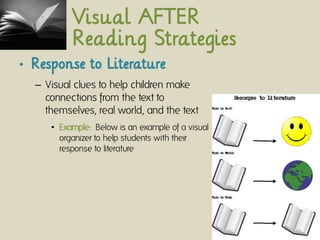
• Response to Literature
  – Visual clues to help children make
    connections from the text to
    themselves, real world, and the text
     • Example: Below is an example of a visual
       organizer to help students with their
       response to literature
Resources for Reading
             Comprehension
Mashable: 6 Sites that can create Mrs. Dowling's Reading
comics online                     Comprehension Skills Corner
English for Everyone: Free reading Enchanted Learning: Resources and
comprehension practice passages worksheets for all subjects
for all levels
                                   Starfall: Free phonics and reading
Mr. Nussbaum: Reading              help
Comprehension passages and
quizzes                            Reading A-Z: Everything you need
                                   to teach someone to read
Interactive Reading Websites
                                   Teacher Planet: Worksheets for
The Reading Matrix: Interactive    teachers and parents
Reading Games
                                   Intervention Central: Intervention
                                   help and tips

Reading comprehension using visual strategies

  • 1.
    Reading Comprehension Using Visual Strategies ‚There is an old saying that a picture is worth a thousand words. When it comes to comprehension, this saying might be paraphrased, ‘a visual display helps readers understand, organize, and remember some of those thousand words.’‛ ~Duke & Pearson, 2002 Katie Leslie Whitney
  • 2.
    Reading Comprehension "Researchers havefound that good readers are active or strategic readers who use a variety of comprehension strategies before, during, and after reading a text.‚ ~Perfection Learning Corporation
  • 3.
    Visual Strategies • Whatis it? Reading comprehension using visual strategies is understanding the text through the use of pictures, imagery, and graphic organizers. This means the reader connects their thoughts into visual representations to better understand the literature. • How can these strategies help? ‚There is an old saying that a picture is worth a thousand words. When it comes to comprehension, this saying might be paraphrased, ‘a visual display helps readers understand, organize, and remember some of those thousand words.’‛¹—Duke & Pearson, 2002
  • 4.
    Visual BEFORE Reading Strategies • Build Prior Knowledge – Prior knowledge is using previous experiences to connect or predict upcoming events • Predict – Use prior knowledge to talk about what is going to happen in the story or text • Example: While looking at the image of the book below, what do you think is going to happen in the story?
  • 5.
    Visual BEFORE Reading Strategies • Picture Walks – Going through images only from the text to familiarize your student with the story's contents • Vocabulary Identification – Have students go through the text and identify the unknown vocabulary. Students can then create pictures to illustrate the meaning of the vocabulary before they read. • Example: Students illustrate science vocabulary words to help them with the meaning
  • 6.
    Visual DURING Reading Strategies • Highlight Important Facts – As students read, have them underline or highlight the important facts of the text • Literature: color code the highlighting for the story elements • Textbook: highlight important vocabulary and main topics of the text under each heading • If you are unable to write in a book, use post-its by putting the post-it along the edge of the page to mark the important facts • Graphic Organizer – Using graphic organizers can help students sequence and organize thoughts about a story as they read it
  • 7.
    Visual DURING Reading Strategies • Picture Cues – As the student is reading, have them look at the pictures to help them understand what is going on in the text • Stop and Check with Visualization – Have students read a sentence and describe what it looks like in their mind • Example: A student stops while reading her story to picture the words as images in her mind
  • 8.
    Visual AFTER Reading Strategies • Sequencing – Have students create visual drawings or story maps of what occurred during the story after they have read it. • Readers Theater – Students role play events from the text by creating the images they "see" while reading • Example: Below is an image of students role playing the events from a story they just finished reading
  • 9.
    Visual AFTER Reading Strategies • Response to Literature – Visual clues to help children make connections from the text to themselves, real world, and the text • Example: Below is an example of a visual organizer to help students with their response to literature
  • 10.
    Resources for Reading Comprehension Mashable: 6 Sites that can create Mrs. Dowling's Reading comics online Comprehension Skills Corner English for Everyone: Free reading Enchanted Learning: Resources and comprehension practice passages worksheets for all subjects for all levels Starfall: Free phonics and reading Mr. Nussbaum: Reading help Comprehension passages and quizzes Reading A-Z: Everything you need to teach someone to read Interactive Reading Websites Teacher Planet: Worksheets for The Reading Matrix: Interactive teachers and parents Reading Games Intervention Central: Intervention help and tips