Welcome
To
Today’s seminar on
EMERGENCY
ANESTHESIA
EMERGENCY ANAESTHESIA
Section – I
Karishma Mahatheer Hoque
5th year, MBBS
CuMC
Brief history:
 The term Anesthesia, suggested by Oliver
Wendell in 1846.
 Diethyl ether was first described by
Paracelsus in 1540.
 N2O suggested for analgesia in 1799 by
Humphray Davy and 1st use in 1844 by
Horace Wells.
Basics of Anesthesia, contd..
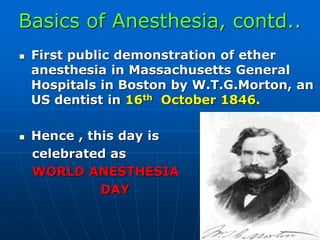
 First public demonstration of ether
anesthesia in Massachusetts General
Hospitals in Boston by W.T.G.Morton, an
US dentist in 16th October 1846.
 Hence , this day is
celebrated as
WORLD ANESTHESIA
DAY
Happy 173rd anesthesia day
Objectives
 To know about the patient selection,
triage.
 To assess the patient’s condition
 To resuscitate the patient accordingly
 To know about the outcome of the
operation and counsel
Classifications of Operations
 Emergency operation :
Immediate operation within 1 hour of
surgical consultation and considered as life
saving.
Example:Ruptured aortic aneurysm repair.
Laparotomy or thoracotomy in case of
major abdominal or thoracic trauma.
Classifications of Operations
 Urgent operation:
Operation as soon as possible after
resuscitation usually within 24 hours of
surgical consultation.
Example:Laparotomy for intestinal
obstruction and perforation.
Fixation in case of compound
fracture.
Classifications of Operations
 Scheduled operation :
Early operation between 1-3 weeks of
surgical consultation which is not
immediately life saving.
Example : Cancer surgery
Cardiac surgery
Classifications of Operations
 Elective operation:
Operation at the time to suit with both the
patient and surgeon.
Example :Laparoscopic cholecystectomy.
Problems with Emergency
Anaesthesia
Emergency patient may have-
Uncertain diagnosis.
Uncontrolled coexisting medical disease.
Physiological derangements.
The major principle
To identify the condition as emergency.
To correct the physiological abnormalities
preoperatively.
Contd…
An anaesthetist must be prepared for
potential complications arising from
anaesthetising the patient in sub-optimal
condition.
These include :
-Vomiting & regurgitation
-Hypovolaemia & haemorrhage
-Abnormal drug reactions
-Electrolyte disturbances
Preoperative assessment
Section-II
Dr. Syed Tabarukuzzaman
Diploma(Anaesthesia)-8th batch
Cumilla Medical College.
Preoperative assesment
 Assessment of cardiorespiratory status:
History
History of past medical illness:
-Angina
-Productive cough
-Orthopnoea
-Paroxysmal nocturnal dyspnoea
Drug history:
-Anti platelet
-Anti anginal
-Antihypertensive.
Contd.
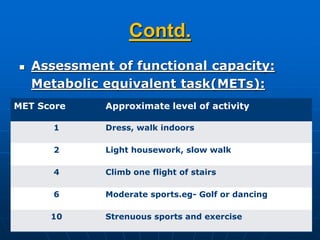
 Assessment of functional capacity:
Metabolic equivalent task(METs):
MET Score Approximate level of activity
1 Dress, walk indoors
2 Light housework, slow walk
4 Climb one flight of stairs
6 Moderate sports.eg- Golf or dancing
10 Strenuous sports and exercise
Contd.
 Assessment of airway:
1.General appearance of neck,face,maxilla
and mandible
2.Jaw movement
3.Head extension and neck movement
4.Teeth and oropharynx
5.Soft tissue of neck
6.Recent chest and cervical spine X-rays
7.Previous anaesthetic record.
Contd…
Different scoring and grading systems
for airway assessment :
-Mallampati scoring
-Modified Mallampati scoring
-EL Ganzouri scoring
-Wilson scoring
-LEMON airway assessment.
Contd.
Assessment of circulatory volume:
This is very essential.
The anaesthtetist should quantify deficit
of--
-Intravascular volume
-Extracellular volume
Contd…
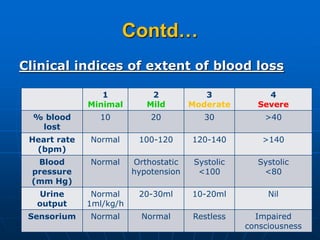
Clinical indices of extent of blood loss
1
Minimal
2
Mild
3
Moderate
4
Severe
% blood
lost
10 20 30 >40
Heart rate
(bpm)
Normal 100-120 120-140 >140
Blood
pressure
(mm Hg)
Normal Orthostatic
hypotension
Systolic
<100
Systolic
<80
Urine
output
Normal
1ml/kg/h
20-30ml 10-20ml Nil
Sensorium Normal Normal Restless Impaired
consciousness
Contd…
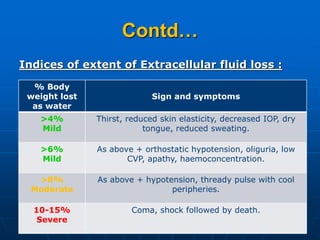
Indices of extent of Extracellular fluid loss :
% Body
weight lost
as water
Sign and symptoms
>4%
Mild
Thirst, reduced skin elasticity, decreased IOP, dry
tongue, reduced sweating.
>6%
Mild
As above + orthostatic hypotension, oliguria, low
CVP, apathy, haemoconcentration.
>8%
Moderate
As above + hypotension, thready pulse with cool
peripheries.
10-15%
Severe
Coma, shock followed by death.
Contd…
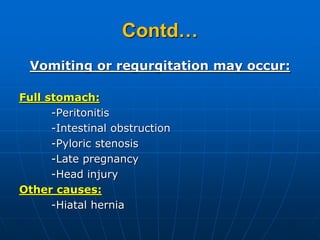
Vomiting or regurgitation may occur:
Full stomach:
-Peritonitis
-Intestinal obstruction
-Pyloric stenosis
-Late pregnancy
-Head injury
Other causes:
-Hiatal hernia
Anaesthetic techniques
Section-III
Dr. M. M. Sakhawat Hossain
Anaesthesiologist
Cumilla Medical College Hospital
Techniques of anaesthesia
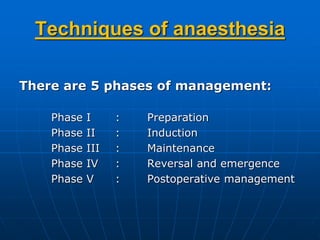
There are 5 phases of management:
Phase I : Preparation
Phase II : Induction
Phase III : Maintenance
Phase IV : Reversal and emergence
Phase V : Postoperative management
Preparation
Preparation of anaesthetic
equipments:
*Oropharyngeal tube
*Nasopharyngeal tube
*Endotracheal tube
*Laryngeal mask airway
*Video laryngoscope
*Suction apparatus
Contd…
Preparation of patient :
a)Resuscitation:
*Opening of 2 wide bore I/V
channel(16G or below)
*Opening of CV line
*Choice of fluid may be
crystalloid, colloid or blood.
Contd…
b)Gastric decompression:
-Insertion of a nasogastric tube
c)Aspiration prophylaxis:
-Inj. Ranitidine
-Inj. Metochlorpramide
-Non-particulate antacid
(30ml 0.3M sodium citrate)
Induction..
a)Rapid sequence induction:
*To prevent aspiration and
regurgitation of gastric contents.
*Patient is kept in trendelenburg
position.
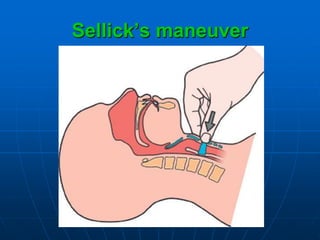
*(20-40)N cricoid pressure by an
expert assistant(Sellick’s
maneuvour).
Sellick’s maneuver
Contd…
Induction agent:
-Thiopental Na, Propofol, Ketamine,
Etomidate.
Muscle relaxant:
-Suxamethonium
-Rocuronium
(If suxamethonium is contraindicated)
Contd…
b) Inhalational induction:
-Elderly frail patients who may not
tolerate IV induction agents.
-Position may be left lateral, head
down or even supine with cricoid
pressure.
-It may be done by Oxygen and
Halothane or Sevoflurane.
Contd…
Regional anaesthesia:
-Regional block is acceptable in
emergency anaesthesia, if
hemodynamically stable.
-General anaesthesia is safer than
neuroaxial anaesthesia, especially for
the juniors.
Maintenance, reversal and
postoperative care
Section-IV
Dr. Susmita Sen Supta
Indoor Medical Officer
Anesthesioogy
CuMCH
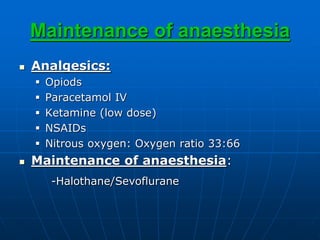
Maintenance of anaesthesia
 Analgesics:
 Opiods
 Paracetamol IV
 Ketamine (low dose)
 NSAIDs
 Nitrous oxygen: Oxygen ratio 33:66
 Maintenance of anaesthesia:
-Halothane/Sevoflurane
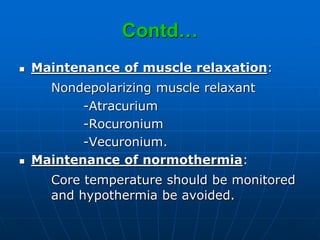
Contd…
 Maintenance of muscle relaxation:
Nondepolarizing muscle relaxant
-Atracurium
-Rocuronium
-Vecuronium.
 Maintenance of normothermia:
Core temperature should be monitored
and hypothermia be avoided.
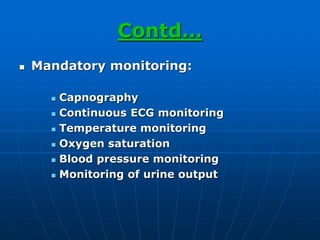
Contd…
 Mandatory monitoring:
 Capnography
 Continuous ECG monitoring
 Temperature monitoring
 Oxygen saturation
 Blood pressure monitoring
 Monitoring of urine output
Contd…
 Fluid management:
Choice : Isotonic crystalloids.
Maintenance fluid :1.5ml/kg/hour.
Third space loss, evaporative
loss and blood loss should be
calculated and corrected
meticulously .
Contd…
 Blood transfusion:
-Patient’s Hb% 7gm/dL is the
trigger point for blood transfusion.
-If blood is not available,
crystalloid(1:3-4)ratio or
colloid(1:1)ratio can be
administered.
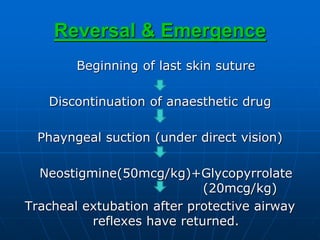
Reversal & Emergence
Beginning of last skin suture
Discontinuation of anaesthetic drug
Phayngeal suction (under direct vision)
Neostigmine(50mcg/kg)+Glycopyrrolate
(20mcg/kg)
Tracheal extubation after protective airway
reflexes have returned.
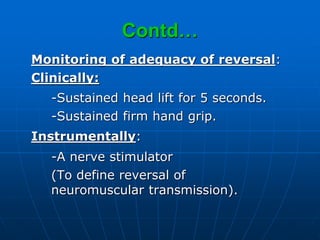
Contd…
Monitoring of adequacy of reversal:
Clinically:
-Sustained head lift for 5 seconds.
-Sustained firm hand grip.
Instrumentally:
-A nerve stimulator
(To define reversal of
neuromuscular transmission).
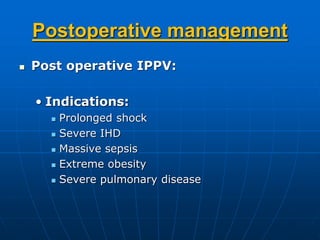
Postoperative management
 Post operative IPPV:
• Indications:
 Prolonged shock
 Severe IHD
 Massive sepsis
 Extreme obesity
 Severe pulmonary disease
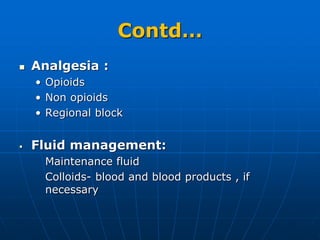
Contd…
 Analgesia :
• Opioids
• Non opioids
• Regional block
 Fluid management:
Maintenance fluid
Colloids- blood and blood products , if
necessary
Contd…
 Referral to ICU criteria after
emergency surgery:
• Patient requiring advance respiratory support
• Need two or more organ system support
• Planned admission from OT after prolong or
complicated surgery
• Emergency admission from OT due to delayed
recovery or any complication from surgery or
anesthesia.
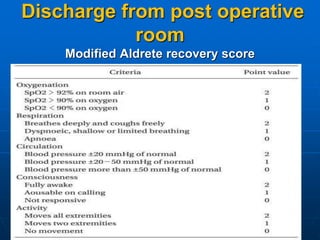
Discharge from post operative
room
Modified Aldrete recovery score
Thank You

Emergency anaesthesia

  • 2.
  • 3.
    EMERGENCY ANAESTHESIA Section –I Karishma Mahatheer Hoque 5th year, MBBS CuMC
  • 4.
    Brief history:  Theterm Anesthesia, suggested by Oliver Wendell in 1846.  Diethyl ether was first described by Paracelsus in 1540.  N2O suggested for analgesia in 1799 by Humphray Davy and 1st use in 1844 by Horace Wells.
  • 5.
    Basics of Anesthesia,contd..  First public demonstration of ether anesthesia in Massachusetts General Hospitals in Boston by W.T.G.Morton, an US dentist in 16th October 1846.  Hence , this day is celebrated as WORLD ANESTHESIA DAY
  • 6.
  • 7.
    Objectives  To knowabout the patient selection, triage.  To assess the patient’s condition  To resuscitate the patient accordingly  To know about the outcome of the operation and counsel
  • 8.
    Classifications of Operations Emergency operation : Immediate operation within 1 hour of surgical consultation and considered as life saving. Example:Ruptured aortic aneurysm repair. Laparotomy or thoracotomy in case of major abdominal or thoracic trauma.
  • 9.
    Classifications of Operations Urgent operation: Operation as soon as possible after resuscitation usually within 24 hours of surgical consultation. Example:Laparotomy for intestinal obstruction and perforation. Fixation in case of compound fracture.
  • 10.
    Classifications of Operations Scheduled operation : Early operation between 1-3 weeks of surgical consultation which is not immediately life saving. Example : Cancer surgery Cardiac surgery
  • 11.
    Classifications of Operations Elective operation: Operation at the time to suit with both the patient and surgeon. Example :Laparoscopic cholecystectomy.
  • 12.
    Problems with Emergency Anaesthesia Emergencypatient may have- Uncertain diagnosis. Uncontrolled coexisting medical disease. Physiological derangements. The major principle To identify the condition as emergency. To correct the physiological abnormalities preoperatively.
  • 13.
    Contd… An anaesthetist mustbe prepared for potential complications arising from anaesthetising the patient in sub-optimal condition. These include : -Vomiting & regurgitation -Hypovolaemia & haemorrhage -Abnormal drug reactions -Electrolyte disturbances
  • 14.
    Preoperative assessment Section-II Dr. SyedTabarukuzzaman Diploma(Anaesthesia)-8th batch Cumilla Medical College.
  • 15.
    Preoperative assesment  Assessmentof cardiorespiratory status: History History of past medical illness: -Angina -Productive cough -Orthopnoea -Paroxysmal nocturnal dyspnoea Drug history: -Anti platelet -Anti anginal -Antihypertensive.
  • 16.
    Contd.  Assessment offunctional capacity: Metabolic equivalent task(METs): MET Score Approximate level of activity 1 Dress, walk indoors 2 Light housework, slow walk 4 Climb one flight of stairs 6 Moderate sports.eg- Golf or dancing 10 Strenuous sports and exercise
  • 17.
    Contd.  Assessment ofairway: 1.General appearance of neck,face,maxilla and mandible 2.Jaw movement 3.Head extension and neck movement 4.Teeth and oropharynx 5.Soft tissue of neck 6.Recent chest and cervical spine X-rays 7.Previous anaesthetic record.
  • 18.
    Contd… Different scoring andgrading systems for airway assessment : -Mallampati scoring -Modified Mallampati scoring -EL Ganzouri scoring -Wilson scoring -LEMON airway assessment.
  • 19.
    Contd. Assessment of circulatoryvolume: This is very essential. The anaesthtetist should quantify deficit of-- -Intravascular volume -Extracellular volume
  • 20.
    Contd… Clinical indices ofextent of blood loss 1 Minimal 2 Mild 3 Moderate 4 Severe % blood lost 10 20 30 >40 Heart rate (bpm) Normal 100-120 120-140 >140 Blood pressure (mm Hg) Normal Orthostatic hypotension Systolic <100 Systolic <80 Urine output Normal 1ml/kg/h 20-30ml 10-20ml Nil Sensorium Normal Normal Restless Impaired consciousness
  • 21.
    Contd… Indices of extentof Extracellular fluid loss : % Body weight lost as water Sign and symptoms >4% Mild Thirst, reduced skin elasticity, decreased IOP, dry tongue, reduced sweating. >6% Mild As above + orthostatic hypotension, oliguria, low CVP, apathy, haemoconcentration. >8% Moderate As above + hypotension, thready pulse with cool peripheries. 10-15% Severe Coma, shock followed by death.
  • 22.
    Contd… Vomiting or regurgitationmay occur: Full stomach: -Peritonitis -Intestinal obstruction -Pyloric stenosis -Late pregnancy -Head injury Other causes: -Hiatal hernia
  • 23.
    Anaesthetic techniques Section-III Dr. M.M. Sakhawat Hossain Anaesthesiologist Cumilla Medical College Hospital
  • 24.
    Techniques of anaesthesia Thereare 5 phases of management: Phase I : Preparation Phase II : Induction Phase III : Maintenance Phase IV : Reversal and emergence Phase V : Postoperative management
  • 25.
    Preparation Preparation of anaesthetic equipments: *Oropharyngealtube *Nasopharyngeal tube *Endotracheal tube *Laryngeal mask airway *Video laryngoscope *Suction apparatus
  • 26.
    Contd… Preparation of patient: a)Resuscitation: *Opening of 2 wide bore I/V channel(16G or below) *Opening of CV line *Choice of fluid may be crystalloid, colloid or blood.
  • 27.
    Contd… b)Gastric decompression: -Insertion ofa nasogastric tube c)Aspiration prophylaxis: -Inj. Ranitidine -Inj. Metochlorpramide -Non-particulate antacid (30ml 0.3M sodium citrate)
  • 28.
    Induction.. a)Rapid sequence induction: *Toprevent aspiration and regurgitation of gastric contents. *Patient is kept in trendelenburg position. *(20-40)N cricoid pressure by an expert assistant(Sellick’s maneuvour).
  • 29.
  • 30.
    Contd… Induction agent: -Thiopental Na,Propofol, Ketamine, Etomidate. Muscle relaxant: -Suxamethonium -Rocuronium (If suxamethonium is contraindicated)
  • 31.
    Contd… b) Inhalational induction: -Elderlyfrail patients who may not tolerate IV induction agents. -Position may be left lateral, head down or even supine with cricoid pressure. -It may be done by Oxygen and Halothane or Sevoflurane.
  • 32.
    Contd… Regional anaesthesia: -Regional blockis acceptable in emergency anaesthesia, if hemodynamically stable. -General anaesthesia is safer than neuroaxial anaesthesia, especially for the juniors.
  • 33.
    Maintenance, reversal and postoperativecare Section-IV Dr. Susmita Sen Supta Indoor Medical Officer Anesthesioogy CuMCH
  • 34.
    Maintenance of anaesthesia Analgesics:  Opiods  Paracetamol IV  Ketamine (low dose)  NSAIDs  Nitrous oxygen: Oxygen ratio 33:66  Maintenance of anaesthesia: -Halothane/Sevoflurane
  • 35.
    Contd…  Maintenance ofmuscle relaxation: Nondepolarizing muscle relaxant -Atracurium -Rocuronium -Vecuronium.  Maintenance of normothermia: Core temperature should be monitored and hypothermia be avoided.
  • 36.
    Contd…  Mandatory monitoring: Capnography  Continuous ECG monitoring  Temperature monitoring  Oxygen saturation  Blood pressure monitoring  Monitoring of urine output
  • 37.
    Contd…  Fluid management: Choice: Isotonic crystalloids. Maintenance fluid :1.5ml/kg/hour. Third space loss, evaporative loss and blood loss should be calculated and corrected meticulously .
  • 38.
    Contd…  Blood transfusion: -Patient’sHb% 7gm/dL is the trigger point for blood transfusion. -If blood is not available, crystalloid(1:3-4)ratio or colloid(1:1)ratio can be administered.
  • 39.
    Reversal & Emergence Beginningof last skin suture Discontinuation of anaesthetic drug Phayngeal suction (under direct vision) Neostigmine(50mcg/kg)+Glycopyrrolate (20mcg/kg) Tracheal extubation after protective airway reflexes have returned.
  • 40.
    Contd… Monitoring of adequacyof reversal: Clinically: -Sustained head lift for 5 seconds. -Sustained firm hand grip. Instrumentally: -A nerve stimulator (To define reversal of neuromuscular transmission).
  • 41.
    Postoperative management  Postoperative IPPV: • Indications:  Prolonged shock  Severe IHD  Massive sepsis  Extreme obesity  Severe pulmonary disease
  • 42.
    Contd…  Analgesia : •Opioids • Non opioids • Regional block  Fluid management: Maintenance fluid Colloids- blood and blood products , if necessary
  • 43.
    Contd…  Referral toICU criteria after emergency surgery: • Patient requiring advance respiratory support • Need two or more organ system support • Planned admission from OT after prolong or complicated surgery • Emergency admission from OT due to delayed recovery or any complication from surgery or anesthesia.
  • 44.
    Discharge from postoperative room Modified Aldrete recovery score
  • 45.