TYPES OF ANAESTHESIA
Dr (Major) Swayam Sahu
Anaesthesia - Definition
- From Greek “anaisthesis” means: not sensation
- insensitivity to pain, especially as artificially induced by the
administration of gases or the injection of drugs before surgical
operations
Anaesthesia - Definition
- From Greek “anaisthesis” means: not sensation
- insensitivity to pain, especially as artificially induced by the
administration of gases or the injection of drugs before surgical
operations
Anaesthesia - Definition
- Anesthesia is a medical procedure which is deliberately produced to
make a patient insensible to pain either in a part or in the whole of the
body by which diagnostic and surgical procedure are done while the
patient safety and comforts are maintained.
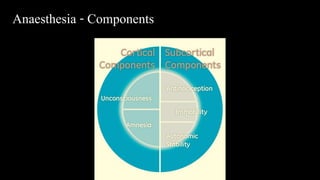
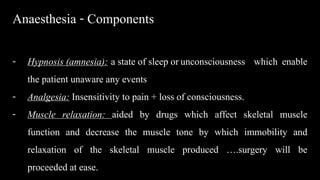
Anaesthesia - Components
- Hypnosis (amnesia): a state of sleep orunconsciousness which enable
the patient unaware any events
- Analgesia: Insensitivity to pain + loss of consciousness.
- Muscle relaxation: aided by drugs which affect skeletal muscle
function and decrease the muscle tone by which immobility and
relaxation of the skeletal muscle produced ….surgery will be
proceeded at ease.
An anesthetic procedure should:
- Abolish pain
- Be Completely reversible.
- Comfort- important
- Safety - essential and must come first.
- Provide good operating conditions.
- E.g. good relaxation for abdominal surgery.
- Be acceptable to the patient.
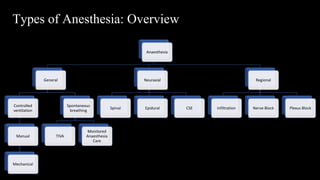
Types of Anesthesia: Overview
Anaesthesia
General
Controlled
ventilation
Manual
Mechanical
Spontaneous
breathing
TIVA
Monitored
Anaesthesia
Care
Neuraxial
Spinal Epidural CSE
Regional
Infiltration Nerve Block Plexus Block
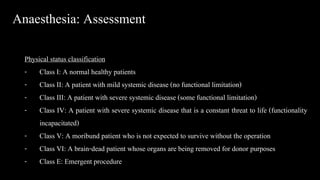
Anaesthesia: Assessment
Physical status classification
- Class I: A normal healthy patients
- Class II: A patient with mild systemic disease (no functional limitation)
- Class III: A patient with severe systemic disease (some functional limitation)
- Class IV: A patient with severe systemic disease that is a constant threat to life (functionality
incapacitated)
- Class V: A moribund patient who is not expected to survive without the operation
- Class VI: A brain-dead patient whose organs are being removed for donor purposes
- Class E: Emergent procedure
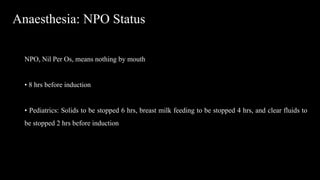
Anaesthesia: NPO Status
NPO, Nil Per Os, means nothing by mouth
• 8 hrs before induction
• Pediatrics: Solids to be stopped 6 hrs, breast milk feeding to be stopped 4 hrs, and clear fluids to
be stopped 2 hrs before induction
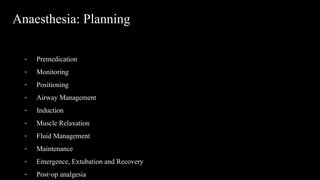
Anaesthesia: Planning
- Premedication
- Monitoring
- Positioning
- Airway Management
- Induction
- Muscle Relaxation
- Fluid Management
- Maintenance
- Emergence, Extubation and Recovery
- Post-op analgesia
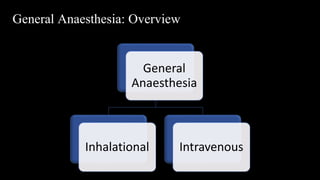
General Anaesthesia: Overview
General
Anaesthesia
Inhalational Intravenous
General Anaesthesia: Overview
- Assessment
- • Planning I: Monitors
- • Planning II: Drugs
- • Planning III: Fluids
- • Planning IV: Airway
General Anaesthesia: Overview
- Management
- • Induction
- • Maintenance
- • Emergence
- • Postoperative
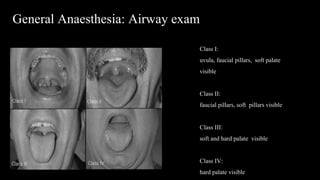
General Anaesthesia: Airway exam
Class I:
uvula, faucial pillars, soft palate
visible
Class II:
faucial pillars, soft pillars visible
Class III:
soft and hard palate visible
Class IV:
hard palate visible
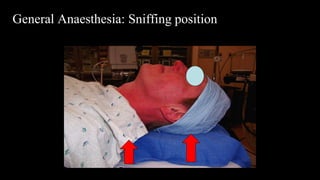
General Anaesthesia: Sniffing position
Anaesthesia: Monitoring
- interpret available clinical data to help recognize present or future mishaps
or unfavorable system conditions
- Standardized basic monitoring requirements (guidelines) from the ASA
(American Society of Anesthesiologists), CAS (Canadian
Anesthesiologists’ Society) , and AAGBI
Anaesthesia: Monitoring
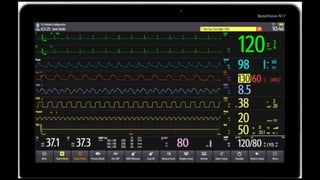
- ASA monitoring for general anesthesia , monitored anesthesia care and
regional anesthesia :
- Oxygenation (oxygen analyzer, pulse oximetry),
- Ventilation (capnography, minute ventilation), respiratory rate (under
regional anesthesia)
- Circulation (electrocardiogram [ECG], arterial blood pressure, perfusion
assessment),
- Temperature.
Anaesthesia: Monitoring
- Advanced Monitoring
- TOF monitor: neuromuscular blockade
- BIS/ Entropy monitor Depth of anaesthesia
- Trans-esophageal echocardiography
- Evoked potential monitoring
- EEG
- CSF pressure monitoring
- NIRS – regional tissue oxygenation monitoring
Anaesthesia: Monitoring
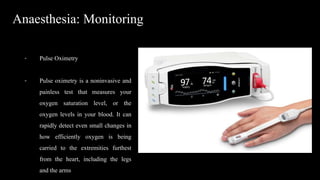
- Pulse Oximetry
- Pulse oximetry is a noninvasive and
painless test that measures your
oxygen saturation level, or the
oxygen levels in your blood. It can
rapidly detect even small changes in
how efficiently oxygen is being
carried to the extremities furthest
from the heart, including the legs
and the arms
Anaesthesia: Monitoring
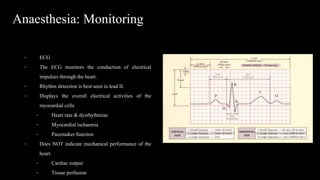
- ECG
- The ECG monitors the conduction of electrical
impulses through the heart.
- Rhythm detection is best seen in lead II.
- Displays the overall electrical activities of the
myocardial cells
- Heart rate & dysrhythmias
- Myocardial ischaemia
- Pacemaker function
- Does NOT indicate mechanical performance of the
heart:
- Cardiac output
- Tissue perfusion
Anaesthesia: Monitoring
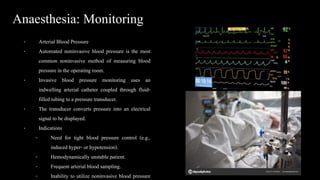
- Arterial Blood Pressure
- Automated noninvasive blood pressure is the most
common noninvasive method of measuring blood
pressure in the operating room.
- Invasive blood pressure monitoring uses an
indwelling arterial catheter coupled through fluid-
filled tubing to a pressure transducer.
- The transducer converts pressure into an electrical
signal to be displayed.
- Indications
- Need for tight blood pressure control (e.g.,
induced hyper- or hypotension).
- Hemodynamicallyunstable patient.
- Frequent arterial blood sampling.
- Inability to utilize noninvasive blood pressure
Anaesthesia: Monitoring
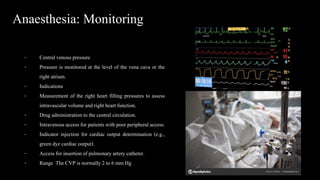
- Central venous pressure
- Pressure is monitored at the level of the vena cava or the
right atrium.
- Indications
- Measurement of the right heart filling pressures to assess
intravascular volume and right heart function.
- Drug administration to the central circulation.
- Intravenousaccess for patients with poor peripheralaccess.
- Indicator injection for cardiac output determination (e.g.,
green dye cardiacoutput).
- Access for insertion of pulmonary artery catheter.
- Range The CVP is normally 2 to 6 mm Hg
Anaesthesia: Monitoring
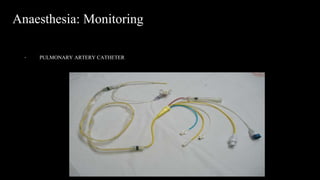
- PULMONARY ARTERY CATHETER
Anaesthesia: Monitoring
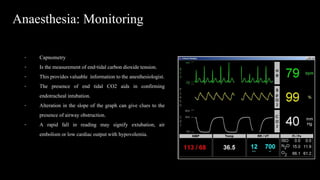
- Capnometry
- Is the measurement of end-tidal carbon dioxide tension.
- This providesvaluable information tothe anesthesiologist.
- The presence of end tidal CO2 aids in confirming
endotracheal intubation.
- Alteration in the slope of the graph can give clues to the
presence ofairway obstruction.
- A rapid fall in reading may signify extubation, air
embolism or low cardiac outputwith hypovolemia.
Anaesthesia: Monitoring
- Temperature
- Infants and small children are prone to thermal lability due to their high surface area to volume ratio.
- Adults subjected to large evaporative losses or low ambient temperatures (as occur with exposed body cavity, large volume
transfusion ofunwarmed fluids, or burns) are prone to hypothermia.
- Malignant hyperthermiais always a possible complication, and temperature monitoring should always be available.
- Monitoring sites:
- Tympanic membranetemperature
- Rectal temperature
- Nasopharyngealtemperature,
- Esophageal temperature monitoring reflects the core temperature well. The probe should be located at the lower third
of the esophagus and rarely may be misplaced inthe airway.
- Blood temperature measurements may be obtained with the thermistor ofa PAC.
Anaesthesia: Monitoring
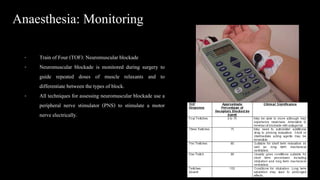
- Train of Four (TOF): Neuromuscular blockade
- Neuromuscular blockade is monitored during surgery to
guide repeated doses of muscle relaxants and to
differentiate between the types of block.
- All techniques for assessing neuromuscular blockade use a
peripheral nerve stimulator (PNS) to stimulate a motor
nerve electrically.
Anaesthesia: Monitoring
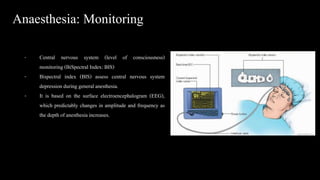
- Central nervous system (level of consciousness)
monitoring (BiSpectral Index: BIS)
- Bispectral index (BIS) assess central nervous system
depression during general anesthesia.
- It is based on the surface electroencephalogram (EEG),
which predictably changes in amplitude and frequency as
the depth of anesthesia increases.
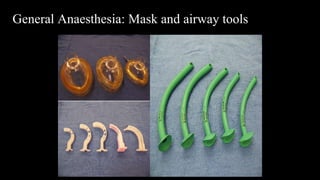
General Anaesthesia: Mask and airway tools
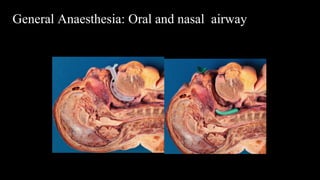
General Anaesthesia: Oral and nasal airway
General Anaesthesia: Induction agents
- Opioids – Fentanyl ( 2mcg/kg)
- Anxiolytic: Midazolam (0.1 mg/kg)
- Hypnotics: Propofol (1.5-2.5mg/kg)
- Thiopental (3-4 mg/kg)
- Etomidate (0.3-0.6 mg/kg)
- Muscle relaxants:
- Depolarizing : Succinyl Choline (1-2 mg/kg)
- Nondepolarizing: Atracurium, Rocuronium, Vecuronium
- Inhalation induction
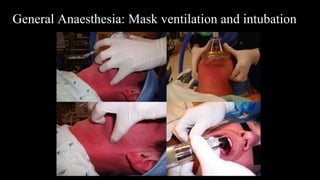
General Anaesthesia: Mask ventilation and intubation
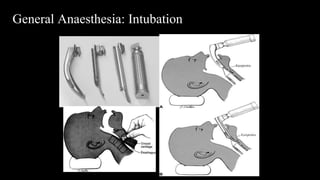
General Anaesthesia: Intubation
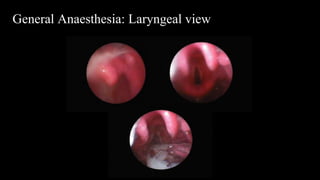
General Anaesthesia: Laryngeal view
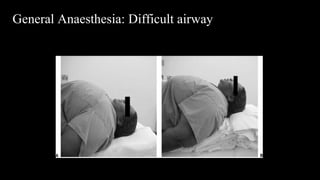
General Anaesthesia: Difficult airway
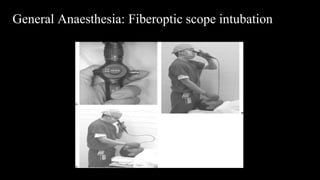
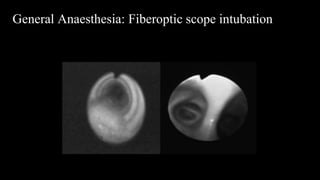
General Anaesthesia: Fiberoptic scope intubation
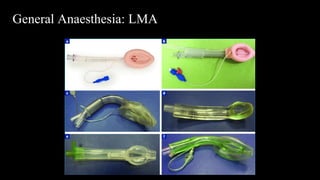
General Anaesthesia: LMA
General Anaesthesia: Intraoperative management
- Maintenance
- Inhalation agents: N2O, Sevoflurane, Desflurane, Isoflurane
- Total IV agents: Propofol, Dexmedetomidine
- Opioids: Fentanyl, Morphine
- Muscle relaxants
- Balance anesthesia: TIVA, Epidural analgesia
Anaesthesia: Fluid and electrolyte management
- Preoperative Evaluation of Fluid Status
- Mental status
- H/O intake and output
- Blood pressure: supine and standing
- Heart rate
- Skin turgor
- Urinary output
- CVP
Anaesthesia: Fluid and electrolyte management
- Peri-operative Fluid Requirements
- C V E - COMPENSATORY INTRAVASCULAR VOLUME EXPANSION
- Maintenance fluid
- Deficit
- Third space losses
- Replacement of loss
Anaesthesia: Fluid and electrolyte management
- C V E - COMPENSATORY INTRAVASCULAR VOLUME EXPANSION
- Most general and regional anaesthetics cause arteriolar and venous dilatation,
expanding the vascular capacity, which reduces the peripheral venous pressure, venous
return, and cardiac output.
- Fluid must be adm. to expand the blood vol to compensate for venodilation .
- Expansion with 5-7ml/kg of BSS must occur before or simultaneous with the onset of
anaesthesia .
Anaesthesia: Fluid and electrolyte management
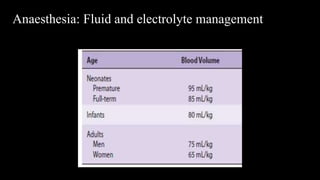
- Maintenance Fluid Requirements
- “4-2-1 Rule” – Holiday-Segar formula
- 4 ml/kg/hr for the first 10 kg of body weight
- 2 ml/kg/hr for the second 10 kg body weight
- 1 ml/kg/hr subsequent kg body weight
- Eg : 70 Kg pt
- Maintenance fluid : 40+20+50= 110 ml/hr
Anaesthesia: Fluid and electrolyte management
- Deficit
- Deficit = number of hours NPO x maintenance fluid requirement.
- Measurable fluid losses, e.g. NG suctioning, vomiting, stoma output.
- 70 kg pt fasting for 8 hrs
- Deficit : 8 X 110 = 880 ml
- Half in first hr
- One fourth each in next two hr .
Anaesthesia: Fluid and electrolyte management
- Third Space Losses
- Isotonic transfer of ECF from functional body fluid compartments to non-functional
compartments.
- Depends on location and duration of surgical procedure, amount of tissue trauma, ambient
temperature, room ventilation.
Anaesthesia: Fluid and electrolyte management
- Replacing Third Space Losses
- Minimal Surgical Trauma: 0-2 ml/kg/hr
- e.g. herniorrhaphy
- Moderate Surgical Trauma: 2-4 ml/kg/hr
- e.g. cholecystectomy
- Severe surgical trauma: 4-6 ml/kg/hr (or even more)
- e.g. major bowel resection
Anaesthesia: Fluid and electrolyte management
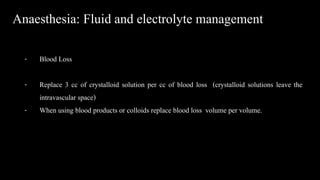
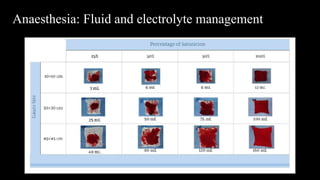
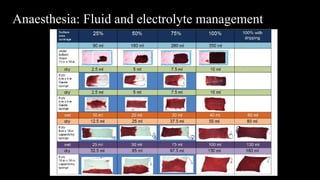
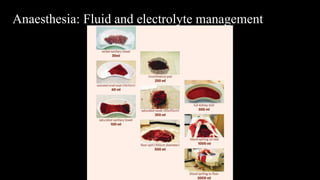
- Blood Loss
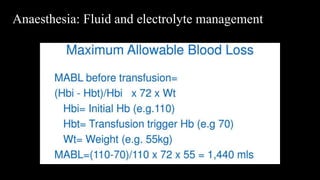
- Replace 3 cc of crystalloid solution per cc of blood loss (crystalloid solutions leave the
intravascular space)
- When using blood products or colloids replace blood loss volume per volume.
Anaesthesia: Fluid and electrolyte management
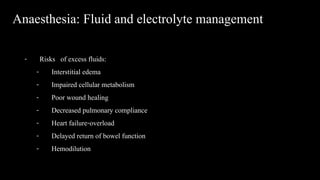
- Risks of excess fluids:
- Interstitial edema
- Impaired cellular metabolism
- Poor wound healing
- Decreased pulmonary compliance
- Heart failure-overload
- Delayed return of bowel function
- Hemodilution
Anaesthesia: Fluid and electrolyte management
- Choiceof fluids:
- Crystalloids
- Colloids
- Blood/blood products and blood substitutes
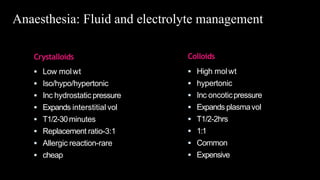
Anaesthesia: Fluid and electrolyte management
ColloidsCrystalloids
 Low molwt
 Iso/hypo/hypertonic
 Inc hydrostatic pressure
 Expands interstitial vol
 T1/2-30minutes
 Replacement ratio-3:1
 Allergic reaction-rare
 cheap
 High molwt
 hypertonic
 Inc oncoticpressure
 Expands plasmavol
 T1/2-2hrs
 1:1
 Common
 Expensive
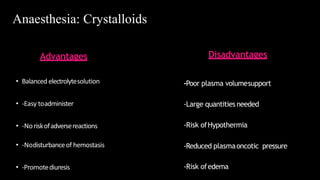
Anaesthesia: Crystalloids
Advantagesvantag
es
• Balanced electrolytesolution
• -Easy toadminister
• -Noriskofadversereactions
• -Nodisturbanceof hemostasis
• -Promotediuresis
Disadvantages
-Poor plasma volumesupport
-Large quantities needed
-Risk ofHypothermia
-Reduced plasmaoncotic pressure
-Risk ofedema
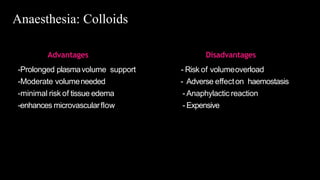
Anaesthesia: Colloids
Advantages
-Prolonged plasmavolume support
-Moderate volumeneeded
-minimal risk of tissue edema
-enhances microvascularflow
Disadvantages
- Risk of volumeoverload
- Adverse effecton haemostasis
- Anaphylactic reaction
- Expensive
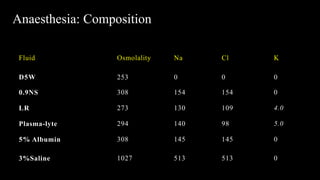
Anaesthesia: Composition
Fluid Osmolality Na Cl K
D5W 253 0 0 0
0.9NS 308 154 154 0
LR 273 130 109 4.0
Plasma-lyte 294 140 98 5.0
5% Albumin 308 145 145 0
3%Saline 1027 513 513 0
Anaesthesia: Clinical Evaluation of Fluid Replacement
- Urine Output: at least 1.0 ml/kg/hour
- Vital Signs: Blood pressure and heart rate
- Physical Assessment: texture of skin and mucous membranes; thirst in an awake patient
- Laboratory tests: periodic monitoring of hemoglobin and hematocrit
Anaesthesia: Fluids - Summary
- Most physiological :BSS – Sterofundin, Kabilyte, RL
- Rich in sodium : 3% Saline, NS, DNS
- Rich in potassium :ISo –p
- Glucose free: RL, NS, 3% saline
- Sodium free: Dextrose
- Potassium free: NS, DNS, Dextrose
- Can correct acidosis directly : RL, ISo-p
General Anaesthesia: Emergence
- Turn off the agent (inhalation or IV agents)
- Reverse the muscle relaxants
- Return to spontaneous ventilation with adequate ventilation and
oxygenation
- Suction upper airway
- Wait for pts to wake up and follow command
- Hemodynamically stable
Anaesthesia: Postoperative management
- Post-anesthesia care unit (PACU)
- Oxygen supplement
- Pain control
- Nausea and vomiting
- Hypertension and hypotension
- Agitation
- Surgical intensive care unit (SICU)
- Mechanical ventilation
- Hemodynamic monitoring
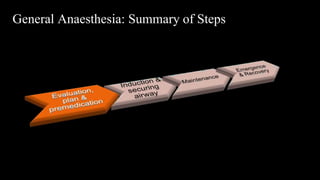
General Anaesthesia: Summary of Steps
Regional Anaesthesia: Overview
- It is the art of rendering a part of the body insensible for surgical operation
or manipulation based on the concept that the pain is conveyed by nerve
fibers which are amenable to interruption anywhere along their path way.
Regional Anaesthesia: Overview
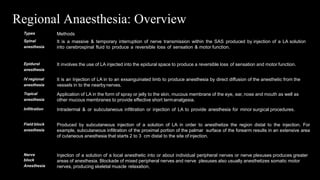
Types Methods
Spinal
anesthesia
It is a massive & temporary interruption of nerve transmission within the SAS produced by injection of a LA solution
into cerebrospinal fluid to produce a reversible loss of sensation & motor function.
Epidural
anesthesia
It involves the use of LA injected into the epidural space to produce a reversible loss of sensation and motor function.
IV regional
anesthesia
It is an Injection of LA in to an exsanguinated limb to produce anesthesia by direct diffusion of the anesthetic from the
vessels in to the nearbynerves.
Topical
anesthesia
Application of LA in the form of spray or jelly to the skin, mucous membrane of the eye, ear, nose and mouth as well as
other mucous membranes to provide effective short termanalgesia.
Infiltration Intradermal & or subcutaneous infiltration or injection of LA to provide anesthesia for minor surgical procedures.
Field block
anesthesia
Produced by subcutaneous injection of a solution of LA in order to anesthetize the region distal to the injection. For
example, subcutaneous infiltration of the proximal portion of the palmar surface of the forearm results in an extensive area
of cutaneous anesthesia that starts 2 to 3 cm distal to the site of injection.
Nerve
block
Anesthesia
Injection of a solution of a local anesthetic into or about individual peripheral nerves or nerve plexuses produces greater
areas of anesthesia. Blockade of mixed peripheral nerves and nerve plexuses also usually anesthetizes somatic motor
nerves, producing skeletal muscle relaxation,
Regional Anaesthesia: Overview
- It is the art of rendering a part of the body insensible for surgical operation
or manipulation based on the concept that the pain is conveyed by nerve
fibers which are amenable to interruption anywhere along their path way.