Principles Of Anesthesia
KyU
Anesthesia Lecture Series
James Nderitu
©2024
Perioperative Care
Def:
It is the all-round practice of patient-centered,
multidisciplinary and integrated medical care of patients from
the moment of contemplation/prescription of surgery until full
recovery.
Pre-operative | Intra-operative | Post-operative
Background
• Several large-scale epidemiological studies e.g. Confidential Enquiry into
Perioperative Deaths (CEPOD) study have indicated that inadequate
preoperative preparation of the patient may contribute greatly to the
primary anesthetic causes of perioperative mortality. It is therefore essential
that the anesthetist visit every patient in the ward before surgery to assess
‘fitness for anesthesia’ as this function cannot be undertaken by the
surgical or medical team.
Preoperative visit
• Preoperative phase involves the patient care and preparation from the
time surgery is prescribed and scheduled until the patient enters the
operating room.
Purpose For The Visit
• Establish rapport with the patient
• Obtain a history and perform a physical examination
• Review available investigations and order any relevant additional tests.
• Assess the risks of anesthesia and surgery and recommend optimization of
any underlying medical conditions.
• Prescribe premeds as necessary.
• Discuss about the need for fasting.
• Develop and discuss with the patient/guardian on the anesthetic plan and
post-anesthetic care plan.
• Make appropriate consultations in case of high risk cases.
History …
• Medical history – proper medical history, evaluate the current
general health.
• Medication – find out what medications s/he is on including non-
prescription herbal medication, any food/drug allergies.
• Anesthetic history – If any, any known incidents on record (old
notes helpful if available).
• Family history – Any family member had a bad rection to
anesthetics, hemophilia etc.
• Smoking – obtain details and encourage stoppage prior to surgery
• Physical exam – Pay particular attention to airway, respiratory and
cardiovascular systems.
History …
Investigations – review available blood, imaging tests and determine
need for more i.e. if the results will alter pt’s management plan.
Documentation – record assessment and discussion on the form for QA
and medico legal purpose.
Anesthetic plan – discuss available anesthetic options and procedures
and attendant risks. Allow pt to choose unless c/i. answer all questions.
Premeds – evaluate the need – relief anxiety, analgesia, reduce risk of
aspiration pneumonia. Regular meds to ct. unless contraindicated.
Stop/change anticoagulants, Aspirin, Oral hypoglycemics, herbal remedies e.g.
garlic.
Cont. antiepileptics, antibiotics, some antihypertensives etc.
Physical Exam
• Allows the anesthetist to focus specifically on:
• Expected airway condition. incl. mouth opening (Mallampati scoring).
• Loose or problematic dentition.
• Limitation in neck range of motion, neck anatomy.
• Aids the anesthetist prepare appropriate plan for difficult intubation
interventions
• Definite difficult airway include: - small receding jaw, small mouth
opening, hx of previous DI, short and thick neck, limited neck
extension, poor dentition/protruding incisors, neck tumors, facial
trauma, hard cervical collar etc.
• Review and examination of respiratory and cardiovascular systems.
Physical Exam
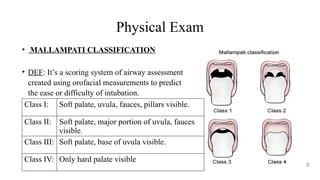
• MALLAMPATI CLASSIFICATION
• DEF: It’s a scoring system of airway assessment
created using orofacial measurements to predict
the ease or difficulty of intubation.
Class I: Soft palate, uvula, fauces, pillars visible.
Class II: Soft palate, major portion of uvula, fauces
visible.
Class III: Soft palate, base of uvula visible.
Class IV: Only hard palate visible
Physical Status Assessment
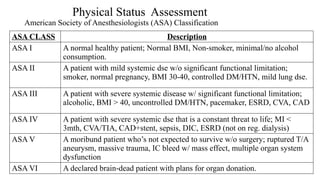
American Society of Anesthesiologists (ASA) Classification
ASA CLASS Description
ASA I A normal healthy patient; Normal BMI, Non-smoker, minimal/no alcohol
consumption.
ASA II A patient with mild systemic dse w/o significant functional limitation;
smoker, normal pregnancy, BMI 30-40, controlled DM/HTN, mild lung dse.
ASA III A patient with severe systemic disease w/ significant functional limitation;
alcoholic, BMI > 40, uncontrolled DM/HTN, pacemaker, ESRD, CVA, CAD
ASA IV A patient with severe systemic dse that is a constant threat to life; MI <
3mth, CVA/TIA, CAD+stent, sepsis, DIC, ESRD (not on reg. dialysis)
ASA V A moribund patient who’s not expected to survive w/o surgery; ruptured T/A
aneurysm, massive trauma, IC bleed w/ mass effect, multiple organ system
dysfunction
ASA VI A declared brain-dead patient with plans for organ donation.
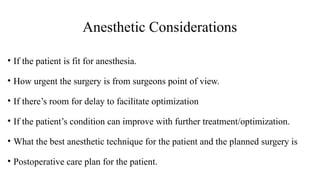
Anesthetic Considerations
• If the patient is fit for anesthesia.
• How urgent the surgery is from surgeons point of view.
• If there’s room for delay to facilitate optimization
• If the patient’s condition can improve with further treatment/optimization.
• What the best anesthetic technique for the patient and the planned surgery is
• Postoperative care plan for the patient.
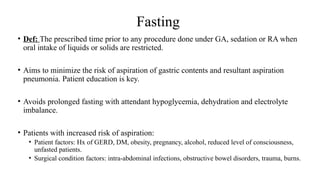
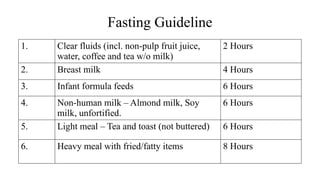
Fasting
• Def: The prescribed time prior to any procedure done under GA, sedation or RA when
oral intake of liquids or solids are restricted.
• Aims to minimize the risk of aspiration of gastric contents and resultant aspiration
pneumonia. Patient education is key.
• Avoids prolonged fasting with attendant hypoglycemia, dehydration and electrolyte
imbalance.
• Patients with increased risk of aspiration:
• Patient factors: Hx of GERD, DM, obesity, pregnancy, alcohol, reduced level of consciousness,
unfasted patients.
• Surgical condition factors: intra-abdominal infections, obstructive bowel disorders, trauma, burns.
Fasting Guideline
1. Clear fluids (incl. non-pulp fruit juice,
water, coffee and tea w/o milk)
2 Hours
2. Breast milk 4 Hours
3. Infant formula feeds 6 Hours
4. Non-human milk – Almond milk, Soy
milk, unfortified.
6 Hours
5. Light meal – Tea and toast (not buttered) 6 Hours
6. Heavy meal with fried/fatty items 8 Hours
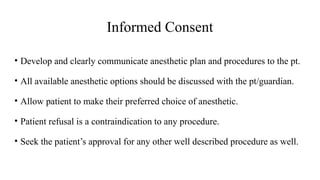
Informed Consent
• Develop and clearly communicate anesthetic plan and procedures to the pt.
• All available anesthetic options should be discussed with the pt/guardian.
• Allow patient to make their preferred choice of anesthetic.
• Patient refusal is a contraindication to any procedure.
• Seek the patient’s approval for any other well described procedure as well.
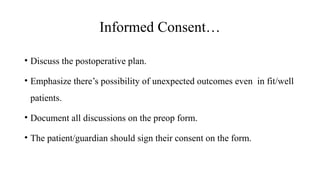
Informed Consent…
• Discuss the postoperative plan.
• Emphasize there’s possibility of unexpected outcomes even in fit/well
patients.
• Document all discussions on the preop form.
• The patient/guardian should sign their consent on the form.
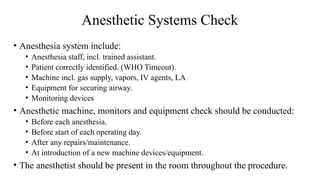
Anesthetic Systems Check
• Anesthesia system include:
• Anesthesia staff, incl. trained assistant.
• Patient correctly identified. (WHO Timeout).
• Machine incl. gas supply, vapors, IV agents, LA
• Equipment for securing airway.
• Monitoring devices
• Anesthetic machine, monitors and equipment check should be conducted:
• Before each anesthesia.
• Before start of each operating day.
• After any repairs/maintenance.
• At introduction of a new machine devices/equipment.
• The anesthetist should be present in the room throughout the procedure.
Anesthetic systems check…
• Anesthesia adjuncts should be available, in varying sizes and working:
• Airway equipment: – 2 Laryngoscopes with range of blades, range of masks,
range of airways, introducers/bougies, range of ETTs, LMAs
• Suction apparatus: - Machine, tubing, range of catheters, Yankeurs.
• Consumables: - syringes, needles, cannulas, Adhesive plasters, blankets,
pillows etc.
• All anesthetic and emergency drugs: - available in good stock, drawn-up and
labeled, emergency drugs within reach. Avoid drug errors.
Practical Conduct of Anesthesia
• General anesthesia is a state of induced, reversible loss of consciousness,
during which the patient is unaware of their surroundings and of
painful stimuli.
• The effects of anesthesia and surgery results in an array of physiological
consequences requiring continuous monitoring and correction.
• A competent anesthetist should at all time have ethical responsibility to their
patients and colleagues/team.
Practical Conduct of Anesthesia
• General anesthesia (GA) may not always be the best choice.
• Anesthetists consider all factors influencing patient’s medical condition
before selecting the optimal anesthetic technique accordingly.
• The choices may include local, regional or general anesthesia depending
on patient’s clinical presentation.
Practical Conduct of Anesthesia
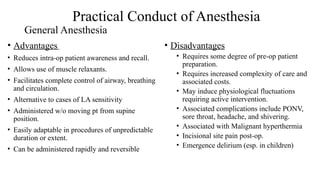
General Anesthesia
• Advantages
• Reduces intra-op patient awareness and recall.
• Allows use of muscle relaxants.
• Facilitates complete control of airway, breathing
and circulation.
• Alternative to cases of LA sensitivity
• Administered w/o moving pt from supine
position.
• Easily adaptable in procedures of unpredictable
duration or extent.
• Can be administered rapidly and reversible
• Disadvantages
• Requires some degree of pre-op patient
preparation.
• Requires increased complexity of care and
associated costs.
• May induce physiological fluctuations
requiring active intervention.
• Associated complications include PONV,
sore throat, headache, and shivering.
• Associated with Malignant hyperthermia
• Incisional site pain post-op.
• Emergence delirium (esp. in children)
Practical Conduct of Anesthesia
• PREMEDICATION
• Usually done in the ward or pre-op holding area.
• Aims to have the patient relaxed, calm, child easily separable from parent.
• Ideal premed is Midazolam (short-acting benzodiazepine).
• Others - pre-emptive analgesics e.g., NSAID, paracetamol.
- H2 blockers and clear antacids (Hx of GERD)
Intraoperative Phase
INDUCTION
• Set up and take note of pre-induction vitals, SPO2, HR, BP, ECG trace etc.
• Opioid analgesic is given as appropriate e.g., Fentanyl.
• IV or Inhalational anesthetic induction agent or both is administered as apt.
• Securing the airway – ETT, LMA as appropriate.
• Indications for endotracheal intubation:
• Potential for airway contamination (full stomach, GERD, GI or pharyngeal bleeding)
• Surgical need for muscle relaxation
• Patient positioning for surgical access.
• Surgery of mouth, face, upper GI
• Prolonged surgical procedure
• Intermediate or long-acting muscle relaxants as appropriate (maintenance).
Intraoperative Phase
RAPID SEQUENCE INDUCTION (RSI)
• Def: Refers to a set of actions during induction of anesthesia in
unfasted patients or patients at risk of aspiration/regurgitation of
gastric contents with the aim of securing the airway quickly and
safely while actively reducing the risk of aspiration. First
described in 1970.
• Classical RSI consists of the following steps:
• Confirm that the ventilation equipment is well set up and ready for
use.
• Monitoring of initial vital signs.
• IV line placement.
Intraoperative Phase
RAPID SEQUENCE INDUCTION (RSI)
• Cont’d…
• Patient positioning.
• Functional suction machine with wide bore suction catheter on.
• Preoxygenation with 100% Oxygen via face mask (3-5 min).
• IV injection of anesthetic induction agent then a rapid onset muscle
relaxant.
• ETT intubation with Sellick maneuver (cricoid pressure) and inflation
of cuff.
• Connection to the already set ventilation equipment/machine.
Intraoperative Phase…
MAINTENANCE
• Monitoring and responding to pt’s emerging needs as a continuum of
activities
• Surgical anesthesia plane maintained by inhalation(commonest), IV agents or
both.
• Muscle relaxants, when used are tapered per response/monitoring device.
• Adjust depths with various needs/stages of procedure.
• Avoid awareness. Aim for MAC – Prevents SE, slower awakening
Intraoperative Phase…
REVERSAL
• Plan emergence as procedure draws to a close. Note time last muscle
relaxant given, stepping down on inhalational agent..
• Give post operative analgesia as appropriate if due/not given.
• At end of procedure switch off inhalational agent and N2O, 100% O2
• Residual muscle relaxants are reversed using specific drugs e.g.,
Neostigmine.
• Extubation is performed after patient has met a list of extubation criteria.
• Have suction apparatus ready and prepare to re-intubate as per need.
• Give O2 via mask for about five minute before releasing pt to PACU.
Postoperative Phase…
• Patient transferred to PACU or ICU/HDU as the case may be and
handed to appropriately trained nurse.
• Instructions given according to protocol.
• Patients are discharged to the general ward after satisfying
PACU/ICU/HDU discharge criteria.
THANK YOU