Basics of Anesthesia
Lecture Objectives
• Discuss briefly the History of Anesthesia
• Discuss the scope of anesthesia including
preoperative assessment, intraoperative care
and postoperative care.
The History of Anesthesia
• The first successful anesthetic took place at Massachusetts
General Hospital in 1846 by a dentist, Dr. William T Morton.
• No significant new inhaled anesthetics were introduced
during the next 80 years.
• In the 1930s Cyclopropane, became the most
important new inhaled anesthetic b/c of its low blood
solubility and support of the circulation.
• Fluorinated inhaled anesthetics were used in the 1950s b/c
of minimal depression of cardiovascular function, less organ
toxicity and low blood solubility.
• Presently, one gas (nitrous oxide) and the vapors of three
volatile liquids (sevoflurane, desflurane isoflurane) represent
the commonly used inhaled anesthetics.
Preoperative management
• Areas to investigate in preop history.
– Previous adverse responses related to anesthesia
– Allergic Reactions
– Sleep apnea
– Prolonged skeletal muscle paralysis
– Delayed awakening
– Nausea and vomiting
– Adverse responses in relatives
– Central Nervous System
• Cerebrovascular insufficiency
• Seizures
• Areas to investigate in preop history.
– Cardiovascular System
• Exercise Tolerance
• Angina
• Prior MI
• HTN
• Claudication
– Lungs
• Exercise Tolerance
• Dyspnea and Orthopnea
• Cough and Sputum Production
• Cigarette consumption
• Pneumonia
• Recent upper resp. tract infection
– Liver
• Alcohol Consumption
• Hepatitis
– Kidneys
• Nocturia
• Pyuria
– Skeletal and Muscular Systems
• Arthritis
• Osteoporosis
• Weakness
• Endocrine System
– Diabetes mellitus
– Thyroid gland dysfunction
– Adrenal gland dysfunction
• Coagulation
– Bleeding tendency
– Easy bruising
– Hereditary coagulopathies
• Reproductive System
– Menstrual History
– STDs
– Dentition
– Dentures
– Caps
• Other important Info needed in History
– Current Drug Therapy
– Neonatal Hx
– Previous Surgeries
Physical Exam
• CNS
– Level of Consciousness
– Evidence of peripheral, sensory or skeletal muscle
dysfanction
• CV
– Auscultation of heart
– Systemic blood pressure
– Peripheral pulses
– Veins
– Peripheral edema
• Lungs
– Auscultation of Lungs
– Pattern of breathing
Mallampati Classification
• Size of Tongue Vs Pharynx
– The size of the tongue vs the oral cavity can be visually
graded by assessing how much the pharynx is obscured
by the tongue.
– This is the basis for the Mallampati Classification.
– Class I
• Soft palate,anterior and posterior tonsillar pillars and uvula
visible
– Class II
• Tonsillar pillars and base of uvula hidden by base of tongue
– Class III
• Only soft palate visible
– Class IV
• Soft palate not visible
What Laboratory tests are needed?
• Surgical patients require preop lab and diagnostic
studies that are consistent with:
– their medical histories,
– the proposed operative procedures, and
– the potential for blood loss.
• Lab Test
– CXR
– ECG
– Clinical indications
• Pneumonia, pulmonary edema,
• Atelectasis, mediastinal or pulmonary masses,pulm. HTN,
cardiomegaly,
• Advanced COPD with blebs, Pulmonary Embolism.
• Hx of CAD, Age >50, HTN, chest pain, CHF, DM, PVD, SOB, DOE,
palpitations, murmurs
Lab Test
• LFT
• Renal fxn testing
• CBC
• Coagulation testing
• Pregnancy testing
Clinical Indications
• Hx of Hepatitis, Cirrhosis, portal
HTN, GB or biliary tract disease,
Jaundice
• HTN, increased fluid overload,
diabetes, urinary problems,
dialysis pts
• Hematologic disorder, bleeding,
malignancy,
• Chemo/radiation tx, renal ds.,
highly invasive or trauma hx.
• Bleeding disorder hx.,
Anticoagulant meds, Hepatic ds.
• Sexually active, time of last
menstrual period.
Choice Of Anesthesia
• There are four main types of anesthesia from
which to choose
• General anesthesia
– Provides loss of consciousness and loss of
sensation.
• Regional anesthesia
– Involves the injection of a local anesthetic to
provide numbness, loss of pain or loss of
sensation to a large region of the body.
– Regional anesthetic techniques include spinal
blocks, epidural blocks and arm and leg blocks
• Medications can be given that will make the pt
comfortable.
• Monitored anesthesia (MAC)
– Consists of medications to make you drowsy and to
relieve pain.
– These medications supplement local anesthetic
injections, which are often given by your surgeon.
– While you are sedated, your anesthesiologist will
monitor your vital body functions.
• Local anesthesia
– Numbness to a small area, is often injected by
your surgeon.
– In this case, there may be no anesthesia team
member with the patient.
ASA Classification
• The American Society of Anesthesiologists
(ASA) physical status classification serves as a
guide, to allow communication among
anesthesiologists about clinical conditions of
patients.
• A way to predict their anesthetic/surgical risks
-the higher ASA class, the higher the risks.
ASA Classification
• Class 1Healthy patient, no medical problems
• Class 2 Mild systemic disease
• Class 3 Severe systemic disease, but not incapacitating
• Class 4 Severe systemic disease that is a constant
threat to life.
• Class 5 Moribund, not expected to live 24 hours
irrespective of operation.
• An E is added to the status number to designate an
emergency operation.
• An organ donor is usually designated as Class 6.
Intraoperative management
• Equipment Check
– Suction
– Airway
– Laryngoscope
– Tube
• Apply Standard ASA Monitors - Pulse ox, EKG,
NIBP, precordial or esophageal stethoscope
• Put pt in optimal intubating position.
• Preoxygenate
• Induction - IV anesthetic (propofol), Narcotics, Muscle relaxant
• Mask ventilate
• Intubate
• Check breath sounds, end tidal CO2, Blood pressure, HR, sats.
• Maintain on Inhalation agent.
• Patient positioning - protect pressure areas
• Intraop fluid management
• Anesthesia record
• Vital signs monitoring
Indications for intubation
• Uncorrectable hypoxemia (pO2 <55 on 100 O2 NRB).
• Hypercapnia (pCO2 >55) with acidosis
(pH<7.25) remember patients with COPD often live
with a pCO2 50-70 without acidosis.
• Ineffective respiration (max inspiratory
force <25 cmH2O).
• Fatigue (tachypnea with increasing pCO2).
• Airway protection.
• Upper airway obstruction.
• Septic shock.
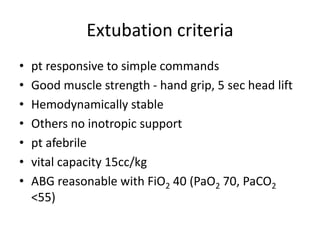
Extubation criteria
• pt responsive to simple commands
• Good muscle strength - hand grip, 5 sec head lift
• Hemodynamically stable
• Others no inotropic support
• pt afebrile
• vital capacity 15cc/kg
• ABG reasonable with FiO2 40 (PaO2 70, PaCO2
<55)
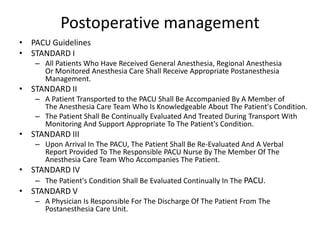
Postoperative management
• PACU Guidelines
• STANDARD I
– All Patients Who Have Received General Anesthesia, Regional Anesthesia
Or Monitored Anesthesia Care Shall Receive Appropriate Postanesthesia
Management.
• STANDARD II
– A Patient Transported to the PACU Shall Be Accompanied By A Member of
The Anesthesia Care Team Who Is Knowledgeable About The Patient's Condition.
– The Patient Shall Be Continually Evaluated And Treated During Transport With
Monitoring And Support Appropriate To The Patient's Condition.
• STANDARD III
– Upon Arrival In The PACU, The Patient Shall Be Re-Evaluated And A Verbal
Report Provided To The Responsible PACU Nurse By The Member Of The
Anesthesia Care Team Who Accompanies The Patient.
• STANDARD IV
– The Patient's Condition Shall Be Evaluated Continually In The PACU.
• STANDARD V
– A Physician Is Responsible For The Discharge Of The Patient From The
Postanesthesia Care Unit.
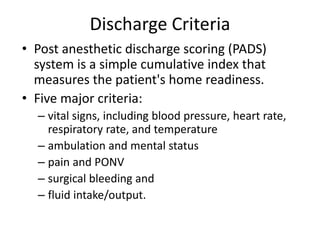
Discharge Criteria
• Post anesthetic discharge scoring (PADS)
system is a simple cumulative index that
measures the patient's home readiness.
• Five major criteria:
– vital signs, including blood pressure, heart rate,
respiratory rate, and temperature
– ambulation and mental status
– pain and PONV
– surgical bleeding and
– fluid intake/output.
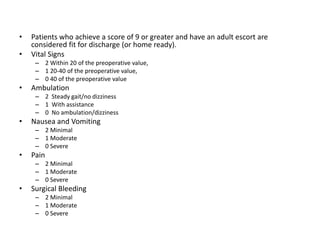
• Patients who achieve a score of 9 or greater and have an adult escort are
considered fit for discharge (or home ready).
• Vital Signs
– 2 Within 20 of the preoperative value,
– 1 20-40 of the preoperative value,
– 0 40 of the preoperative value
• Ambulation
– 2 Steady gait/no dizziness
– 1 With assistance
– 0 No ambulation/dizziness
• Nausea and Vomiting
– 2 Minimal
– 1 Moderate
– 0 Severe
• Pain
– 2 Minimal
– 1 Moderate
– 0 Severe
• Surgical Bleeding
– 2 Minimal
– 1 Moderate
– 0 Severe

Basics of Anesthesia.pptx

  • 1.
  • 2.
    Lecture Objectives • Discussbriefly the History of Anesthesia • Discuss the scope of anesthesia including preoperative assessment, intraoperative care and postoperative care.
  • 3.
    The History ofAnesthesia • The first successful anesthetic took place at Massachusetts General Hospital in 1846 by a dentist, Dr. William T Morton. • No significant new inhaled anesthetics were introduced during the next 80 years. • In the 1930s Cyclopropane, became the most important new inhaled anesthetic b/c of its low blood solubility and support of the circulation. • Fluorinated inhaled anesthetics were used in the 1950s b/c of minimal depression of cardiovascular function, less organ toxicity and low blood solubility. • Presently, one gas (nitrous oxide) and the vapors of three volatile liquids (sevoflurane, desflurane isoflurane) represent the commonly used inhaled anesthetics.
  • 4.
    Preoperative management • Areasto investigate in preop history. – Previous adverse responses related to anesthesia – Allergic Reactions – Sleep apnea – Prolonged skeletal muscle paralysis – Delayed awakening – Nausea and vomiting – Adverse responses in relatives – Central Nervous System • Cerebrovascular insufficiency • Seizures
  • 5.
    • Areas toinvestigate in preop history. – Cardiovascular System • Exercise Tolerance • Angina • Prior MI • HTN • Claudication – Lungs • Exercise Tolerance • Dyspnea and Orthopnea • Cough and Sputum Production • Cigarette consumption • Pneumonia • Recent upper resp. tract infection
  • 6.
    – Liver • AlcoholConsumption • Hepatitis – Kidneys • Nocturia • Pyuria – Skeletal and Muscular Systems • Arthritis • Osteoporosis • Weakness
  • 7.
    • Endocrine System –Diabetes mellitus – Thyroid gland dysfunction – Adrenal gland dysfunction • Coagulation – Bleeding tendency – Easy bruising – Hereditary coagulopathies • Reproductive System – Menstrual History – STDs – Dentition – Dentures – Caps
  • 8.
    • Other importantInfo needed in History – Current Drug Therapy – Neonatal Hx – Previous Surgeries
  • 9.
    Physical Exam • CNS –Level of Consciousness – Evidence of peripheral, sensory or skeletal muscle dysfanction • CV – Auscultation of heart – Systemic blood pressure – Peripheral pulses – Veins – Peripheral edema • Lungs – Auscultation of Lungs – Pattern of breathing
  • 10.
    Mallampati Classification • Sizeof Tongue Vs Pharynx – The size of the tongue vs the oral cavity can be visually graded by assessing how much the pharynx is obscured by the tongue. – This is the basis for the Mallampati Classification. – Class I • Soft palate,anterior and posterior tonsillar pillars and uvula visible – Class II • Tonsillar pillars and base of uvula hidden by base of tongue – Class III • Only soft palate visible – Class IV • Soft palate not visible
  • 11.
    What Laboratory testsare needed? • Surgical patients require preop lab and diagnostic studies that are consistent with: – their medical histories, – the proposed operative procedures, and – the potential for blood loss. • Lab Test – CXR – ECG – Clinical indications • Pneumonia, pulmonary edema, • Atelectasis, mediastinal or pulmonary masses,pulm. HTN, cardiomegaly, • Advanced COPD with blebs, Pulmonary Embolism. • Hx of CAD, Age >50, HTN, chest pain, CHF, DM, PVD, SOB, DOE, palpitations, murmurs
  • 13.
    Lab Test • LFT •Renal fxn testing • CBC • Coagulation testing • Pregnancy testing Clinical Indications • Hx of Hepatitis, Cirrhosis, portal HTN, GB or biliary tract disease, Jaundice • HTN, increased fluid overload, diabetes, urinary problems, dialysis pts • Hematologic disorder, bleeding, malignancy, • Chemo/radiation tx, renal ds., highly invasive or trauma hx. • Bleeding disorder hx., Anticoagulant meds, Hepatic ds. • Sexually active, time of last menstrual period.
  • 14.
    Choice Of Anesthesia •There are four main types of anesthesia from which to choose • General anesthesia – Provides loss of consciousness and loss of sensation.
  • 15.
    • Regional anesthesia –Involves the injection of a local anesthetic to provide numbness, loss of pain or loss of sensation to a large region of the body. – Regional anesthetic techniques include spinal blocks, epidural blocks and arm and leg blocks • Medications can be given that will make the pt comfortable.
  • 16.
    • Monitored anesthesia(MAC) – Consists of medications to make you drowsy and to relieve pain. – These medications supplement local anesthetic injections, which are often given by your surgeon. – While you are sedated, your anesthesiologist will monitor your vital body functions.
  • 17.
    • Local anesthesia –Numbness to a small area, is often injected by your surgeon. – In this case, there may be no anesthesia team member with the patient.
  • 18.
    ASA Classification • TheAmerican Society of Anesthesiologists (ASA) physical status classification serves as a guide, to allow communication among anesthesiologists about clinical conditions of patients. • A way to predict their anesthetic/surgical risks -the higher ASA class, the higher the risks.
  • 19.
    ASA Classification • Class1Healthy patient, no medical problems • Class 2 Mild systemic disease • Class 3 Severe systemic disease, but not incapacitating • Class 4 Severe systemic disease that is a constant threat to life. • Class 5 Moribund, not expected to live 24 hours irrespective of operation. • An E is added to the status number to designate an emergency operation. • An organ donor is usually designated as Class 6. Intraoperative management
  • 20.
    • Equipment Check –Suction – Airway – Laryngoscope – Tube • Apply Standard ASA Monitors - Pulse ox, EKG, NIBP, precordial or esophageal stethoscope • Put pt in optimal intubating position. • Preoxygenate • Induction - IV anesthetic (propofol), Narcotics, Muscle relaxant • Mask ventilate • Intubate • Check breath sounds, end tidal CO2, Blood pressure, HR, sats. • Maintain on Inhalation agent. • Patient positioning - protect pressure areas • Intraop fluid management • Anesthesia record • Vital signs monitoring
  • 21.
    Indications for intubation •Uncorrectable hypoxemia (pO2 <55 on 100 O2 NRB). • Hypercapnia (pCO2 >55) with acidosis (pH<7.25) remember patients with COPD often live with a pCO2 50-70 without acidosis. • Ineffective respiration (max inspiratory force <25 cmH2O). • Fatigue (tachypnea with increasing pCO2). • Airway protection. • Upper airway obstruction. • Septic shock.
  • 22.
    Extubation criteria • ptresponsive to simple commands • Good muscle strength - hand grip, 5 sec head lift • Hemodynamically stable • Others no inotropic support • pt afebrile • vital capacity 15cc/kg • ABG reasonable with FiO2 40 (PaO2 70, PaCO2 <55)
  • 23.
    Postoperative management • PACUGuidelines • STANDARD I – All Patients Who Have Received General Anesthesia, Regional Anesthesia Or Monitored Anesthesia Care Shall Receive Appropriate Postanesthesia Management. • STANDARD II – A Patient Transported to the PACU Shall Be Accompanied By A Member of The Anesthesia Care Team Who Is Knowledgeable About The Patient's Condition. – The Patient Shall Be Continually Evaluated And Treated During Transport With Monitoring And Support Appropriate To The Patient's Condition. • STANDARD III – Upon Arrival In The PACU, The Patient Shall Be Re-Evaluated And A Verbal Report Provided To The Responsible PACU Nurse By The Member Of The Anesthesia Care Team Who Accompanies The Patient. • STANDARD IV – The Patient's Condition Shall Be Evaluated Continually In The PACU. • STANDARD V – A Physician Is Responsible For The Discharge Of The Patient From The Postanesthesia Care Unit.
  • 24.
    Discharge Criteria • Postanesthetic discharge scoring (PADS) system is a simple cumulative index that measures the patient's home readiness. • Five major criteria: – vital signs, including blood pressure, heart rate, respiratory rate, and temperature – ambulation and mental status – pain and PONV – surgical bleeding and – fluid intake/output.
  • 25.
    • Patients whoachieve a score of 9 or greater and have an adult escort are considered fit for discharge (or home ready). • Vital Signs – 2 Within 20 of the preoperative value, – 1 20-40 of the preoperative value, – 0 40 of the preoperative value • Ambulation – 2 Steady gait/no dizziness – 1 With assistance – 0 No ambulation/dizziness • Nausea and Vomiting – 2 Minimal – 1 Moderate – 0 Severe • Pain – 2 Minimal – 1 Moderate – 0 Severe • Surgical Bleeding – 2 Minimal – 1 Moderate – 0 Severe