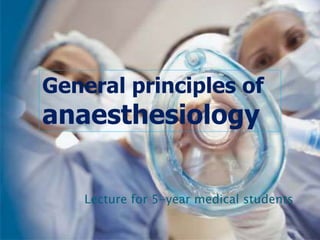
Lecture for 5-year medical students
General principles of
anaesthesiology
◦ Introduction
◦ Preoperative History and Physical
◦ IV’s and Premedication
◦ Commonly Used Medications
◦ Room Setup and Monitors
◦ Induction and Intubation
◦ Maintenance
◦ Emergence
◦ PACU Concerns
Induction to anaesthesiology
Definitions
Anesthesia - From the Greek
meaning lack of sensation;
particularly during surgical
intervention.
Induction to anaesthesiology
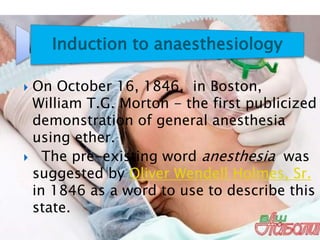
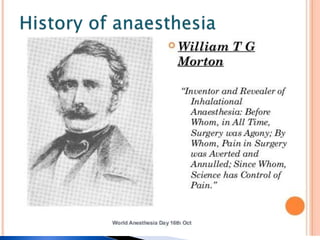
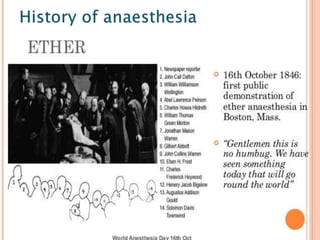
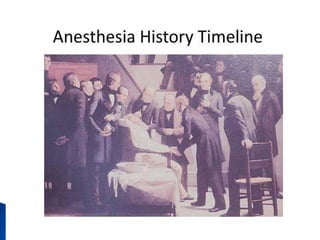
 On October 16, 1846, in Boston,
William T.G. Morton - the first publicized
demonstration of general anesthesia
using ether.
 The pre-existing word anesthesia was
suggested by Oliver Wendell Holmes, Sr.
in 1846 as a word to use to describe this
state.
 General anesthesia–
a condition characterized by temporary
shutting down
 consciousness
pain sensitivity
reflexes
relaxation of skeletal muscles
due to exposure to the anesthetics on the
Central nervous system
Anaesthesia
 Reversible, drug-induced condition
◦ Amnesia & unconsciousness
◦ Analgesia
◦ Muscle relaxation
◦ Attenuation of autonomic
responses to noxious stimulation
◦ Homeostasis of Vital
◦ Functions
Anaesthesiology is the
science of managing the life
functions of the patients
organism in time of surgery
or aggressive diagnostic
procedure.
Induction to anaesthesiology
 General Anesthesia
 Preoperative evaluation
 Intraoperative management
 Postoperative management
 Physical Examination
 Physical exams of all systems.
 Airway assessment to determine the
likelihood of difficult intubation
Preoperative History and Physical
 Unlike the standard internal medicine
H&P, ours is much more focused, with
specific attention being paid to the
airway and to organ systems at
potential risk for anesthetic
complications. The type of operation,
and the type of anesthetic will also
help to focus the evaluation.
 • Elective: operation at a time to suit
both patient and surgeon; for example
hip replacement, varicose veins.
 • Scheduled: an early operation but
not immediately life saving; operation
usually within 3 weeks; for example
surgery for malignancy.
 .
 • Urgent: operation as soon as possible
after resuscitation and within 24 h; for
example intestinal obstruction, major
fractures.
 • Emergency: immediate life-saving
operation, resuscitation simultaneous with
surgical treatment; operation usually within
1h; for example major trauma with
uncontrolled haemorrhage, extradural
haematoma
Of particular interest in the history portion of the
evaluation are:
◦ Coronary Artery Disease
◦ Hypertension
◦ Asthma
◦ Kidney or Liver disease
◦ Reflux Disease
◦ Smoking
◦ Alcohol Consumption or Drug Abuse?
◦ Diabetes
◦ Medications
◦ Allergies
◦ Family History
◦ Anesthesia history
◦ Last Meal
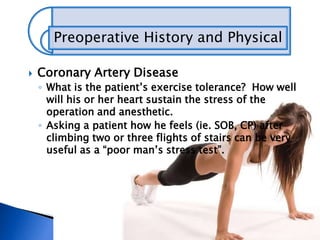
 Coronary Artery Disease
◦ What is the patient’s exercise tolerance? How well
will his or her heart sustain the stress of the
operation and anesthetic.
◦ Asking a patient how he feels (ie. SOB, CP) after
climbing two or three flights of stairs can be very
useful as a “poor man’s stress test”.
Preoperative History and Physical
 Coronary Artery Disease
◦ What is the patient’s exercise tolerance? How well
will his or her heart sustain the stress of the
operation and anesthetic.
◦ Asking a patient how he feels (ie. SOB, CP) after
climbing two or three flights of stairs can be very
useful as a “poor man’s stress test”.
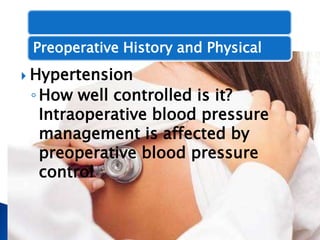
 Hypertension
◦How well controlled is it?
Intraoperative blood pressure
management is affected by
preoperative blood pressure
control
Preoperative History and Physical
 Asthma
◦ How well controlled is it? What triggers it? Many of
the stressors of surgery as well as intubation and
ventilation can stimulate bronchospasm.
◦ Is there any history of being hospitalized,
intubated, or prescribed steroids for asthma? This
can help assess the severity of disease
Preoperative History and Physical
 Kidney or Liver disease
◦ Different anesthetic drugs have
different modes of clearance and
organ function can affect our choice
of drugs.
 Reflux Disease
◦ Present or not? Anesthetized and relaxed patients
are prone to regurgitation and aspiration,
particularly if a history of reflux is present
 Smoking
◦ Currently smoking? Airway and secretion
management can become more difficult in smokers.
 Alcohol Consumption or Drug Abuse?
◦ Drinkers have an increased tolerance to many
sedative drugs (conversely they have a decreased
requirement if drunk), and are at an increased risk
of hepatic disease, which can impact the choice of
anesthetic agents.
 Diabetes
◦ Well controlled? The stress response to surgery and
anesthesia can markedly increase blood glucose
concentrations, especially in diabetics
 Medications
◦ Many medications interact with anesthetic agents,
and some should be taken on the morning of
surgery (blood pressure medications) while others
should probably not (diuretics, diabetes
medications).
 Allergies
◦ We routinely give narcotics and antibiotics
perioperatively, and it is important to know the
types of reactions that a patient has had to
medications in the past.
 Family History
◦ There is a rare, but serious disorder known as
malignant hyperthermia that affects susceptible
patients under anesthesia, and is heritable
 Anesthesia history
◦ Has the patient ever had anesthesia and surgery
before? Did anything go wrong?
 Last Meal
◦ Whether the patient has an empty stomach or not
impacts the choice of induction technique
 All patients must have an assessment made
of their airway, the aim being to try and
predict those patients who may be difficult to
intubate.

 Finding any of these suggests that intubation
may be more difficult.
 • limitation of mouth opening;
 • a receding mandible;
 • position, number and health of teeth;
 • size of the tongue;
 • soft tissue swelling at the front of the neck;
 • deviation of the larynx or trachea;
 • limitations in flexion and extension of the
cervical spine.
 Also, any loose or missing teeth should be
noted, as should cervical range of motion,
mouth opening, and thyromental distance,
all of which will impact the actual intubation
prior to surgery.
During the physical examination, particular
attention is paid to the airway by asking the
patient to “open your mouth as wide as you
can and stick out your tongue” The
classification scale of Mallampati is
commonly used.
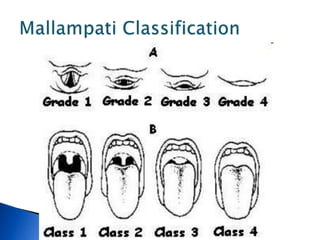
Mallampati Classification
 Class I: Entire uvula and tonsillar pillars
visible
 Class II: Tip of uvula and pillars hidden by
tongue
 Class III: Only soft palate visible
 Class IV: Only hard palate visible
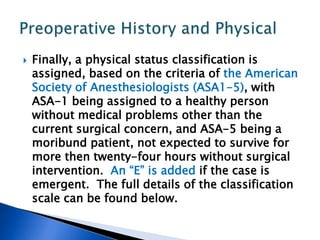
 Finally, a physical status classification is
assigned, based on the criteria of the American
Society of Anesthesiologists (ASA1-5), with
ASA-1 being assigned to a healthy person
without medical problems other than the
current surgical concern, and ASA-5 being a
moribund patient, not expected to survive for
more then twenty-four hours without surgical
intervention. An “E” is added if the case is
emergent. The full details of the classification
scale can be found below.
ASA Physical Status Classification
 ASA-I: Healthy patient with no systemic disease
 ASA-II: Mild systemic disease , no functional
limitations
 ASA-III: Moderate to severe systemic disease, some
functional limitations
 ASA-IV: Severe systemic disease, incapacitating, and a
constant threat to life
 ASA-V: Moribund patient, not expected to survive >
24 hours without surgery
 ASA-VI: Brain-dead patient undergoing organ harvest
 E: Added when the case is emergent
 general anesthesia
 Simple (one-component) anaesthesia
Inhalation
 mask
 endotracheal
 Noninhalation
 intravenous
 Combined (multi-component anaesthesia
Inhalation + Inhalation
Noninhalation + Noninhalation
Noninhalation + Inhalation
Combined with miorelaxanthams
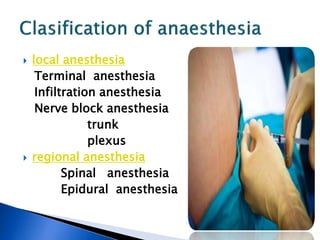
 local anesthesia
Terminal anesthesia
Infiltration anesthesia
Nerve block anesthesia
trunk
plexus
 regional anesthesia
Spinal anesthesia
Epidural anesthesia
 Every patient (with the exception of some
children that can have their IV’s inserted
following inhalation induction) will require IV
access prior to being brought to the
operating room.
 Normal saline, Lactated Ringer’s solution, or
other balanced electrolyte solutions
(Plasmalyte, Isolyte) are all commonly used
solutions intraoperatively.
Premedication
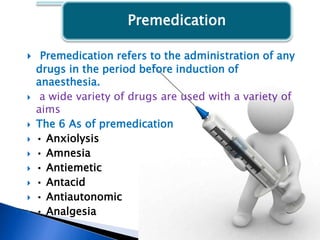
 Premedication refers to the administration of any
drugs in the period before induction of
anaesthesia.
 a wide variety of drugs are used with a variety of
aims
 The 6 As of premedication
 • Anxiolysis
 • Amnesia
 • Antiemetic
 • Antacid
 • Antiautonomic
 • Analgesia
 Many patients are understandably nervous
preoperatively, and we often premedicate
them, usually with a rapid acting
benzodiazepine such as intravenous
midazolam (which is also fabulously effective
in children orally or rectally).
 Metoclopramide and an H2 blocker are also
often used if there is a concern that the
patient has a full stomach,
 and anticholinergics such as glycopyrrolate or
atropin can be used to decrease secretions.
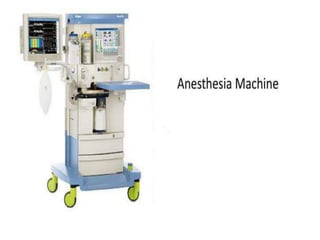
 Before bringing the patient to the room, the
anesthesia machine, ventilator, monitors,
and cart must be checked and set up.
 The anesthesia machine must be tested to
ensure that the gauges and monitors are
functioning properly, that there are no leaks
in the gas delivery system, and that the
backup systems and fail-safes are
functioning properly.
 The monitors that we use on most patients
include the pulse oximeter, blood pressure
monitor, and electrocardiogram, all of which
are ASA requirements for patient safety.
 Each are checked and prepared to allow for
easy placement when the patient enters the
room.
 You may see some more complicated cases
that require more invasive monitoring such as
arterial or central lines
 The anesthesia cart is set up to allow easy
access to intubation equipment including
endotracheal tubes, laryngoscopes, stylets,
oral/nasal airways and the myriad of drugs
that we use daily.
 A properly functioning suction system is also
vital during any type of anesthetic
 Other preparations that can be done before
the case focus on patient positioning and
comfort, since anesthesiologists ultimately
are responsible for intraoperative positioning
and resultant neurologic or skin injuries.
Heel and ulnar protectors should be available,
as should axillary rolls and other pads
depending on the position of the patient.
Four Phases
 Induction
 Maintenance
 Emergence
 Recovery
Four Phases
 Induction
 Maintenance
 Emergence
 Recovery
General Anesthesia
You now have your sedated patient in the
room with his IV and he’s comfortably lying
on the operating table with all of the
aforementioned monitors in place and
functioning. It is now time to start induction
of anesthesia.
 Induction is the process that produces a state
of surgical anaesthesia in a patient.
 Stage I – Amnesia
 Stage II – Excitement
 Stage III – Surgical Intervention (4 planes)
 Stage IV – Overdose
 Stage I (stage of analgesia or
disorientation): from beginning of induction
of general anesthesia to loss of
consciousness.
 Stage II (stage of excitement or delirium):
from loss of consciousness to onset of
automatic breathing. Eyelash reflex
disappear but other reflexes remain intact
and coughing, vomiting and struggling may
occur; respiration can be irregular with
breath-holding.
 Stage III (stage of surgical anesthesia): from
onset of automatic respiration to
respiratory paralysis.
 It is divided into four planes:
 Plane I - from onset of automatic
respiration to cessation of eyeball
movements. Eyelid reflex is lost, swallowing
reflex disappears, marked eyeball
movement may occur but conjunctival
reflex is lost at the bottom of the plane
Plane II - from cessation of eyeball
movements to beginning of paralysis of
intercostal muscles. Laryngeal reflex is lost
although inflammation of the upper
respiratory tract increases reflex irritability,
corneal reflex disappears, secretion of tears
increases (a useful sign of light anesthesia),
respiration is automatic and regular,
movement and deep breathing as a
response to skin stimulation disappears.
 Plane III - from beginning to completion of
intercostal muscle paralysis. Diaphragmatic
respiration persists but there is progressive
intercostal paralysis, pupils dilated and light
reflex is abolished. The laryngeal reflex lost
in plane II can still be initiated by painful
stimuli arising from the dilatation of anus or
cervix. This was the desired plane for surgery
when muscle relaxants were not used.
 Plane IV - from complete intercostal paral
ysis to diaphragmatic paralysis (apnea).
 Stage IV: from stoppage of respiration till
death. Anesthetic overdose cause medullary
paralysis with respiratory arrest and
vasomotor collapse.
 The first part of induction of anesthesia
should be preoxygenation with 100%
oxygen delivered via a facemask.
 Again, using the example of a normal
smooth induction in a healthy patient with
an empty stomach, the next step is to
administer an IV anesthetic until the patient
is unconscious. A useful guide to
anesthetic induction is the loss of the lash
reflex, which can be elicited by gently
brushing the eyelashes and looking for
eyelid motion.
 Patients frequently become apneic
after induction and you may have to
assist ventilation.
 The most common choices used for
IV induction are Propofol, Thiopental,
and Ketamine.
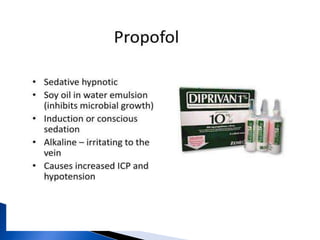
 • Propofol
 Typical adult induction
dose 1.5–2.5 mg/kg
 Popular and widely used drug associated with
rapid and ‘clear-headed' recovery. Rapid
metabolism and lack
Pro: Prevents nausea/vomiting, Quick recovery if
used as solo anesthetic agent
Con: Pain on injection, Expensive, Supports
bacterial growth, Myocardial depression),
Vasodilation
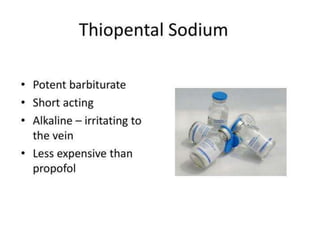
 • Thiopental Sodium
 Typical adult induction dose 3–5 mg/kg (2.5%
solution)
 The ‘gold-standard’ against which all other drugs
are judged. Smooth induction in one arm–brain
circulation time
Pro: Excellent brain protection, Stops convulsion ,
Cheap
Con: Myocardial depression, Vasodilation,
Histamine release.
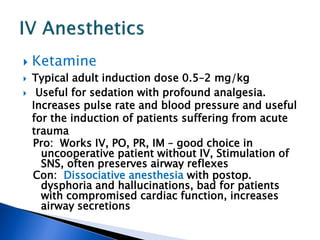
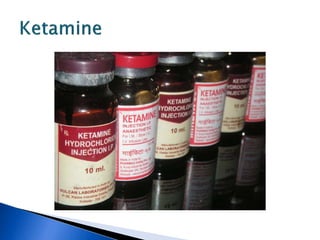
 Ketamine
 Typical adult induction dose 0.5–2 mg/kg
 Useful for sedation with profound analgesia.
Increases pulse rate and blood pressure and useful
for the induction of patients suffering from acute
trauma
Pro: Works IV, PO, PR, IM – good choice in
uncooperative patient without IV, Stimulation of
SNS, often preserves airway reflexes
Con: Dissociative anesthesia with postop.
dysphoria and hallucinations, bad for patients
with compromised cardiac function, increases
airway secretions
 Assuming that you are now able to
mask ventilate the patient, the next
step is usually to administer a
neuromuscular blocking agent such as
succinylcholine (a depolarizing
relaxer).
 Once the patient is adequately
anesthetized and relaxed, it’s time to
intubate, assuming you have all
necessary supplies at the ready.
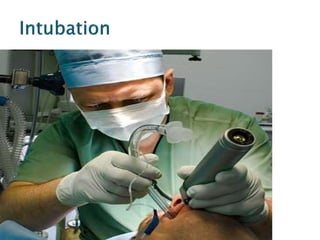
 . Hold the laryngoscope in your left hand (whether you’re right or
left handed) then open the patient’s mouth with your right hand,
either with a head tilt, using your fingers in a scissors motion, or
both. Insert the laryngoscope carefully and advance it until you can
see the epiglottis, sweeping the tongue to the left. Advance the
laryngoscope further into the vallecula (assuming you’re using a
curved Macintosh blade), then using your upper arm and NOT your
wrist, lift the laryngoscope toward the juncture of the opposite wall
and ceiling. There should be no rotational movement with your
wrist, as this can cause dental damage. When properly done, the
blade should never contact the upper teeth. Once you see the vocal
cords, insert the endotracheal tube until the balloon is no longer
visible, then remove the laryngoscope, hold the tube tightly, remove
the stylet, inflate the cuff balloon, attach the tube to your circuit and
listen for bilateral breath. If you have chest rise with ventilation,
misting of the endotracheal tube, bilateral breath sounds and end
tidal CO2, you’re in the right place and all is well! Tape the tube
securely in place, place the patient on the ventilator, and set your
gas flows appropriately.
 Careful and continues vigilance of vital sings and
depth of anesthesia is the integral part of the
maintenance phase.
 Pulse oximetry, End-tidal carbon dioxide tension,
patient's temperature, ECG and blood pressure are
continuously monitored during the maintenance
phase. End-tidal concentration of nitrous oxide
and inhalation agents (isoflurane, halothane etc) is
continuously monitored for the proper depth of
anesthesia (analgesia, amnesia, sedation and
muscle relaxation).
 It is important to keep track of the
blood loss during the case and should
be replaced hourly with crystalloid.
Fluid therapy should be guided by
monitoring hourly urine output (0.5
cc/Kg/Hr).
 It is also vital to pay attention to the
case itself, since blood loss can occur
very rapidly, and certain parts of the
procedure can threaten the patient’s
airway, especially during oral surgery
or ENT cases. It is also important to
keep track of the progress of the case.
 Vigilance is key to a good anesthesia.
 One can also prepare for potential
post-operative problems during the
case, by treating the patient
intraoperatively with long-acting anti-
emetics and pain medications.
Volatile Anesthetics
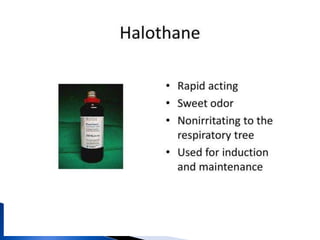
 Halothane
◦ Pro: Cheap, Nonirritating so can be
used for inhalation induction
◦ Con: Long time to onset/offset,
Significant Myocardial Depression,
Sensitizes myocardium to
catecholamines, Association with
Hepatitis
Volatile Anesthetics
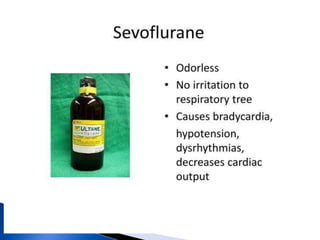
 Sevoflurane
◦ Pro: Nonirritating so can be used for
inhalation induction, Extremely rapid
onset/offset
◦ Con: Expensive, Due to risk of
“Compound A” exposure must be
used at flows >2 liters/minute,
Theoretical potential for renal
toxicity from inorganic fluoride
metabolites
Volatile Anesthetics
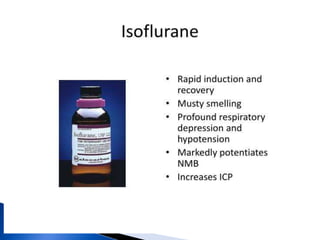
Isoflurane
◦ Pro: Cheap, Excellent renal, hepatic,
coronary, and cerebral blood flow
preservation
◦ Con: Long time to onset/offset,
Irritating so cannot be used for
inhalation induction
Volatile Anesthetics
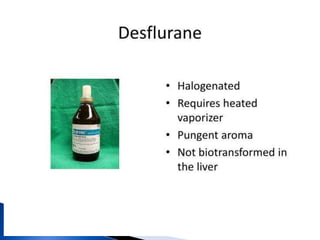
 Desflurane
◦ Pro: Extremely rapid onset/offset
◦ Con: Expensive, Stimulates
catecholamine release, Possibly
increases postoperative nausea and
vomiting, Requires special active-
temperature controlled vaporizer due
to high vapor pressure, Irritating so
cannot be used for inhalation induction
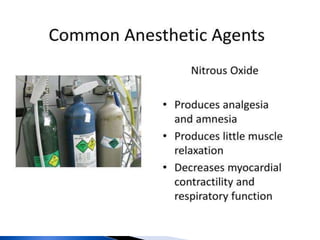
 Nitrous Oxide
Pro: Decreases volatile anesthetic
requirement, Dirt cheap, Less
myocardial depression than volatile
agents
Con: Diffuses freely into gas filled
spaces (bowel, pneumothorax, middle
ear, gas bubbles used during retinal
surgery), Decreases FiO2, Increases
pulmonary vascular resistance
Muscle Relaxants
 Depolarizing
Succinylcholine inhibits the postjunctional receptor
and passively diffuses off the membrane, while
circulating drug is metabolized by plasma
esterases. Associated with increased ICP/IOP,
muscle fasciculations and postop muscle aches,
triggers MH, increases serum potassium
especially in patients with burns, crush injury,
spinal cord injury, muscular dystrophy or disuse
syndromes.
Rapid and short acting.
 Nondepolarizing
Many different kinds, all ending in “onium” or
“urium”. Each has different site of metabolism,
onset, and duration making choice depend on
specific patient and case. Some examples:
Pancuronium - Slow onset, long duration,
tachycardia due to vagolytic effect. Cisatracurium
- Slow onset, intermediate duration, Hoffman
(nonenzymatic) elimination so attractive choice in
liver/renal disease. Rocuronium - Fastest onset
of nondepolarizers making it useful for rapid
sequence induction, intermediate duration.
 EMERGENCE FROM GENERAL ANESTHESIA
 1. Reversal of muscle relaxation.
 2. Turning off the inhalation agents and nitrous oxide
 3. Meeting the extubation criteria
 4. Extubation of trachea
 5. Transfer of the patient to post anesthesia care unit.
 First, the patient’s neuromuscular blockade must
be re-assessed, and if necessary reversed and then
rechecked with a twitch monitor.
 Next, the patient has to be able to breathe on his
own, and ideally follow commands, demonstrating
purposeful movement and the ability to protect his
airway following extubation. Suction must always
be close at hand, since many patients can become
nauseous after extubation, or simply have copious
oropharyngeal secretions
 . Once the patient is reversed, awake,
suctioned, and extubated, care must be
taken in transferring him to the gurney and
oxygen must be readily available for
transportation to the recovery room/Post-
Anesthesia Care Unit (PACU). Finally,
remember that whenever extubating a
patient, you must be fully prepared to
reintubate if necessary, which means having
drugs and equipment handy.
 The anesthesiologist’s job isn’t over once the
patient leaves the operating room. Concerns
that are directly the responsibility of the
anesthesiologist in the immediate
postoperative period include
nausea/vomiting, hemodynamic stability, and
pain.
 Other concerns include continuing
awareness of the patient’s airway and level
of consciousness, as well as follow-up of
intraoperative procedures such as central
line placement and postoperative X-rays to
rule out pneumothorax. A resident and
staff member are usually assigned to the
PACU specifically to follow up on these
concerns, since we frequently have to return
to the OR for subsequent cases, and may
not be available if problems should arise.
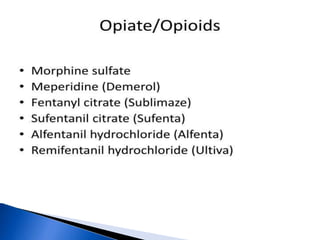
Opioids
 Morphine – long acting, histamine release, renally
excreted active metabolite with opiate properties
therefore beware in renal failure
 Dilaudid – long acting, no active metabolites or histamine
release, same onset/duration as morphine
 Demerol  euphoria, stimulates catecholamine release, so
beware in patients using MAOI’s, renally excreted active
metabolite associated with seizure activity, renally
excreted metabolite with seizure potential therefore
beware in renal failure
 Fentanyl/Alfentanil/Sufentanil – low doses produce brief
effect, but larger doses are long acting, increased
incidence of chest wall rigidity vs. other opiates, no active
metabolites
 Remifentanil – almost instantaneous onset/offset of
action due to metabolism by plasma esterases, must be
given as continuous infusion, significant incidence of
Reversal Agents/Anticholinergics
 Reversal Agents: all are acetylcholinesterase inhibitors, thereby
allowing more acetylcholine to be available to overcome the
neuromuscular blocker effect at the nicotinic receptor, but also
causing muscarinic stimulation
 Neostigmine – shares duration of action with glycopyrrolate (see
below)
 Edrophonium – shares duration of action with atropine (see below)
 Physostigmine – crosses the BBB, therefore useful for atropine
overdose
 Anticholinergics: given with reversal agents to block the muscarinic
effects of cholinergic stimulation, also excellent for treating
bradycardia and excess secretions
 Atropine – used in conjunction with edrophonium, crosses the BBB
causing drowsiness, so maybe bad at end of surgery for reversal,
some use as premed for all children since they tend to become
bradycardic with intubation and produce copious drool
 Glycopyrrolate – used in conjunction with neostigmine, does not
cross the BBB
Questions?
Thank you for listening.

Anesthesia. General anesthesia. Anesthetis.ppt

  • 1.
    Lecture for 5-yearmedical students General principles of anaesthesiology
  • 2.
    ◦ Introduction ◦ PreoperativeHistory and Physical ◦ IV’s and Premedication ◦ Commonly Used Medications ◦ Room Setup and Monitors ◦ Induction and Intubation ◦ Maintenance ◦ Emergence ◦ PACU Concerns
  • 3.
    Induction to anaesthesiology Definitions Anesthesia- From the Greek meaning lack of sensation; particularly during surgical intervention.
  • 4.
    Induction to anaesthesiology On October 16, 1846, in Boston, William T.G. Morton - the first publicized demonstration of general anesthesia using ether.  The pre-existing word anesthesia was suggested by Oliver Wendell Holmes, Sr. in 1846 as a word to use to describe this state.
  • 7.
     General anesthesia– acondition characterized by temporary shutting down  consciousness pain sensitivity reflexes relaxation of skeletal muscles due to exposure to the anesthetics on the Central nervous system
  • 10.
    Anaesthesia  Reversible, drug-inducedcondition ◦ Amnesia & unconsciousness ◦ Analgesia ◦ Muscle relaxation ◦ Attenuation of autonomic responses to noxious stimulation ◦ Homeostasis of Vital ◦ Functions
  • 11.
    Anaesthesiology is the scienceof managing the life functions of the patients organism in time of surgery or aggressive diagnostic procedure.
  • 12.
    Induction to anaesthesiology General Anesthesia  Preoperative evaluation  Intraoperative management  Postoperative management
  • 13.
     Physical Examination Physical exams of all systems.  Airway assessment to determine the likelihood of difficult intubation Preoperative History and Physical
  • 14.
     Unlike thestandard internal medicine H&P, ours is much more focused, with specific attention being paid to the airway and to organ systems at potential risk for anesthetic complications. The type of operation, and the type of anesthetic will also help to focus the evaluation.
  • 15.
     • Elective:operation at a time to suit both patient and surgeon; for example hip replacement, varicose veins.  • Scheduled: an early operation but not immediately life saving; operation usually within 3 weeks; for example surgery for malignancy.  .
  • 16.
     • Urgent:operation as soon as possible after resuscitation and within 24 h; for example intestinal obstruction, major fractures.  • Emergency: immediate life-saving operation, resuscitation simultaneous with surgical treatment; operation usually within 1h; for example major trauma with uncontrolled haemorrhage, extradural haematoma
  • 17.
    Of particular interestin the history portion of the evaluation are: ◦ Coronary Artery Disease ◦ Hypertension ◦ Asthma ◦ Kidney or Liver disease ◦ Reflux Disease ◦ Smoking ◦ Alcohol Consumption or Drug Abuse? ◦ Diabetes ◦ Medications ◦ Allergies ◦ Family History ◦ Anesthesia history ◦ Last Meal
  • 18.
     Coronary ArteryDisease ◦ What is the patient’s exercise tolerance? How well will his or her heart sustain the stress of the operation and anesthetic. ◦ Asking a patient how he feels (ie. SOB, CP) after climbing two or three flights of stairs can be very useful as a “poor man’s stress test”.
  • 19.
    Preoperative History andPhysical  Coronary Artery Disease ◦ What is the patient’s exercise tolerance? How well will his or her heart sustain the stress of the operation and anesthetic. ◦ Asking a patient how he feels (ie. SOB, CP) after climbing two or three flights of stairs can be very useful as a “poor man’s stress test”.
  • 20.
     Hypertension ◦How wellcontrolled is it? Intraoperative blood pressure management is affected by preoperative blood pressure control Preoperative History and Physical
  • 21.
     Asthma ◦ Howwell controlled is it? What triggers it? Many of the stressors of surgery as well as intubation and ventilation can stimulate bronchospasm. ◦ Is there any history of being hospitalized, intubated, or prescribed steroids for asthma? This can help assess the severity of disease
  • 22.
    Preoperative History andPhysical  Kidney or Liver disease ◦ Different anesthetic drugs have different modes of clearance and organ function can affect our choice of drugs.
  • 23.
     Reflux Disease ◦Present or not? Anesthetized and relaxed patients are prone to regurgitation and aspiration, particularly if a history of reflux is present
  • 24.
     Smoking ◦ Currentlysmoking? Airway and secretion management can become more difficult in smokers.
  • 25.
     Alcohol Consumptionor Drug Abuse? ◦ Drinkers have an increased tolerance to many sedative drugs (conversely they have a decreased requirement if drunk), and are at an increased risk of hepatic disease, which can impact the choice of anesthetic agents.
  • 26.
     Diabetes ◦ Wellcontrolled? The stress response to surgery and anesthesia can markedly increase blood glucose concentrations, especially in diabetics
  • 27.
     Medications ◦ Manymedications interact with anesthetic agents, and some should be taken on the morning of surgery (blood pressure medications) while others should probably not (diuretics, diabetes medications).
  • 28.
     Allergies ◦ Weroutinely give narcotics and antibiotics perioperatively, and it is important to know the types of reactions that a patient has had to medications in the past.
  • 29.
     Family History ◦There is a rare, but serious disorder known as malignant hyperthermia that affects susceptible patients under anesthesia, and is heritable
  • 30.
     Anesthesia history ◦Has the patient ever had anesthesia and surgery before? Did anything go wrong?
  • 31.
     Last Meal ◦Whether the patient has an empty stomach or not impacts the choice of induction technique
  • 32.
     All patientsmust have an assessment made of their airway, the aim being to try and predict those patients who may be difficult to intubate. 
  • 33.
     Finding anyof these suggests that intubation may be more difficult.  • limitation of mouth opening;  • a receding mandible;  • position, number and health of teeth;  • size of the tongue;  • soft tissue swelling at the front of the neck;  • deviation of the larynx or trachea;  • limitations in flexion and extension of the cervical spine.
  • 34.
     Also, anyloose or missing teeth should be noted, as should cervical range of motion, mouth opening, and thyromental distance, all of which will impact the actual intubation prior to surgery. During the physical examination, particular attention is paid to the airway by asking the patient to “open your mouth as wide as you can and stick out your tongue” The classification scale of Mallampati is commonly used.
  • 35.
    Mallampati Classification  ClassI: Entire uvula and tonsillar pillars visible  Class II: Tip of uvula and pillars hidden by tongue  Class III: Only soft palate visible  Class IV: Only hard palate visible
  • 37.
     Finally, aphysical status classification is assigned, based on the criteria of the American Society of Anesthesiologists (ASA1-5), with ASA-1 being assigned to a healthy person without medical problems other than the current surgical concern, and ASA-5 being a moribund patient, not expected to survive for more then twenty-four hours without surgical intervention. An “E” is added if the case is emergent. The full details of the classification scale can be found below.
  • 38.
    ASA Physical StatusClassification  ASA-I: Healthy patient with no systemic disease  ASA-II: Mild systemic disease , no functional limitations  ASA-III: Moderate to severe systemic disease, some functional limitations  ASA-IV: Severe systemic disease, incapacitating, and a constant threat to life  ASA-V: Moribund patient, not expected to survive > 24 hours without surgery  ASA-VI: Brain-dead patient undergoing organ harvest  E: Added when the case is emergent
  • 39.
     general anesthesia Simple (one-component) anaesthesia Inhalation  mask  endotracheal  Noninhalation  intravenous  Combined (multi-component anaesthesia Inhalation + Inhalation Noninhalation + Noninhalation Noninhalation + Inhalation Combined with miorelaxanthams
  • 40.
     local anesthesia Terminalanesthesia Infiltration anesthesia Nerve block anesthesia trunk plexus  regional anesthesia Spinal anesthesia Epidural anesthesia
  • 42.
     Every patient(with the exception of some children that can have their IV’s inserted following inhalation induction) will require IV access prior to being brought to the operating room.  Normal saline, Lactated Ringer’s solution, or other balanced electrolyte solutions (Plasmalyte, Isolyte) are all commonly used solutions intraoperatively.
  • 43.
    Premedication  Premedication refersto the administration of any drugs in the period before induction of anaesthesia.  a wide variety of drugs are used with a variety of aims  The 6 As of premedication  • Anxiolysis  • Amnesia  • Antiemetic  • Antacid  • Antiautonomic  • Analgesia
  • 44.
     Many patientsare understandably nervous preoperatively, and we often premedicate them, usually with a rapid acting benzodiazepine such as intravenous midazolam (which is also fabulously effective in children orally or rectally).  Metoclopramide and an H2 blocker are also often used if there is a concern that the patient has a full stomach,  and anticholinergics such as glycopyrrolate or atropin can be used to decrease secretions.
  • 45.
     Before bringingthe patient to the room, the anesthesia machine, ventilator, monitors, and cart must be checked and set up.  The anesthesia machine must be tested to ensure that the gauges and monitors are functioning properly, that there are no leaks in the gas delivery system, and that the backup systems and fail-safes are functioning properly.
  • 47.
     The monitorsthat we use on most patients include the pulse oximeter, blood pressure monitor, and electrocardiogram, all of which are ASA requirements for patient safety.  Each are checked and prepared to allow for easy placement when the patient enters the room.  You may see some more complicated cases that require more invasive monitoring such as arterial or central lines
  • 48.
     The anesthesiacart is set up to allow easy access to intubation equipment including endotracheal tubes, laryngoscopes, stylets, oral/nasal airways and the myriad of drugs that we use daily.  A properly functioning suction system is also vital during any type of anesthetic
  • 49.
     Other preparationsthat can be done before the case focus on patient positioning and comfort, since anesthesiologists ultimately are responsible for intraoperative positioning and resultant neurologic or skin injuries. Heel and ulnar protectors should be available, as should axillary rolls and other pads depending on the position of the patient.
  • 50.
    Four Phases  Induction Maintenance  Emergence  Recovery
  • 51.
    Four Phases  Induction Maintenance  Emergence  Recovery General Anesthesia
  • 52.
    You now haveyour sedated patient in the room with his IV and he’s comfortably lying on the operating table with all of the aforementioned monitors in place and functioning. It is now time to start induction of anesthesia.  Induction is the process that produces a state of surgical anaesthesia in a patient.
  • 53.
     Stage I– Amnesia  Stage II – Excitement  Stage III – Surgical Intervention (4 planes)  Stage IV – Overdose
  • 54.
     Stage I(stage of analgesia or disorientation): from beginning of induction of general anesthesia to loss of consciousness.  Stage II (stage of excitement or delirium): from loss of consciousness to onset of automatic breathing. Eyelash reflex disappear but other reflexes remain intact and coughing, vomiting and struggling may occur; respiration can be irregular with breath-holding.
  • 55.
     Stage III(stage of surgical anesthesia): from onset of automatic respiration to respiratory paralysis.  It is divided into four planes:  Plane I - from onset of automatic respiration to cessation of eyeball movements. Eyelid reflex is lost, swallowing reflex disappears, marked eyeball movement may occur but conjunctival reflex is lost at the bottom of the plane
  • 56.
    Plane II -from cessation of eyeball movements to beginning of paralysis of intercostal muscles. Laryngeal reflex is lost although inflammation of the upper respiratory tract increases reflex irritability, corneal reflex disappears, secretion of tears increases (a useful sign of light anesthesia), respiration is automatic and regular, movement and deep breathing as a response to skin stimulation disappears.
  • 57.
     Plane III- from beginning to completion of intercostal muscle paralysis. Diaphragmatic respiration persists but there is progressive intercostal paralysis, pupils dilated and light reflex is abolished. The laryngeal reflex lost in plane II can still be initiated by painful stimuli arising from the dilatation of anus or cervix. This was the desired plane for surgery when muscle relaxants were not used.
  • 58.
     Plane IV- from complete intercostal paral ysis to diaphragmatic paralysis (apnea).  Stage IV: from stoppage of respiration till death. Anesthetic overdose cause medullary paralysis with respiratory arrest and vasomotor collapse.
  • 59.
     The firstpart of induction of anesthesia should be preoxygenation with 100% oxygen delivered via a facemask.  Again, using the example of a normal smooth induction in a healthy patient with an empty stomach, the next step is to administer an IV anesthetic until the patient is unconscious. A useful guide to anesthetic induction is the loss of the lash reflex, which can be elicited by gently brushing the eyelashes and looking for eyelid motion.
  • 60.
     Patients frequentlybecome apneic after induction and you may have to assist ventilation.  The most common choices used for IV induction are Propofol, Thiopental, and Ketamine.
  • 62.
     • Propofol Typical adult induction dose 1.5–2.5 mg/kg  Popular and widely used drug associated with rapid and ‘clear-headed' recovery. Rapid metabolism and lack Pro: Prevents nausea/vomiting, Quick recovery if used as solo anesthetic agent Con: Pain on injection, Expensive, Supports bacterial growth, Myocardial depression), Vasodilation
  • 64.
     • ThiopentalSodium  Typical adult induction dose 3–5 mg/kg (2.5% solution)  The ‘gold-standard’ against which all other drugs are judged. Smooth induction in one arm–brain circulation time Pro: Excellent brain protection, Stops convulsion , Cheap Con: Myocardial depression, Vasodilation, Histamine release.
  • 66.
     Ketamine  Typicaladult induction dose 0.5–2 mg/kg  Useful for sedation with profound analgesia. Increases pulse rate and blood pressure and useful for the induction of patients suffering from acute trauma Pro: Works IV, PO, PR, IM – good choice in uncooperative patient without IV, Stimulation of SNS, often preserves airway reflexes Con: Dissociative anesthesia with postop. dysphoria and hallucinations, bad for patients with compromised cardiac function, increases airway secretions
  • 72.
     Assuming thatyou are now able to mask ventilate the patient, the next step is usually to administer a neuromuscular blocking agent such as succinylcholine (a depolarizing relaxer).  Once the patient is adequately anesthetized and relaxed, it’s time to intubate, assuming you have all necessary supplies at the ready.
  • 73.
     . Holdthe laryngoscope in your left hand (whether you’re right or left handed) then open the patient’s mouth with your right hand, either with a head tilt, using your fingers in a scissors motion, or both. Insert the laryngoscope carefully and advance it until you can see the epiglottis, sweeping the tongue to the left. Advance the laryngoscope further into the vallecula (assuming you’re using a curved Macintosh blade), then using your upper arm and NOT your wrist, lift the laryngoscope toward the juncture of the opposite wall and ceiling. There should be no rotational movement with your wrist, as this can cause dental damage. When properly done, the blade should never contact the upper teeth. Once you see the vocal cords, insert the endotracheal tube until the balloon is no longer visible, then remove the laryngoscope, hold the tube tightly, remove the stylet, inflate the cuff balloon, attach the tube to your circuit and listen for bilateral breath. If you have chest rise with ventilation, misting of the endotracheal tube, bilateral breath sounds and end tidal CO2, you’re in the right place and all is well! Tape the tube securely in place, place the patient on the ventilator, and set your gas flows appropriately.
  • 75.
     Careful andcontinues vigilance of vital sings and depth of anesthesia is the integral part of the maintenance phase.  Pulse oximetry, End-tidal carbon dioxide tension, patient's temperature, ECG and blood pressure are continuously monitored during the maintenance phase. End-tidal concentration of nitrous oxide and inhalation agents (isoflurane, halothane etc) is continuously monitored for the proper depth of anesthesia (analgesia, amnesia, sedation and muscle relaxation).
  • 76.
     It isimportant to keep track of the blood loss during the case and should be replaced hourly with crystalloid. Fluid therapy should be guided by monitoring hourly urine output (0.5 cc/Kg/Hr).
  • 77.
     It isalso vital to pay attention to the case itself, since blood loss can occur very rapidly, and certain parts of the procedure can threaten the patient’s airway, especially during oral surgery or ENT cases. It is also important to keep track of the progress of the case.  Vigilance is key to a good anesthesia.
  • 78.
     One canalso prepare for potential post-operative problems during the case, by treating the patient intraoperatively with long-acting anti- emetics and pain medications.
  • 81.
    Volatile Anesthetics  Halothane ◦Pro: Cheap, Nonirritating so can be used for inhalation induction ◦ Con: Long time to onset/offset, Significant Myocardial Depression, Sensitizes myocardium to catecholamines, Association with Hepatitis
  • 83.
    Volatile Anesthetics  Sevoflurane ◦Pro: Nonirritating so can be used for inhalation induction, Extremely rapid onset/offset ◦ Con: Expensive, Due to risk of “Compound A” exposure must be used at flows >2 liters/minute, Theoretical potential for renal toxicity from inorganic fluoride metabolites
  • 85.
    Volatile Anesthetics Isoflurane ◦ Pro:Cheap, Excellent renal, hepatic, coronary, and cerebral blood flow preservation ◦ Con: Long time to onset/offset, Irritating so cannot be used for inhalation induction
  • 86.
    Volatile Anesthetics  Desflurane ◦Pro: Extremely rapid onset/offset ◦ Con: Expensive, Stimulates catecholamine release, Possibly increases postoperative nausea and vomiting, Requires special active- temperature controlled vaporizer due to high vapor pressure, Irritating so cannot be used for inhalation induction
  • 88.
     Nitrous Oxide Pro:Decreases volatile anesthetic requirement, Dirt cheap, Less myocardial depression than volatile agents Con: Diffuses freely into gas filled spaces (bowel, pneumothorax, middle ear, gas bubbles used during retinal surgery), Decreases FiO2, Increases pulmonary vascular resistance
  • 91.
    Muscle Relaxants  Depolarizing Succinylcholineinhibits the postjunctional receptor and passively diffuses off the membrane, while circulating drug is metabolized by plasma esterases. Associated with increased ICP/IOP, muscle fasciculations and postop muscle aches, triggers MH, increases serum potassium especially in patients with burns, crush injury, spinal cord injury, muscular dystrophy or disuse syndromes. Rapid and short acting.
  • 92.
     Nondepolarizing Many differentkinds, all ending in “onium” or “urium”. Each has different site of metabolism, onset, and duration making choice depend on specific patient and case. Some examples: Pancuronium - Slow onset, long duration, tachycardia due to vagolytic effect. Cisatracurium - Slow onset, intermediate duration, Hoffman (nonenzymatic) elimination so attractive choice in liver/renal disease. Rocuronium - Fastest onset of nondepolarizers making it useful for rapid sequence induction, intermediate duration.
  • 93.
     EMERGENCE FROMGENERAL ANESTHESIA  1. Reversal of muscle relaxation.  2. Turning off the inhalation agents and nitrous oxide  3. Meeting the extubation criteria  4. Extubation of trachea  5. Transfer of the patient to post anesthesia care unit.
  • 94.
     First, thepatient’s neuromuscular blockade must be re-assessed, and if necessary reversed and then rechecked with a twitch monitor.  Next, the patient has to be able to breathe on his own, and ideally follow commands, demonstrating purposeful movement and the ability to protect his airway following extubation. Suction must always be close at hand, since many patients can become nauseous after extubation, or simply have copious oropharyngeal secretions
  • 95.
     . Oncethe patient is reversed, awake, suctioned, and extubated, care must be taken in transferring him to the gurney and oxygen must be readily available for transportation to the recovery room/Post- Anesthesia Care Unit (PACU). Finally, remember that whenever extubating a patient, you must be fully prepared to reintubate if necessary, which means having drugs and equipment handy.
  • 96.
     The anesthesiologist’sjob isn’t over once the patient leaves the operating room. Concerns that are directly the responsibility of the anesthesiologist in the immediate postoperative period include nausea/vomiting, hemodynamic stability, and pain.
  • 97.
     Other concernsinclude continuing awareness of the patient’s airway and level of consciousness, as well as follow-up of intraoperative procedures such as central line placement and postoperative X-rays to rule out pneumothorax. A resident and staff member are usually assigned to the PACU specifically to follow up on these concerns, since we frequently have to return to the OR for subsequent cases, and may not be available if problems should arise.
  • 98.
    Opioids  Morphine –long acting, histamine release, renally excreted active metabolite with opiate properties therefore beware in renal failure  Dilaudid – long acting, no active metabolites or histamine release, same onset/duration as morphine  Demerol  euphoria, stimulates catecholamine release, so beware in patients using MAOI’s, renally excreted active metabolite associated with seizure activity, renally excreted metabolite with seizure potential therefore beware in renal failure  Fentanyl/Alfentanil/Sufentanil – low doses produce brief effect, but larger doses are long acting, increased incidence of chest wall rigidity vs. other opiates, no active metabolites  Remifentanil – almost instantaneous onset/offset of action due to metabolism by plasma esterases, must be given as continuous infusion, significant incidence of
  • 99.
    Reversal Agents/Anticholinergics  ReversalAgents: all are acetylcholinesterase inhibitors, thereby allowing more acetylcholine to be available to overcome the neuromuscular blocker effect at the nicotinic receptor, but also causing muscarinic stimulation  Neostigmine – shares duration of action with glycopyrrolate (see below)  Edrophonium – shares duration of action with atropine (see below)  Physostigmine – crosses the BBB, therefore useful for atropine overdose  Anticholinergics: given with reversal agents to block the muscarinic effects of cholinergic stimulation, also excellent for treating bradycardia and excess secretions  Atropine – used in conjunction with edrophonium, crosses the BBB causing drowsiness, so maybe bad at end of surgery for reversal, some use as premed for all children since they tend to become bradycardic with intubation and produce copious drool  Glycopyrrolate – used in conjunction with neostigmine, does not cross the BBB Questions? Thank you for listening.