EMBEDDED SYSTEMS Presented by : Pratik Mehta Guided by : Mr.Chirag Modi An Overview
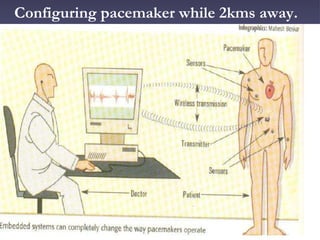
Configuring pacemaker while 2kms away.
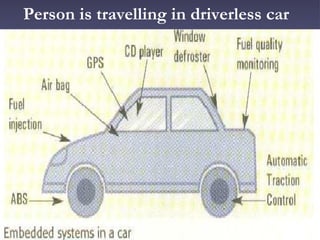
Person is travelling in driverless car
Possible within few couples of years. Real Time Operating System (RTOS) and Embedded system are the major technologies that played a major role in making the above fairly tales come true.
Defination of Embedded System An embedded system is one that has computer hardware with software embedded in it as one of its most important component.  It is a  dedicated  computer based system for an application or product. As its software usually embeds in  ROM , it does not need secondary memories as in a computer.
CHARACTERISTICS OF EMBEDDED SYSTEM
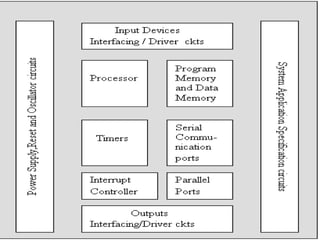
COMPONENTS Main application Software :  Which may perform concurrently the series of tasks or multiple tasks. RTOS:  Supervises the application software and provides a mechanism to let processor run process as per scheduling. Hardware:   Which includes following components.
 
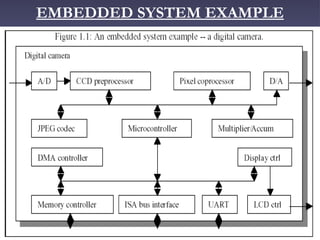
EMBEDDED SYSTEM EXAMPLE
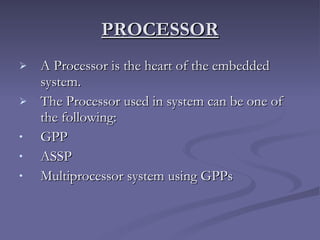
PROCESSOR A Processor is the heart of the embedded system.  The Processor used in system can be one of the following: GPP ASSP Multiprocessor system using GPPs
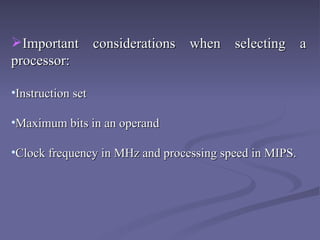
Important considerations when selecting a processor: Instruction set  Maximum bits in an operand  Clock frequency in MHz and processing speed in MIPS.   
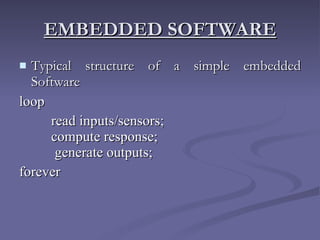
EMBEDDED SOFTWARE Typical structure of a simple embedded Software loop read inputs/sensors;   compute response;    generate outputs; forever
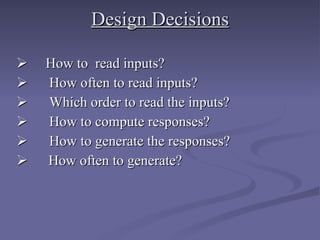
Design Decisions        How to  read inputs?        How often to read inputs?        Which order to read the inputs?        How to compute responses?         How to generate the responses?    How often to generate?
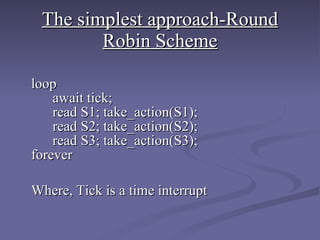
The simplest approach-Round Robin Scheme   loop   await tick;   read S1; take_action(S1);   read S2; take_action(S2);   read S3; take_action(S3); forever   Where, Tick is a time interrupt
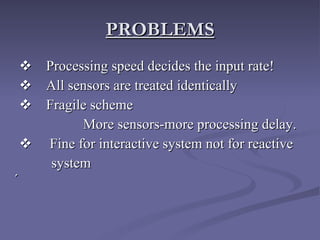
PROBLEMS       Processing speed decides the input rate!       All sensors are treated identically        Fragile scheme More sensors-more processing delay.     Fine for interactive system not for reactive system 
The Most General Scheme         Real-time OS (RTOS kernel) – manages the tasks – task communications – timer services – Schedules the tasks for execution using various scheduling strategies
Problems with RTOS      too much time and space overhead       more complex design        deadlocks  Building predictable system is very  challenging
Video games, Video terminals, multiple levels of wireless networking, media caching and always on access to friends, news, entertainment, and data will keep our homes humming and trillions of MIPS flowing. With terabytes and petabytes of storage, we will be able to store every book, every song, and every movie we have ever seen or ever want to see. IT'S TOMORROW
Imagination is more Powerful than knowledge -Albert Einstein THANK YOU

Embeded System

  • 1.
    EMBEDDED SYSTEMS Presentedby : Pratik Mehta Guided by : Mr.Chirag Modi An Overview
  • 2.
  • 3.
    Person is travellingin driverless car
  • 4.
    Possible within fewcouples of years. Real Time Operating System (RTOS) and Embedded system are the major technologies that played a major role in making the above fairly tales come true.
  • 5.
    Defination of EmbeddedSystem An embedded system is one that has computer hardware with software embedded in it as one of its most important component. It is a dedicated computer based system for an application or product. As its software usually embeds in ROM , it does not need secondary memories as in a computer.
  • 6.
  • 7.
    COMPONENTS Main applicationSoftware : Which may perform concurrently the series of tasks or multiple tasks. RTOS: Supervises the application software and provides a mechanism to let processor run process as per scheduling. Hardware: Which includes following components.
  • 8.
  • 9.
  • 10.
    PROCESSOR A Processoris the heart of the embedded system. The Processor used in system can be one of the following: GPP ASSP Multiprocessor system using GPPs
  • 11.
    Important considerations whenselecting a processor: Instruction set Maximum bits in an operand Clock frequency in MHz and processing speed in MIPS.  
  • 12.
    EMBEDDED SOFTWARE Typicalstructure of a simple embedded Software loop read inputs/sensors; compute response; generate outputs; forever
  • 13.
    Design Decisions      How to read inputs?       How often to read inputs?       Which order to read the inputs?       How to compute responses?       How to generate the responses?    How often to generate?
  • 14.
    The simplest approach-RoundRobin Scheme   loop await tick; read S1; take_action(S1); read S2; take_action(S2); read S3; take_action(S3); forever   Where, Tick is a time interrupt
  • 15.
    PROBLEMS      Processing speed decides the input rate!      All sensors are treated identically      Fragile scheme More sensors-more processing delay.    Fine for interactive system not for reactive system 
  • 16.
    The Most GeneralScheme        Real-time OS (RTOS kernel) – manages the tasks – task communications – timer services – Schedules the tasks for execution using various scheduling strategies
  • 17.
    Problems with RTOS    too much time and space overhead     more complex design       deadlocks  Building predictable system is very challenging
  • 18.
    Video games, Videoterminals, multiple levels of wireless networking, media caching and always on access to friends, news, entertainment, and data will keep our homes humming and trillions of MIPS flowing. With terabytes and petabytes of storage, we will be able to store every book, every song, and every movie we have ever seen or ever want to see. IT'S TOMORROW
  • 19.
    Imagination is morePowerful than knowledge -Albert Einstein THANK YOU