Real-Time Embedded System
Contents
• What is a Real Time (RT)?
• What is an Embedded System (ES)?
• Real Time Embedded System (RTES).
• Requirements for RTES
• Characteristics of Embedded Systems
• Embedded system components Hardware and Software
• examples of Embedded operating systems
• Examples of RTES in Past, Present, and Future.
What is a Real Time (RT)?
• Real-time systems can be defined as those systems that respond to
external events in a timely fashion. The response time is
guaranteed.
 needs timely computation
deadlines, jitters, periodicity
temporal dependency
What is a Real Time (RT)?
Is defined as a system in which the time where the outputs are
produced is significant (within specified bounds or deadlines)
RTS
Sensor Data
Commands
Actuator Outputs
Displays
Correctness depends on output values and the time at which
the inputs are processed and the outputs are produced
Real Time (RT) System
Real-Time Systems can be Hard Real-Time systems or Soft Real-Time systems
In Hard Real-Time systems outputs must be produced within the specified
deadlines or a system failure will occur (Examples include: Flight Control systems,
Air Traffic Control systems, Robots, Automotive Control Systems,..)
In Soft Real-Time Systems, deadlines can be occasionally missed ( Examples include:
communications systems using time out protocols, ATMs, Air line Reservation
Systems, Process Control Systems designed to tolerate delays)
What is an Embedded System (ES)?
Embedded system
 The software and hardware component that is an essential part of,
and inside another system
Conventional Dedicated Systems
Unique solution (HW/SW/tool) for each application System +
domain knowledge
Embedded Systems
Embedded Systems
• are everywhere
• How many embedded processors in your home?
• What are they?
40-50 estimated in 1999.
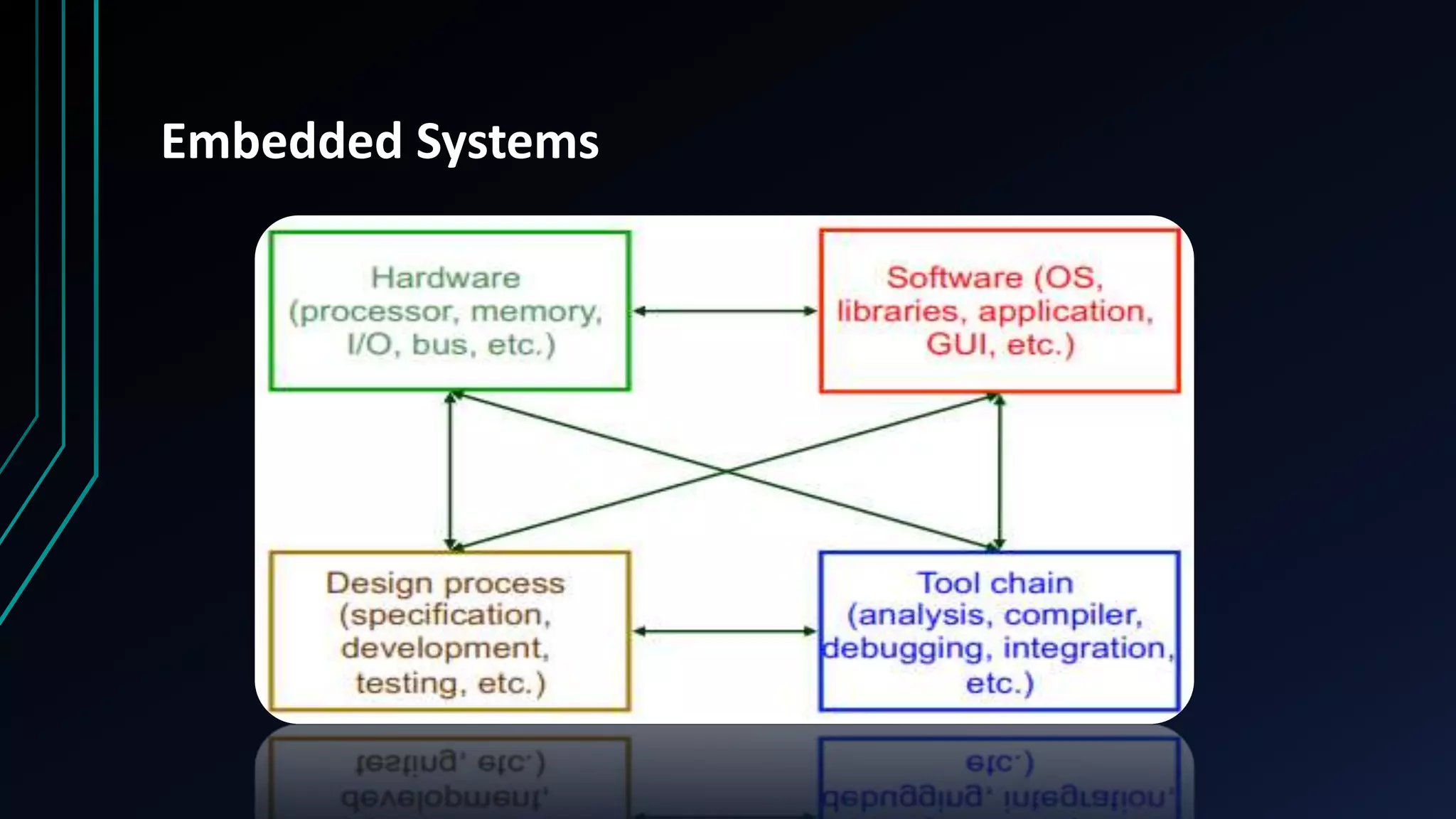
Hardware (chips) + Software (program)
 CPU processor (ARM, PowerPC, Xscale/SA, 68K)
 Memory (256MB or more)
 Input/output interfaces (parallel and serial ports)
Real-time Embedded Systems (RTES)
A good way to understand the relationship between real-time
systems and embedded systems is to view them as two intersecting
circles.
Requirements for RTES
Environmental – size, power (heat), weight, and
radiation-hardened
Performance –responsive, predictable (fast?)
Economics – low cost and time-to-market
Consequence – safety, faulty-tolerance, security
 Smaller, cheaper, better, and faster
CHARACTERISTICS OF EMBEDDED SYSTEMS
• Reactive and real-time: Many embedded systems must continually react to
changes in the system’s environment, and must compute certain results in real
time without delay.
• For example, a car have different tasks for controls such as for the following:
 Driving Gears
 Windows
 Temperature
 Door-lock/ Theft-lock-alarm
 Brakes/ Accelerator
 Air-Bag, Accident/ Emergency
 Ignition, Fuel Tank/ Brake Oil
12
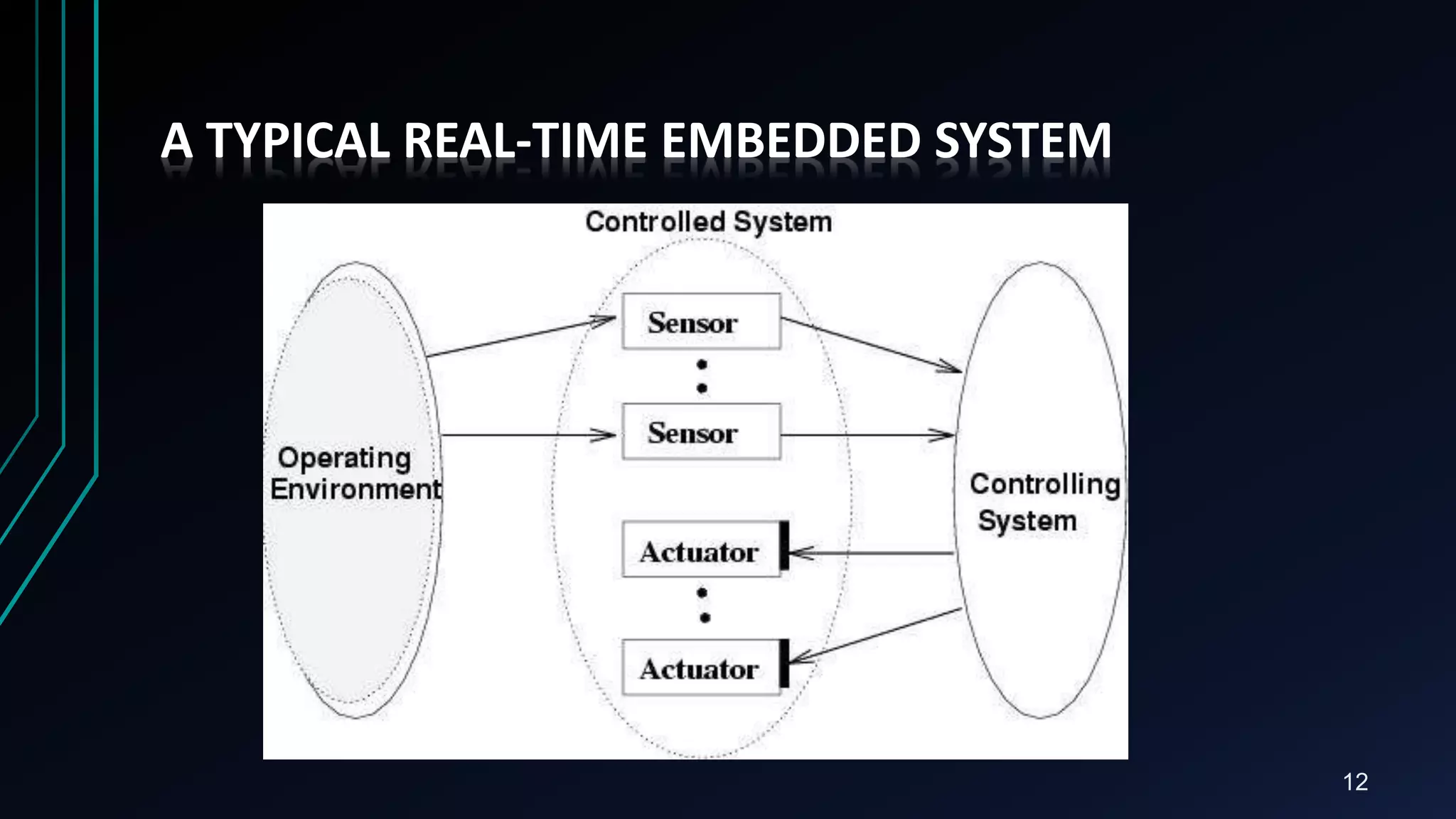
A TYPICAL REAL-TIME EMBEDDED SYSTEM
13
CAR EXAMPLE
• Mission: Reaching the destination safely.
• Controlled System: Car.
• Operating environment: Road conditions.
• Controlling System
- Human driver: Sensors - Eyes and Ears of the driver.
- Computer: Sensors - Cameras, Infrared receiver, and Laser telemeter.
• Controls: Accelerator, Steering wheel, Break-pedal.
• Actuators: Wheels, Engines, and Brakes.
14
CAR EXAMPLE (CONTD)
• Critical tasks: Steering and breaking.
• Non-critical tasks: Turning on radio.
• Cost of fulfilling the mission → Efficient solution.
• Reliability of the driver → Fault-tolerance needs to be considered.
CHARACTERISTICS OF EMBEDDED SYSTEMS(CON.)
• Digital camera illustrates some of the embedded system
characteristics described above. First, it performs a single function
repeatedly. The system always acts as a digital camera Second, it is
tightly constrained. The system must be low cost since consumers
must be able to afford such a camera.
EMBEDDED SYSTEM COMPONENTS HARDWARE AND
SOFTWARE
• To meet those constraints, Hardware/software codesign is the
simultaneous design of the hardware and software components of
a digital system.
• HARDWARE COMPONENTS
• The hardware components are:
1.Processor (e.g ARM)
2.Memory
3.peripherals
• Except for very simple systems, scheduling, task switching, and I/O require
the support of an operating system suited for embedded applications.
• The following are essential features of real-time and embedded operating
systems:
 Configurability is therefore one of the main characteristics of embedded
OSs.Configurability in its simplest form might just remove unused functions (to some
extent, this can be done by a linker).
 Dynamic data might be replaced by static data.
 Advanced compile-time evaluation and advanced compiler optimizations may also be
useful in this context.
 Object-orientation could lead to a derivation of proper subclasses.
 There is a large variety of peripheral devices employed in embedded systems. Many
embedded systems do not have a hard disc, a keyboard, a screen or a mouse.
 Protection mechanisms are not always necessary, since embedded systems are
typically designed for a single purpose and untested programs are hardly ever loaded.
SOFTWARE COMPONENTS (EMBEDDED OPERATING SYSTEM)
EXAMPLES OF EMBEDDED OPERATING SYSTEMS
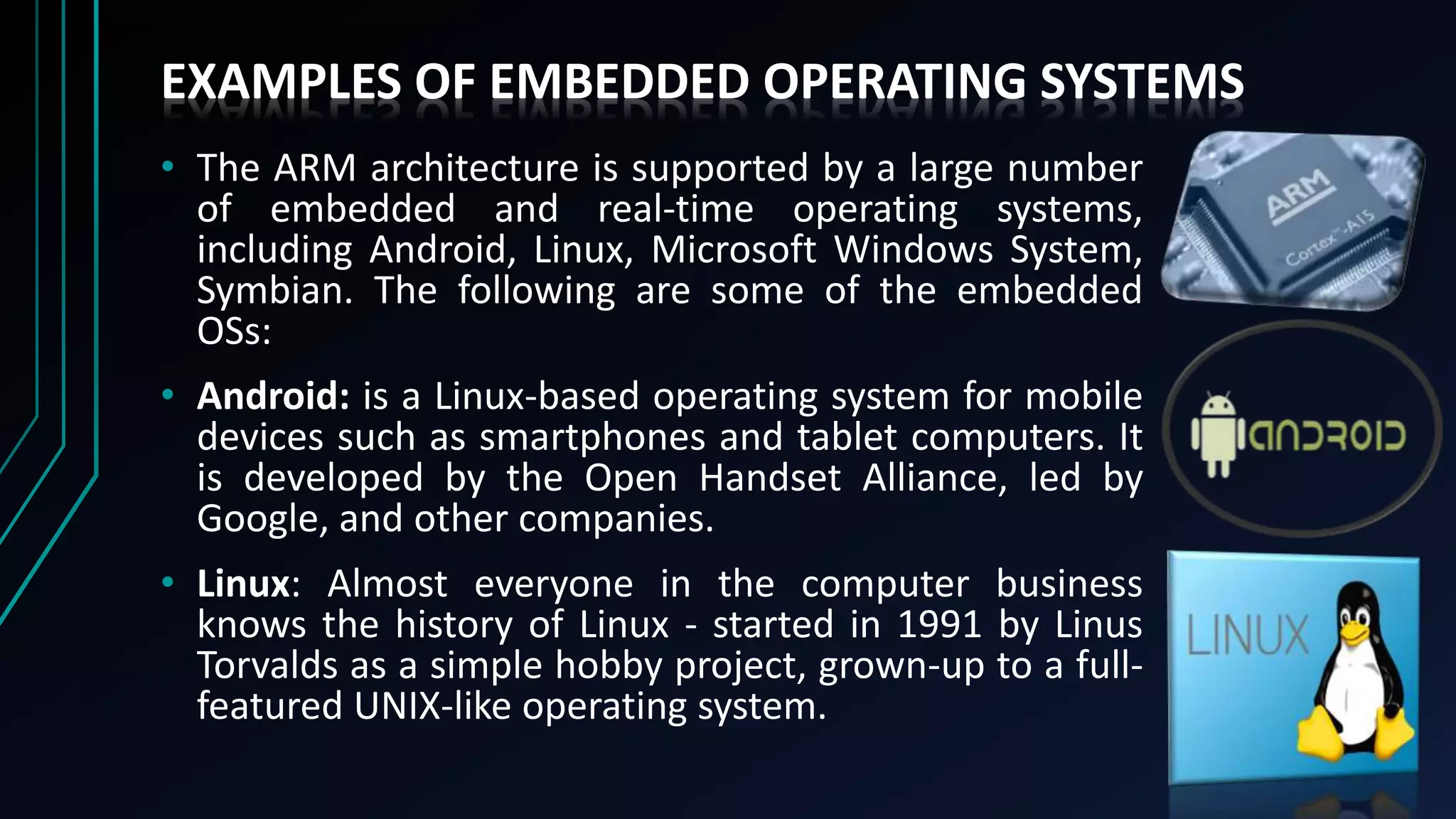
• The ARM architecture is supported by a large number
of embedded and real-time operating systems,
including Android, Linux, Microsoft Windows System,
Symbian. The following are some of the embedded
OSs:
• Android: is a Linux-based operating system for mobile
devices such as smartphones and tablet computers. It
is developed by the Open Handset Alliance, led by
Google, and other companies.
• Linux: Almost everyone in the computer business
knows the history of Linux - started in 1991 by Linus
Torvalds as a simple hobby project, grown-up to a full-
featured UNIX-like operating system.
EXAMPLES OF EMBEDDED OPERATING SYSTEMS (CON.)
• Microsoft Windows Systems: At present, there are
two operating systems for embedded systems
from Microsoft – Windows CE and Windows XP
Embedded.
 Windows CE (WinCE) is an operating system for
minimalistic computers and embedded systems.
 Windows XP Embedded, or XPe, is a modularised variant
of Microsoft Windows XP Professional.
• Symbian: OS is the successor of 32-bit EPOC
Platform from Psion. Symbian is currently owned
by Ericsson (15.6%), Nokia (47.9%), Panasonic
(10.5%), Samsung (4.5%), Siemens AG (8.4%), and
Sony Ericsson (13.1%). All of the owners are (or
were) manufacturers of mobile phones.
Examples In Past
Examples In Past (Con.)
LAMPS Radar Test
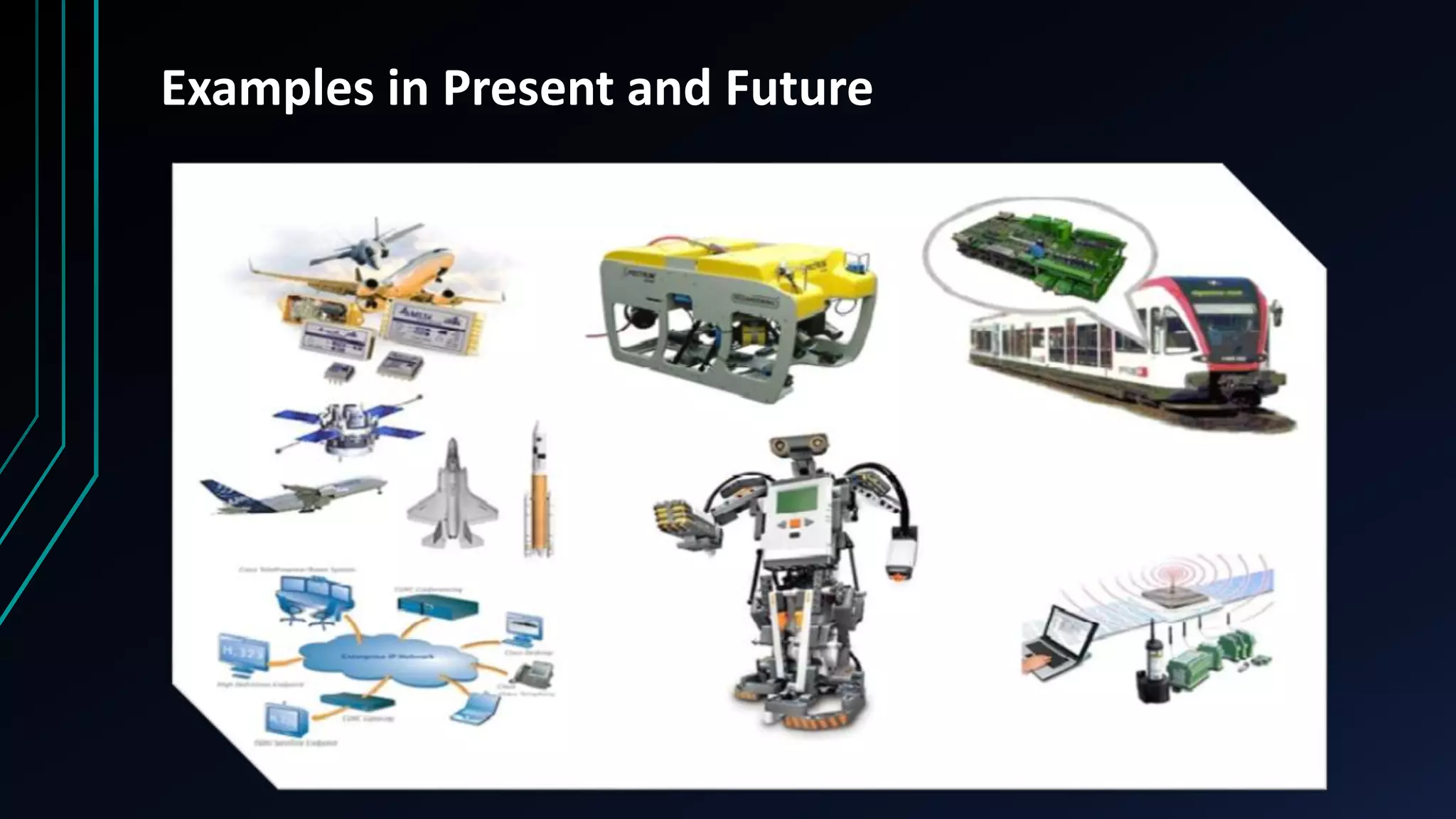
Examples in Present and Future
13086000.ppt

13086000.ppt

  • 1.
  • 2.
    Contents • What isa Real Time (RT)? • What is an Embedded System (ES)? • Real Time Embedded System (RTES). • Requirements for RTES • Characteristics of Embedded Systems • Embedded system components Hardware and Software • examples of Embedded operating systems • Examples of RTES in Past, Present, and Future.
  • 3.
    What is aReal Time (RT)? • Real-time systems can be defined as those systems that respond to external events in a timely fashion. The response time is guaranteed.  needs timely computation deadlines, jitters, periodicity temporal dependency
  • 4.
    What is aReal Time (RT)? Is defined as a system in which the time where the outputs are produced is significant (within specified bounds or deadlines) RTS Sensor Data Commands Actuator Outputs Displays Correctness depends on output values and the time at which the inputs are processed and the outputs are produced
  • 5.
    Real Time (RT)System Real-Time Systems can be Hard Real-Time systems or Soft Real-Time systems In Hard Real-Time systems outputs must be produced within the specified deadlines or a system failure will occur (Examples include: Flight Control systems, Air Traffic Control systems, Robots, Automotive Control Systems,..) In Soft Real-Time Systems, deadlines can be occasionally missed ( Examples include: communications systems using time out protocols, ATMs, Air line Reservation Systems, Process Control Systems designed to tolerate delays)
  • 6.
    What is anEmbedded System (ES)? Embedded system  The software and hardware component that is an essential part of, and inside another system Conventional Dedicated Systems Unique solution (HW/SW/tool) for each application System + domain knowledge
  • 7.
  • 8.
    Embedded Systems • areeverywhere • How many embedded processors in your home? • What are they? 40-50 estimated in 1999. Hardware (chips) + Software (program)  CPU processor (ARM, PowerPC, Xscale/SA, 68K)  Memory (256MB or more)  Input/output interfaces (parallel and serial ports)
  • 9.
    Real-time Embedded Systems(RTES) A good way to understand the relationship between real-time systems and embedded systems is to view them as two intersecting circles.
  • 10.
    Requirements for RTES Environmental– size, power (heat), weight, and radiation-hardened Performance –responsive, predictable (fast?) Economics – low cost and time-to-market Consequence – safety, faulty-tolerance, security  Smaller, cheaper, better, and faster
  • 11.
    CHARACTERISTICS OF EMBEDDEDSYSTEMS • Reactive and real-time: Many embedded systems must continually react to changes in the system’s environment, and must compute certain results in real time without delay. • For example, a car have different tasks for controls such as for the following:  Driving Gears  Windows  Temperature  Door-lock/ Theft-lock-alarm  Brakes/ Accelerator  Air-Bag, Accident/ Emergency  Ignition, Fuel Tank/ Brake Oil
  • 12.
    12 A TYPICAL REAL-TIMEEMBEDDED SYSTEM
  • 13.
    13 CAR EXAMPLE • Mission:Reaching the destination safely. • Controlled System: Car. • Operating environment: Road conditions. • Controlling System - Human driver: Sensors - Eyes and Ears of the driver. - Computer: Sensors - Cameras, Infrared receiver, and Laser telemeter. • Controls: Accelerator, Steering wheel, Break-pedal. • Actuators: Wheels, Engines, and Brakes.
  • 14.
    14 CAR EXAMPLE (CONTD) •Critical tasks: Steering and breaking. • Non-critical tasks: Turning on radio. • Cost of fulfilling the mission → Efficient solution. • Reliability of the driver → Fault-tolerance needs to be considered.
  • 15.
    CHARACTERISTICS OF EMBEDDEDSYSTEMS(CON.) • Digital camera illustrates some of the embedded system characteristics described above. First, it performs a single function repeatedly. The system always acts as a digital camera Second, it is tightly constrained. The system must be low cost since consumers must be able to afford such a camera.
  • 16.
    EMBEDDED SYSTEM COMPONENTSHARDWARE AND SOFTWARE • To meet those constraints, Hardware/software codesign is the simultaneous design of the hardware and software components of a digital system. • HARDWARE COMPONENTS • The hardware components are: 1.Processor (e.g ARM) 2.Memory 3.peripherals
  • 17.
    • Except forvery simple systems, scheduling, task switching, and I/O require the support of an operating system suited for embedded applications. • The following are essential features of real-time and embedded operating systems:  Configurability is therefore one of the main characteristics of embedded OSs.Configurability in its simplest form might just remove unused functions (to some extent, this can be done by a linker).  Dynamic data might be replaced by static data.  Advanced compile-time evaluation and advanced compiler optimizations may also be useful in this context.  Object-orientation could lead to a derivation of proper subclasses.  There is a large variety of peripheral devices employed in embedded systems. Many embedded systems do not have a hard disc, a keyboard, a screen or a mouse.  Protection mechanisms are not always necessary, since embedded systems are typically designed for a single purpose and untested programs are hardly ever loaded. SOFTWARE COMPONENTS (EMBEDDED OPERATING SYSTEM)
  • 18.
    EXAMPLES OF EMBEDDEDOPERATING SYSTEMS • The ARM architecture is supported by a large number of embedded and real-time operating systems, including Android, Linux, Microsoft Windows System, Symbian. The following are some of the embedded OSs: • Android: is a Linux-based operating system for mobile devices such as smartphones and tablet computers. It is developed by the Open Handset Alliance, led by Google, and other companies. • Linux: Almost everyone in the computer business knows the history of Linux - started in 1991 by Linus Torvalds as a simple hobby project, grown-up to a full- featured UNIX-like operating system.
  • 19.
    EXAMPLES OF EMBEDDEDOPERATING SYSTEMS (CON.) • Microsoft Windows Systems: At present, there are two operating systems for embedded systems from Microsoft – Windows CE and Windows XP Embedded.  Windows CE (WinCE) is an operating system for minimalistic computers and embedded systems.  Windows XP Embedded, or XPe, is a modularised variant of Microsoft Windows XP Professional. • Symbian: OS is the successor of 32-bit EPOC Platform from Psion. Symbian is currently owned by Ericsson (15.6%), Nokia (47.9%), Panasonic (10.5%), Samsung (4.5%), Siemens AG (8.4%), and Sony Ericsson (13.1%). All of the owners are (or were) manufacturers of mobile phones.
  • 20.
  • 21.
  • 22.
  • 23.
  • 24.
  • 25.
  • 26.
  • 27.