
EMBEDDED SYSTEMS
1
 Study Of flow Of Electrons
 Nothing Without Current
 Basically A Branch Of Science Which Have No Limits
 Full Of Creativity.
 Transforming Ideas Into Reality
 Only Limit Is Imagination
Embedded Systems Are Heart Of Electronics
2
Also Known As Potential Difference
Because Represents The Potential Gap Between Two Points
Always Measured With A Reference Point
Root Cause Of Flow Of Current
Determines Total Electromotive Force Acting Between Charges
Basically The Amount Of Charge Determines The Potential Of A
Point
3
Flow Of Electrons
Generally From Higher Potential To Lower Potential
Similar Behavior To that Of Water
Makes Its Own Way Itself
Usually Follows The Least Resistance Path
In Two Parallel Branches Divided According To The
Inverse Proportion Of Their Resistances
4
A system is a way
of working,
organizing or
doing one or many
tasks according to
a fixed plan,
program or set of
rules.
• A system is also an
arrangement in which
all its units assemble
and work together
according to the plan
or program.
5
SOFTWARE PROGRAM
#include <16f876a.h>
#use delay (clock=20000000)
#byte PORTB=6
main()
{
set_tris_b(0);
portb=255; //decimal
delay_ms(1000);
portb=0x55; //hexadecimal
delay_ms(1000);
portb=0b10101010; //binary
delay_ms(500);
}
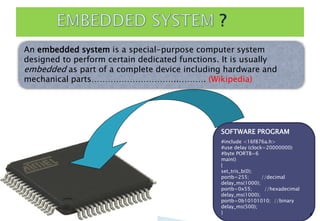
An embedded system is a special-purpose computer system
designed to perform certain dedicated functions. It is usually
embedded as part of a complete device including hardware and
mechanical parts…………………………..………. (Wikipedia)
6
 We can say that it is “A combination of computer
hardware and software, and perhaps additional
mechanical or other parts, designed to perform a
dedicated function.
 Embedded software is a part of almost every electronic
device in the use today.
 Each embedded System is unique, and the hardware is
highly specialized to the application domain.
 Its software embeds in ROM (Read Only Memory) &
does not requires secondary memories as in a computer.
7
8
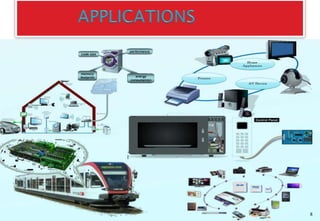
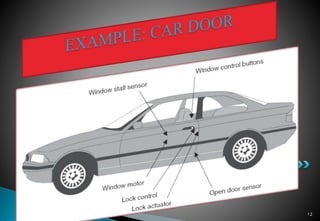
Embedded systems span all aspects of modern life and there
are many examples of their use.
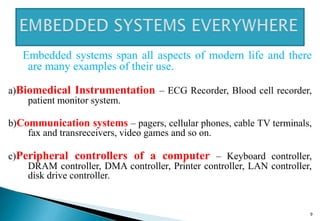
a)Biomedical Instrumentation – ECG Recorder, Blood cell recorder,
patient monitor system.
b)Communication systems – pagers, cellular phones, cable TV terminals,
fax and transreceivers, video games and so on.
c)Peripheral controllers of a computer – Keyboard controller,
DRAM controller, DMA controller, Printer controller, LAN controller,
disk drive controller.
9
d) Industrial Instrumentation – Process controller, DC motor
controller, robotic systems, CNC machine controller, close loop
engine controller, industrial moisture recorder cum controller.
e) Scientific – digital storage system, CRT display controller,
spectrum analyser.
f) Defence - machine guns, GPS, tanks, wireless, missiles,
Submarines, Aircrafts & All Other Latest Equipments
10
11
12
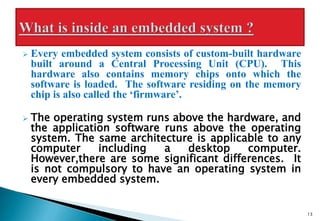
 Every embedded system consists of custom-built hardware
built around a Central Processing Unit (CPU). This
hardware also contains memory chips onto which the
software is loaded. The software residing on the memory
chip is also called the ‘firmware’.
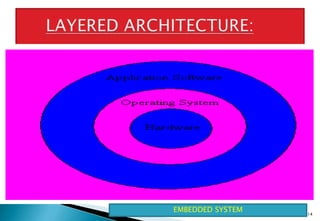
 The operating system runs above the hardware, and
the application software runs above the operating
system. The same architecture is applicable to any
computer including a desktop computer.
However,there are some significant differences. It
is not compulsory to have an operating system in
every embedded system.
13
EMBEDDED SYSTEM 14
•POWER
•SUPPLY
•CAPACITORS
MICRO
CONTROLLER
RESISTORS
DIODESTRANSISTORS
15
16
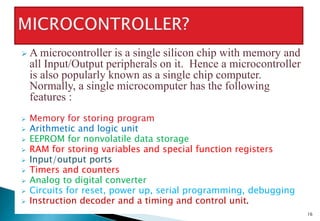
 A microcontroller is a single silicon chip with memory and
all Input/Output peripherals on it. Hence a microcontroller
is also popularly known as a single chip computer.
Normally, a single microcomputer has the following
features :
 Memory for storing program
 Arithmetic and logic unit
 EEPROM for nonvolatile data storage
 RAM for storing variables and special function registers
 Input/output ports
 Timers and counters
 Analog to digital converter
 Circuits for reset, power up, serial programming, debugging
 Instruction decoder and a timing and control unit.
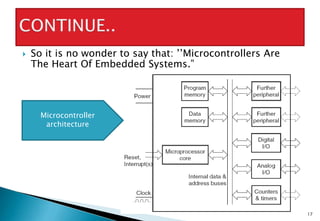
 So it is no wonder to say that: ’’Microcontrollers Are
The Heart Of Embedded Systems.”
17
Microcontroller
architecture
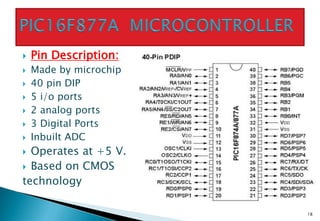
 Pin Description:
 Made by microchip
 40 pin DIP
 5 i/o ports
 2 analog ports
 3 Digital Ports
 Inbuilt ADC
 Operates at +5 V.
 Based on CMOS
technology
18
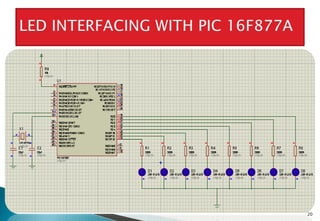
 Use of microcontroller always involves some
interfacing.
 Interfacing is nothing but connecting an i/o device or
some other device with our microcontroller.
 Basically it is the effective interfacing which
completes the embedded system
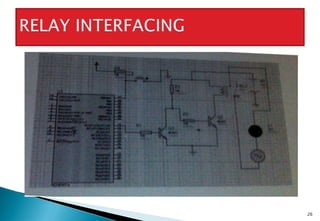
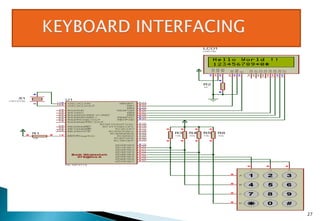
 Various components like LCD, Switch, Led, Relay
etc. will have to be interface with the microcontroller.
 In the next few slides we will explain these
interfacings.
19
20
21
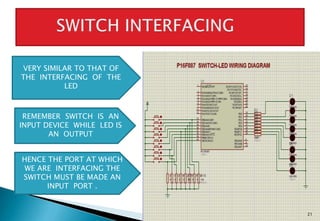
VERY SIMILAR TO THAT OF
THE INTERFACING OF THE
LED
REMEMBER SWITCH IS AN
INPUT DEVICE WHILE LED IS
AN OUTPUT
HENCE THE PORT AT WHICH
WE ARE INTERFACING THE
SWITCH MUST BE MADE AN
INPUT PORT .
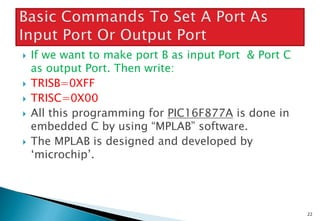
 If we want to make port B as input Port & Port C
as output Port. Then write:
 TRISB=0XFF
 TRISC=0X00
 All this programming for PIC16F877A is done in
embedded C by using “MPLAB” software.
 The MPLAB is designed and developed by
‘microchip’.
22
23
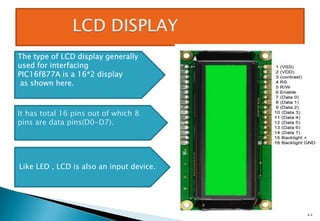
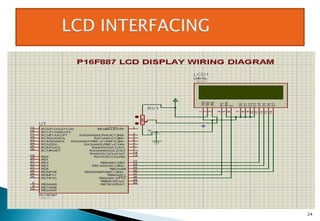
The type of LCD display generally
used for interfacing
PIC16f877A is a 16*2 display
as shown here.
It has total 16 pins out of which 8
pins are data pins(D0-D7).
Like LED , LCD is also an input device.
24
25
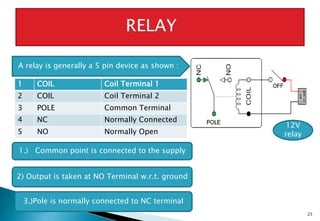
A relay is generally a 5 pin device as shown :
1 COIL Coil Terminal 1
2 COIL Coil Terminal 2
3 POLE Common Terminal
4 NC Normally Connected
5 NO Normally Open
1.) Common point is connected to the supply
12V
relay
2) Output is taken at NO Terminal w.r.t. ground
3.)Pole is normally connected to NC terminal
26
27
 1) Password Based Security System:
 The project was made by using a pic16f877a, a 16*2 LCD display,5
push/pull switches, and a 5V power supply along with basic
electronic components
 The program code was written in embedded c language using
MPLAB software. And burning of the program on pic
microcontroller was done using pic burner with the help of pic kit2
software.
 A particular password for the system was set.
 Reset switch erases the previous content and allows the user to
again enter the password
28
 If the password enter by the user is correct then
the LCD display shows the message ‘password
matched.’
 However if the password entered is incorrect then
the LCD display shows the massage ‘Un
authorised User’.
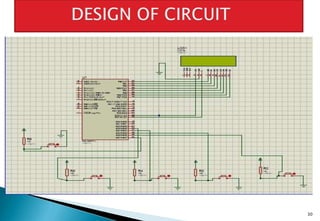
 Next slide shows the design of this circuit in
Proteus software.
29
30
31
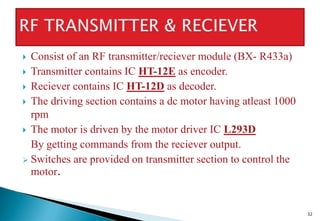
 Consist of an RF transmitter/reciever module (BX- R433a)
 Transmitter contains IC HT-12E as encoder.
 Reciever contains IC HT-12D as decoder.
 The driving section contains a dc motor having atleast 1000
rpm
 The motor is driven by the motor driver IC L293D
By getting commands from the reciever output.
 Switches are provided on transmitter section to control the
motor.
32
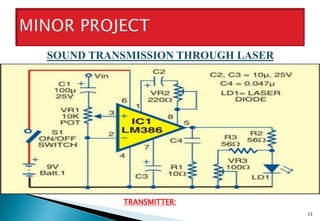
SOUND TRANSMISSION THROUGH LASER
33
TRANSMITTER:
34
35

Embedded systems presentation

  • 1.
  • 2.
     Study Offlow Of Electrons  Nothing Without Current  Basically A Branch Of Science Which Have No Limits  Full Of Creativity.  Transforming Ideas Into Reality  Only Limit Is Imagination Embedded Systems Are Heart Of Electronics 2
  • 3.
    Also Known AsPotential Difference Because Represents The Potential Gap Between Two Points Always Measured With A Reference Point Root Cause Of Flow Of Current Determines Total Electromotive Force Acting Between Charges Basically The Amount Of Charge Determines The Potential Of A Point 3
  • 4.
    Flow Of Electrons GenerallyFrom Higher Potential To Lower Potential Similar Behavior To that Of Water Makes Its Own Way Itself Usually Follows The Least Resistance Path In Two Parallel Branches Divided According To The Inverse Proportion Of Their Resistances 4
  • 5.
    A system isa way of working, organizing or doing one or many tasks according to a fixed plan, program or set of rules. • A system is also an arrangement in which all its units assemble and work together according to the plan or program. 5
  • 6.
    SOFTWARE PROGRAM #include <16f876a.h> #usedelay (clock=20000000) #byte PORTB=6 main() { set_tris_b(0); portb=255; //decimal delay_ms(1000); portb=0x55; //hexadecimal delay_ms(1000); portb=0b10101010; //binary delay_ms(500); } An embedded system is a special-purpose computer system designed to perform certain dedicated functions. It is usually embedded as part of a complete device including hardware and mechanical parts…………………………..………. (Wikipedia) 6
  • 7.
     We cansay that it is “A combination of computer hardware and software, and perhaps additional mechanical or other parts, designed to perform a dedicated function.  Embedded software is a part of almost every electronic device in the use today.  Each embedded System is unique, and the hardware is highly specialized to the application domain.  Its software embeds in ROM (Read Only Memory) & does not requires secondary memories as in a computer. 7
  • 8.
  • 9.
    Embedded systems spanall aspects of modern life and there are many examples of their use. a)Biomedical Instrumentation – ECG Recorder, Blood cell recorder, patient monitor system. b)Communication systems – pagers, cellular phones, cable TV terminals, fax and transreceivers, video games and so on. c)Peripheral controllers of a computer – Keyboard controller, DRAM controller, DMA controller, Printer controller, LAN controller, disk drive controller. 9
  • 10.
    d) Industrial Instrumentation– Process controller, DC motor controller, robotic systems, CNC machine controller, close loop engine controller, industrial moisture recorder cum controller. e) Scientific – digital storage system, CRT display controller, spectrum analyser. f) Defence - machine guns, GPS, tanks, wireless, missiles, Submarines, Aircrafts & All Other Latest Equipments 10
  • 11.
  • 12.
  • 13.
     Every embeddedsystem consists of custom-built hardware built around a Central Processing Unit (CPU). This hardware also contains memory chips onto which the software is loaded. The software residing on the memory chip is also called the ‘firmware’.  The operating system runs above the hardware, and the application software runs above the operating system. The same architecture is applicable to any computer including a desktop computer. However,there are some significant differences. It is not compulsory to have an operating system in every embedded system. 13
  • 14.
  • 15.
  • 16.
    16  A microcontrolleris a single silicon chip with memory and all Input/Output peripherals on it. Hence a microcontroller is also popularly known as a single chip computer. Normally, a single microcomputer has the following features :  Memory for storing program  Arithmetic and logic unit  EEPROM for nonvolatile data storage  RAM for storing variables and special function registers  Input/output ports  Timers and counters  Analog to digital converter  Circuits for reset, power up, serial programming, debugging  Instruction decoder and a timing and control unit.
  • 17.
     So itis no wonder to say that: ’’Microcontrollers Are The Heart Of Embedded Systems.” 17 Microcontroller architecture
  • 18.
     Pin Description: Made by microchip  40 pin DIP  5 i/o ports  2 analog ports  3 Digital Ports  Inbuilt ADC  Operates at +5 V.  Based on CMOS technology 18
  • 19.
     Use ofmicrocontroller always involves some interfacing.  Interfacing is nothing but connecting an i/o device or some other device with our microcontroller.  Basically it is the effective interfacing which completes the embedded system  Various components like LCD, Switch, Led, Relay etc. will have to be interface with the microcontroller.  In the next few slides we will explain these interfacings. 19
  • 20.
  • 21.
    21 VERY SIMILAR TOTHAT OF THE INTERFACING OF THE LED REMEMBER SWITCH IS AN INPUT DEVICE WHILE LED IS AN OUTPUT HENCE THE PORT AT WHICH WE ARE INTERFACING THE SWITCH MUST BE MADE AN INPUT PORT .
  • 22.
     If wewant to make port B as input Port & Port C as output Port. Then write:  TRISB=0XFF  TRISC=0X00  All this programming for PIC16F877A is done in embedded C by using “MPLAB” software.  The MPLAB is designed and developed by ‘microchip’. 22
  • 23.
    23 The type ofLCD display generally used for interfacing PIC16f877A is a 16*2 display as shown here. It has total 16 pins out of which 8 pins are data pins(D0-D7). Like LED , LCD is also an input device.
  • 24.
  • 25.
    25 A relay isgenerally a 5 pin device as shown : 1 COIL Coil Terminal 1 2 COIL Coil Terminal 2 3 POLE Common Terminal 4 NC Normally Connected 5 NO Normally Open 1.) Common point is connected to the supply 12V relay 2) Output is taken at NO Terminal w.r.t. ground 3.)Pole is normally connected to NC terminal
  • 26.
  • 27.
  • 28.
     1) PasswordBased Security System:  The project was made by using a pic16f877a, a 16*2 LCD display,5 push/pull switches, and a 5V power supply along with basic electronic components  The program code was written in embedded c language using MPLAB software. And burning of the program on pic microcontroller was done using pic burner with the help of pic kit2 software.  A particular password for the system was set.  Reset switch erases the previous content and allows the user to again enter the password 28
  • 29.
     If thepassword enter by the user is correct then the LCD display shows the message ‘password matched.’  However if the password entered is incorrect then the LCD display shows the massage ‘Un authorised User’.  Next slide shows the design of this circuit in Proteus software. 29
  • 30.
  • 31.
  • 32.
     Consist ofan RF transmitter/reciever module (BX- R433a)  Transmitter contains IC HT-12E as encoder.  Reciever contains IC HT-12D as decoder.  The driving section contains a dc motor having atleast 1000 rpm  The motor is driven by the motor driver IC L293D By getting commands from the reciever output.  Switches are provided on transmitter section to control the motor. 32
  • 33.
    SOUND TRANSMISSION THROUGHLASER 33 TRANSMITTER:
  • 34.
  • 35.