Types of

DAMS
                   •Arvind Gupta
           •M. Tech.-AHES(1st Yr.)
                      •12512006
Contents:
• Definitions
• Purposes
• Classifications
  – On the basis of size
  – On the basis of structure and material used
• Environmental issues
• References
Definitions:
• A dam is a structure which prevents the flow of
  water and accumulates it in a reservoir

• Dam is a solid barrier constructed at a suitable
  location across a river valley to store flowing water.

• A barrier constructed across a waterway to control
  the flow or raise the level of water.
Purpose:
1. Drinking and domestic water supply
2. Flood control
3. Irrigation
4. Industrial water supply
5. Hydroelectric energy production
6. Retention and control of sediments
7. Inland navigation
8. Improvement of water quality
9. Fish Farming
10. Recreation facilities
Classification of Dams
According to size of a Dam
Large dams
Small dams
  – According to International commission on Large
    Dams, a dam is big if height is more than 15m.
  – According to ICOLD, if the height is between 10m-
    15m the dams is big:
     • If the crest length is bigger than 500m
     • If the reservoir capacity is larger than 1 million m3
     • If the flood discharge is more than 2000 m3/s
According to Height of dam
• High Dam
  – If the height is more than 100m.
• Medium Dam
  – If the height is between 50-100m
• Low Dam
  – If the height is below 50
According to structure and materials
used
•   Gravity dams
•   Arch dams
•   Arch-gravity dams
•   Buttress dams
•   Barrages
•   Embankment dams
    –   Homogeneous earth dams
    –   Non-Homogeneous (zoned) earth dams
    –   Rolled fill earth dams
    –   Hydraulic fill dam
Gravity Dams
• Gravity dams are dams which resist the horizontal thrust of
  the water entirely by their own weight. They use their weight
  to hold back the water in the reservoir.

• The section of the gravity dam is approximately triangular in
  shape, with its apex at its top and maximum width at bottom.

• A gravity dam is generally straight in plan and, therefore, it is
  also called straight gravity dam.

• A gravity dam is made of concrete or masonry.

• It requires great quantities of material to construct.
Section of a Gravity Dam
• The non-overflow section and
• The over flow section or spillway section.
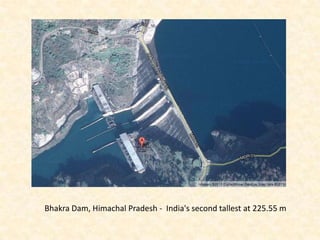
Bhakra Dam, Himachal Pradesh - India's second tallest at 225.55 m
Arch Dam
• An arch dam is curved in plan, with its convexity towards the
  upstream side. They transfers the water pressure and other forces
  mainly to the abutments by arch action.
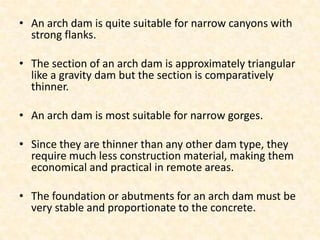
• An arch dam is quite suitable for narrow canyons with
  strong flanks.

• The section of an arch dam is approximately triangular
  like a gravity dam but the section is comparatively
  thinner.

• An arch dam is most suitable for narrow gorges.

• Since they are thinner than any other dam type, they
  require much less construction material, making them
  economical and practical in remote areas.

• The foundation or abutments for an arch dam must be
  very stable and proportionate to the concrete.
• There are two basic designs for an arch dam:
  – constant-radius dams, which have constant radius
    of curvature, and
  – variable-radius dams, which have both upstream
    and downstream curves that systematically
    decrease in radius below the crest


• A dam that is double-curved in both its
  horizontal and vertical planes may be called
  a dome dam.
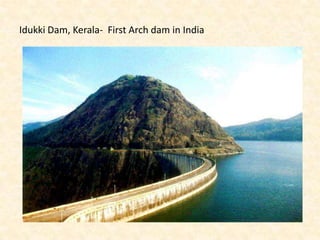
Idukki Dam, Kerala- First Arch dam in India
Arch-Gravity Dam
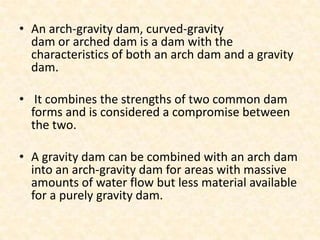
• An arch-gravity dam, curved-gravity
  dam or arched dam is a dam with the
  characteristics of both an arch dam and a gravity
  dam.

• It combines the strengths of two common dam
  forms and is considered a compromise between
  the two.

• A gravity dam can be combined with an arch dam
  into an arch-gravity dam for areas with massive
  amounts of water flow but less material available
  for a purely gravity dam.
Hoover dam, Arizona, US
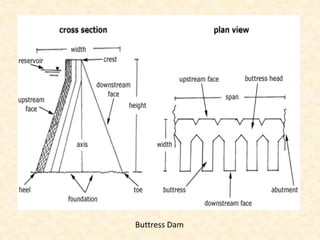
Buttress dams
• A buttress dam or hollow dam is a dam with a
  solid, water-tight upstream side that is supported
  at intervals on the downstream side by a series
  of buttresses or supports.

• The dam wall may be flat or curved.

• In comparison with massive gravity
  dams, buttress dams save 40 percent and more in
  concrete and costs.
Buttress Dam
Buttress Dam
Barrages
• A barrage dam is a special kind of dam which
  consists of a line of large gates that can be
  opened or closed to control the amount of
  water passing the dam.

• The gates are set between flanking piers
  which are responsible for supporting the
  water load.

• They are often used to control and stabilize
  water flow of rivers for irrigation systems.
Farakka barrage, WB
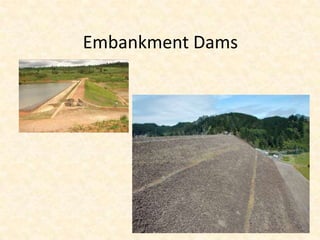
Embankment Dams
A dam composed of any type of soil including rock is
  known as embankment dams. These are classified into
  two main categories :
• Earth-fill dams
 • An earthfill dam is an embankment dam, constructed
   primarily of compacted earth, either homogeneous or
   zoned, and containing more than 50% of earth.


• Rock-fill dams
 • An embankment type of dam, dependent for its stability
   primarily on rock.
 • The earth utilized often contains a large percentage of
   large particles hence the term rock-fill.
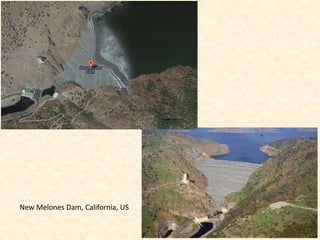
Rock-fill Dam:
• An embankment consisting of various sizes of rock to
  provide stability and an impervious core of membrane to
  provide water-tightness.

• The impervious zone may be on the upstream face and
  made of masonry, concrete, plastic membrane, steel
  sheet piles, timber or other material.

• The impervious zone may also be within the
  embankment in which case it is referred to as a core.
Upstream core


Sloping core


Central core
New Melones Dam, California, US
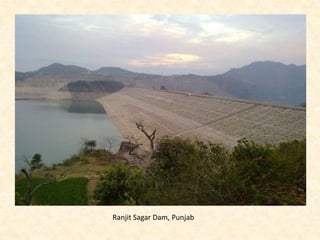
Earthfill dams:
.
• Local available soil is the main construction material
• It must be sufficiently impervious to prevent excessive
  loss of water through the dam.

• The soil should develop a maximum practical shear
  strength under compaction and maintain most of it after
  the filling of the reservoir;

• It must not consolidate, soften or liquify upon saturation.
Ranjit Sagar Dam, Punjab
Types of Earthfill dams:

  •   Homogeneous earth dams
  •   Non-Homogeneous (zoned) earth dams
  •   Rolled fill earth dams
  •   Hydraulic fill dam
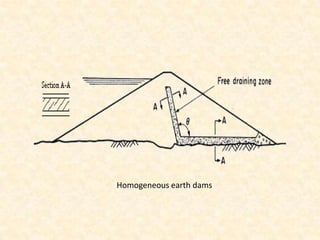
Homogeneous earth dams
• These dams are constructed with uniform and
  homogeneous materials. It is suitable for low height
  dams (up to 10m).

• The seepage action of such dams are not favourable,
  therefore, for safety in case of rapid drawdown, the
  upstream slope is kept relatively flat (3:1)

• Homogeneous section is modified by constructing rock
  toe at the downstream lower end and providing
  horizontal filter drain.
Homogeneous earth dams
Non-Homogeneous (zoned) earth
dams

• These are dams with the central portions called core
  or hearting made from materials which are relatively
  impervious.

• The thickness of the core wall is made sufficiently
  thick to prevent leakage of water through the body
  of the dam.
Rolled fill earth dams

• An embankment dam of earth or rock in which the
  material is placed in layers and compacted by the use of
  rollers or rolling equipment.

• In this type of dams, successive layers of moistened or
  damp soils are laid one over the other. Each layer not
  exceeding 20 cm in thickness is properly consolidated at
  optimum moisture content, only then is the next layer
  laid.
Hydraulic Fill dams
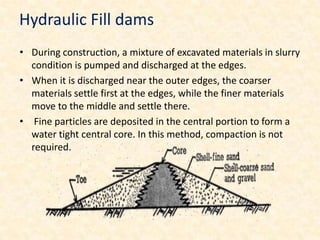
• During construction, a mixture of excavated materials in slurry
  condition is pumped and discharged at the edges.
• When it is discharged near the outer edges, the coarser
  materials settle first at the edges, while the finer materials
  move to the middle and settle there.
• Fine particles are deposited in the central portion to form a
  water tight central core. In this method, compaction is not
  required.
Rubber Dam
• Inflatable rubber dams are cylindrical rubber fabrics
  placed across channels, streams and weir or dam
  crests to raise the upstream water level when inflated.

• The membrane is a multi-layer fabric made of synthetic
  fibre (usually nylon)and rubberised on one or both
  sides.

• The fabric is quite flexible and yet exhibits good wear-
  resistance characteristics
Jhanjavathi Rubber Dam, Andhra Pradesh- India’s 1st Rubber dam
Environmental Issues:
• Dams disturb natural fluctuations in water flow
• Dams block migratory fish species from their spawning
  and feeding sites
• Water quality can be degraded
• The transport of sediment along the river is disrupted
• Reservoirs can emit climate-changing greenhouse gases
References
•   Varshney, R. S., Hydro Power Structures
•   Wikipedia http://en.wikipedia.org/wiki/Dam
•   http://www.idk.kerala.gov.in/index.php?option=com_content&view=article&id=85
    &Itemid=58
•   http://nptel.iitm.ac.in/courses/Webcourse-
    contents/IIT%20Kharagpur/Water%20Resource%20Engg/
•   pdf/m4l06.pdf
•   http://beengineeringinfo.blogspot.in/2012/04/types-of-dams-introduction-
    and.html
•   http://www.dur.ac.uk/~des0www4/cal/dams/emba/emba.htm
•   http://theconstructor.org/water-resources/earthfill-dams-its-classification/2273/
Thank You!
Questions..??

Dams arvind gupta-12march13 (2)

  • 1.
    Types of DAMS •Arvind Gupta •M. Tech.-AHES(1st Yr.) •12512006
  • 2.
    Contents: • Definitions • Purposes •Classifications – On the basis of size – On the basis of structure and material used • Environmental issues • References
  • 3.
    Definitions: • A damis a structure which prevents the flow of water and accumulates it in a reservoir • Dam is a solid barrier constructed at a suitable location across a river valley to store flowing water. • A barrier constructed across a waterway to control the flow or raise the level of water.
  • 4.
    Purpose: 1. Drinking anddomestic water supply 2. Flood control 3. Irrigation 4. Industrial water supply 5. Hydroelectric energy production 6. Retention and control of sediments 7. Inland navigation 8. Improvement of water quality 9. Fish Farming 10. Recreation facilities
  • 5.
  • 6.
    According to sizeof a Dam Large dams Small dams – According to International commission on Large Dams, a dam is big if height is more than 15m. – According to ICOLD, if the height is between 10m- 15m the dams is big: • If the crest length is bigger than 500m • If the reservoir capacity is larger than 1 million m3 • If the flood discharge is more than 2000 m3/s
  • 7.
    According to Heightof dam • High Dam – If the height is more than 100m. • Medium Dam – If the height is between 50-100m • Low Dam – If the height is below 50
  • 8.
    According to structureand materials used • Gravity dams • Arch dams • Arch-gravity dams • Buttress dams • Barrages • Embankment dams – Homogeneous earth dams – Non-Homogeneous (zoned) earth dams – Rolled fill earth dams – Hydraulic fill dam
  • 9.
  • 10.
    • Gravity damsare dams which resist the horizontal thrust of the water entirely by their own weight. They use their weight to hold back the water in the reservoir. • The section of the gravity dam is approximately triangular in shape, with its apex at its top and maximum width at bottom. • A gravity dam is generally straight in plan and, therefore, it is also called straight gravity dam. • A gravity dam is made of concrete or masonry. • It requires great quantities of material to construct.
  • 11.
    Section of aGravity Dam
  • 13.
    • The non-overflowsection and • The over flow section or spillway section.
  • 14.
    Bhakra Dam, HimachalPradesh - India's second tallest at 225.55 m
  • 15.
  • 16.
    • An archdam is curved in plan, with its convexity towards the upstream side. They transfers the water pressure and other forces mainly to the abutments by arch action.
  • 17.
    • An archdam is quite suitable for narrow canyons with strong flanks. • The section of an arch dam is approximately triangular like a gravity dam but the section is comparatively thinner. • An arch dam is most suitable for narrow gorges. • Since they are thinner than any other dam type, they require much less construction material, making them economical and practical in remote areas. • The foundation or abutments for an arch dam must be very stable and proportionate to the concrete.
  • 19.
    • There aretwo basic designs for an arch dam: – constant-radius dams, which have constant radius of curvature, and – variable-radius dams, which have both upstream and downstream curves that systematically decrease in radius below the crest • A dam that is double-curved in both its horizontal and vertical planes may be called a dome dam.
  • 20.
    Idukki Dam, Kerala-First Arch dam in India
  • 21.
  • 22.
    • An arch-gravitydam, curved-gravity dam or arched dam is a dam with the characteristics of both an arch dam and a gravity dam. • It combines the strengths of two common dam forms and is considered a compromise between the two. • A gravity dam can be combined with an arch dam into an arch-gravity dam for areas with massive amounts of water flow but less material available for a purely gravity dam.
  • 23.
  • 24.
  • 25.
    • A buttressdam or hollow dam is a dam with a solid, water-tight upstream side that is supported at intervals on the downstream side by a series of buttresses or supports. • The dam wall may be flat or curved. • In comparison with massive gravity dams, buttress dams save 40 percent and more in concrete and costs.
  • 26.
  • 27.
  • 28.
  • 29.
    • A barragedam is a special kind of dam which consists of a line of large gates that can be opened or closed to control the amount of water passing the dam. • The gates are set between flanking piers which are responsible for supporting the water load. • They are often used to control and stabilize water flow of rivers for irrigation systems.
  • 30.
  • 31.
  • 32.
    A dam composedof any type of soil including rock is known as embankment dams. These are classified into two main categories : • Earth-fill dams • An earthfill dam is an embankment dam, constructed primarily of compacted earth, either homogeneous or zoned, and containing more than 50% of earth. • Rock-fill dams • An embankment type of dam, dependent for its stability primarily on rock. • The earth utilized often contains a large percentage of large particles hence the term rock-fill.
  • 33.
    Rock-fill Dam: • Anembankment consisting of various sizes of rock to provide stability and an impervious core of membrane to provide water-tightness. • The impervious zone may be on the upstream face and made of masonry, concrete, plastic membrane, steel sheet piles, timber or other material. • The impervious zone may also be within the embankment in which case it is referred to as a core.
  • 34.
  • 35.
    New Melones Dam,California, US
  • 36.
    Earthfill dams: . • Localavailable soil is the main construction material • It must be sufficiently impervious to prevent excessive loss of water through the dam. • The soil should develop a maximum practical shear strength under compaction and maintain most of it after the filling of the reservoir; • It must not consolidate, soften or liquify upon saturation.
  • 37.
  • 38.
    Types of Earthfilldams: • Homogeneous earth dams • Non-Homogeneous (zoned) earth dams • Rolled fill earth dams • Hydraulic fill dam
  • 39.
    Homogeneous earth dams •These dams are constructed with uniform and homogeneous materials. It is suitable for low height dams (up to 10m). • The seepage action of such dams are not favourable, therefore, for safety in case of rapid drawdown, the upstream slope is kept relatively flat (3:1) • Homogeneous section is modified by constructing rock toe at the downstream lower end and providing horizontal filter drain.
  • 40.
  • 41.
    Non-Homogeneous (zoned) earth dams •These are dams with the central portions called core or hearting made from materials which are relatively impervious. • The thickness of the core wall is made sufficiently thick to prevent leakage of water through the body of the dam.
  • 42.
    Rolled fill earthdams • An embankment dam of earth or rock in which the material is placed in layers and compacted by the use of rollers or rolling equipment. • In this type of dams, successive layers of moistened or damp soils are laid one over the other. Each layer not exceeding 20 cm in thickness is properly consolidated at optimum moisture content, only then is the next layer laid.
  • 43.
    Hydraulic Fill dams •During construction, a mixture of excavated materials in slurry condition is pumped and discharged at the edges. • When it is discharged near the outer edges, the coarser materials settle first at the edges, while the finer materials move to the middle and settle there. • Fine particles are deposited in the central portion to form a water tight central core. In this method, compaction is not required.
  • 44.
    Rubber Dam • Inflatablerubber dams are cylindrical rubber fabrics placed across channels, streams and weir or dam crests to raise the upstream water level when inflated. • The membrane is a multi-layer fabric made of synthetic fibre (usually nylon)and rubberised on one or both sides. • The fabric is quite flexible and yet exhibits good wear- resistance characteristics
  • 45.
    Jhanjavathi Rubber Dam,Andhra Pradesh- India’s 1st Rubber dam
  • 46.
    Environmental Issues: • Damsdisturb natural fluctuations in water flow • Dams block migratory fish species from their spawning and feeding sites • Water quality can be degraded • The transport of sediment along the river is disrupted • Reservoirs can emit climate-changing greenhouse gases
  • 47.
    References • Varshney, R. S., Hydro Power Structures • Wikipedia http://en.wikipedia.org/wiki/Dam • http://www.idk.kerala.gov.in/index.php?option=com_content&view=article&id=85 &Itemid=58 • http://nptel.iitm.ac.in/courses/Webcourse- contents/IIT%20Kharagpur/Water%20Resource%20Engg/ • pdf/m4l06.pdf • http://beengineeringinfo.blogspot.in/2012/04/types-of-dams-introduction- and.html • http://www.dur.ac.uk/~des0www4/cal/dams/emba/emba.htm • http://theconstructor.org/water-resources/earthfill-dams-its-classification/2273/
  • 48.
  • 49.