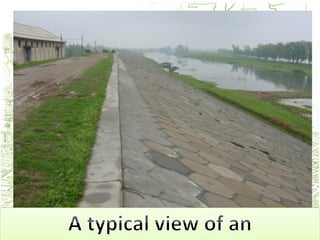
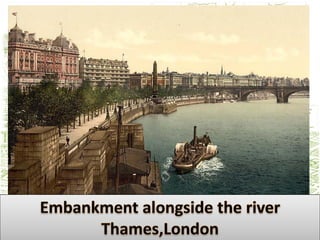
An embankment is an artificial barrier that
typically is used to hold back water or to
support a roadway, railway, or canal.

It is a ridge to prevent water from passing
beyond desirable limits.

These man-made mounds mainly consist of
stones, rocks, and earth.

Most have sloping sides, much like small hills.
Generally, embankments are longer than they
are in height.
The Place Embankment along the Neva River in
Saint Petersburg, Russia
The Embankment along the Daniub River in
Europe
The Embankment along the DEE River in North
Wales, England
Eagle eye view: The Place Embankment
along the Neva River in Saint Petersburg,
Russia
 To hold back water in order to prevent
flooding from seas, lakes, or rivers onto
adjacent land.

Typically strong barriers provide
protection to lower-lying grounds by
acting as a levee, as well.

Helps to confine the movement of
water by allowing it to flow faster and
higher without overflowing.
(CONTD.)

 A transportation embankment usually is
used to support a roadway, canal or
railway by keeping land flat or straight and
uninterrupted.

It also may be used to support lowlands,
such as valleys, that may need to be
crossed.

Most embankments are built so as to be
immune to surface erosion.
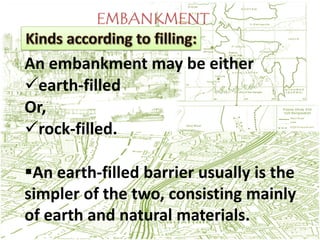
An embankment may be either
earth-filled
Or,
rock-filled.

An earth-filled barrier usually is the
simpler of the two, consisting mainly
of earth and natural materials.
(CONTD.)
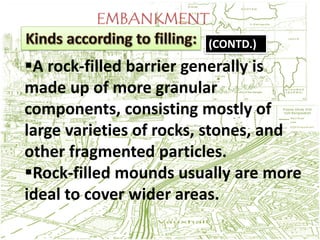
A rock-filled barrier generally is
made up of more granular
components, consisting mostly of
large varieties of rocks, stones, and
other fragmented particles.
Rock-filled mounds usually are more
ideal to cover wider areas.
Fig: The river bank of the Brahmaputra river in a
   village in the Kamarjani Union
Components of an embankment:

                               (Geotextiles
                               are permeable
                               fabrics which,
                               when used in
                               association
                               with soil, have
                               the ability to
                               separate,
                               filter,
                               reinforce,
                               protect,
                                or drain )
CONSTRUCTION OF EMBANKMENTS:


       EARTH CUTTING
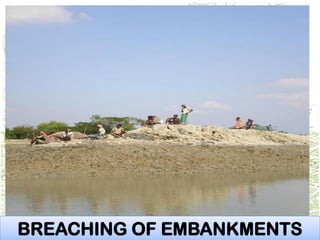
BREACHING OF EMBANKMENTS
EMBANKMENT UNDER CONSTRUCTION
Displacement
                                    of cc block


Embankment condition after rainy season.
x
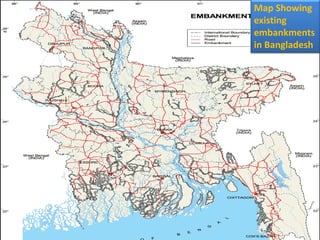
Map Showing
existing
embankments
in Bangladesh
Notable Embankments at a glance:
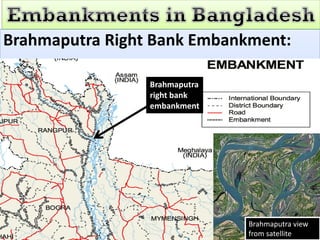
Brahmaputra Right Bank
 Embankment

Gumti River Embankment

Khowai River Embankment
Brahmaputra Right Bank Embankment:

                 Brahmaputra
                 right bank
                 embankment


                               Brahmaputra view
                               from satellite
Brahmaputra Right Bank Embankment:
One of the first embankments
 constructed in 1960s to provide flood
 protection to about 230,000 ha lying on
 the western side of the Brahmaputra-
 Jamuna and Tista rivers.
It is 217 km long and extends from
 Kaunia in Rangpur at the northern end
 up to Bera upazila in Sirajganj district at
 the southern end.
Brahmaputra Right Bank Embankment:
Construction of the embankment
 started in 1963 and was completed in
 1968 at a cost of about Tk. 80 million.
The average height is 4.5m, crest
 width 6m and side slope 1:3 on both
 sides.
The embankment has been under
 constant threat of erosion by the
 Jamuna river and needs relocation
 further away from the riverbank.
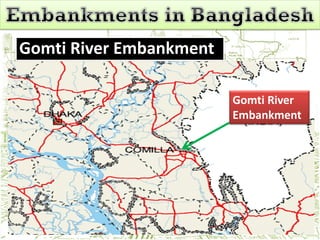
Gomti River Embankment

                         Gomti River
                         Embankment
Gumti River Embankment:
 located in Comilla district

Comprises 67 km of embankment
 on the left bank of the river Gumti
 from Katak Bazar and 64 km on
 the right bank from Golabari up to
 Gauripur of Daudkandi.
Khowai River Embankment
                          Khowai River
                          Embankment
Khowai River Embankment:

Lies in HABIGANJ district and

Provides flood protection to 25,790 ha of land.

This 40 km embankment on the right bank of
 the river Khowai extends from Habiganj to
 CHUNARUGHAT and 47 km on the left bank up to
 Rajabazar.
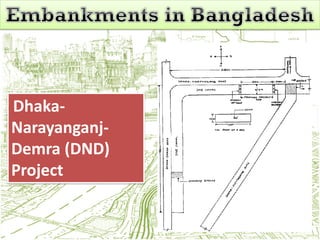
Dhaka-
Narayanganj-
Demra (DND)
Project
DND PROJECT
Located between the cities of Dhaka and
Narayanganj and bounded by the Buriganga and
the Shitalakshya river.

It was started in 1964 and completed in 1968
at a cost of Tk. 22.9 million.

 A dual purpose pumping station is located at
Shim rail having a total capacity of 4.2 cusec. The
project provides flood control for 4,860 ha,
irrigation for 6,070 ha, pumped drainage for
4,860 ha and gravity drainage for 2,470 ha of
land.
HAZARDS CAUSED BY DND PROJECT
• But as the project is
  located close to
  Dhaka city,
  urbanization is taking
  place rapidly. So the
  initial objective has
  been distorted.
• The area gets clogged
  in the rainy season.
HAZARDS CAUSED BY DND
          PROJECT
Nearly two million people have
become marooned as unplanned
urbanization left the rainwater trapped
inside the Dhaka-Narayanganj-Demra
Protection Embankment.
The urbanization, which is taking
place rapidly in the DND irrigation
project, posed a severe threat to the
project as well as to the people in the
area.
The Coastal Embankment Project (CEP)
  BACKGROUND:
 CEP Covers the coastal districts of Bangladesh
and includes Cox's Bazar, Chittagong, Feni,
Noakhali, Lakshmipur, Bhola, Barisal,
Patuakhali, Jhalokati, Barguna,Pirojpur, Khulna,
Satkhira and Bagerhat districts.
The project was implemented between
1961 and 1978 by the Bangladesh water
development board in two
phases.
The Coastal Embankment Project (CEP)
BACKGROUND:   (CONTD.)

Phase I comprises some 92 polders
providing protection to one million ha of land
Phase II consists of 16 polders covering
another 0.40 million ha. Polder is a Dutch
word meaning an area enclosed by dikes.
Within the CEP more than 4,000 km of
embankment and 1,039 drainage sluices
have been constructed.
The Coastal Embankment Project (CEP)
Main Purposes:

The CEP comprises a complex network of
dikes and drainage sluices and was the first
comprehensive plan for providing protection
against flood and

To prevent saline water intrusion in the
coastal area.
The Coastal Embankment Project (CEP)


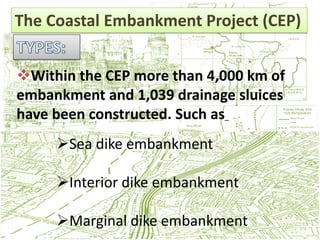
Within the CEP more than 4,000 km of
embankment and 1,039 drainage sluices
have been constructed. Such as_
     Sea dike embankment

     Interior dike embankment

     Marginal dike embankment
The Coastal Embankment Project (CEP)
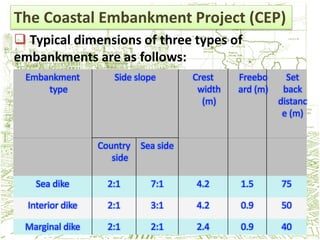
 Typical dimensions of three types of
embankments are as follows:
 Embankment          Side slope        Crest    Freebo      Set
     type                               width   ard (m)    back
                                         (m)              distanc
                                                           e (m)


                  Country   Sea side
                     side

    Sea dike        2:1       7:1      4.2      1.5       75

  Interior dike     2:1       3:1      4.2      0.9       50

 Marginal dike      2:1       2:1      2.4      0.9       40
The portion of Bangladesh map
showing Coastal Embankment protected area


 The Coastal
 Embankment
 Protected Area
The Coastal Embankment Project (CEP)


More than 4,000 km of
embankment and 1,039 drainage
sluices have been constructed in the
Coastal area.
providing protection against flood
and saline water intrusion in the
coastal area
The Coastal Embankment Project (CEP)
              (CONTD.)


oThese embankments are intended to protect
land from tidal inundation but cannot prevent
overtopping and damage from cyclonic surges
and tidal bores.

oIn addition to increased agricultural
production, these embankments have provided
good road communication and contributed
towards improvement of the overall socio-
economic condition in the coastal zone.
Embankment Erosion
The instability in river regime coupled with
huge discharge and sediment load cause
erosion, scouring and also deposition, and
thus a chain action proceeds. This is almost a
recurring phenomenon. As per the latest
information available from BWDB, it is found
that 441 projects/sub-projects are either fully
or partially damaged due to the severe floods
of 1998. The total estimated cost of the
rehabilitation works is about US$143.17
million.
Collapse of
Embankment


 Embankment
Main areas of erosion in Bangladesh8
         River    No. of location of   Length of erosion
                 bank/embankment            (km)
                       erosion
Brahmaputra-             41                162.50
Jamuna
Ganges-Padma             26                  94.0
Meghna                   8                   72.0
Teesta                   11                 34.90
Minor river             112                 92.30
Flashy river             75                  23.0
Tidal river              32                 85.80
Total                   305                 565.10
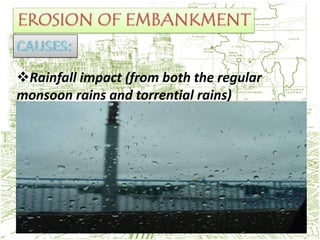
Rainfall impact (from both the regular
monsoon rains and torrential rains)
CAUSES OF EROSION (Contd.)
Wave action (daily/periodic and
created by constant wind):
 Tidal waves cause damage to the
embankments located too near to the
sea.
A severe hydraulic load is steadily
exerted on the toes and slopes and
causes
erosion.
Cyclonic storms in the coastal zone
(occurring repeatedly) act upon the
water surface, causing it to advance
towards the shore with enormous
hydraulic loads.
The waves thus formed eventually hit
the embankment toe and slopes.
Creating force
towards
Embankment
Turbulent water currents (mainly in
rivers and at coastlines):


·
 The high velocity flow of water
associated with vortex motion in rivers
and estuaries often causes erosion of
the banks by undermining, and the
eventual collapse of the embankment
threatens unless protective measures
are taken.
Source: Bangladesh Meteorological Department
The presence of continuous borrow-
pits on a river:
· The presence of continuous borrow-
pits on a river or seaside induces
undercutting of the embankment toes
and slopes due to complete inundation of
the riverbank or seashore during the
monsoon. The borrow-pits and adjoining
lowlands thus inundated induce a parallel
water current to flow along very near the
embankment toes and slopes, thereby
eroding the surfaces rapidly.
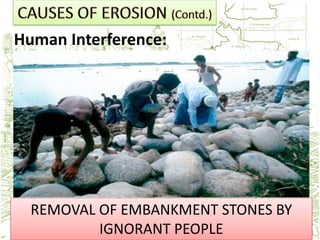
Human Interference:
The human interference responsible
for major embankment erosion is
quite diverse in nature and often
varies according to the lifestyle and
manner of using the embankments of
the inhabitants of different areas.
Human Interference:


  REMOVAL OF EMBANKMENT STONES BY
          IGNORANT PEOPLE
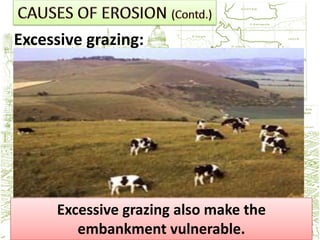
Excessive grazing:


     Excessive grazing also make the
        embankment vulnerable.
At different locations protective
measures are taken by any of the
following methods:
· Mattressing along the bank line
· Revetments either by boulders or by
concrete/brick boulders
· Permeable spurs
· Groynes
· Guide bundle
Rehabilitation of Embankments
· Artificial loop cut
· Porcupines
· Retards (palisade fences)
· Gravel drains
· Bandals
· Biological treatment eg.
afforestation in the foreshore and
embankment.
Embankment

Embankment

  • 3.
    An embankment isan artificial barrier that typically is used to hold back water or to support a roadway, railway, or canal. It is a ridge to prevent water from passing beyond desirable limits. These man-made mounds mainly consist of stones, rocks, and earth. Most have sloping sides, much like small hills. Generally, embankments are longer than they are in height.
  • 8.
    The Place Embankmentalong the Neva River in Saint Petersburg, Russia
  • 9.
    The Embankment alongthe Daniub River in Europe
  • 10.
    The Embankment alongthe DEE River in North Wales, England
  • 11.
    Eagle eye view:The Place Embankment along the Neva River in Saint Petersburg, Russia
  • 12.
     To holdback water in order to prevent flooding from seas, lakes, or rivers onto adjacent land. Typically strong barriers provide protection to lower-lying grounds by acting as a levee, as well. Helps to confine the movement of water by allowing it to flow faster and higher without overflowing.
  • 13.
    (CONTD.)  A transportationembankment usually is used to support a roadway, canal or railway by keeping land flat or straight and uninterrupted. It also may be used to support lowlands, such as valleys, that may need to be crossed. Most embankments are built so as to be immune to surface erosion.
  • 14.
    An embankment maybe either earth-filled Or, rock-filled. An earth-filled barrier usually is the simpler of the two, consisting mainly of earth and natural materials.
  • 15.
    (CONTD.) A rock-filled barriergenerally is made up of more granular components, consisting mostly of large varieties of rocks, stones, and other fragmented particles. Rock-filled mounds usually are more ideal to cover wider areas.
  • 16.
    Fig: The riverbank of the Brahmaputra river in a village in the Kamarjani Union
  • 17.
    Components of anembankment: (Geotextiles are permeable fabrics which, when used in association with soil, have the ability to separate, filter, reinforce, protect, or drain )
  • 18.
  • 19.
  • 20.
  • 21.
    Displacement of cc block Embankment condition after rainy season.
  • 23.
  • 26.
  • 27.
    Notable Embankments ata glance: Brahmaputra Right Bank Embankment Gumti River Embankment Khowai River Embankment
  • 28.
    Brahmaputra Right BankEmbankment: Brahmaputra right bank embankment Brahmaputra view from satellite
  • 29.
    Brahmaputra Right BankEmbankment: One of the first embankments constructed in 1960s to provide flood protection to about 230,000 ha lying on the western side of the Brahmaputra- Jamuna and Tista rivers. It is 217 km long and extends from Kaunia in Rangpur at the northern end up to Bera upazila in Sirajganj district at the southern end.
  • 30.
    Brahmaputra Right BankEmbankment: Construction of the embankment started in 1963 and was completed in 1968 at a cost of about Tk. 80 million. The average height is 4.5m, crest width 6m and side slope 1:3 on both sides. The embankment has been under constant threat of erosion by the Jamuna river and needs relocation further away from the riverbank.
  • 31.
    Gomti River Embankment Gomti River Embankment
  • 32.
    Gumti River Embankment: located in Comilla district Comprises 67 km of embankment on the left bank of the river Gumti from Katak Bazar and 64 km on the right bank from Golabari up to Gauripur of Daudkandi.
  • 33.
    Khowai River Embankment Khowai River Embankment
  • 34.
    Khowai River Embankment: Liesin HABIGANJ district and Provides flood protection to 25,790 ha of land. This 40 km embankment on the right bank of the river Khowai extends from Habiganj to CHUNARUGHAT and 47 km on the left bank up to Rajabazar.
  • 35.
  • 36.
    DND PROJECT Located betweenthe cities of Dhaka and Narayanganj and bounded by the Buriganga and the Shitalakshya river. It was started in 1964 and completed in 1968 at a cost of Tk. 22.9 million.  A dual purpose pumping station is located at Shim rail having a total capacity of 4.2 cusec. The project provides flood control for 4,860 ha, irrigation for 6,070 ha, pumped drainage for 4,860 ha and gravity drainage for 2,470 ha of land.
  • 37.
    HAZARDS CAUSED BYDND PROJECT • But as the project is located close to Dhaka city, urbanization is taking place rapidly. So the initial objective has been distorted. • The area gets clogged in the rainy season.
  • 38.
    HAZARDS CAUSED BYDND PROJECT Nearly two million people have become marooned as unplanned urbanization left the rainwater trapped inside the Dhaka-Narayanganj-Demra Protection Embankment. The urbanization, which is taking place rapidly in the DND irrigation project, posed a severe threat to the project as well as to the people in the area.
  • 40.
    The Coastal EmbankmentProject (CEP) BACKGROUND:  CEP Covers the coastal districts of Bangladesh and includes Cox's Bazar, Chittagong, Feni, Noakhali, Lakshmipur, Bhola, Barisal, Patuakhali, Jhalokati, Barguna,Pirojpur, Khulna, Satkhira and Bagerhat districts. The project was implemented between 1961 and 1978 by the Bangladesh water development board in two phases.
  • 41.
    The Coastal EmbankmentProject (CEP) BACKGROUND: (CONTD.) Phase I comprises some 92 polders providing protection to one million ha of land Phase II consists of 16 polders covering another 0.40 million ha. Polder is a Dutch word meaning an area enclosed by dikes. Within the CEP more than 4,000 km of embankment and 1,039 drainage sluices have been constructed.
  • 42.
    The Coastal EmbankmentProject (CEP) Main Purposes: The CEP comprises a complex network of dikes and drainage sluices and was the first comprehensive plan for providing protection against flood and To prevent saline water intrusion in the coastal area.
  • 43.
    The Coastal EmbankmentProject (CEP) Within the CEP more than 4,000 km of embankment and 1,039 drainage sluices have been constructed. Such as_ Sea dike embankment Interior dike embankment Marginal dike embankment
  • 44.
    The Coastal EmbankmentProject (CEP)  Typical dimensions of three types of embankments are as follows: Embankment Side slope Crest Freebo Set type width ard (m) back (m) distanc e (m) Country Sea side side Sea dike 2:1 7:1 4.2 1.5 75 Interior dike 2:1 3:1 4.2 0.9 50 Marginal dike 2:1 2:1 2.4 0.9 40
  • 45.
    The portion ofBangladesh map showing Coastal Embankment protected area The Coastal Embankment Protected Area
  • 46.
    The Coastal EmbankmentProject (CEP) More than 4,000 km of embankment and 1,039 drainage sluices have been constructed in the Coastal area. providing protection against flood and saline water intrusion in the coastal area
  • 47.
    The Coastal EmbankmentProject (CEP) (CONTD.) oThese embankments are intended to protect land from tidal inundation but cannot prevent overtopping and damage from cyclonic surges and tidal bores. oIn addition to increased agricultural production, these embankments have provided good road communication and contributed towards improvement of the overall socio- economic condition in the coastal zone.
  • 48.
    Embankment Erosion The instabilityin river regime coupled with huge discharge and sediment load cause erosion, scouring and also deposition, and thus a chain action proceeds. This is almost a recurring phenomenon. As per the latest information available from BWDB, it is found that 441 projects/sub-projects are either fully or partially damaged due to the severe floods of 1998. The total estimated cost of the rehabilitation works is about US$143.17 million.
  • 50.
  • 51.
    Main areas oferosion in Bangladesh8 River No. of location of Length of erosion bank/embankment (km) erosion Brahmaputra- 41 162.50 Jamuna Ganges-Padma 26 94.0 Meghna 8 72.0 Teesta 11 34.90 Minor river 112 92.30 Flashy river 75 23.0 Tidal river 32 85.80 Total 305 565.10
  • 52.
    Rainfall impact (fromboth the regular monsoon rains and torrential rains)
  • 53.
    CAUSES OF EROSION(Contd.) Wave action (daily/periodic and created by constant wind):  Tidal waves cause damage to the embankments located too near to the sea. A severe hydraulic load is steadily exerted on the toes and slopes and causes erosion.
  • 54.
    Cyclonic storms inthe coastal zone (occurring repeatedly) act upon the water surface, causing it to advance towards the shore with enormous hydraulic loads. The waves thus formed eventually hit the embankment toe and slopes.
  • 55.
  • 56.
    Turbulent water currents(mainly in rivers and at coastlines): ·
  • 57.
     The highvelocity flow of water associated with vortex motion in rivers and estuaries often causes erosion of the banks by undermining, and the eventual collapse of the embankment threatens unless protective measures are taken. Source: Bangladesh Meteorological Department
  • 58.
    The presence ofcontinuous borrow- pits on a river:
  • 59.
    · The presenceof continuous borrow- pits on a river or seaside induces undercutting of the embankment toes and slopes due to complete inundation of the riverbank or seashore during the monsoon. The borrow-pits and adjoining lowlands thus inundated induce a parallel water current to flow along very near the embankment toes and slopes, thereby eroding the surfaces rapidly.
  • 60.
    Human Interference: The humaninterference responsible for major embankment erosion is quite diverse in nature and often varies according to the lifestyle and manner of using the embankments of the inhabitants of different areas.
  • 61.
    Human Interference: REMOVAL OF EMBANKMENT STONES BY IGNORANT PEOPLE
  • 62.
    Excessive grazing: Excessive grazing also make the embankment vulnerable.
  • 63.
    At different locationsprotective measures are taken by any of the following methods: · Mattressing along the bank line · Revetments either by boulders or by concrete/brick boulders · Permeable spurs · Groynes · Guide bundle
  • 64.
  • 65.
    · Artificial loopcut · Porcupines · Retards (palisade fences) · Gravel drains · Bandals · Biological treatment eg. afforestation in the foreshore and embankment.