1111111111111
What is dam?
 Dam is a solid barrier constructed at a
suitable location across a river valley to store
flowing water.
 Or
The arrangement made for systematic
control of water flow for better optimum
utilization of available water.
Humanity control over Natural resources
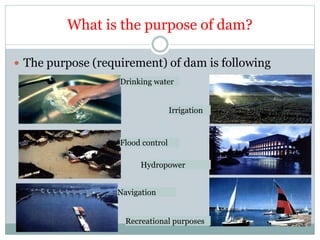
What is the purpose of dam?
 The purpose (requirement) of dam is following
Drinking water
Navigation
Flood control
Recreational purposes
Irrigation
Hydropower
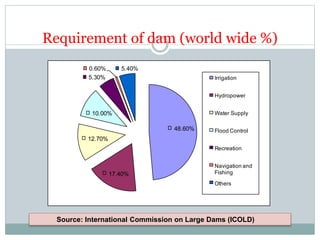
Requirement of dam (world wide %)
48.60%
17.40%
12.70%
10.00%
5.30%
0.60% 5.40%
Irrigation
Hydropower
Water Supply
Flood Control
Recreation
Navigation and
Fishing
Others
Source: International Commission on Large Dams (ICOLD)
Parts of a dam
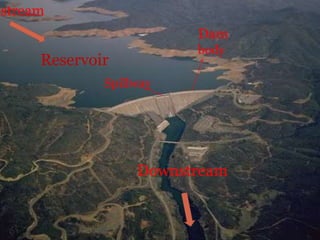
 Dam body: Body forms the main part of a dam as an
impervious barrier
 Reservoir: It is the artificial lake behind a dam body
 Spillway: is that part of a dam to evacuate the flood water from
reservoir.
 Water intake structures: is a facility to withdraw water from
a reservoir.
 Sluiceway: Gerektiğinde baraj gölünü tamamen boşaltmak,
dolusavak kapasitesini azaltmak, akarsu mansabına bırakılacak
suyu salmak amacına yönelik tesisler.
 Diversion facilities: To redirect the streamflow from
construction area
pstream
Spillway
Dam
body
Downstream
Reservoir
Types of dam?
ACCORDING to the SIZE of the DAM
1. Large (Big) dam
2. Small dam
International Commision on Large Dams, (ICOLD) assumes a
dam as big when its height is bigger than 15m.
If the height of the dam is between 10m and 15m and matches
the following criteria, then ICOLD accepts the dam as big:
If the crest length is bigger than 500m
If the reservoir capacity is larger than 1 million m3
If the flood discharge is more than 2000 m3/s
If there are some difficulties in the construction of
foundation
ACCORDING to HEIGHT of DAM
 High Dam or Large Dam
If the height of the dam is bigger than 100m
 Medium Dam
If the height of the dam is between 50m and 100m
 Low Dam or Small Dam
If the height of the dam is lower than 50m
ACCORDING to the STATICAL DESIGN of
DAM BODY
Gravity Dams
Arch Dams
Butress Dams
Embankment(Earth) Dams
Composite Dams
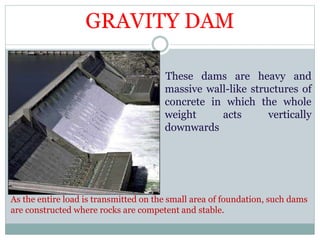
GRAVITY DAM
These dams are heavy and
massive wall-like structures of
concrete in which the whole
weight acts vertically
downwards
As the entire load is transmitted on the small area of foundation, such dams
are constructed where rocks are competent and stable.
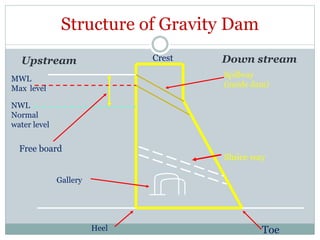
Structure of Gravity Dam
Heel
Gallery
Toe
Spillway
(inside dam)
Crest
NWL
Normal
water level
MWL
Max. level
Free board
Sluice way
Upstream Down stream
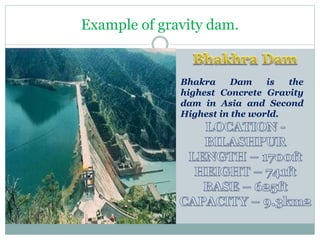
Example of gravity dam.
• Bhakra Dam is the
highest Concrete Gravity
dam in Asia and Second
Highest in the world.
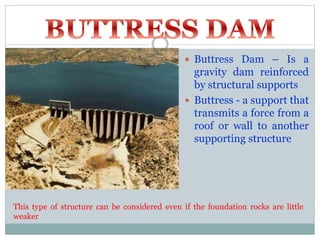
 Buttress Dam – Is a
gravity dam reinforced
by structural supports
 Buttress - a support that
transmits a force from a
roof or wall to another
supporting structure
This type of structure can be considered even if the foundation rocks are little
weaker
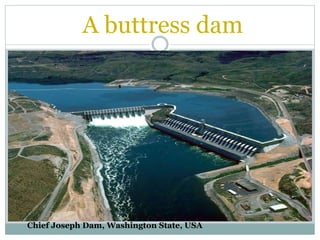
A buttress dam
Chief Joseph Dam, Washington State, USA
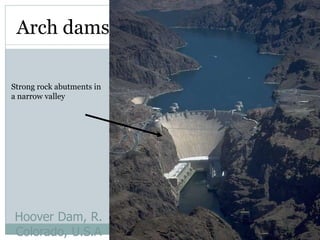
Hoover Dam, R.
Colorado, U.S.A
Strong rock abutments in
a narrow valley
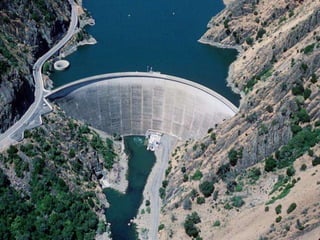
Arch dams
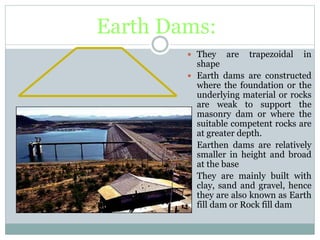
Earth Dams:
 They are trapezoidal in
shape
 Earth dams are constructed
where the foundation or the
underlying material or rocks
are weak to support the
masonry dam or where the
suitable competent rocks are
at greater depth.
 Earthen dams are relatively
smaller in height and broad
at the base
 They are mainly built with
clay, sand and gravel, hence
they are also known as Earth
fill dam or Rock fill dam
ADVANTAGE OF DAM
 40 % Of world food production comes from Irrigated
forming out of which 16% is contributed due to
dams.
 30-40% of 268 million hectares of irrigated land is
watered from dams
 19% of world energy comes from hydro-electric
power ( which includes 150 countries)
 90% of 24 countries
 50% in 63 countries
DISADVANTAGE OF DAM
 FLOOD
 NOT ECONOMICAL
 TIME
 CULTURAL DAMAGE
 Loss of forests , wildlife habitat, the degradation of
upstream catchments

 Disruption of fishing and waterway traffic
The fragmentation and physical transformation
of rivers
Thank
You

Dam PPT

  • 1.
  • 4.
    What is dam? Dam is a solid barrier constructed at a suitable location across a river valley to store flowing water.  Or The arrangement made for systematic control of water flow for better optimum utilization of available water. Humanity control over Natural resources
  • 5.
    What is thepurpose of dam?  The purpose (requirement) of dam is following Drinking water Navigation Flood control Recreational purposes Irrigation Hydropower
  • 6.
    Requirement of dam(world wide %) 48.60% 17.40% 12.70% 10.00% 5.30% 0.60% 5.40% Irrigation Hydropower Water Supply Flood Control Recreation Navigation and Fishing Others Source: International Commission on Large Dams (ICOLD)
  • 7.
    Parts of adam  Dam body: Body forms the main part of a dam as an impervious barrier  Reservoir: It is the artificial lake behind a dam body  Spillway: is that part of a dam to evacuate the flood water from reservoir.  Water intake structures: is a facility to withdraw water from a reservoir.  Sluiceway: Gerektiğinde baraj gölünü tamamen boşaltmak, dolusavak kapasitesini azaltmak, akarsu mansabına bırakılacak suyu salmak amacına yönelik tesisler.  Diversion facilities: To redirect the streamflow from construction area
  • 8.
  • 9.
    Types of dam? ACCORDINGto the SIZE of the DAM 1. Large (Big) dam 2. Small dam International Commision on Large Dams, (ICOLD) assumes a dam as big when its height is bigger than 15m. If the height of the dam is between 10m and 15m and matches the following criteria, then ICOLD accepts the dam as big: If the crest length is bigger than 500m If the reservoir capacity is larger than 1 million m3 If the flood discharge is more than 2000 m3/s If there are some difficulties in the construction of foundation
  • 10.
    ACCORDING to HEIGHTof DAM  High Dam or Large Dam If the height of the dam is bigger than 100m  Medium Dam If the height of the dam is between 50m and 100m  Low Dam or Small Dam If the height of the dam is lower than 50m
  • 11.
    ACCORDING to theSTATICAL DESIGN of DAM BODY Gravity Dams Arch Dams Butress Dams Embankment(Earth) Dams Composite Dams
  • 12.
    GRAVITY DAM These damsare heavy and massive wall-like structures of concrete in which the whole weight acts vertically downwards As the entire load is transmitted on the small area of foundation, such dams are constructed where rocks are competent and stable.
  • 13.
    Structure of GravityDam Heel Gallery Toe Spillway (inside dam) Crest NWL Normal water level MWL Max. level Free board Sluice way Upstream Down stream
  • 14.
    Example of gravitydam. • Bhakra Dam is the highest Concrete Gravity dam in Asia and Second Highest in the world.
  • 15.
     Buttress Dam– Is a gravity dam reinforced by structural supports  Buttress - a support that transmits a force from a roof or wall to another supporting structure This type of structure can be considered even if the foundation rocks are little weaker
  • 16.
    A buttress dam ChiefJoseph Dam, Washington State, USA
  • 17.
    Hoover Dam, R. Colorado,U.S.A Strong rock abutments in a narrow valley Arch dams
  • 19.
    Earth Dams:  Theyare trapezoidal in shape  Earth dams are constructed where the foundation or the underlying material or rocks are weak to support the masonry dam or where the suitable competent rocks are at greater depth.  Earthen dams are relatively smaller in height and broad at the base  They are mainly built with clay, sand and gravel, hence they are also known as Earth fill dam or Rock fill dam
  • 20.
    ADVANTAGE OF DAM 40 % Of world food production comes from Irrigated forming out of which 16% is contributed due to dams.  30-40% of 268 million hectares of irrigated land is watered from dams  19% of world energy comes from hydro-electric power ( which includes 150 countries)  90% of 24 countries  50% in 63 countries
  • 21.
    DISADVANTAGE OF DAM FLOOD  NOT ECONOMICAL  TIME  CULTURAL DAMAGE  Loss of forests , wildlife habitat, the degradation of upstream catchments   Disruption of fishing and waterway traffic The fragmentation and physical transformation of rivers
  • 22.