Vocabulary and Concept
Development
Prepared by: M. Rahim ‘Rafaat’.
Year: 2015
Introduction
When teachers and speech-language pathologists talk about
vocabulary, they are referring to the set of words that a child
knows.
 Receptive vocabulary
 Expressive vocabulary
 Why vocabulary is important?
Because vocabulary is the basis for learning a language.
Education research shows that vocabulary strongly relates to
reading comprehension, intelligence and general ability.
My monograph consists of useful contents like: Vocabulary
Development, The Complexity of Word Knowledge, Teaching
Word Meaning and Concept, Teaching Word Parts…etc.
Vocabulary Development
Why a monograph a about Vocabulary and Concept
Development? Because vocabularies are the very foundation of
learning, and words are the tools we use to access our
background knowledge, express ideas, and about new concepts.
Students’ word knowledge linked strongly to academic success.
And it is necessary for their comprehension when they read a
text.
 Poor reader
 Good reader
This monograph is divided into three parts.1.some obstacles,
2.effective instruction, 3.useful techniques for word meaning.
(Anderson, R.C, and Nagy, W.E. (1991) pp. 631-632)
Some Obstacles to Vocabulary
Development
Good instructions are more important for students to
learn new vocabularies.
Instructions are:
 The size of the task.
 The differences between spoken and written English.
 The limitation of sources of information about words.
 The complexity of word knowledge.
The Size of the Task:
This part shows the number of words that students need to
learn is exceedingly large.
Although there is still debate over exactly how many and
what word are essential for students.
 On average, students add 2000-3000 words/ year (six to eight
new words/day.) But it mostly belong to economic and social
situation of that students.
The Differences between Spoken and Written
English:
Because of different communicative tools at our disposal-
gestures, tone of voice, and facial expression, and the
accuracy of communication depends more on feedback from
listeners than what is said exactly right.
In writing, and especially in literate writing, the primary
communicative tool is precision in word choice.
This is a major problem for every native and second
language learners to learn literate vocabularies. (Anderson, 1992, pp. 789-
814)
Limitation of the Source of Information about
Words:
Learning on their own or as part of a lesson, students have
three main sources of information about words:
 Dictionaries
 Word Parts
 Context
(Cunningham, & Stanvich, 1988, pp. 572-585)
Dictionaries:
Although dictionary use is a main feature of most
vocabulary instruction, many students do not receive the
kind of instruction they need to learn how to use a
dictionary effectively. There are two main issues with
dictionary use:
 How to look for an information about words in a
dictionary.
 Difficulty with choosing the appropriate meanings from
a dictionary.
Word Parts:
Interpreting the word parts – prefixes, suffixes, and roots
– generally can help greatly to their vocabulary growth.
It can share recognizable parts of speech, but are not
clearly in their meaning. E.g. casual / casualty, emerge/
emergency, sign/ resign/design,
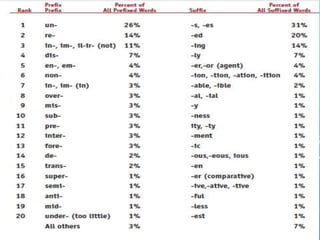
The Most Frequent Affixes in Printed School English are:
Roots:
what does these words mean? biosphere, astronomy,
superstructure, or deconstruct? Of course, these words are a
little different because, the suffix and prefix of these words has
Greek or Latin roots.
For the purposes of word study, however—when students
have already been provided the meaning of the word—knowing
the story or the history of the word may well make it more
memorable.
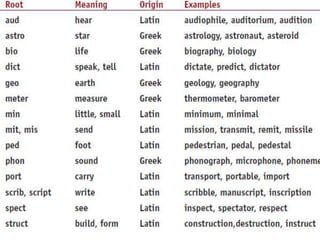
A distinction also should be made between time spent
studying those roots, especially Greek roots used in scientific
terminology, that have relatively specific meanings (bio, hemo,
meter), and time spent studying those roots, more often from
Latin, whose meanings wander all over the map (for example,
Context:
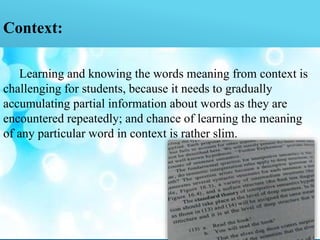
Learning and knowing the words meaning from context is
challenging for students, because it needs to gradually
accumulating partial information about words as they are
encountered repeatedly; and chance of learning the meaning
of any particular word in context is rather slim.
The Complexity of Word Knowledge:
When we talk about knowing a word, we mean knowing its
definition. But knowing a word’s definition is not the same thing as
being able to use that word in speech and writing or to understand a text
in which the word appears.
 Find the category which a word belongs
 Define how the word differs from other members of that category.
When students know the meaning of a word in context, see if that
word and other surrounded words are used in its place.
 Function word ( used to structure the sentence. Like: are, that, a, or,
the…etc)
 Content word ( they are unlimited. Like: nouns, verbs, adjectives.
Concrete and abstract, synonyms, antonyms)
The Components of Effective Vocabulary
Instruction
Opportunities for word learning by:
 Encouraging wide reading;
 Exposing student to high-quality oral language;
 Promoting word consciousness;
 Providing explicit instruction of specific word;
 Providing modeling and instruction in independent word
learning strategies.
Teaching Word Meanings as Concepts
Different techniques can help students establish
connections among context, their prior knowledge, and the
concepts or words being taught.
 Concept of Definition Map
 Semantic Mapping
 Possible sentences
 Comparing and contrasting
 Teaching word parts
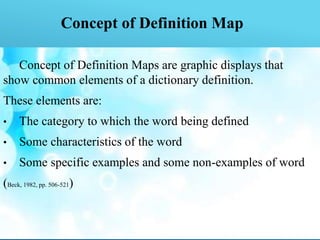
Concept of Definition Map
Concept of Definition Maps are graphic displays that
show common elements of a dictionary definition.
These elements are:
• The category to which the word being defined
• Some characteristics of the word
• Some specific examples and some non-examples of word
(Beck, 1982, pp. 506-521)
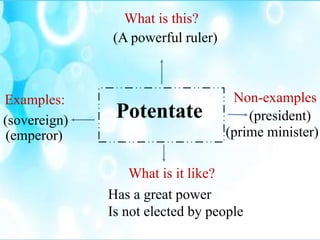
Potentate
What is this?
What is it like?
(A powerful ruler)
Has a great power
Is not elected by people
Examples: Non-examples
(sovereign)
(emperor)
(president)
(prime minister)
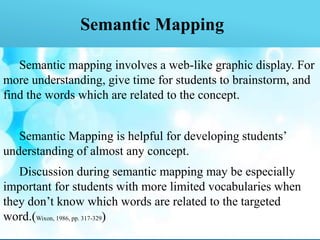
Semantic Mapping
Semantic mapping involves a web-like graphic display. For
more understanding, give time for students to brainstorm, and
find the words which are related to the concept.
Semantic Mapping is helpful for developing students’
understanding of almost any concept.
Discussion during semantic mapping may be especially
important for students with more limited vocabularies when
they don’t know which words are related to the targeted
word.(Wixon, 1986, pp. 317-329)
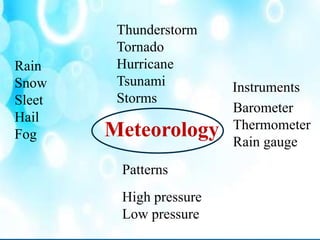
Meteorology
Instruments
Barometer
Thermometer
Rain gauge
Thunderstorm
Tornado
Hurricane
Tsunami
Storms
Patterns
High pressure
Low pressure
Rain
Snow
Sleet
Hail
Fog
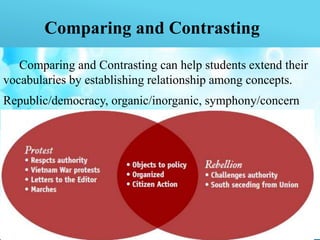
Comparing and Contrasting
Comparing and Contrasting can help students extend their
vocabularies by establishing relationship among concepts.
Republic/democracy, organic/inorganic, symphony/concern
Conclusion
In the beginning of this monograph, I stressed the difficulties associated
with trying to promote vocabulary development. In closing, I reiterate that
helping students to develop large and powerful vocabularies is anything but an
easy task.
The number of words students need to learn is astronomical; their exposure
to the vocabulary of literate English outside of school may be minimal;
effective use of dictionary definitions, word parts, and context to determine
word meanings requires students to be flexible and strategic learners; and
traditional methods of teaching vocabulary are often ineffective in helping them
deal with the complexity of word knowledge.
However, helping students develop strong vocabularies is essential to their
success, both in school and beyond. Students may forget many of the specific
facts they learn in school, but the words they learn will serve them as useful
tools for a lifetime. Effective vocabulary instruction is an attainable goal. I hope
that the information I have provided in this monograph will help us to attain
this goal for the students.
Rahim

Rahim

  • 1.
    Vocabulary and Concept Development Preparedby: M. Rahim ‘Rafaat’. Year: 2015
  • 2.
    Introduction When teachers andspeech-language pathologists talk about vocabulary, they are referring to the set of words that a child knows.  Receptive vocabulary  Expressive vocabulary  Why vocabulary is important? Because vocabulary is the basis for learning a language. Education research shows that vocabulary strongly relates to reading comprehension, intelligence and general ability. My monograph consists of useful contents like: Vocabulary Development, The Complexity of Word Knowledge, Teaching Word Meaning and Concept, Teaching Word Parts…etc.
  • 3.
    Vocabulary Development Why amonograph a about Vocabulary and Concept Development? Because vocabularies are the very foundation of learning, and words are the tools we use to access our background knowledge, express ideas, and about new concepts. Students’ word knowledge linked strongly to academic success. And it is necessary for their comprehension when they read a text.  Poor reader  Good reader This monograph is divided into three parts.1.some obstacles, 2.effective instruction, 3.useful techniques for word meaning. (Anderson, R.C, and Nagy, W.E. (1991) pp. 631-632)
  • 4.
    Some Obstacles toVocabulary Development Good instructions are more important for students to learn new vocabularies. Instructions are:  The size of the task.  The differences between spoken and written English.  The limitation of sources of information about words.  The complexity of word knowledge.
  • 5.
    The Size ofthe Task: This part shows the number of words that students need to learn is exceedingly large. Although there is still debate over exactly how many and what word are essential for students.  On average, students add 2000-3000 words/ year (six to eight new words/day.) But it mostly belong to economic and social situation of that students.
  • 6.
    The Differences betweenSpoken and Written English: Because of different communicative tools at our disposal- gestures, tone of voice, and facial expression, and the accuracy of communication depends more on feedback from listeners than what is said exactly right. In writing, and especially in literate writing, the primary communicative tool is precision in word choice. This is a major problem for every native and second language learners to learn literate vocabularies. (Anderson, 1992, pp. 789- 814)
  • 7.
    Limitation of theSource of Information about Words: Learning on their own or as part of a lesson, students have three main sources of information about words:  Dictionaries  Word Parts  Context (Cunningham, & Stanvich, 1988, pp. 572-585)
  • 8.
    Dictionaries: Although dictionary useis a main feature of most vocabulary instruction, many students do not receive the kind of instruction they need to learn how to use a dictionary effectively. There are two main issues with dictionary use:  How to look for an information about words in a dictionary.  Difficulty with choosing the appropriate meanings from a dictionary.
  • 9.
    Word Parts: Interpreting theword parts – prefixes, suffixes, and roots – generally can help greatly to their vocabulary growth. It can share recognizable parts of speech, but are not clearly in their meaning. E.g. casual / casualty, emerge/ emergency, sign/ resign/design, The Most Frequent Affixes in Printed School English are:
  • 11.
    Roots: what does thesewords mean? biosphere, astronomy, superstructure, or deconstruct? Of course, these words are a little different because, the suffix and prefix of these words has Greek or Latin roots. For the purposes of word study, however—when students have already been provided the meaning of the word—knowing the story or the history of the word may well make it more memorable. A distinction also should be made between time spent studying those roots, especially Greek roots used in scientific terminology, that have relatively specific meanings (bio, hemo, meter), and time spent studying those roots, more often from Latin, whose meanings wander all over the map (for example,
  • 13.
    Context: Learning and knowingthe words meaning from context is challenging for students, because it needs to gradually accumulating partial information about words as they are encountered repeatedly; and chance of learning the meaning of any particular word in context is rather slim.
  • 14.
    The Complexity ofWord Knowledge: When we talk about knowing a word, we mean knowing its definition. But knowing a word’s definition is not the same thing as being able to use that word in speech and writing or to understand a text in which the word appears.  Find the category which a word belongs  Define how the word differs from other members of that category. When students know the meaning of a word in context, see if that word and other surrounded words are used in its place.  Function word ( used to structure the sentence. Like: are, that, a, or, the…etc)  Content word ( they are unlimited. Like: nouns, verbs, adjectives. Concrete and abstract, synonyms, antonyms)
  • 15.
    The Components ofEffective Vocabulary Instruction Opportunities for word learning by:  Encouraging wide reading;  Exposing student to high-quality oral language;  Promoting word consciousness;  Providing explicit instruction of specific word;  Providing modeling and instruction in independent word learning strategies.
  • 16.
    Teaching Word Meaningsas Concepts Different techniques can help students establish connections among context, their prior knowledge, and the concepts or words being taught.  Concept of Definition Map  Semantic Mapping  Possible sentences  Comparing and contrasting  Teaching word parts
  • 17.
    Concept of DefinitionMap Concept of Definition Maps are graphic displays that show common elements of a dictionary definition. These elements are: • The category to which the word being defined • Some characteristics of the word • Some specific examples and some non-examples of word (Beck, 1982, pp. 506-521)
  • 18.
    Potentate What is this? Whatis it like? (A powerful ruler) Has a great power Is not elected by people Examples: Non-examples (sovereign) (emperor) (president) (prime minister)
  • 19.
    Semantic Mapping Semantic mappinginvolves a web-like graphic display. For more understanding, give time for students to brainstorm, and find the words which are related to the concept. Semantic Mapping is helpful for developing students’ understanding of almost any concept. Discussion during semantic mapping may be especially important for students with more limited vocabularies when they don’t know which words are related to the targeted word.(Wixon, 1986, pp. 317-329)
  • 20.
  • 21.
    Comparing and Contrasting Comparingand Contrasting can help students extend their vocabularies by establishing relationship among concepts. Republic/democracy, organic/inorganic, symphony/concern
  • 22.
    Conclusion In the beginningof this monograph, I stressed the difficulties associated with trying to promote vocabulary development. In closing, I reiterate that helping students to develop large and powerful vocabularies is anything but an easy task. The number of words students need to learn is astronomical; their exposure to the vocabulary of literate English outside of school may be minimal; effective use of dictionary definitions, word parts, and context to determine word meanings requires students to be flexible and strategic learners; and traditional methods of teaching vocabulary are often ineffective in helping them deal with the complexity of word knowledge. However, helping students develop strong vocabularies is essential to their success, both in school and beyond. Students may forget many of the specific facts they learn in school, but the words they learn will serve them as useful tools for a lifetime. Effective vocabulary instruction is an attainable goal. I hope that the information I have provided in this monograph will help us to attain this goal for the students.