PRINCIPLES AND
URPOSES OF
LANGUAGE
ASSESSMENT
Prepared by: Sarsona A., Gulmatico, M., Mandigal, M.
LEARNING OBJECTIVES:
At the end of this Module,
students should be able to:
1. Explore the different definitions of
concepts related to language and
literature assessment
LEARNING OBJECTIVES:
2. Explain the principles that govern
effective assessment and evaluation
3. Discuss the purposes of language
testing.
4. Identify the functions of language
tests in education.
LEARNING OBJECTIVES:
5. Acknowledge the value of
assessment in the language
learning-teaching process.
A. KEY CONCEPTS
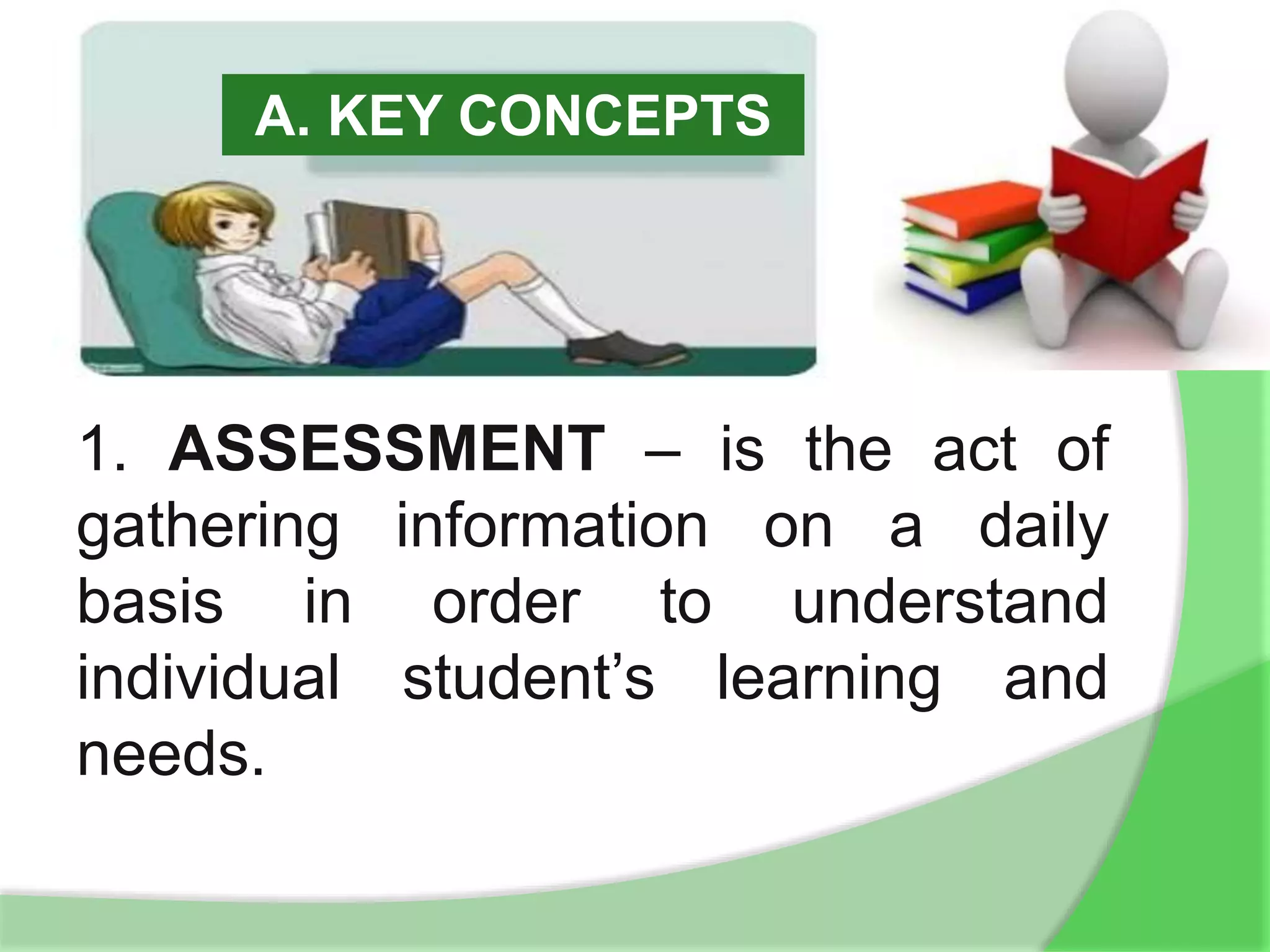
1. ASSESSMENT – is the act of
gathering information on a daily
basis in order to understand
individual student’s learning and
needs.
“In the context of language teaching
and learning, this refers to the act of
collecting information and making
judgments about a language learners’
knowledge of a language and ability to
use it.”
- (Carol Chapelle and Geoff
Brindley)-
A. KEY CONCEPTS
2. TESTING – refers to procedures that
are based on tests. In learning, it is a
salient part of assessment.
3. LANGUAGE TESTING – is “the
practice and study of evaluating the
proficiency of an individual in using a
particular language effectively.”
(Priscilla Allen)
A. KEY CONCEPTS
4. MEASUREMENT – more broadly
includes testing and other types of
measurement, as well as other types of
information that result in quantitative
data such as attendance, records,
questionnaires, teacher ratings of
students, etc.
A. KEY CONCEPTS
5. EVALUATION – is the culminating
act of interpreting the information
gathered for the purpose of making
decisions or judgments about
students’ learning and needs, often at
reporting time.
A. KEY CONCEPTS
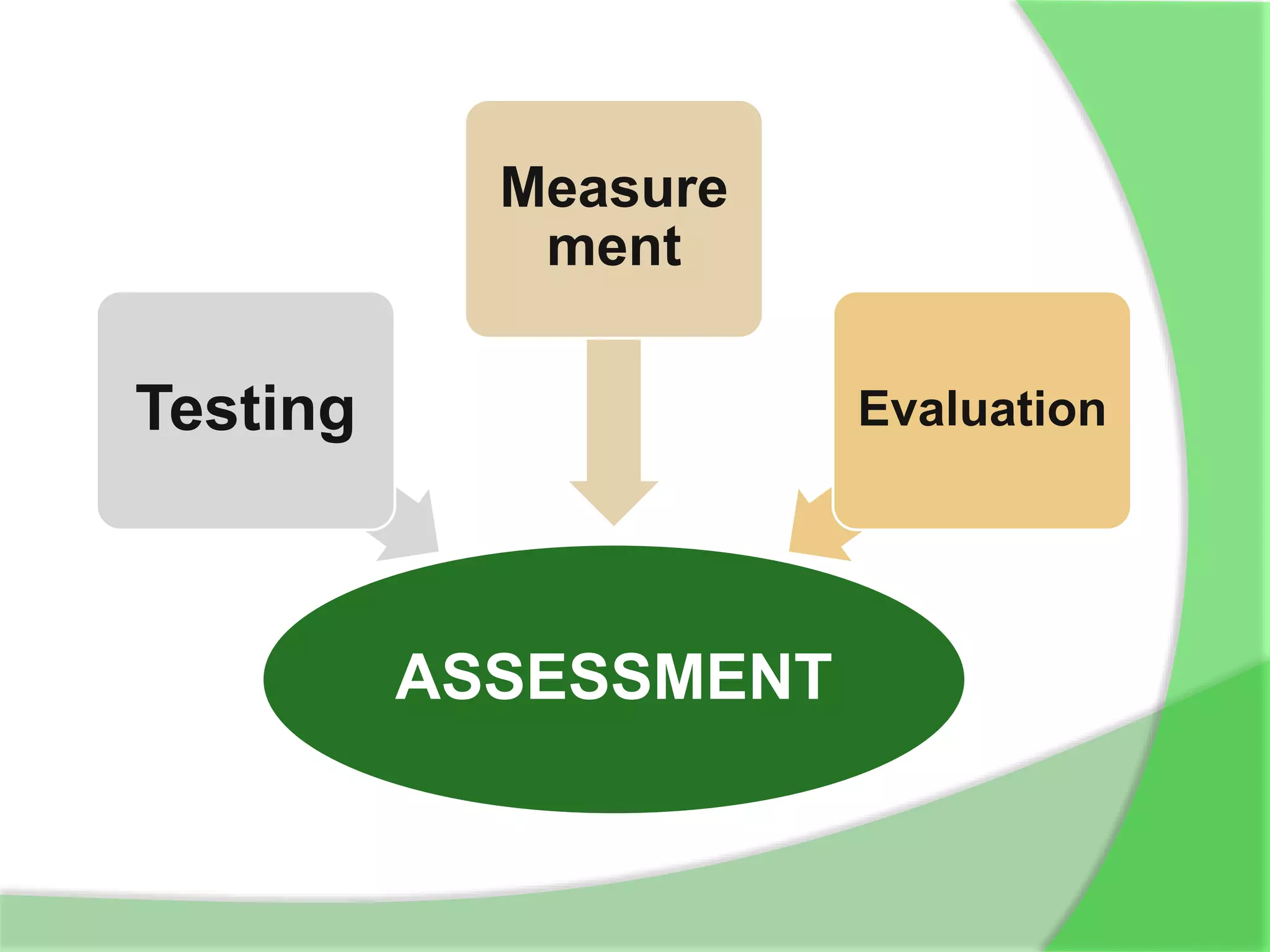
ASSESSMENT
Testing
Measure
ment
Evaluation
B. ASSESSMENT
AND EVALUATION
PRINCIPLES
1. Assessment and evaluation are
essential components of the
teaching-learning process.
2. A variety of assessment and
evaluation techniques should be
used.
B. ASSESSMENT AND
EVALUATION PRINCIPLES
3. Teachers should communicate
assessment and evaluation
strategies and plan in advance,
informing the students of the
objectives and the assessment
procedures relative to the
objectives.
B. ASSESSMENT AND
EVALUATION PRINCIPLES
4. Assessment and evaluation should
be fair and equitable. They should
be free of bias.
5. Assessment and evaluation should
help students.
B. ASSESSMENT AND
EVALUATION PRINCIPLES
6. Assessment and evaluation data and
results should be communicated to
students and parents/ guardians
regularly, in meaningful ways.
7. Assessment and evaluation should
use a variety of techniques and
tools.
B. ASSESSMENT AND
EVALUATION PRINCIPLES
C. PURPOSES
OF
ASSESSMENT
C. PURPOSES OF ASSESSMENT
Black and William define this as “all those
activities undertaken by teachers and/or by
the students, which provide information to be
used as feedback to modify the teaching and
learning activities in which they are
engaged.”
1. ASSESSMENT FOR LEARNING
Focuses on the gap between where
learner is in his/her learning, and where
he/she needs to be – the desired goal.
C. PURPOSES OF ASSESSMENT
They understand clearly
They are given feedback
They are given advice
They are fully involved
Learners learn best when…
C. PURPOSES OF ASSESSMENT
2. ASSESSMENT AS LEARNING -
is about reflecting on evidence of
learning.
Through this, learners become
more aware of:
 What they learn
 How they learn
 What helps them learn
C. PURPOSES OF ASSESSMENT
3. ASSESSMENT OF LEARNING -
involves working with the range of
available evidence that enables staff
and the wider assessment community
to check on students’ progress and
using this information in a number of
ways.
C. PURPOSES OF ASSESSMENT
Judgments about students’ learning need
to be dependable. This means that;
They are valid
They are reliable
They are comparable
Judgments about students’ learning
need to be dependable. This means
that;
 They are valid
 They are reliable
 They are comparable
Judgments about students’ learning need
to be dependable. This means that;
They are valid
They are reliable
They are comparable
D. FUNCTIONS OF
LANGUAGE TESTS
D. FUNCTIONS OF LANGUAGE TESTS
1. IN LEARNING
Tests are used to measure students’
language ability, to discover how much
they have been learning, to diagnose
students’ strengths and weaknesses,
and to motivate students in learning.
D. FUNCTIONS OF LANGUAGE TESTS
2. IN TEACHING
Tests are used as a means to ensure
effective teaching, to improve teaching
quality, to obtain feedback on student
learning place on a course.
D. FUNCTIONS OF LANGUAGE TESTS
3. IN RESEARCH
Language tests have a potentially
important role in virtually all research –
both basic and applied, that is related to
the nature of language proficiency,
language processing, language
acquisition, language attrition, and
language teaching.
Instructor: Dr. Ramlah A. Ampatuan

Module 1 Principles and Purposes of Language Assessment

  • 1.
    PRINCIPLES AND URPOSES OF LANGUAGE ASSESSMENT Preparedby: Sarsona A., Gulmatico, M., Mandigal, M.
  • 2.
    LEARNING OBJECTIVES: At theend of this Module, students should be able to: 1. Explore the different definitions of concepts related to language and literature assessment
  • 3.
    LEARNING OBJECTIVES: 2. Explainthe principles that govern effective assessment and evaluation 3. Discuss the purposes of language testing. 4. Identify the functions of language tests in education.
  • 4.
    LEARNING OBJECTIVES: 5. Acknowledgethe value of assessment in the language learning-teaching process.
  • 5.
    A. KEY CONCEPTS 1.ASSESSMENT – is the act of gathering information on a daily basis in order to understand individual student’s learning and needs.
  • 6.
    “In the contextof language teaching and learning, this refers to the act of collecting information and making judgments about a language learners’ knowledge of a language and ability to use it.” - (Carol Chapelle and Geoff Brindley)- A. KEY CONCEPTS
  • 7.
    2. TESTING –refers to procedures that are based on tests. In learning, it is a salient part of assessment. 3. LANGUAGE TESTING – is “the practice and study of evaluating the proficiency of an individual in using a particular language effectively.” (Priscilla Allen) A. KEY CONCEPTS
  • 8.
    4. MEASUREMENT –more broadly includes testing and other types of measurement, as well as other types of information that result in quantitative data such as attendance, records, questionnaires, teacher ratings of students, etc. A. KEY CONCEPTS
  • 9.
    5. EVALUATION –is the culminating act of interpreting the information gathered for the purpose of making decisions or judgments about students’ learning and needs, often at reporting time. A. KEY CONCEPTS
  • 10.
  • 11.
  • 12.
    1. Assessment andevaluation are essential components of the teaching-learning process. 2. A variety of assessment and evaluation techniques should be used. B. ASSESSMENT AND EVALUATION PRINCIPLES
  • 13.
    3. Teachers shouldcommunicate assessment and evaluation strategies and plan in advance, informing the students of the objectives and the assessment procedures relative to the objectives. B. ASSESSMENT AND EVALUATION PRINCIPLES
  • 14.
    4. Assessment andevaluation should be fair and equitable. They should be free of bias. 5. Assessment and evaluation should help students. B. ASSESSMENT AND EVALUATION PRINCIPLES
  • 15.
    6. Assessment andevaluation data and results should be communicated to students and parents/ guardians regularly, in meaningful ways. 7. Assessment and evaluation should use a variety of techniques and tools. B. ASSESSMENT AND EVALUATION PRINCIPLES
  • 16.
  • 17.
    C. PURPOSES OFASSESSMENT Black and William define this as “all those activities undertaken by teachers and/or by the students, which provide information to be used as feedback to modify the teaching and learning activities in which they are engaged.” 1. ASSESSMENT FOR LEARNING Focuses on the gap between where learner is in his/her learning, and where he/she needs to be – the desired goal.
  • 18.
    C. PURPOSES OFASSESSMENT They understand clearly They are given feedback They are given advice They are fully involved Learners learn best when…
  • 19.
    C. PURPOSES OFASSESSMENT 2. ASSESSMENT AS LEARNING - is about reflecting on evidence of learning. Through this, learners become more aware of:  What they learn  How they learn  What helps them learn
  • 20.
    C. PURPOSES OFASSESSMENT 3. ASSESSMENT OF LEARNING - involves working with the range of available evidence that enables staff and the wider assessment community to check on students’ progress and using this information in a number of ways.
  • 21.
    C. PURPOSES OFASSESSMENT Judgments about students’ learning need to be dependable. This means that; They are valid They are reliable They are comparable Judgments about students’ learning need to be dependable. This means that;  They are valid  They are reliable  They are comparable
  • 22.
    Judgments about students’learning need to be dependable. This means that; They are valid They are reliable They are comparable D. FUNCTIONS OF LANGUAGE TESTS
  • 23.
    D. FUNCTIONS OFLANGUAGE TESTS 1. IN LEARNING Tests are used to measure students’ language ability, to discover how much they have been learning, to diagnose students’ strengths and weaknesses, and to motivate students in learning.
  • 24.
    D. FUNCTIONS OFLANGUAGE TESTS 2. IN TEACHING Tests are used as a means to ensure effective teaching, to improve teaching quality, to obtain feedback on student learning place on a course.
  • 25.
    D. FUNCTIONS OFLANGUAGE TESTS 3. IN RESEARCH Language tests have a potentially important role in virtually all research – both basic and applied, that is related to the nature of language proficiency, language processing, language acquisition, language attrition, and language teaching.
  • 26.