Reading and comprehension II
Course: B.Tech
Subject: English Communication and Life Skills
Unit: 2
What is writing skill?
• Writing is a medium of communication that represents
language through the inscription of signs and symbols.
• In most languages, writing is a complement to speech
or spoken language.
• Writing is not a language but a form of technology.
• Within a language system, writing relies on many of
the same structures as speech, such as vocabulary,
grammar and semantics, with the added dependency
of a system of signs or symbols, usually in the form of a
formal alphabet.
1
Discursive writing
• Paragraph 1: Introduction
First Paragraph should:
• Be a general introduction: don’t include
specific points in the paragraph
• Include a response to the title: You may need
to identify the issues that lie behind the title,
to give historical or topical background
• Be interesting and relavant
2
Paragraph 2
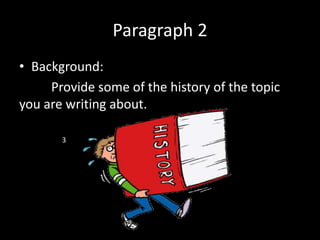
• Background:
Provide some of the history of the topic
you are writing about.
3
Paragraph 2
• Your argument (at least 6/7 reasons, thus 6/7
paragraphs)
• These paragraphs must:
 contain one major point of the argument, stating your
reason for agreeing/disagreeing with question posed.
 begin with or have near its start a topic (or
“signpost”) sentence (a sentence which indicates what
the paragraph will be about and how it relates to the
essay title). This is NOT a sub-heading! Your writing
should be formal continuous prose.
Contin…
be linked to the paragraph that comes
before, often with a suitable conjunction or
link words such as in addition, nevertheless,
despite this, however. Don’t put also or for
example at the start of a sentence.
contain generalised evidence of your
research - e.g. statistics/expert opinion.
2nd last paragraph
• Counter argument
Open with “Contrary to this…” “In contrast
there are those who...” “On the other hand…”
List the opposing side’s reasons but do not
change your opinion. Use phrases like: some
people claim… There are those who say…
Conclusion
• A good conclusion WILL:
 be crisp and conclusive in feel, the goal of the whole
essay
 A good conclusion MAY:
• return to something mentioned in the first paragraph
• evaluate what has gone before
• hint at something you might have followed up had the
scope of the question allowed it
• Give your opinion. A discursive essay should feel as if
you have weighed up the arguments and come to a
conclusion at the end.
Types of writing
• Explorative writing: is where the author intends
to inform, explain, describe or define their
subject to you. This is the most common type of
writing you will find in text books and online.
• Descriptive writing: The writing can be poetic at
times, and explain things in great detail. When
you are reading descriptive writing you feel as if
you are there or can actually picture in your mind
what they are describing.
Contin…
• Narrative writing: is very common in novels,
poetry and biographies. The author puts
themselves in their characters shoes and
writes as if they were that person.
• Persuasive writing: takes on the opinion of
the writer or issue the writer is writing for.
This is considered biased material and is most
often found in advertising:
Contin…
• Formal writing:
can be stiff, humourless, and sometimes with a
little arrogance. It contains lots of articles and
prepositions
• Analytical writing:
is about making distinctions. Analytical writers
tend to do well academically, be more honest, and open
to new experiences.
• Narrative writing:
are storytellers. Narrative writing uses lots of
function words involving people, the past-tense and
inclusive words such as "with" and "together".
Contin…
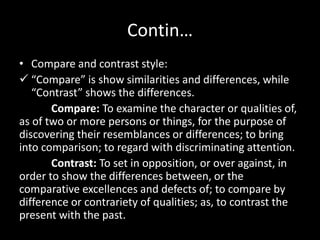
• Compare and contrast style:
 “Compare” is show similarities and differences, while
“Contrast” shows the differences.
Compare: To examine the character or qualities of,
as of two or more persons or things, for the purpose of
discovering their resemblances or differences; to bring
into comparison; to regard with discriminating attention.
Contrast: To set in opposition, or over against, in
order to show the differences between, or the
comparative excellences and defects of; to compare by
difference or contrariety of qualities; as, to contrast the
present with the past.
Contin…
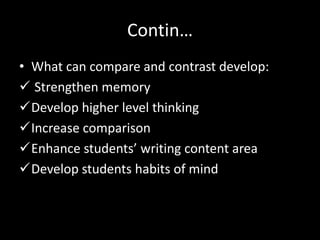
• What can compare and contrast develop:
 Strengthen memory
Develop higher level thinking
Increase comparison
Enhance students’ writing content area
Develop students habits of mind
Contin…
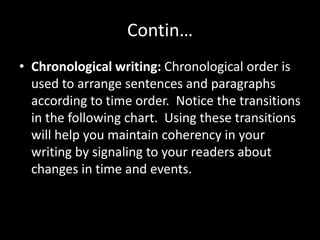
• Chronological writing: Chronological order is
used to arrange sentences and paragraphs
according to time order. Notice the transitions
in the following chart. Using these transitions
will help you maintain coherency in your
writing by signaling to your readers about
changes in time and events.
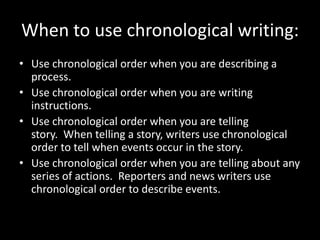
When to use chronological writing:
• Use chronological order when you are describing a
process.
• Use chronological order when you are writing
instructions.
• Use chronological order when you are telling
story. When telling a story, writers use chronological
order to tell when events occur in the story.
• Use chronological order when you are telling about any
series of actions. Reporters and news writers use
chronological order to describe events.
Improving your Reading skills
• Reading for study:
To improve your reading skills you need to:
have clear reading goals;
choose the right texts;
use the right reading style;
use note taking techniques.
Reading goals
• Clear reading goals can significantly increase
your reading efficiency. Everything which is
used is not useful.
Reading goals can be:
an essay or seminar subject;
a report brief;
a selected subject area;
a series of questions about a specific topic.
5
Choosing a text
• You will need to assess the text to see if it
contains information that is relevant to your
reading goals.
Check the date of publication. Is the information
up-to-date?
Read the publisher's blurb at the back or inside
sleeve for an overview of the content.
Check the contents page for relevant chapters.
Look up references for your topic in the index.
If the text does not seem relevant, discard it.
Reading techniques
• Scanning
Scanning is the technique you might use when
reading a telephone directory. You pass your vision
speedily over a section of text in order to find particular
words or phrases that are relevant to your current task.
You can scan:
 the introduction or preface of a text;
 the first or last paragraphs of chapters;
 the concluding or summarising chapter of a text;
 the book index.
Contin…
• Skimming
Skimming is the process of speedy reading for
general meaning. Let your eyes skip over sentences
or phrases which contain detail. Concentrate on
identifying the central or main points.
Use this technique to:
• pre-view a selection of text prior to detailed
reading;
• refresh your understanding of a selection of text
following detailed reading.
Detailed reading and note taking
• underlining and highlighting: to pick out what
seem to you the most central or important
words and phrases. Do this in your own copy
of texts or on photocopies - never on
borrowed texts;
• Keywords: to record the main headings as you
read. Use one or two keywords for each main
point. Keywords can be used when you don't
want to mark the text;
Contin…
• Questions: to encourage you to take an active
approach to your reading. Record your questions
as you read. They can also be used as prompts for
follow up work;
• Summaries: to check you have understood what
you have read. Pause after a section of text and
put what you have read in your own words. Skim
over the text to check the accuracy of your
summary, filling in any significant gaps.
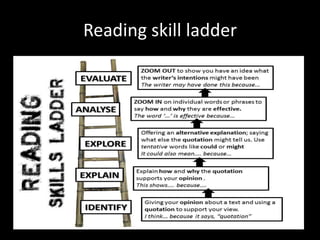
What is reading comprehension?
• Reading comprehension skills separates the
"passive" unskilled reader from the "active"
readers. Skilled readers don't just read, they
interact with the text. To help a beginning
reader understand this concept, you might
make them privy to the dialogue readers have
with themselves while reading.
Reading skill ladder
Recourses/References
• http://www.google.co.in/url?sa=t&rct=j&q=&esrc=s&source=web&cd=4&cad=rja
&uact=8&ved=0CDAQFjAD&url=http%3A%2F%2Fwww.olsp.org.uk%2FWebsites%2
FSchSecOurLadyandSaintPatrick%2527sHighSchool%2FUserFiles%2Ffile%2FEnglish
%2FengDisc.doc&ei=HuukVLK6I5SsuQSwxIL4DQ&usg=AFQjCNGSe6XiUgv7p8zVwH
Agt9WnmHOGmQ
• http://www.teach-nology.com/themes/lang_arts/typesofwriting/
• http://www.kent.ac.uk/careers/sk/written-communication.htm
• https://www.google.co.in/search?q=reading+skills&biw=1093&bih=506&source=l
nms&tbm=isch&sa=X&ei=0AOlVMSdNMm9uATVuYDgAg&ved=0CAYQ_AUoAQ#fac
rc=_&imgdii=_&imgrc=0LDgEt-
HORnXPM%253A%3BMdyzrH6xiAZ1xM%3Bhttp%253A%252F%252Fwww.readingt
utorprogram.com%252Fbooks2.jpg%3Bhttp%253A%252F%252Fwww.readingtutor
program.com%252Fabout-the-program.html%3B279%3B500
• http://www.time4learning.com/readingpyramid/Comprehension.htm
• http://www2.le.ac.uk/offices/ld/resources/study/reading
• http://faculty.mdc.edu/hroland/Trash%20to%20Treasure/ChronoOrder.htm
Contin…
• http://www.ascd.org/publications/books/110126/chapters/Section-1@-Why-
Compare-$-Contrast%C2%A2.aspx
• Image 1,2
https://www.google.co.in/search?q=chronological+writing&biw=1093&bih=506&s
ource=lnms&tbm=isch&sa=X&ei=XySuVM2hGaT_ygP_1IDQDA&ved=0CAYQ_AUoA
Q#tbm=isch&q=writing+clipart&imgdii=_&imgrc=61Ey6qu4MBpDGM%253A%3B5
5CBPYUQexqZpM%3Bhttp%253A%252F%252Fimages.clipartpanda.com%252Fwriti
ng-clip-art-writing-clip-art-
8.jpg%3Bhttp%253A%252F%252Fwww.clipartpanda.com%252Fcategories%252Fw
riting-clip-art-black-and-white%3B327%3B450
• Image
3https://www.google.co.in/search?q=chronological+writing&biw=1093&bih=506&
source=lnms&tbm=isch&sa=X&ei=XySuVM2hGaT_ygP_1IDQDA&ved=0CAYQ_AUo
AQ#tbm=isch&q=history+clipart&revid=521912800&imgdii=_&imgrc=k0KB4TPs7or
OxM%253A%3BBHYalEWXVUMPNM%3Bhttp%253A%252F%252Fimages.clipartpan
da.com%252Fhistorian-clipart-
history.gif%3Bhttp%253A%252F%252Fwww.clipartpanda.com%252Fcategories%25
2Fworld-history-class-clipart%3B302%3B317
Contin…
• Image 4
https://www.google.co.in/search?q=reading+skills&biw=1093&bih=506&s
ource=lnms&tbm=isch&sa=X&ei=0AOlVMSdNMm9uATVuYDgAg&ved=0CA
YQ_AUoAQ#facrc=_&imgdii=_&imgrc=0LDgEt-
HORnXPM%253A%3BMdyzrH6xiAZ1xM%3Bhttp%253A%252F%252Fwww.
readingtutorprogram.com%252Fbooks2.jpg%3Bhttp%253A%252F%252Fw
ww.readingtutorprogram.com%252Fabout-the-
program.html%3B279%3B500
• Image 5
https://www.google.co.in/search?q=chronological+writing&biw=1093&bi
h=506&source=lnms&tbm=isch&sa=X&ei=XySuVM2hGaT_ygP_1IDQDA&v
ed=0CAYQ_AUoAQ#tbm=isch&q=reading+goals&imgdii=_&imgrc=urrR3yS
MMHV-
nM%253A%3Bb_G7Ut9RDuQEFM%3Bhttp%253A%252F%252Fses.clintono
kschools.org%252Fgraphics%252Fimage_wlkewf.jpg%3Bhttp%253A%252F
%252Fses.clintonokschools.org%252Fpage%252F38414_4%3B300%3B279

Writing skill

  • 1.
    Reading and comprehensionII Course: B.Tech Subject: English Communication and Life Skills Unit: 2
  • 2.
    What is writingskill? • Writing is a medium of communication that represents language through the inscription of signs and symbols. • In most languages, writing is a complement to speech or spoken language. • Writing is not a language but a form of technology. • Within a language system, writing relies on many of the same structures as speech, such as vocabulary, grammar and semantics, with the added dependency of a system of signs or symbols, usually in the form of a formal alphabet. 1
  • 3.
    Discursive writing • Paragraph1: Introduction First Paragraph should: • Be a general introduction: don’t include specific points in the paragraph • Include a response to the title: You may need to identify the issues that lie behind the title, to give historical or topical background • Be interesting and relavant 2
  • 4.
    Paragraph 2 • Background: Providesome of the history of the topic you are writing about. 3
  • 5.
    Paragraph 2 • Yourargument (at least 6/7 reasons, thus 6/7 paragraphs) • These paragraphs must:  contain one major point of the argument, stating your reason for agreeing/disagreeing with question posed.  begin with or have near its start a topic (or “signpost”) sentence (a sentence which indicates what the paragraph will be about and how it relates to the essay title). This is NOT a sub-heading! Your writing should be formal continuous prose.
  • 6.
    Contin… be linked tothe paragraph that comes before, often with a suitable conjunction or link words such as in addition, nevertheless, despite this, however. Don’t put also or for example at the start of a sentence. contain generalised evidence of your research - e.g. statistics/expert opinion.
  • 7.
    2nd last paragraph •Counter argument Open with “Contrary to this…” “In contrast there are those who...” “On the other hand…” List the opposing side’s reasons but do not change your opinion. Use phrases like: some people claim… There are those who say…
  • 8.
    Conclusion • A goodconclusion WILL:  be crisp and conclusive in feel, the goal of the whole essay  A good conclusion MAY: • return to something mentioned in the first paragraph • evaluate what has gone before • hint at something you might have followed up had the scope of the question allowed it • Give your opinion. A discursive essay should feel as if you have weighed up the arguments and come to a conclusion at the end.
  • 9.
    Types of writing •Explorative writing: is where the author intends to inform, explain, describe or define their subject to you. This is the most common type of writing you will find in text books and online. • Descriptive writing: The writing can be poetic at times, and explain things in great detail. When you are reading descriptive writing you feel as if you are there or can actually picture in your mind what they are describing.
  • 10.
    Contin… • Narrative writing:is very common in novels, poetry and biographies. The author puts themselves in their characters shoes and writes as if they were that person. • Persuasive writing: takes on the opinion of the writer or issue the writer is writing for. This is considered biased material and is most often found in advertising:
  • 11.
    Contin… • Formal writing: canbe stiff, humourless, and sometimes with a little arrogance. It contains lots of articles and prepositions • Analytical writing: is about making distinctions. Analytical writers tend to do well academically, be more honest, and open to new experiences. • Narrative writing: are storytellers. Narrative writing uses lots of function words involving people, the past-tense and inclusive words such as "with" and "together".
  • 12.
    Contin… • Compare andcontrast style:  “Compare” is show similarities and differences, while “Contrast” shows the differences. Compare: To examine the character or qualities of, as of two or more persons or things, for the purpose of discovering their resemblances or differences; to bring into comparison; to regard with discriminating attention. Contrast: To set in opposition, or over against, in order to show the differences between, or the comparative excellences and defects of; to compare by difference or contrariety of qualities; as, to contrast the present with the past.
  • 13.
    Contin… • What cancompare and contrast develop:  Strengthen memory Develop higher level thinking Increase comparison Enhance students’ writing content area Develop students habits of mind
  • 14.
    Contin… • Chronological writing:Chronological order is used to arrange sentences and paragraphs according to time order. Notice the transitions in the following chart. Using these transitions will help you maintain coherency in your writing by signaling to your readers about changes in time and events.
  • 15.
    When to usechronological writing: • Use chronological order when you are describing a process. • Use chronological order when you are writing instructions. • Use chronological order when you are telling story. When telling a story, writers use chronological order to tell when events occur in the story. • Use chronological order when you are telling about any series of actions. Reporters and news writers use chronological order to describe events.
  • 16.
    Improving your Readingskills • Reading for study: To improve your reading skills you need to: have clear reading goals; choose the right texts; use the right reading style; use note taking techniques.
  • 17.
    Reading goals • Clearreading goals can significantly increase your reading efficiency. Everything which is used is not useful. Reading goals can be: an essay or seminar subject; a report brief; a selected subject area; a series of questions about a specific topic. 5
  • 18.
    Choosing a text •You will need to assess the text to see if it contains information that is relevant to your reading goals. Check the date of publication. Is the information up-to-date? Read the publisher's blurb at the back or inside sleeve for an overview of the content. Check the contents page for relevant chapters. Look up references for your topic in the index. If the text does not seem relevant, discard it.
  • 19.
    Reading techniques • Scanning Scanningis the technique you might use when reading a telephone directory. You pass your vision speedily over a section of text in order to find particular words or phrases that are relevant to your current task. You can scan:  the introduction or preface of a text;  the first or last paragraphs of chapters;  the concluding or summarising chapter of a text;  the book index.
  • 20.
    Contin… • Skimming Skimming isthe process of speedy reading for general meaning. Let your eyes skip over sentences or phrases which contain detail. Concentrate on identifying the central or main points. Use this technique to: • pre-view a selection of text prior to detailed reading; • refresh your understanding of a selection of text following detailed reading.
  • 21.
    Detailed reading andnote taking • underlining and highlighting: to pick out what seem to you the most central or important words and phrases. Do this in your own copy of texts or on photocopies - never on borrowed texts; • Keywords: to record the main headings as you read. Use one or two keywords for each main point. Keywords can be used when you don't want to mark the text;
  • 22.
    Contin… • Questions: toencourage you to take an active approach to your reading. Record your questions as you read. They can also be used as prompts for follow up work; • Summaries: to check you have understood what you have read. Pause after a section of text and put what you have read in your own words. Skim over the text to check the accuracy of your summary, filling in any significant gaps.
  • 23.
    What is readingcomprehension? • Reading comprehension skills separates the "passive" unskilled reader from the "active" readers. Skilled readers don't just read, they interact with the text. To help a beginning reader understand this concept, you might make them privy to the dialogue readers have with themselves while reading.
  • 24.
  • 25.
    Recourses/References • http://www.google.co.in/url?sa=t&rct=j&q=&esrc=s&source=web&cd=4&cad=rja &uact=8&ved=0CDAQFjAD&url=http%3A%2F%2Fwww.olsp.org.uk%2FWebsites%2 FSchSecOurLadyandSaintPatrick%2527sHighSchool%2FUserFiles%2Ffile%2FEnglish %2FengDisc.doc&ei=HuukVLK6I5SsuQSwxIL4DQ&usg=AFQjCNGSe6XiUgv7p8zVwH Agt9WnmHOGmQ • http://www.teach-nology.com/themes/lang_arts/typesofwriting/ •http://www.kent.ac.uk/careers/sk/written-communication.htm • https://www.google.co.in/search?q=reading+skills&biw=1093&bih=506&source=l nms&tbm=isch&sa=X&ei=0AOlVMSdNMm9uATVuYDgAg&ved=0CAYQ_AUoAQ#fac rc=_&imgdii=_&imgrc=0LDgEt- HORnXPM%253A%3BMdyzrH6xiAZ1xM%3Bhttp%253A%252F%252Fwww.readingt utorprogram.com%252Fbooks2.jpg%3Bhttp%253A%252F%252Fwww.readingtutor program.com%252Fabout-the-program.html%3B279%3B500 • http://www.time4learning.com/readingpyramid/Comprehension.htm • http://www2.le.ac.uk/offices/ld/resources/study/reading • http://faculty.mdc.edu/hroland/Trash%20to%20Treasure/ChronoOrder.htm
  • 26.
    Contin… • http://www.ascd.org/publications/books/110126/chapters/Section-1@-Why- Compare-$-Contrast%C2%A2.aspx • Image1,2 https://www.google.co.in/search?q=chronological+writing&biw=1093&bih=506&s ource=lnms&tbm=isch&sa=X&ei=XySuVM2hGaT_ygP_1IDQDA&ved=0CAYQ_AUoA Q#tbm=isch&q=writing+clipart&imgdii=_&imgrc=61Ey6qu4MBpDGM%253A%3B5 5CBPYUQexqZpM%3Bhttp%253A%252F%252Fimages.clipartpanda.com%252Fwriti ng-clip-art-writing-clip-art- 8.jpg%3Bhttp%253A%252F%252Fwww.clipartpanda.com%252Fcategories%252Fw riting-clip-art-black-and-white%3B327%3B450 • Image 3https://www.google.co.in/search?q=chronological+writing&biw=1093&bih=506& source=lnms&tbm=isch&sa=X&ei=XySuVM2hGaT_ygP_1IDQDA&ved=0CAYQ_AUo AQ#tbm=isch&q=history+clipart&revid=521912800&imgdii=_&imgrc=k0KB4TPs7or OxM%253A%3BBHYalEWXVUMPNM%3Bhttp%253A%252F%252Fimages.clipartpan da.com%252Fhistorian-clipart- history.gif%3Bhttp%253A%252F%252Fwww.clipartpanda.com%252Fcategories%25 2Fworld-history-class-clipart%3B302%3B317
  • 27.
    Contin… • Image 4 https://www.google.co.in/search?q=reading+skills&biw=1093&bih=506&s ource=lnms&tbm=isch&sa=X&ei=0AOlVMSdNMm9uATVuYDgAg&ved=0CA YQ_AUoAQ#facrc=_&imgdii=_&imgrc=0LDgEt- HORnXPM%253A%3BMdyzrH6xiAZ1xM%3Bhttp%253A%252F%252Fwww. readingtutorprogram.com%252Fbooks2.jpg%3Bhttp%253A%252F%252Fw ww.readingtutorprogram.com%252Fabout-the- program.html%3B279%3B500 •Image 5 https://www.google.co.in/search?q=chronological+writing&biw=1093&bi h=506&source=lnms&tbm=isch&sa=X&ei=XySuVM2hGaT_ygP_1IDQDA&v ed=0CAYQ_AUoAQ#tbm=isch&q=reading+goals&imgdii=_&imgrc=urrR3yS MMHV- nM%253A%3Bb_G7Ut9RDuQEFM%3Bhttp%253A%252F%252Fses.clintono kschools.org%252Fgraphics%252Fimage_wlkewf.jpg%3Bhttp%253A%252F %252Fses.clintonokschools.org%252Fpage%252F38414_4%3B300%3B279