



Mr. Negrete
October 2011
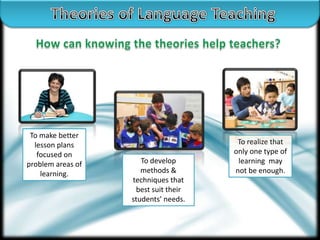
To make better
lesson plans
focused on
problem areas of
learning.

To develop
methods &
techniques that
best suit their
students’ needs.

To realize that
only one type of
learning may
not be enough.
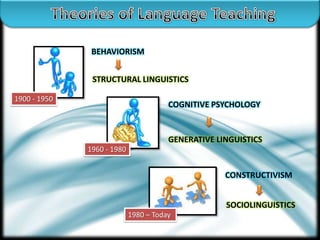
BEHAVIORISM
STRUCTURAL LINGUISTICS
1900 - 1950

COGNITIVE PSYCHOLOGY

GENERATIVE LINGUISTICS
1960 - 1980

CONSTRUCTIVISM
SOCIOLINGUISTICS
1980 – Today
The language system is formed by sounds, words and
sentences; learned through practice & repetition.
1900 - 1950

Teacher produces the stimuli and SS the response.

 Students learn to use correct forms & vocabulary through reinforcement.
 Teachers give positive feedback and respond negatively to incorrect forms.
 Grammar is not taught explicitly.
 Correct grammar is reinforced through teacher execution.
Favors activities such as;
Drills
Pattern Practice
Language is viewed as systematic and not simply learned
through habit-forming procedures.

1960 - 1980

Teachers give detailed explanations of grammar &
structure because they believe it helps learning.

The learning process involves:
 perception
 motivation
 experience

This approach favors these
learning tools:
 Logic
 Reason
 Exploration
 Inference

SS engage in meaningful practice of the grammar & structure taught by the teacher.
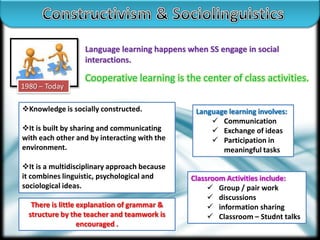
Language learning happens when SS engage in social
interactions.
1980 – Today

Cooperative learning is the center of class activities.

Knowledge is socially constructed.
It is built by sharing and communicating
with each other and by interacting with the
environment.
It is a multidisciplinary approach because
it combines linguistic, psychological and
sociological ideas.
There is little explanation of grammar &
structure by the teacher and teamwork is
encouraged .

Language learning involves:
 Communication
 Exchange of ideas
 Participation in
meaningful tasks

Classroom Activities include:
 Group / pair work
 discussions
 information sharing
 Classroom – Studnt talks
Language learning happens when SS engage in social
interactions.
1980 – Today

Cooperative learning is the center of class activities.

Knowledge is socially constructed.
It is built by sharing and communicating
with each other and by interacting with the
environment.
It is a multidisciplinary approach because
it combines linguistic, psychological and
sociological ideas.
There is little explanation of grammar &
structure by the teacher and teamwork is
encouraged .

Language learning involves:
 Communication
 Exchange of ideas
 Participation in
meaningful tasks

Classroom Activities include:
 Group / pair work
 discussions
 information sharing
 Classroom – Studnt talks

ELT Theories (Basic Introduction)

  • 1.
  • 2.
    To make better lessonplans focused on problem areas of learning. To develop methods & techniques that best suit their students’ needs. To realize that only one type of learning may not be enough.
  • 3.
    BEHAVIORISM STRUCTURAL LINGUISTICS 1900 -1950 COGNITIVE PSYCHOLOGY GENERATIVE LINGUISTICS 1960 - 1980 CONSTRUCTIVISM SOCIOLINGUISTICS 1980 – Today
  • 4.
    The language systemis formed by sounds, words and sentences; learned through practice & repetition. 1900 - 1950 Teacher produces the stimuli and SS the response.  Students learn to use correct forms & vocabulary through reinforcement.  Teachers give positive feedback and respond negatively to incorrect forms.  Grammar is not taught explicitly.  Correct grammar is reinforced through teacher execution. Favors activities such as; Drills Pattern Practice
  • 5.
    Language is viewedas systematic and not simply learned through habit-forming procedures. 1960 - 1980 Teachers give detailed explanations of grammar & structure because they believe it helps learning. The learning process involves:  perception  motivation  experience This approach favors these learning tools:  Logic  Reason  Exploration  Inference SS engage in meaningful practice of the grammar & structure taught by the teacher.
  • 6.
    Language learning happenswhen SS engage in social interactions. 1980 – Today Cooperative learning is the center of class activities. Knowledge is socially constructed. It is built by sharing and communicating with each other and by interacting with the environment. It is a multidisciplinary approach because it combines linguistic, psychological and sociological ideas. There is little explanation of grammar & structure by the teacher and teamwork is encouraged . Language learning involves:  Communication  Exchange of ideas  Participation in meaningful tasks Classroom Activities include:  Group / pair work  discussions  information sharing  Classroom – Studnt talks
  • 7.
    Language learning happenswhen SS engage in social interactions. 1980 – Today Cooperative learning is the center of class activities. Knowledge is socially constructed. It is built by sharing and communicating with each other and by interacting with the environment. It is a multidisciplinary approach because it combines linguistic, psychological and sociological ideas. There is little explanation of grammar & structure by the teacher and teamwork is encouraged . Language learning involves:  Communication  Exchange of ideas  Participation in meaningful tasks Classroom Activities include:  Group / pair work  discussions  information sharing  Classroom – Studnt talks