From Unity to Diversity
Twenty-five Years of Language-
Teaching Methodology
by Diane Larsen-Freeman
Presented by: Alissa Deitterick
• Methodological Developments
• The past 25 years!
• Triangle (Language Learning/Language
Learner, Language/Culture, Language
Teaching/Teacher)
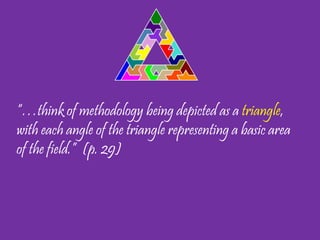
“…think of methodology being depicted
as a triangle, with each angle of the
triangle representing a basic area of the
field.” (p. 29)
Language Learning/Language Learner
• 1962: Learning is reached by habit formation and avoiding errors.
Examples are: repetition, drills, positive reinforcement. ALM (Audio-lingual
Method)
• Naom Chomsky
Opposed this view. Example = Children
Overgeneralization  Children attempt to use rules for past tense. (“maked”
“eated”)
They form a hypotheses based on language, test it, and revise it. Same for
ESL.
• Larry Selinker
Interlanguage: “intermediate between native language and target language”
- considered a type of language
- same constraints as any other language with grammatical rules
Language Learning/Language Learner
• Differential Success Questions
• Many factors affect ESL.
• Richard Schmidt
- imitation
- Learners memorize phrases/sentences.
• Hatch
- Nonlinguistical processes are important too.
- Native-speaker/nonnative-speaker contact includes adjustments,
which promote communication.
Language/Culture
• Syllabus (focus on linguistic structures: simple to complex)
• Hymes
Explained difference between linguistic competence and communicative competence.
• Wilkins
Notional-Functional Syllabus: a course around use of language.
• Krashen and Terrell
Base course on topics and situations.
• 3 dimensions of language: form, function, meaning
• Procedural Syllabus: language is not the basis
• Competency Bases Syllabus: teach survival skills to immigrants
• ESP (English for Special Purposes) = teaching based on the situation of students
• Content Based (bilingual education)
Language/Culture
• Content-Based Approaches
1. Bilingual Education/Immersion Education (monolingual students taught by
target language)
2. Sheltered English (students during transitional period until sufficient English)
3. Writing Across the Curriculum (writing assignments in each subject)
Culture
• “…knowing a culture involves so much more than the transmission of
information these cultural notes allow.” (p. 32)
• “…one can be bilingual without being bicultural.” (p.32)
Language Teaching/Teacher
“…it is rare that one of these methods is practiced exclusively. “ (p. 34)
• Silent Way (Cognitive Code) – Caleb Gattegno’s (1972) : independent,
gradual learning
• Suggestopedi - Georgi Lozanov (1978): positive environment created by teacher
• Community Learning - Charles Curran (1976) : create community and less fear
• Comprehension Approach – students listen to speaker
• Communicative Approach – social experience
• Principles Eclecticism - combination
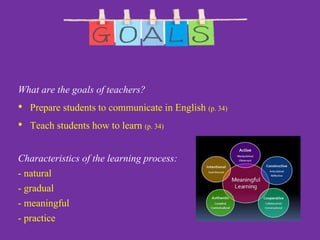
What are the goals of teachers?
• Prepare students to communicate in English (p. 34)
• Teach students how to learn (p. 34)
Characteristics of the learning process:
- natural
- gradual
- meaningful
- practice
So, what do we know now?
“…just because students can speak and hear does not mean that they
know how to communicate orally or listen effectively.” ( p. 35)
• Reading: Schemata – readers develop meaning with background knowledge and
connection
• Writing: This is a recursive process (NOT a linear process)
• Assessment: This should be informal, continual basis (a change in standardized
tests)
Modern methodology is Learner-Centered (humanistic)
Remember…
“Only those who are intimately acquainted
with the situation, with the students, and
with themselves can make the choices they
are uniquely suited to make. It is, after all,
only the teachers who will be there assess
the outcome of the choices they make. It is
only the teachers who are there to make
sure that they know why they are doing
what they are doing.” (p. 37)
My questions for you:
• Question 1) We have had many developments
for language-teaching methodology within the
last 25 years. Which do you find to be the most
significant contributor to modern-day use and
why? Use specifics from the article.
• Question 2) What language-teaching
methodology can you most relate to within your
own classroom and why? Use specifics from the
article.
Language-Teaching Methodoloy

Language-Teaching Methodoloy

  • 1.
    From Unity toDiversity Twenty-five Years of Language- Teaching Methodology by Diane Larsen-Freeman Presented by: Alissa Deitterick
  • 2.
    • Methodological Developments •The past 25 years! • Triangle (Language Learning/Language Learner, Language/Culture, Language Teaching/Teacher)
  • 3.
    “…think of methodologybeing depicted as a triangle, with each angle of the triangle representing a basic area of the field.” (p. 29)
  • 4.
    Language Learning/Language Learner •1962: Learning is reached by habit formation and avoiding errors. Examples are: repetition, drills, positive reinforcement. ALM (Audio-lingual Method) • Naom Chomsky Opposed this view. Example = Children Overgeneralization  Children attempt to use rules for past tense. (“maked” “eated”) They form a hypotheses based on language, test it, and revise it. Same for ESL. • Larry Selinker Interlanguage: “intermediate between native language and target language” - considered a type of language - same constraints as any other language with grammatical rules
  • 5.
    Language Learning/Language Learner •Differential Success Questions • Many factors affect ESL. • Richard Schmidt - imitation - Learners memorize phrases/sentences. • Hatch - Nonlinguistical processes are important too. - Native-speaker/nonnative-speaker contact includes adjustments, which promote communication.
  • 6.
    Language/Culture • Syllabus (focuson linguistic structures: simple to complex) • Hymes Explained difference between linguistic competence and communicative competence. • Wilkins Notional-Functional Syllabus: a course around use of language. • Krashen and Terrell Base course on topics and situations. • 3 dimensions of language: form, function, meaning • Procedural Syllabus: language is not the basis • Competency Bases Syllabus: teach survival skills to immigrants • ESP (English for Special Purposes) = teaching based on the situation of students • Content Based (bilingual education)
  • 7.
    Language/Culture • Content-Based Approaches 1.Bilingual Education/Immersion Education (monolingual students taught by target language) 2. Sheltered English (students during transitional period until sufficient English) 3. Writing Across the Curriculum (writing assignments in each subject) Culture • “…knowing a culture involves so much more than the transmission of information these cultural notes allow.” (p. 32) • “…one can be bilingual without being bicultural.” (p.32)
  • 8.
    Language Teaching/Teacher “…it israre that one of these methods is practiced exclusively. “ (p. 34) • Silent Way (Cognitive Code) – Caleb Gattegno’s (1972) : independent, gradual learning • Suggestopedi - Georgi Lozanov (1978): positive environment created by teacher • Community Learning - Charles Curran (1976) : create community and less fear • Comprehension Approach – students listen to speaker • Communicative Approach – social experience • Principles Eclecticism - combination
  • 9.
    What are thegoals of teachers? • Prepare students to communicate in English (p. 34) • Teach students how to learn (p. 34) Characteristics of the learning process: - natural - gradual - meaningful - practice
  • 10.
    So, what dowe know now? “…just because students can speak and hear does not mean that they know how to communicate orally or listen effectively.” ( p. 35) • Reading: Schemata – readers develop meaning with background knowledge and connection • Writing: This is a recursive process (NOT a linear process) • Assessment: This should be informal, continual basis (a change in standardized tests) Modern methodology is Learner-Centered (humanistic)
  • 11.
    Remember… “Only those whoare intimately acquainted with the situation, with the students, and with themselves can make the choices they are uniquely suited to make. It is, after all, only the teachers who will be there assess the outcome of the choices they make. It is only the teachers who are there to make sure that they know why they are doing what they are doing.” (p. 37)
  • 12.
    My questions foryou: • Question 1) We have had many developments for language-teaching methodology within the last 25 years. Which do you find to be the most significant contributor to modern-day use and why? Use specifics from the article. • Question 2) What language-teaching methodology can you most relate to within your own classroom and why? Use specifics from the article.