Electroplating to makeElectroplating to make
nanostructuresnanostructures
Electroplating
- The chemical conversion of ions in solution into a solid deposit
of metal atoms with the work of a electrical power supply
Cu2+
Cu2+
Cu2+
Cu solid
Cu ions in solution
2e-
Cu2+
+ 2e-
–> Cu(0)
Mz+
+ ze-
–> M(0)
Electroplating Cell
V
I
Cu2+
+ 2e-
–> Cu(0)
"reduction"
CuSO4 dissolved in water
Cu(0)
–> Cu2+
+ 2e-
"oxidation"
anodecathode
If using an inert Pt
electrode:
2 H2O –>
O2 + 4H+
+ 4e-
Working
Electrode
(WE)
Counter
Electrode
(CE)
Amount of Deposition
The number of atoms deposited is
proportional to the number of electrons
passed through the circuit
- We can determine this by measuring
the current
I =
dq
dt
Q = I dt
0
t
∫ = It
If I is constant
# electrons = Q/e = It/e where e = 1.6 x 10⁻¹⁹
C
# atoms = # electrons/z = It/ez
# moles of atoms = # atoms/NA = It/ezNA
eNA = (1.6 x 10⁻¹⁹
C)(6.02 x 10²³
) = 96,500 C = F = "1 Faraday"
# moles of atoms = It/Fz
Cu2+
2e-
ammeter
I
Amount of Deposition (cont.)
# moles of atoms = It/Fz
m = mass = (It/Fz)(gram atomic weight)
t = film thickness = (mass)/(density • area) = m/(ρA)
e.g., AWCu = 63.55 g/mole
Cu2+
2e-
ammeter
I
Note that these equations assume 100% current efficiency
(CE) - that is, assuming that all of the electrons are used for
converting metal ions. However, another reduction reaction
may compete for electrons making the CE less than 100%.
For example, 2H+
+ 2e-
–> H2 . CE must be determined by
an independent measurement.
Why choose electroplating toWhy choose electroplating to
make nanostructures??make nanostructures??
The process is easy to operate and only needs
simple equipment.
It’s simple to control the deposition rate by
controlling the voltage or current.
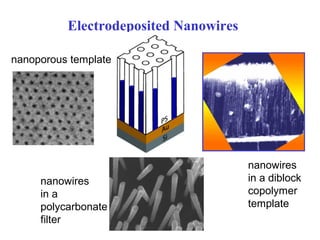
It’s a good way to make Nanowires in a porousIt’s a good way to make Nanowires in a porous
template.template.
Electrodeposited Nanowires
nanoporous template
nanowires
in a
polycarbonate
filter
nanowires
in a diblock
copolymer
template
Application
Data storage elementsData storage elements
1 0 0 1 1
If the nanowires are magnetic,
they can be used to store data
(arrow indicates the direction of magnetization)

Electroplating

  • 1.
    Electroplating to makeElectroplatingto make nanostructuresnanostructures
  • 2.
    Electroplating - The chemicalconversion of ions in solution into a solid deposit of metal atoms with the work of a electrical power supply Cu2+ Cu2+ Cu2+ Cu solid Cu ions in solution 2e- Cu2+ + 2e- –> Cu(0) Mz+ + ze- –> M(0)
  • 3.
    Electroplating Cell V I Cu2+ + 2e- –>Cu(0) "reduction" CuSO4 dissolved in water Cu(0) –> Cu2+ + 2e- "oxidation" anodecathode If using an inert Pt electrode: 2 H2O –> O2 + 4H+ + 4e- Working Electrode (WE) Counter Electrode (CE)
  • 4.
    Amount of Deposition Thenumber of atoms deposited is proportional to the number of electrons passed through the circuit - We can determine this by measuring the current I = dq dt Q = I dt 0 t ∫ = It If I is constant # electrons = Q/e = It/e where e = 1.6 x 10⁻¹⁹ C # atoms = # electrons/z = It/ez # moles of atoms = # atoms/NA = It/ezNA eNA = (1.6 x 10⁻¹⁹ C)(6.02 x 10²³ ) = 96,500 C = F = "1 Faraday" # moles of atoms = It/Fz Cu2+ 2e- ammeter I
  • 5.
    Amount of Deposition(cont.) # moles of atoms = It/Fz m = mass = (It/Fz)(gram atomic weight) t = film thickness = (mass)/(density • area) = m/(ρA) e.g., AWCu = 63.55 g/mole Cu2+ 2e- ammeter I Note that these equations assume 100% current efficiency (CE) - that is, assuming that all of the electrons are used for converting metal ions. However, another reduction reaction may compete for electrons making the CE less than 100%. For example, 2H+ + 2e- –> H2 . CE must be determined by an independent measurement.
  • 6.
    Why choose electroplatingtoWhy choose electroplating to make nanostructures??make nanostructures?? The process is easy to operate and only needs simple equipment. It’s simple to control the deposition rate by controlling the voltage or current. It’s a good way to make Nanowires in a porousIt’s a good way to make Nanowires in a porous template.template.
  • 7.
    Electrodeposited Nanowires nanoporous template nanowires ina polycarbonate filter nanowires in a diblock copolymer template
  • 8.
    Application Data storage elementsDatastorage elements 1 0 0 1 1 If the nanowires are magnetic, they can be used to store data (arrow indicates the direction of magnetization)

Editor's Notes

  • #8 Pulse reverse electrodeposition results in improved microcrystalline structure and improved magnetic properties (larger perpendicula magnetocrystalline anisotropy)