Electro Magnetic Theory
“Electric Field & its Applications”
Submitted By,
Team : 21
Rajvi Trivedi (131039)
Shailaja Sampat (131046)
E
E
E
E
E
E
E
E
E
E
Electric Field in daily life
Lightening Party trick - “Magic Balloons”
Small sparks in blanket at night Pieces of paper attracted by comb
What is Electric Field (E) ?
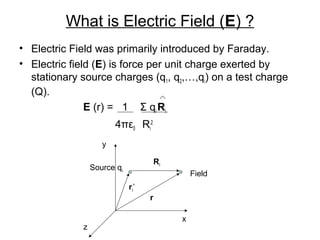
• Electric Field was primarily introduced by Faraday.
• Electric field (E) is force per unit charge exerted by
stationary source charges (q1, q2,…,qi) on a test charge
(Q).
E (r) = 1 Σ qi Ri
4πε0 Ri
2
ri’
r
Source qi
Field
Ri
x
y
z
Direction of an Electric Field
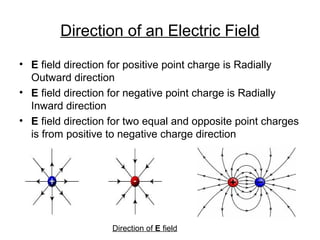
• E field direction for positive point charge is Radially
Outward direction
• E field direction for negative point charge is Radially
Inward direction
• E field direction for two equal and opposite point charges
is from positive to negative charge direction
Direction of E field
Properties of an Electric Field
• Vector Quantity
• SI Unit : N/C, V/m
• ΦE = ∫ • E d‫ז‬ = ∫ E • da = 1 ∫ ρ • d‫ז‬ = Q encl
(ΦE = flux, da = area element, d‫ז‬ = volume element, ρ = volume
charge density, Qencl = charge enclosed )
• x E = 0
• • E = ρ
ε0
∆
‫ע‬ ‫ע‬s
ε0 ε0
∆
∆
Electric Field and Electric Potential
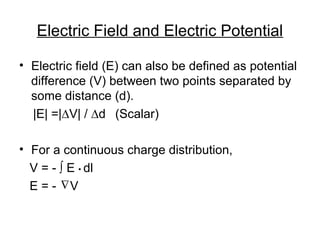
• Electric field (E) can also be defined as potential
difference (V) between two points separated by
some distance (d).
|E| =|∆V| / ∆d (Scalar)
• For a continuous charge distribution,
V = - ∫ E • dl
E = - V
∆
Experiment for relation between E and V
q
q
q
q ө’
q
q ө’’
ө
q
ө = 0
V V
V’
V
V’’’
V
V’’
V
∆V1
∆V2
∆V3
∆V=0
a0=0 a1 > a0
a2 > a1 > a0 a3 > a2 > a1 > a0
Experiment for relation between E and V
• Consider a slope as the potential field and a ball as a
charged particle. Due to difference of height between
two end points of a slanting surface, there exists a
potential difference between two points. If we put a ball
on one side of the hill, it will roll downwards from a
higher to lower potential.
• As the surface became steeper or the greater the
change in potential over a certain displacement, the ball
(charge) will accelerate faster. This change in electric
potential over a certain displacement s is called electric
field.
What can strong electric field do…..
Electric field produced by potential difference 5kV between plates
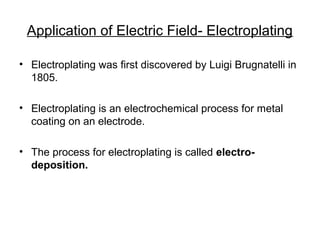
Application of Electric Field- Electroplating
• Electroplating was first discovered by Luigi Brugnatelli in
1805.
• Electroplating is an electrochemical process for metal
coating on an electrode.
• The process for electroplating is called electro-
deposition.
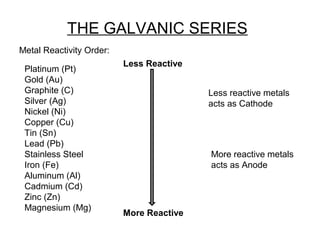
THE GALVANIC SERIES
Metal Reactivity Order:
Platinum (Pt)
Gold (Au)
Graphite (C)
Silver (Ag)
Nickel (Ni)
Copper (Cu)
Tin (Sn)
Lead (Pb)
Stainless Steel
Iron (Fe)
Aluminum (Al)
Cadmium (Cd)
Zinc (Zn)
Magnesium (Mg)
Less Reactive
More Reactive
Less reactive metals
acts as Cathode
More reactive metals
acts as Anode
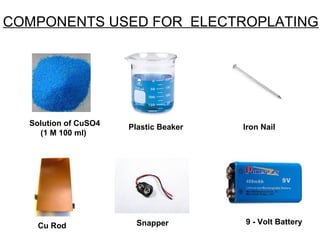
COMPONENTS USED FOR ELECTROPLATING
Snapper
Solution of CuSO4
(1 M 100 ml)
Cu Rod
Iron Nail
9 - Volt Battery
Plastic Beaker
How Electro-deposition works?
• Cathode: The Metal to be plated by another metal
• Anode: The metal to be plated on Cathode
• Electrolyte: Conducting solution containing metal ions in
which Anode and Cathode are placed.
• Power source: Supplies a direct current to the anode and
oxidizes the metal atoms which dissolve in the solution.
Cathode: Mz+(aq) + ze- →M(s)
Anode: M(s) → Mz+(aq) + ze-
Copper plating on Metal
• If we want copper to be plated, fill
electrolytic bath with Copper Sulfate
(CuSO4) (a salt of copper) mixed
with water. Cu plate acts as anode
and Metal on which we want to plate
copper acts as cathode.
• Copper is oxidized at the anode to
Cu2+
by losing two electrons. At the
cathode, the Cu2+
is reduced to
metallic copper by gaining two
electrons. The result is the effective
transfer of copper from the anode to
a plate covering the cathode.
Uses of Electroplating
Electroplating is widely used in
industries such as - automobile,
airplanes, electronics, jewelry,
toys etc.
The other uses include;
• To give metal objects a better
appearance and attraction such
as jewelry, trophies and medals
are coated with Gold, Silver,
Brass and Rhodium.
• To protect metal objects from
corrosion or rust e.g. iron plates
used in ships which remains in
contact with sea-water are plated
with Zinc to prevent corrosion.
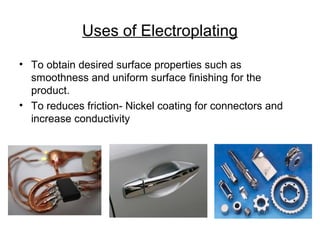
Uses of Electroplating
• To obtain desired surface properties such as
smoothness and uniform surface finishing for the
product.
• To reduces friction- Nickel coating for connectors and
increase conductivity

Electric field and Electroplating

  • 1.
    Electro Magnetic Theory “ElectricField & its Applications” Submitted By, Team : 21 Rajvi Trivedi (131039) Shailaja Sampat (131046) E E E E E E E E E E
  • 2.
    Electric Field indaily life Lightening Party trick - “Magic Balloons” Small sparks in blanket at night Pieces of paper attracted by comb
  • 3.
    What is ElectricField (E) ? • Electric Field was primarily introduced by Faraday. • Electric field (E) is force per unit charge exerted by stationary source charges (q1, q2,…,qi) on a test charge (Q). E (r) = 1 Σ qi Ri 4πε0 Ri 2 ri’ r Source qi Field Ri x y z
  • 4.
    Direction of anElectric Field • E field direction for positive point charge is Radially Outward direction • E field direction for negative point charge is Radially Inward direction • E field direction for two equal and opposite point charges is from positive to negative charge direction Direction of E field
  • 5.
    Properties of anElectric Field • Vector Quantity • SI Unit : N/C, V/m • ΦE = ∫ • E d‫ז‬ = ∫ E • da = 1 ∫ ρ • d‫ז‬ = Q encl (ΦE = flux, da = area element, d‫ז‬ = volume element, ρ = volume charge density, Qencl = charge enclosed ) • x E = 0 • • E = ρ ε0 ∆ ‫ע‬ ‫ע‬s ε0 ε0 ∆ ∆
  • 6.
    Electric Field andElectric Potential • Electric field (E) can also be defined as potential difference (V) between two points separated by some distance (d). |E| =|∆V| / ∆d (Scalar) • For a continuous charge distribution, V = - ∫ E • dl E = - V ∆
  • 7.
    Experiment for relationbetween E and V q q q q ө’ q q ө’’ ө q ө = 0 V V V’ V V’’’ V V’’ V ∆V1 ∆V2 ∆V3 ∆V=0 a0=0 a1 > a0 a2 > a1 > a0 a3 > a2 > a1 > a0
  • 8.
    Experiment for relationbetween E and V • Consider a slope as the potential field and a ball as a charged particle. Due to difference of height between two end points of a slanting surface, there exists a potential difference between two points. If we put a ball on one side of the hill, it will roll downwards from a higher to lower potential. • As the surface became steeper or the greater the change in potential over a certain displacement, the ball (charge) will accelerate faster. This change in electric potential over a certain displacement s is called electric field.
  • 9.
    What can strongelectric field do….. Electric field produced by potential difference 5kV between plates
  • 10.
    Application of ElectricField- Electroplating • Electroplating was first discovered by Luigi Brugnatelli in 1805. • Electroplating is an electrochemical process for metal coating on an electrode. • The process for electroplating is called electro- deposition.
  • 11.
    THE GALVANIC SERIES MetalReactivity Order: Platinum (Pt) Gold (Au) Graphite (C) Silver (Ag) Nickel (Ni) Copper (Cu) Tin (Sn) Lead (Pb) Stainless Steel Iron (Fe) Aluminum (Al) Cadmium (Cd) Zinc (Zn) Magnesium (Mg) Less Reactive More Reactive Less reactive metals acts as Cathode More reactive metals acts as Anode
  • 12.
    COMPONENTS USED FORELECTROPLATING Snapper Solution of CuSO4 (1 M 100 ml) Cu Rod Iron Nail 9 - Volt Battery Plastic Beaker
  • 13.
    How Electro-deposition works? •Cathode: The Metal to be plated by another metal • Anode: The metal to be plated on Cathode • Electrolyte: Conducting solution containing metal ions in which Anode and Cathode are placed. • Power source: Supplies a direct current to the anode and oxidizes the metal atoms which dissolve in the solution. Cathode: Mz+(aq) + ze- →M(s) Anode: M(s) → Mz+(aq) + ze-
  • 14.
    Copper plating onMetal • If we want copper to be plated, fill electrolytic bath with Copper Sulfate (CuSO4) (a salt of copper) mixed with water. Cu plate acts as anode and Metal on which we want to plate copper acts as cathode. • Copper is oxidized at the anode to Cu2+ by losing two electrons. At the cathode, the Cu2+ is reduced to metallic copper by gaining two electrons. The result is the effective transfer of copper from the anode to a plate covering the cathode.
  • 15.
    Uses of Electroplating Electroplatingis widely used in industries such as - automobile, airplanes, electronics, jewelry, toys etc. The other uses include; • To give metal objects a better appearance and attraction such as jewelry, trophies and medals are coated with Gold, Silver, Brass and Rhodium. • To protect metal objects from corrosion or rust e.g. iron plates used in ships which remains in contact with sea-water are plated with Zinc to prevent corrosion.
  • 16.
    Uses of Electroplating •To obtain desired surface properties such as smoothness and uniform surface finishing for the product. • To reduces friction- Nickel coating for connectors and increase conductivity