ELECTROOSMOSIS
Presented By:
WISHAL
BUTT
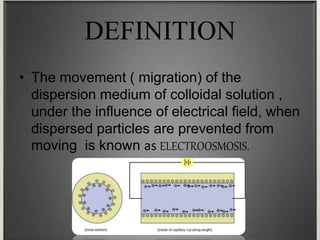
DEFINITION
• The movement ( migration) of the
dispersion medium of colloidal solution ,
under the influence of electrical field, when
dispersed particles are prevented from
moving is known as ELECTROOSMOSIS.
HISTORY
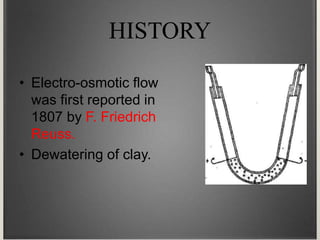
• Electro-osmotic flow
was first reported in
1807 by F. Friedrich
Reuss.
• Dewatering of clay.
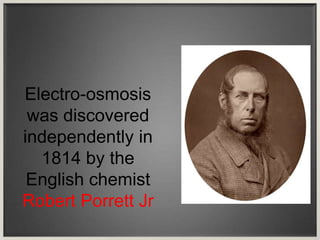
Electro-osmosis
was discovered
independently in
1814 by the
English chemist
Robert Porrett Jr
PURPOSE
• It is basically a drying technique .
• It is used to dewatering a substance or a
colloidal solution electrically.
INSTRUMENTATION
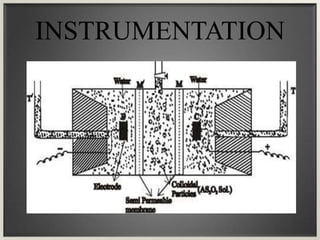
• The electro-osmosis is carried out in a specially
designed apparatus.
• The apparatus consists of a bigger tube having
two side tubes T and T’ attached to its ends.
• The bigger tube is divided into three
compartments A, B and C by means of two semi-
permeable membranes.
• A tube carrying a stop-cock is attached to the
central compartment A.
• Two platinum electrodes are inserted in the outer
compartments B and C.
INSTRUMENTATION
WORKING
• A colloidal dispersion is placed in the central
compartment A.
• the outer compartments B and C are filled with
water. The water in compartments B and C also
extends to the side tube T and T/.
• The function of membrane is to prevent the
movement of colloidal particles.
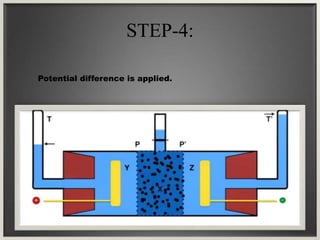
• when a potential difference is applied across the
electrodes held close to the membranes in the
compartment B and C, dispersion medium begins
to move.
Cont…..
• If the particles carry positive charge, the
dispersion medium would start moving towards
the anode and the level of water in the side tube
T would be seen to rise.
• indicating the presence of negative charge on the
dispersion medium.
• If the particles carry negative charge, the
dispersion medium would be seen to move
towards cathode and water in the side tube T
would start rising.
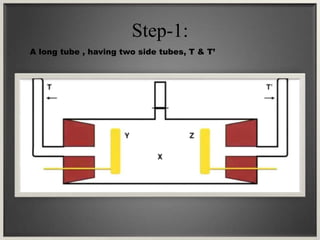
Step-1:
A long tube , having two side tubes, T & T’
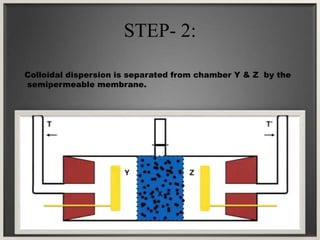
STEP- 2:
Colloidal dispersion is separated from chamber Y & Z by the
semipermeable membrane.
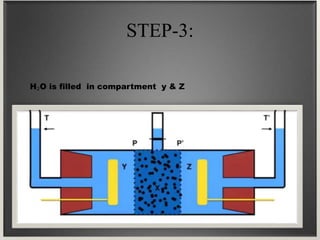
STEP-3:
H₂O is filled in compartment y & Z
STEP-4:
Potential difference is applied.
IMPORTANT TERMS
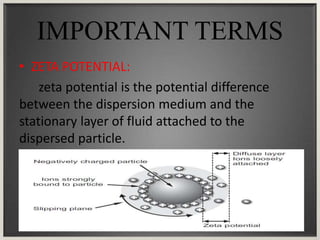
• ZETA POTENTIAL:
zeta potential is the potential difference
between the dispersion medium and the
stationary layer of fluid attached to the
dispersed particle.
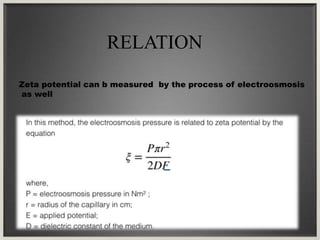
RELATION
Zeta potential can b measured by the process of electroosmosis
as well
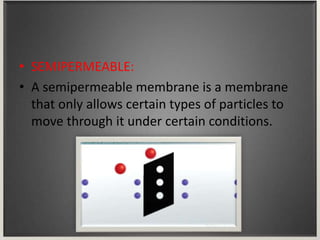
• SEMIPERMEABLE:
• A semipermeable membrane is a membrane
that only allows certain types of particles to
move through it under certain conditions.
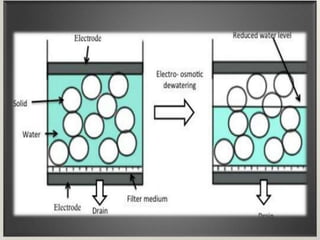
APPLICATIONS
1. Dewatering of moist clay:
• soft clay whose moisture content cannot be
reduced by conventional dewatering method
, can be reduced by electroosmosis.
• Electrodes are fixed in soil & current supplied
& water moves from anode to cathode.
• An ejector well system is used as cathode
which collects & removes water from the
ground.
2. Removal of water from peat
3. Drying of dye paste:
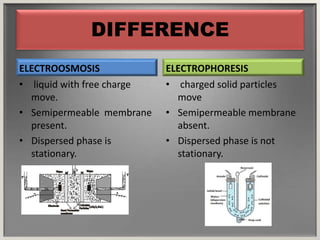
DIFFERENCE
ELECTROOSMOSIS
• liquid with free charge
move.
• Semipermeable membrane
present.
• Dispersed phase is
stationary.
ELECTROPHORESIS
• charged solid particles
move
• Semipermeable membrane
absent.
• Dispersed phase is not
stationary.
Electroosmosis process

Electroosmosis process

  • 1.
  • 2.
    DEFINITION • The movement( migration) of the dispersion medium of colloidal solution , under the influence of electrical field, when dispersed particles are prevented from moving is known as ELECTROOSMOSIS.
  • 3.
    HISTORY • Electro-osmotic flow wasfirst reported in 1807 by F. Friedrich Reuss. • Dewatering of clay.
  • 4.
    Electro-osmosis was discovered independently in 1814by the English chemist Robert Porrett Jr
  • 5.
    PURPOSE • It isbasically a drying technique . • It is used to dewatering a substance or a colloidal solution electrically.
  • 6.
    INSTRUMENTATION • The electro-osmosisis carried out in a specially designed apparatus. • The apparatus consists of a bigger tube having two side tubes T and T’ attached to its ends. • The bigger tube is divided into three compartments A, B and C by means of two semi- permeable membranes. • A tube carrying a stop-cock is attached to the central compartment A. • Two platinum electrodes are inserted in the outer compartments B and C.
  • 7.
  • 8.
    WORKING • A colloidaldispersion is placed in the central compartment A. • the outer compartments B and C are filled with water. The water in compartments B and C also extends to the side tube T and T/. • The function of membrane is to prevent the movement of colloidal particles. • when a potential difference is applied across the electrodes held close to the membranes in the compartment B and C, dispersion medium begins to move.
  • 9.
    Cont….. • If theparticles carry positive charge, the dispersion medium would start moving towards the anode and the level of water in the side tube T would be seen to rise. • indicating the presence of negative charge on the dispersion medium. • If the particles carry negative charge, the dispersion medium would be seen to move towards cathode and water in the side tube T would start rising.
  • 10.
    Step-1: A long tube, having two side tubes, T & T’
  • 11.
    STEP- 2: Colloidal dispersionis separated from chamber Y & Z by the semipermeable membrane.
  • 12.
    STEP-3: H₂O is filledin compartment y & Z
  • 13.
  • 14.
    IMPORTANT TERMS • ZETAPOTENTIAL: zeta potential is the potential difference between the dispersion medium and the stationary layer of fluid attached to the dispersed particle.
  • 15.
    RELATION Zeta potential canb measured by the process of electroosmosis as well
  • 16.
    • SEMIPERMEABLE: • Asemipermeable membrane is a membrane that only allows certain types of particles to move through it under certain conditions.
  • 17.
    APPLICATIONS 1. Dewatering ofmoist clay: • soft clay whose moisture content cannot be reduced by conventional dewatering method , can be reduced by electroosmosis. • Electrodes are fixed in soil & current supplied & water moves from anode to cathode. • An ejector well system is used as cathode which collects & removes water from the ground.
  • 19.
    2. Removal ofwater from peat 3. Drying of dye paste:
  • 20.
    DIFFERENCE ELECTROOSMOSIS • liquid withfree charge move. • Semipermeable membrane present. • Dispersed phase is stationary. ELECTROPHORESIS • charged solid particles move • Semipermeable membrane absent. • Dispersed phase is not stationary.