Get Ready: Preparing for
Implementation of ePractice
Assessment
Dr Fiona Work and Dr Karen Strickland
Gathering the evidence – making the case
for change
Systematic review of the literature on mobile
learning in clinical practice
Review objectives
• To examine primary research articles published
between 2001- December 2014 focussed on
issues for students and educators involved in
assessment of practice learning using m-learning,
• To identify the benefits of m-learning tools in
practice
• To identify the challenges and issues
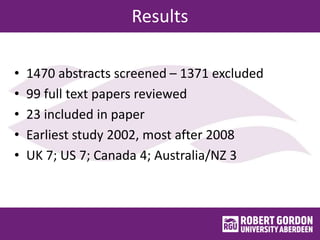
Results
• 1470 abstracts screened – 1371 excluded
• 99 full text papers reviewed
• 23 included in paper
• Earliest study 2002, most after 2008
• UK 7; US 7; Canada 4; Australia/NZ 3
Themes
• Information for healthcare practice
• Knowledge and skill acquisition
• Reflection on learning in practice
Challenges
• Permission to use (Saunders & Dearnley, 2009)
• Concerns over security of patient & student data (Lindquist
et al, 2008; Applegate, 2010; Norman, 2011)
• Risk of transmission of infection (Phyllips & Wyatt 2011)
• Lack of skill bases/reluctance to accept (Norman 2011)
• Time for users to ‘bond’ with their device (Saunders &
Dearnley (2009)
Technical challenges
• Battery life (Applegate, 2010)
• Intermittent internet access
• Screens too small (Scordo et al, 2003; Norman, 2011;
Skiba, 2011)
• Students with disabilities (Applegate, 2010; Saunders &
Dearnley, 2009)
• Damage/loss/theft of devices
Setting the scene in RGU
Ongoing Achievement Record (Scotland) and the
School of Nursing and Midwifery eLearning Strategy
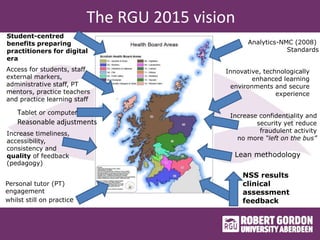
The RGU 2015 vision
Student-centred
benefits preparing
practitioners for digital
era
Personal tutor (PT)
engagement
whilst still on practice
NSS results
clinical
assessment
feedback
Increase confidentiality and
security yet reduce
fraudulent activity
no more “left on the bus”
Analytics-NMC (2008)
Standards
Increase timeliness,
accessibility,
consistency and
quality of feedback
(pedagogy)
Innovative, technologically
enhanced learning
environments and secure
experience
Access for students, staff,
external markers,
administrative staff, PT
mentors, practice teachers
and practice learning staff
Tablet or computer
Reasonable adjustments
Lean methodology
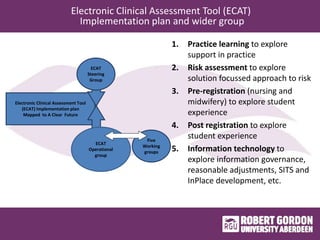
Electronic Clinical Assessment Tool (ECAT)
Implementation plan and wider group
1. Practice learning to explore
support in practice
2. Risk assessment to explore
solution focussed approach to risk
3. Pre-registration (nursing and
midwifery) to explore student
experience
4. Post registration to explore
student experience
5. Information technology to
explore information governance,
reasonable adjustments, SITS and
InPlace development, etc.
Electronic Clinical Assessment Tool
(ECAT) Implementation plan
Mapped to A Clear Future
ECAT
Steering
Group
ECAT
Operational
group
Five
Working
groups
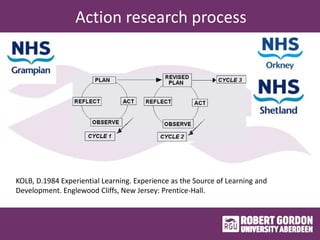
KOLB, D.1984 Experiential Learning. Experience as the Source of Learning and
Development. Englewood Cliffs, New Jersey: Prentice-Hall.
Action research process
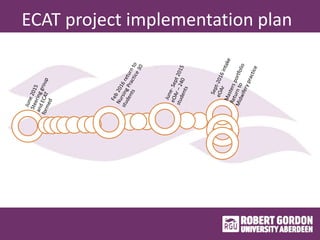
ECAT project implementation plan
Ready? Feedback and Feed forward
• Failure to prepare and prepare to fail
• Literature searching
• Firewall testing
• Partners in Practice and practice educators act as gatekeepers- “buy in”
(Permission to use -Saunders & Dearnley, 2009)
• DELTA, eLearning, ITNS, Disability services, Study support, students, HSE
staff and peers all matter and need to ‘feel’ engaged
• Monthly multi-agency meetings with staged implementation plan
• Risk assessment- identified lack of resources such as computers in wards
Ready? Feedback and Feed forward
(cont’d)
• Digital literacy and fears (Lack of skill bases/reluctance to accept -Norman
2011)
• “ increased my confidence with technology” “encouraged me to use online
banking now”
• “why are we the guinea pigs” and “not enough PCs on wards”
• Table top exercise
• Browser issues –internet explorer 8 required for patient records
• Helplines and emails
• Storyline training guides and high quality training materials
• Analytics and NMC (2008) standards
Are you ready?
Questions ?

Electronic Practice Assessment: Get Ready

  • 1.
    Get Ready: Preparingfor Implementation of ePractice Assessment Dr Fiona Work and Dr Karen Strickland
  • 2.
    Gathering the evidence– making the case for change Systematic review of the literature on mobile learning in clinical practice
  • 3.
    Review objectives • Toexamine primary research articles published between 2001- December 2014 focussed on issues for students and educators involved in assessment of practice learning using m-learning, • To identify the benefits of m-learning tools in practice • To identify the challenges and issues
  • 4.
    Results • 1470 abstractsscreened – 1371 excluded • 99 full text papers reviewed • 23 included in paper • Earliest study 2002, most after 2008 • UK 7; US 7; Canada 4; Australia/NZ 3
  • 5.
    Themes • Information forhealthcare practice • Knowledge and skill acquisition • Reflection on learning in practice
  • 6.
    Challenges • Permission touse (Saunders & Dearnley, 2009) • Concerns over security of patient & student data (Lindquist et al, 2008; Applegate, 2010; Norman, 2011) • Risk of transmission of infection (Phyllips & Wyatt 2011) • Lack of skill bases/reluctance to accept (Norman 2011) • Time for users to ‘bond’ with their device (Saunders & Dearnley (2009)
  • 7.
    Technical challenges • Batterylife (Applegate, 2010) • Intermittent internet access • Screens too small (Scordo et al, 2003; Norman, 2011; Skiba, 2011) • Students with disabilities (Applegate, 2010; Saunders & Dearnley, 2009) • Damage/loss/theft of devices
  • 8.
    Setting the scenein RGU Ongoing Achievement Record (Scotland) and the School of Nursing and Midwifery eLearning Strategy
  • 9.
    The RGU 2015vision Student-centred benefits preparing practitioners for digital era Personal tutor (PT) engagement whilst still on practice NSS results clinical assessment feedback Increase confidentiality and security yet reduce fraudulent activity no more “left on the bus” Analytics-NMC (2008) Standards Increase timeliness, accessibility, consistency and quality of feedback (pedagogy) Innovative, technologically enhanced learning environments and secure experience Access for students, staff, external markers, administrative staff, PT mentors, practice teachers and practice learning staff Tablet or computer Reasonable adjustments Lean methodology
  • 10.
    Electronic Clinical AssessmentTool (ECAT) Implementation plan and wider group 1. Practice learning to explore support in practice 2. Risk assessment to explore solution focussed approach to risk 3. Pre-registration (nursing and midwifery) to explore student experience 4. Post registration to explore student experience 5. Information technology to explore information governance, reasonable adjustments, SITS and InPlace development, etc. Electronic Clinical Assessment Tool (ECAT) Implementation plan Mapped to A Clear Future ECAT Steering Group ECAT Operational group Five Working groups
  • 11.
    KOLB, D.1984 ExperientialLearning. Experience as the Source of Learning and Development. Englewood Cliffs, New Jersey: Prentice-Hall. Action research process
  • 12.
  • 13.
    Ready? Feedback andFeed forward • Failure to prepare and prepare to fail • Literature searching • Firewall testing • Partners in Practice and practice educators act as gatekeepers- “buy in” (Permission to use -Saunders & Dearnley, 2009) • DELTA, eLearning, ITNS, Disability services, Study support, students, HSE staff and peers all matter and need to ‘feel’ engaged • Monthly multi-agency meetings with staged implementation plan • Risk assessment- identified lack of resources such as computers in wards
  • 14.
    Ready? Feedback andFeed forward (cont’d) • Digital literacy and fears (Lack of skill bases/reluctance to accept -Norman 2011) • “ increased my confidence with technology” “encouraged me to use online banking now” • “why are we the guinea pigs” and “not enough PCs on wards” • Table top exercise • Browser issues –internet explorer 8 required for patient records • Helplines and emails • Storyline training guides and high quality training materials • Analytics and NMC (2008) standards
  • 15.