Dr Chris Wright 
Senior Lecturer & Research Coordinator 
CREATING A PAPER-LESS CLINICAL ASSESSMENT 
SYSTEM TO DELIVER INCREASED 
TIME EFFICIENCY FOR STAFF AND STUDENTS 
Faculty of Health and Wellbeing 
Robert Winston Building 
chris.wright@shu.ac.uk 
0114 225 5488
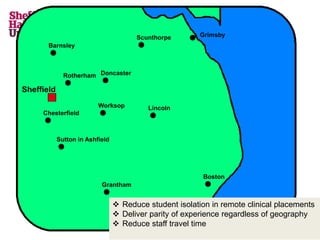
Scunthorpe Grimsby 
24/11/2014 
Barnsley 
Sheffield 
Rotherham Doncaster 
Worksop 
Chesterfield 
Sutton in Ashfield 
Grantham 
Boston 
Lincoln 
 Reduce student isolation in remote clinical placements 
 Deliver parity of experience regardless of geography 
 Reduce staff travel time
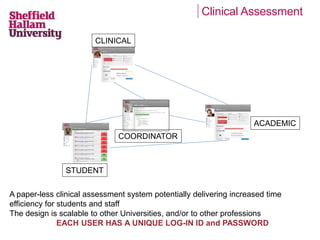
Clinical Assessment 
CLINICAL 
STUDENT 
ACADEMIC 
COORDINATOR 
A paper-less clinical assessment system potentially delivering increased time 
efficiency for students and staff 
The design is scalable to other Universities, and/or to other professions 
EACH USER HAS A UNIQUE LOG-IN ID and PASSWORD
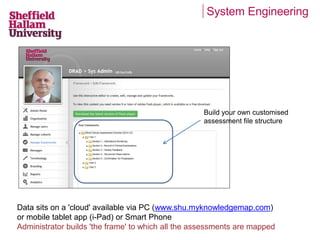
System Engineering 
Build your own customised 
assessment file structure 
Data sits on a 'cloud' available via PC (www.shu.myknowledgemap.com) 
or mobile tablet app (i-Pad) or Smart Phone 
Administrator builds 'the frame' to which all the assessments are mapped
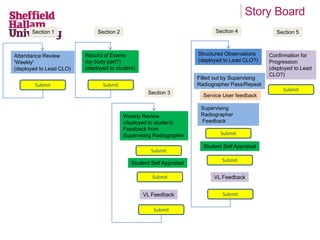
Section 1 Section 4 
Section 3 
Section 2 
Attendance Review 
'Weekly' 
(deployed to Lead CLO) 
Student Self Appraisal 
VL Feedback 
Submit 
Submit 
Submit 
Record of Exams 
(by body part?) 
(deployed to student) 
Structured Observations 
(deployed to Lead CLO?) 
Filled out by Supervising 
Radiographer Pass/Repeat 
Service User feedback 
Supervising 
Radiographer 
Feedback 
Submit 
Student Self Appraisal 
Submit 
VL Feedback 
Submit 
Confirmation for 
Progression 
(deployed to Lead 
CLO?) 
Submit 
Submit 
Section 5 
Weekly Review 
(deployed to student) 
Feedback from 
Supervising Radiographer 
Submit 
Story Board
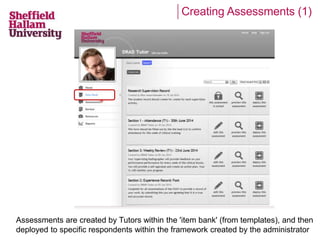
Creating Assessments (1) 
Assessments are created by Tutors within the 'item bank' (from templates), and then 
deployed to specific respondents within the framework created by the administrator
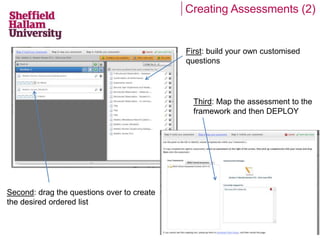
Creating Assessments (2) 
First: build your own customised 
questions 
Second: drag the questions over to create 
the desired ordered list 
Third: Map the assessment to the 
framework and then DEPLOY
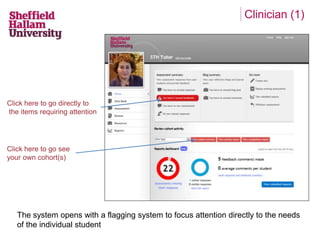
Clinician (1) 
Click here to go directly to 
the items requiring attention 
Click here to go see 
your own cohort(s) 
The system opens with a flagging system to focus attention directly to the needs 
of the individual student
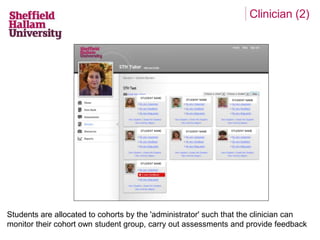
Clinician (2) 
STUDENT NAME 
STUDENT NAME 
STUDENT NAME 
STUDENT NAME STUDENT NAME STUDENT NAME 
STUDENT NAME 
Students are allocated to cohorts by the 'administrator' such that the clinician can 
monitor their cohort own student group, carry out assessments and provide feedback
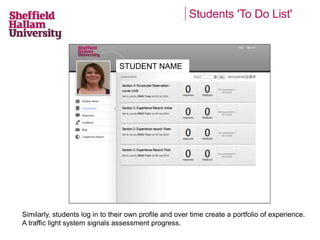
Students 'To Do List' 
STUDENT NAME 
Similarly, students log in to their own profile and over time create a portfolio of experience. 
A traffic light system signals assessment progress.
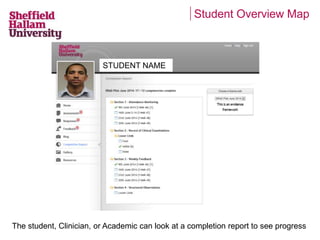
Student Overview Map 
STUDENT NAME 
The student, Clinician, or Academic can look at a completion report to see progress
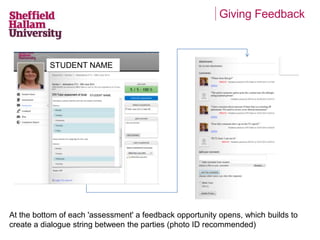
Giving Feedback 
STUDENT NAME 
STUDENT NAME 
At the bottom of each 'assessment' a feedback opportunity opens, which builds to 
create a dialogue string between the parties (photo ID recommended)
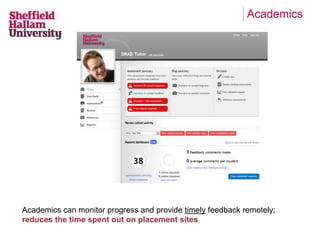
Academics 
Academics can monitor progress and provide timely feedback remotely; 
reduces the time spent out on placement sites
Staff Efficient? 
WEEK NO. 
WEEK 
BEGINNING 
(MONDAY) 
Y1 Level 4 Y2 Level 5 Y3 Level 6 
1 28-Jul V v 
2 04-Aug V v 
3 11-Aug V C 
4 18-Aug V C 
5** 25-Aug A C 
6 01-Sep C C 
7 08-Sep C C 
8 15-Sep 
C C 
9 22-Sep A C A 
10 29-Sep A C A 
11 06-Oct 
A C A 
12 13-Oct A A A 
13 20-Oct A A C 
14 27-Oct A A C 
15 03-Nov 
A A C 
16 10-Nov C A C 
17 17-Nov C A C 
18 24-Nov C A A 
19 01-Dec C C A 
20 08-Dec C C A 
21 15-Dec 
A A A 
22^^ 22-Dec V V V 
23^^ 29-Dec V V V 
24 05-Jan 
A C A 
25 12-Jan A C A 
26 19-Jan A C A 
27 26-Jan C C A 
28 02-Feb C C A 
29 09-Feb C A C 
30 16-Feb C A C 
31 23-Feb A A C 
32 02-Mar A A C 
33 09-Mar A A C 
34 16-Mar A A C 
35 23-Mar A A A 
36** 30-Mar A A A 
37** 06-Apr V V V 
38 13-Apr 
C C A 
39 20-Apr C C A 
40 27-Apr C C A 
41** 04-May A C A 
42 11-May 
C A A 
43 18-May C A C 
44** 25-May C A C 
45 01-Jun C C C 
46 08-Jun A C C 
47 15-Jun C C C 
48 22-Jun C C C 
49 29-Jun C C © 
50 06-Jul C C © 
51 13-Jul C V © 
52 20-Jul C V © 
1 27-Jul C V © 
2 03-Aug C V © 
3 10-Aug V C © 
4 17-Aug V C © 
5 24-Aug V C © 
6 31-Aug V C © 
7 07-Sep C C (V) 
8 14-Sep C C (V) 
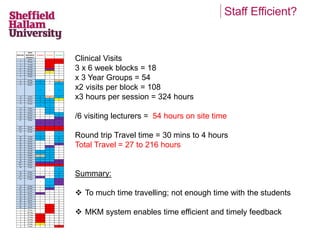
Clinical Visits 
3 x 6 week blocks = 18 
x 3 Year Groups = 54 
x2 visits per block = 108 
x3 hours per session = 324 hours 
/6 visiting lecturers = 54 hours on site time 
Round trip Travel time = 30 mins to 4 hours 
Total Travel = 27 to 216 hours 
Summary: 
 To much time travelling; not enough time with the students 
 MKM system enables time efficient and timely feedback
Student Efficient? 
WEEK NO. 
WEEK 
BEGINNING 
(MONDAY) 
Y1 Level 4 Y2 Level 5 Y3 Level 6 
1 28-Jul V v 
2 04-Aug V v 
3 11-Aug V C 
4 18-Aug V C 
5** 25-Aug A C 
6 01-Sep C C 
7 08-Sep C C 
8 15-Sep 
C C 
9 22-Sep A C A 
10 29-Sep A C A 
11 06-Oct 
A C A 
12 13-Oct A A A 
13 20-Oct A A C 
14 27-Oct A A C 
15 03-Nov 
A A C 
16 10-Nov C A C 
17 17-Nov C A C 
18 24-Nov C A A 
19 01-Dec C C A 
20 08-Dec C C A 
21 15-Dec 
A A A 
22^^ 22-Dec V V V 
23^^ 29-Dec V V V 
24 05-Jan 
A C A 
25 12-Jan A C A 
26 19-Jan A C A 
27 26-Jan C C A 
28 02-Feb C C A 
29 09-Feb C A C 
30 16-Feb C A C 
31 23-Feb A A C 
32 02-Mar A A C 
33 09-Mar A A C 
34 16-Mar A A C 
35 23-Mar A A A 
36** 30-Mar A A A 
37** 06-Apr V V V 
38 13-Apr 
C C A 
39 20-Apr C C A 
40 27-Apr C C A 
41** 04-May A C A 
42 11-May 
C A A 
43 18-May C A C 
44** 25-May C A C 
45 01-Jun C C C 
46 08-Jun A C C 
47 15-Jun C C C 
48 22-Jun C C C 
49 29-Jun C C © 
50 06-Jul C C © 
51 13-Jul C V © 
52 20-Jul C V © 
1 27-Jul C V © 
2 03-Aug C V © 
3 10-Aug V C © 
4 17-Aug V C © 
5 24-Aug V C © 
6 31-Aug V C © 
7 07-Sep C C (V) 
8 14-Sep C C (V) 
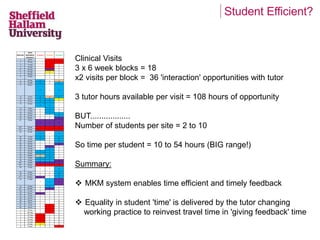
Clinical Visits 
3 x 6 week blocks = 18 
x2 visits per block = 36 'interaction' opportunities with tutor 
3 tutor hours available per visit = 108 hours of opportunity 
BUT.................. 
Number of students per site = 2 to 10 
So time per student = 10 to 54 hours (BIG range!) 
Summary: 
 MKM system enables time efficient and timely feedback 
 Equality in student 'time' is delivered by the tutor changing 
working practice to reinvest travel time in 'giving feedback' time
Challenges & Recommendations 
 Story board the full scheme BEFORE you start to build it 
 Check IT requirements 
 Consider the full cost implications before starting out 
- Hardware 
- Software 
- Set-up Expertise and Time 
 Do you have an organisation with people willing to change?!
Why Go Paperless? 
 1) Students love it 
 2) Staff love it 
 3) Facilitates quality improvement 
- robust audit trail 
- timely feedback 
- time effective for staff (less travel time and costs) 
"Change is a fact of life. It's how we implement change that's important!"

Anglia Ruskin

  • 1.
    Dr Chris Wright Senior Lecturer & Research Coordinator CREATING A PAPER-LESS CLINICAL ASSESSMENT SYSTEM TO DELIVER INCREASED TIME EFFICIENCY FOR STAFF AND STUDENTS Faculty of Health and Wellbeing Robert Winston Building chris.wright@shu.ac.uk 0114 225 5488
  • 2.
    Scunthorpe Grimsby 24/11/2014 Barnsley Sheffield Rotherham Doncaster Worksop Chesterfield Sutton in Ashfield Grantham Boston Lincoln  Reduce student isolation in remote clinical placements  Deliver parity of experience regardless of geography  Reduce staff travel time
  • 3.
    Clinical Assessment CLINICAL STUDENT ACADEMIC COORDINATOR A paper-less clinical assessment system potentially delivering increased time efficiency for students and staff The design is scalable to other Universities, and/or to other professions EACH USER HAS A UNIQUE LOG-IN ID and PASSWORD
  • 4.
    System Engineering Buildyour own customised assessment file structure Data sits on a 'cloud' available via PC (www.shu.myknowledgemap.com) or mobile tablet app (i-Pad) or Smart Phone Administrator builds 'the frame' to which all the assessments are mapped
  • 5.
    Section 1 Section4 Section 3 Section 2 Attendance Review 'Weekly' (deployed to Lead CLO) Student Self Appraisal VL Feedback Submit Submit Submit Record of Exams (by body part?) (deployed to student) Structured Observations (deployed to Lead CLO?) Filled out by Supervising Radiographer Pass/Repeat Service User feedback Supervising Radiographer Feedback Submit Student Self Appraisal Submit VL Feedback Submit Confirmation for Progression (deployed to Lead CLO?) Submit Submit Section 5 Weekly Review (deployed to student) Feedback from Supervising Radiographer Submit Story Board
  • 6.
    Creating Assessments (1) Assessments are created by Tutors within the 'item bank' (from templates), and then deployed to specific respondents within the framework created by the administrator
  • 7.
    Creating Assessments (2) First: build your own customised questions Second: drag the questions over to create the desired ordered list Third: Map the assessment to the framework and then DEPLOY
  • 8.
    Clinician (1) Clickhere to go directly to the items requiring attention Click here to go see your own cohort(s) The system opens with a flagging system to focus attention directly to the needs of the individual student
  • 9.
    Clinician (2) STUDENTNAME STUDENT NAME STUDENT NAME STUDENT NAME STUDENT NAME STUDENT NAME STUDENT NAME Students are allocated to cohorts by the 'administrator' such that the clinician can monitor their cohort own student group, carry out assessments and provide feedback
  • 10.
    Students 'To DoList' STUDENT NAME Similarly, students log in to their own profile and over time create a portfolio of experience. A traffic light system signals assessment progress.
  • 11.
    Student Overview Map STUDENT NAME The student, Clinician, or Academic can look at a completion report to see progress
  • 12.
    Giving Feedback STUDENTNAME STUDENT NAME At the bottom of each 'assessment' a feedback opportunity opens, which builds to create a dialogue string between the parties (photo ID recommended)
  • 13.
    Academics Academics canmonitor progress and provide timely feedback remotely; reduces the time spent out on placement sites
  • 14.
    Staff Efficient? WEEKNO. WEEK BEGINNING (MONDAY) Y1 Level 4 Y2 Level 5 Y3 Level 6 1 28-Jul V v 2 04-Aug V v 3 11-Aug V C 4 18-Aug V C 5** 25-Aug A C 6 01-Sep C C 7 08-Sep C C 8 15-Sep C C 9 22-Sep A C A 10 29-Sep A C A 11 06-Oct A C A 12 13-Oct A A A 13 20-Oct A A C 14 27-Oct A A C 15 03-Nov A A C 16 10-Nov C A C 17 17-Nov C A C 18 24-Nov C A A 19 01-Dec C C A 20 08-Dec C C A 21 15-Dec A A A 22^^ 22-Dec V V V 23^^ 29-Dec V V V 24 05-Jan A C A 25 12-Jan A C A 26 19-Jan A C A 27 26-Jan C C A 28 02-Feb C C A 29 09-Feb C A C 30 16-Feb C A C 31 23-Feb A A C 32 02-Mar A A C 33 09-Mar A A C 34 16-Mar A A C 35 23-Mar A A A 36** 30-Mar A A A 37** 06-Apr V V V 38 13-Apr C C A 39 20-Apr C C A 40 27-Apr C C A 41** 04-May A C A 42 11-May C A A 43 18-May C A C 44** 25-May C A C 45 01-Jun C C C 46 08-Jun A C C 47 15-Jun C C C 48 22-Jun C C C 49 29-Jun C C © 50 06-Jul C C © 51 13-Jul C V © 52 20-Jul C V © 1 27-Jul C V © 2 03-Aug C V © 3 10-Aug V C © 4 17-Aug V C © 5 24-Aug V C © 6 31-Aug V C © 7 07-Sep C C (V) 8 14-Sep C C (V) Clinical Visits 3 x 6 week blocks = 18 x 3 Year Groups = 54 x2 visits per block = 108 x3 hours per session = 324 hours /6 visiting lecturers = 54 hours on site time Round trip Travel time = 30 mins to 4 hours Total Travel = 27 to 216 hours Summary:  To much time travelling; not enough time with the students  MKM system enables time efficient and timely feedback
  • 15.
    Student Efficient? WEEKNO. WEEK BEGINNING (MONDAY) Y1 Level 4 Y2 Level 5 Y3 Level 6 1 28-Jul V v 2 04-Aug V v 3 11-Aug V C 4 18-Aug V C 5** 25-Aug A C 6 01-Sep C C 7 08-Sep C C 8 15-Sep C C 9 22-Sep A C A 10 29-Sep A C A 11 06-Oct A C A 12 13-Oct A A A 13 20-Oct A A C 14 27-Oct A A C 15 03-Nov A A C 16 10-Nov C A C 17 17-Nov C A C 18 24-Nov C A A 19 01-Dec C C A 20 08-Dec C C A 21 15-Dec A A A 22^^ 22-Dec V V V 23^^ 29-Dec V V V 24 05-Jan A C A 25 12-Jan A C A 26 19-Jan A C A 27 26-Jan C C A 28 02-Feb C C A 29 09-Feb C A C 30 16-Feb C A C 31 23-Feb A A C 32 02-Mar A A C 33 09-Mar A A C 34 16-Mar A A C 35 23-Mar A A A 36** 30-Mar A A A 37** 06-Apr V V V 38 13-Apr C C A 39 20-Apr C C A 40 27-Apr C C A 41** 04-May A C A 42 11-May C A A 43 18-May C A C 44** 25-May C A C 45 01-Jun C C C 46 08-Jun A C C 47 15-Jun C C C 48 22-Jun C C C 49 29-Jun C C © 50 06-Jul C C © 51 13-Jul C V © 52 20-Jul C V © 1 27-Jul C V © 2 03-Aug C V © 3 10-Aug V C © 4 17-Aug V C © 5 24-Aug V C © 6 31-Aug V C © 7 07-Sep C C (V) 8 14-Sep C C (V) Clinical Visits 3 x 6 week blocks = 18 x2 visits per block = 36 'interaction' opportunities with tutor 3 tutor hours available per visit = 108 hours of opportunity BUT.................. Number of students per site = 2 to 10 So time per student = 10 to 54 hours (BIG range!) Summary:  MKM system enables time efficient and timely feedback  Equality in student 'time' is delivered by the tutor changing working practice to reinvest travel time in 'giving feedback' time
  • 16.
    Challenges & Recommendations  Story board the full scheme BEFORE you start to build it  Check IT requirements  Consider the full cost implications before starting out - Hardware - Software - Set-up Expertise and Time  Do you have an organisation with people willing to change?!
  • 17.
    Why Go Paperless?  1) Students love it  2) Staff love it  3) Facilitates quality improvement - robust audit trail - timely feedback - time effective for staff (less travel time and costs) "Change is a fact of life. It's how we implement change that's important!"