E-learning
- edX -
Submitted to Dr. Gaurav Mishra sir
By,
K sarvan,
Jigna patel
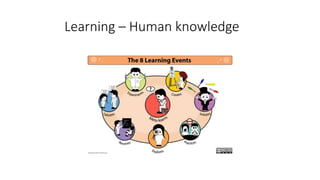
Learning – Human knowledge
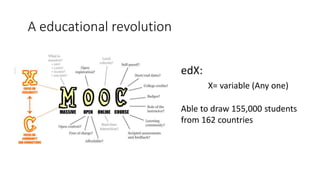
A educational revolution
edX:
X= variable (Any one)
Able to draw 155,000 students
from 162 countries
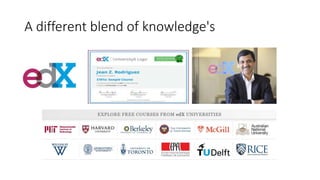
A different blend of knowledge's
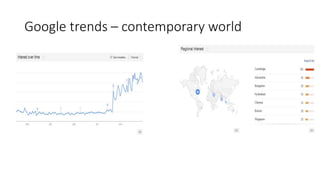
Google trends – contemporary world
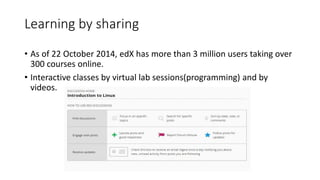
Learning by sharing
• As of 22 October 2014, edX has more than 3 million users taking over
300 courses online.
• Interactive classes by virtual lab sessions(programming) and by
videos.
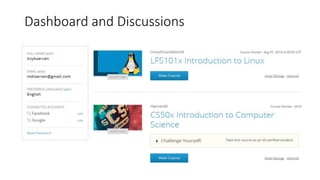
Dashboard and Discussions
• The main aim of the study is to predict if academics and
students will accept the new blend of learning environment
through online learning.
Objectives:
 To identify the students who are accessible to new method
of learning by e-learning.
OBJECTIVES AND AIMS
 To understand the acceptance of students by two methodology models.
To identify the structural and organisable variables which helps in
acceptance of new technology (E-learning).
Determine the functionality of e-learning resources offered to students by
the edX.
Careful recording of analysis by the responses of quarries that asked.
Scope and Limitations
• The study will be limited to academics and students at University of DA-IICT
and few students of near colleges.
• The result of the study can not be generalized to all institutions of higher
and other technical educational centres because of the constraints of
infrastructure and technology accessibility .
• The predictive power of any user acceptance model is not 100% efficient,
for example UTAUT model was only able to correctly predict 70% of all
cases surveyed, therefore 30% of cases will not be correctly predicted.
Acceptance - Adaptation
• Acceptance of technology has long been a challenging issue in
information system research.
• Many people accept new technologies some people reject
technologies also irrespective of their social awareness and financial
stability.
• In order to evaluate the acceptance of the technology “Social Factor”
was selected for the studying of impact of social presence on
individual behaviour.
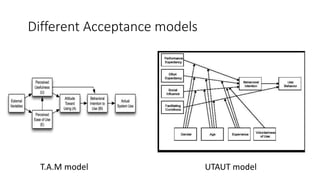
Different Acceptance models
T.A.M model UTAUT model
Thank you

Ed x

  • 1.
    E-learning - edX - Submittedto Dr. Gaurav Mishra sir By, K sarvan, Jigna patel
  • 2.
  • 3.
    A educational revolution edX: X=variable (Any one) Able to draw 155,000 students from 162 countries
  • 4.
    A different blendof knowledge's
  • 5.
    Google trends –contemporary world
  • 6.
    Learning by sharing •As of 22 October 2014, edX has more than 3 million users taking over 300 courses online. • Interactive classes by virtual lab sessions(programming) and by videos.
  • 7.
  • 8.
    • The mainaim of the study is to predict if academics and students will accept the new blend of learning environment through online learning. Objectives:  To identify the students who are accessible to new method of learning by e-learning. OBJECTIVES AND AIMS
  • 9.
     To understandthe acceptance of students by two methodology models. To identify the structural and organisable variables which helps in acceptance of new technology (E-learning). Determine the functionality of e-learning resources offered to students by the edX. Careful recording of analysis by the responses of quarries that asked.
  • 10.
    Scope and Limitations •The study will be limited to academics and students at University of DA-IICT and few students of near colleges. • The result of the study can not be generalized to all institutions of higher and other technical educational centres because of the constraints of infrastructure and technology accessibility . • The predictive power of any user acceptance model is not 100% efficient, for example UTAUT model was only able to correctly predict 70% of all cases surveyed, therefore 30% of cases will not be correctly predicted.
  • 11.
    Acceptance - Adaptation •Acceptance of technology has long been a challenging issue in information system research. • Many people accept new technologies some people reject technologies also irrespective of their social awareness and financial stability. • In order to evaluate the acceptance of the technology “Social Factor” was selected for the studying of impact of social presence on individual behaviour.
  • 12.
  • 13.