Irfan Ansari
WWW:

http://www.IrfanAnsari.com

Email:

Irfan@IrfanAnsari.com

LinkedIn:

http://pk.linkedin.com/in/IrfanAnsari

Twitter:

http://www.twitter.com/_IrfanAnsari

Google Plus: http://plus.google.com/+IrfanAnsari
ELECTRONIC
PAYMENT SYSTEMS
What is an E-Payment System?


An integral part of e-commerce.



Can either be a:


Simple electronic version of existing payment systems such as
cheques and credit cards



Or, based on the digital currency technology
Traditional Payment Systems


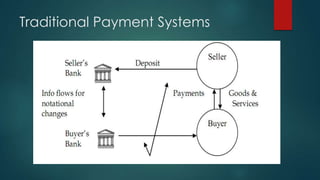
A conventional process of payment and settlement involves a
buyer-to-seller transfer of cash or payment information (i.e.,
cheque and credit cards).



The actual settlement of payment takes place in the financial
processing network.
Traditional Payment Systems
Problems with Traditional Systems


Lack of Convenience



Lack of Security



Lack of Coverage



Lack of Eligibility



Lack of support for micro-transactions
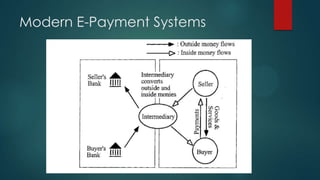
Modern E-Payment Systems


The traditional system does not depend on a central processing
intermediary.



An electronic fund transfer is a financial application of EDI
(Electronic Data Interchange), which sends credit card numbers
or electronic cheques via secured private networks between
banks and major corporations.
Modern E-Payment Systems
Types of E-Payment Systems


Credit Card



Smart Card



Debit Cards



Electronic Cheques



Peer-to-peer Payments
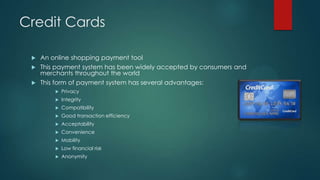
Credit Cards
An online shopping payment tool
 This payment system has been widely accepted by consumers and
merchants throughout the world
 This form of payment system has several advantages:




Privacy



Integrity



Compatibility



Good transaction efficiency



Acceptability



Convenience



Mobility



Low financial risk



Anonymity
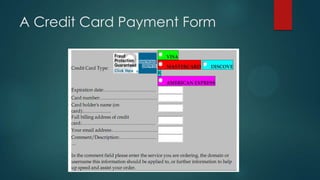
A Credit Card Payment Form
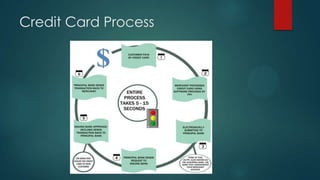
Credit Card Process
Credit Cards: Pros & Cons


ADVANTAGES



Faster Checkout



Cheaper than



More Security





Increased Sales.

More Choices

DISADVANTAGES


Cost



Fraud



Chargebacks
Smart Cards


“Smart cards‟ are receiving renewed attention as a mode of online
payment



Plastic cards with the memory chips



In some cases, with microprocessors embedded in them so as to
serve as storage devices for much greater information than credit
cards with inbuilt transaction processing capability.



This card also contains some kinds of an encrypted key that is
compared to a secret key contained on the user’s processor.
Applications of Smart Card


Authentication, ID



Medical records



E-cash



Store loyalty programs



Personal profiles



Government




Licenses

Mall parking
Smart Card: Pros & Cons


ADVANTAGES:



Feasible for very small transactions (information commerce)



(Potentially) anonymous



Security of physical storage





Atomic, debt-free transactions

(Potentially) currency-neutral

DISADVANTAGES:


Low maximum transaction limit (not suitable for B2B or most B2C)



High Infrastructure costs (not suitable for C2C)



Not (yet) widely used
Debit Cards


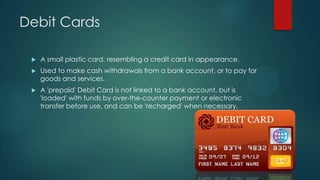
A small plastic card, resembling a credit card in appearance.



Used to make cash withdrawals from a bank account, or to pay for
goods and services.



A 'prepaid' Debit Card is not linked to a bank account, but is
'loaded' with funds by over-the-counter payment or electronic
transfer before use, and can be 'recharged' when necessary.
Debit Card Process


Card owners are usually issued with a Personal Identification
Number used to verify their identity and authority to use the card.



This PIN (generally a four digit number) should be kept secret, and
typed into a terminal or ATM or entered on to an Internet form to
verify your identity when using the card.



Some Debit Card purchases can be confirmed with a signature.



Both methods provide good security, though it is important for card
owners to keep their card somewhere safe and inaccessible to
others, and to report any loss at once.
Debit Card : Pros & Cons
ADVANTAGES


Accepted by merchants because of its easiness, safety and quick money
transaction utility



One time fee with no extra interests or surcharges like late fee, APR, etc.



A debit card can be used at anywhere, anytime for any buying.



You can use your debit card to obtain cash from an ATM without paying any
extra charge



Anyone who has bank account can obtain a debit card.

DISADVANTAGES


Overdraft charges.



Non-sufficient funds or over-limit fee.



Some countries does not offer much security on a debit card than credit card



Easier for hackers than a credit card.
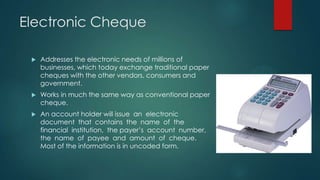
Electronic Cheque


Addresses the electronic needs of millions of
businesses, which today exchange traditional paper
cheques with the other vendors, consumers and
government.



Works in much the same way as conventional paper
cheque.



An account holder will issue an electronic
document that contains the name of the
financial institution, the payer’s account number,
the name of payee and amount of cheque.
Most of the information is in uncoded form.
E-Check: Pros and Cons
ADVANTAGES


Does not require consumers to reveal account information to
other individuals when setting an auction



Does not require consumers to continually send sensitive financial
information



It is less expensive than credit cards



It is much faster than paper based traditional cheque.

DISADVANTAGES


Relatively high fixed costs



Limited use only in virtual world and the fact that they can protect
the users‟ anonymity.
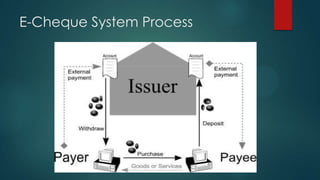
E-Cheque System Process
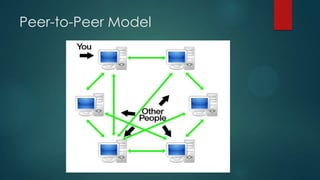
Peer-to-Peer Payments


Newest and fastest-growing payment schemes. E



Enable the transfer of funds between two individuals



One of the first companies to offer this service was PayPal
(paypal.com).



PayPal claimed, in late 2001, to have 8 million customer accounts,
handling 25 percent of all eBay transactions and funneling $5 billion
in payments through its servers annually.
Peer-to-Peer Model
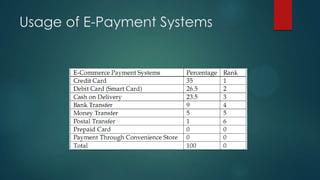
Usage of E-Payment Systems
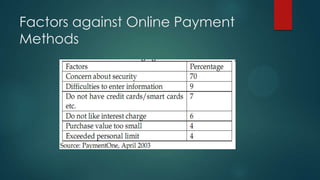
Factors against Online Payment
Methods
Benefits of E-Payment Systems


Electronic payment is very convenient for the consumer.



Completing a transaction is as simple as clicking your mouse: All you
have to do is confirm your purchase and you're done.



Electronic payment lowers costs for businesses.



The more payments they can process electronically, the less they
spend on paper and postage.



Offering electronic payment can also help businesses improve
customer retention.



A customer is more likely to return to the same e-commerce site
where his or her information has already been entered and stored.
Disadvantages


Most of the online banking require you to open an online account
with them.



For secure online transactions, the site that hosts your account
should follow strict security policies.



Identity theft!!



Electronic payments are resistant to forgery, the keys are vulnerable
to attack.
This was not to discourage you from taking to electronic
payments. It was rather to make you aware of the disadvantages
of electronic payment systems. While we are moving towards a
paperless environment, we are inviting issues related to
electronic security.
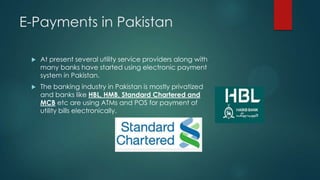
E-Payments in Pakistan


At present several utility service providers along with
many banks have started using electronic payment
system in Pakistan.



The banking industry in Pakistan is mostly privatized
and banks like HBL, HMB, Standard Chartered and
MCB etc are using ATMs and POS for payment of
utility bills electronically.
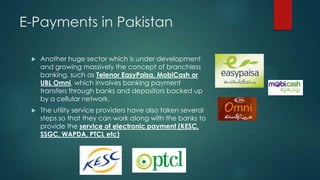
E-Payments in Pakistan


Another huge sector which is under development
and growing massively the concept of branchless
banking, such as Telenor EasyPaisa, MobiCash or
UBL Omni, which involves banking payment
transfers through banks and depositors backed up
by a cellular network.



The utility service providers have also taken several
steps so that they can work along with the banks to
provide the service of electronic payment (KESC,
SSGC, WAPDA, PTCL etc)
Conclusion


Technology has inarguably made our lives easier.



It has cut across distance, space and even time.



One of the technological innovations in banking, finance and
commerce is the Electronic Payments.



Electronic Payments (e-payments) refers to the technological
breakthrough that enables us to perform financial transactions
electronically, thus avoiding long lines and other hassles.
Thank You

Electronic payment systems - Presentation by IrfanAnsari.com

  • 1.
  • 3.
  • 4.
    What is anE-Payment System?  An integral part of e-commerce.  Can either be a:  Simple electronic version of existing payment systems such as cheques and credit cards  Or, based on the digital currency technology
  • 5.
    Traditional Payment Systems  Aconventional process of payment and settlement involves a buyer-to-seller transfer of cash or payment information (i.e., cheque and credit cards).  The actual settlement of payment takes place in the financial processing network.
  • 6.
  • 7.
    Problems with TraditionalSystems  Lack of Convenience  Lack of Security  Lack of Coverage  Lack of Eligibility  Lack of support for micro-transactions
  • 8.
    Modern E-Payment Systems  Thetraditional system does not depend on a central processing intermediary.  An electronic fund transfer is a financial application of EDI (Electronic Data Interchange), which sends credit card numbers or electronic cheques via secured private networks between banks and major corporations.
  • 9.
  • 10.
    Types of E-PaymentSystems  Credit Card  Smart Card  Debit Cards  Electronic Cheques  Peer-to-peer Payments
  • 11.
    Credit Cards An onlineshopping payment tool  This payment system has been widely accepted by consumers and merchants throughout the world  This form of payment system has several advantages:   Privacy  Integrity  Compatibility  Good transaction efficiency  Acceptability  Convenience  Mobility  Low financial risk  Anonymity
  • 12.
    A Credit CardPayment Form
  • 13.
  • 14.
    Credit Cards: Pros& Cons  ADVANTAGES   Faster Checkout  Cheaper than  More Security   Increased Sales. More Choices DISADVANTAGES  Cost  Fraud  Chargebacks
  • 15.
    Smart Cards  “Smart cards‟are receiving renewed attention as a mode of online payment  Plastic cards with the memory chips  In some cases, with microprocessors embedded in them so as to serve as storage devices for much greater information than credit cards with inbuilt transaction processing capability.  This card also contains some kinds of an encrypted key that is compared to a secret key contained on the user’s processor.
  • 16.
    Applications of SmartCard  Authentication, ID  Medical records  E-cash  Store loyalty programs  Personal profiles  Government   Licenses Mall parking
  • 17.
    Smart Card: Pros& Cons  ADVANTAGES:   Feasible for very small transactions (information commerce)  (Potentially) anonymous  Security of physical storage   Atomic, debt-free transactions (Potentially) currency-neutral DISADVANTAGES:  Low maximum transaction limit (not suitable for B2B or most B2C)  High Infrastructure costs (not suitable for C2C)  Not (yet) widely used
  • 18.
    Debit Cards  A smallplastic card, resembling a credit card in appearance.  Used to make cash withdrawals from a bank account, or to pay for goods and services.  A 'prepaid' Debit Card is not linked to a bank account, but is 'loaded' with funds by over-the-counter payment or electronic transfer before use, and can be 'recharged' when necessary.
  • 19.
    Debit Card Process  Cardowners are usually issued with a Personal Identification Number used to verify their identity and authority to use the card.  This PIN (generally a four digit number) should be kept secret, and typed into a terminal or ATM or entered on to an Internet form to verify your identity when using the card.  Some Debit Card purchases can be confirmed with a signature.  Both methods provide good security, though it is important for card owners to keep their card somewhere safe and inaccessible to others, and to report any loss at once.
  • 20.
    Debit Card :Pros & Cons ADVANTAGES  Accepted by merchants because of its easiness, safety and quick money transaction utility  One time fee with no extra interests or surcharges like late fee, APR, etc.  A debit card can be used at anywhere, anytime for any buying.  You can use your debit card to obtain cash from an ATM without paying any extra charge  Anyone who has bank account can obtain a debit card. DISADVANTAGES  Overdraft charges.  Non-sufficient funds or over-limit fee.  Some countries does not offer much security on a debit card than credit card  Easier for hackers than a credit card.
  • 21.
    Electronic Cheque  Addresses theelectronic needs of millions of businesses, which today exchange traditional paper cheques with the other vendors, consumers and government.  Works in much the same way as conventional paper cheque.  An account holder will issue an electronic document that contains the name of the financial institution, the payer’s account number, the name of payee and amount of cheque. Most of the information is in uncoded form.
  • 22.
    E-Check: Pros andCons ADVANTAGES  Does not require consumers to reveal account information to other individuals when setting an auction  Does not require consumers to continually send sensitive financial information  It is less expensive than credit cards  It is much faster than paper based traditional cheque. DISADVANTAGES  Relatively high fixed costs  Limited use only in virtual world and the fact that they can protect the users‟ anonymity.
  • 23.
  • 24.
    Peer-to-Peer Payments  Newest andfastest-growing payment schemes. E  Enable the transfer of funds between two individuals  One of the first companies to offer this service was PayPal (paypal.com).  PayPal claimed, in late 2001, to have 8 million customer accounts, handling 25 percent of all eBay transactions and funneling $5 billion in payments through its servers annually.
  • 25.
  • 26.
  • 27.
    Factors against OnlinePayment Methods
  • 28.
    Benefits of E-PaymentSystems  Electronic payment is very convenient for the consumer.  Completing a transaction is as simple as clicking your mouse: All you have to do is confirm your purchase and you're done.  Electronic payment lowers costs for businesses.  The more payments they can process electronically, the less they spend on paper and postage.  Offering electronic payment can also help businesses improve customer retention.  A customer is more likely to return to the same e-commerce site where his or her information has already been entered and stored.
  • 29.
    Disadvantages  Most of theonline banking require you to open an online account with them.  For secure online transactions, the site that hosts your account should follow strict security policies.  Identity theft!!  Electronic payments are resistant to forgery, the keys are vulnerable to attack. This was not to discourage you from taking to electronic payments. It was rather to make you aware of the disadvantages of electronic payment systems. While we are moving towards a paperless environment, we are inviting issues related to electronic security.
  • 30.
    E-Payments in Pakistan  Atpresent several utility service providers along with many banks have started using electronic payment system in Pakistan.  The banking industry in Pakistan is mostly privatized and banks like HBL, HMB, Standard Chartered and MCB etc are using ATMs and POS for payment of utility bills electronically.
  • 31.
    E-Payments in Pakistan  Anotherhuge sector which is under development and growing massively the concept of branchless banking, such as Telenor EasyPaisa, MobiCash or UBL Omni, which involves banking payment transfers through banks and depositors backed up by a cellular network.  The utility service providers have also taken several steps so that they can work along with the banks to provide the service of electronic payment (KESC, SSGC, WAPDA, PTCL etc)
  • 32.
    Conclusion  Technology has inarguablymade our lives easier.  It has cut across distance, space and even time.  One of the technological innovations in banking, finance and commerce is the Electronic Payments.  Electronic Payments (e-payments) refers to the technological breakthrough that enables us to perform financial transactions electronically, thus avoiding long lines and other hassles.
  • 33.