Name Registration Number
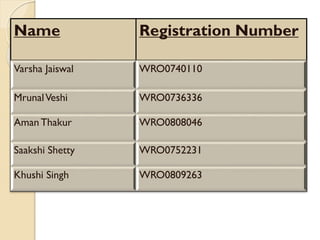
Varsha Jaiswal WRO0740110
MrunalVeshi WRO0736336
Aman Thakur WRO0808046
Saakshi Shetty WRO0752231
Khushi Singh WRO0809263
Introduction
The transfer of payment electronically is an alternate mode of
paying payments to the payee; in such cases , the electronic payment
system arises as the third party serves the payee and payer.
In other words, we can say that e-payment is a type of service that
serves the customer who buys the goods over the internet via
online shopping portals available at their local countries or globally,
and it adds value to the online shopping provider and increases the
ratio of sell.
Electronic payment systems are necessary to intimate the needed
structure to ease payments.
The electronic payment system is an important part of the future
development of business and commerce.
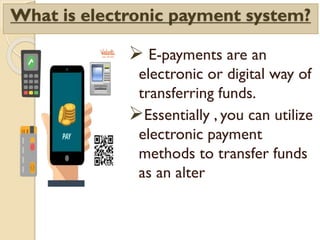
What is electronic payment system?
 E-payments are an
electronic or digital way of
transferring funds.
Essentially , you can utilize
electronic payment
methods to transfer funds
as an alter
Application used for Electronic Payments
E-payments are orchestrated by an electronic funds
transfer (EFT), which is the process of transferring
money from one bank account to another without any
exchange by hand. Online payment methods that use
EFT include:
 Credit and debit cards
 E-wallet
 QR codes
 Other applications used for online receipt and
payments
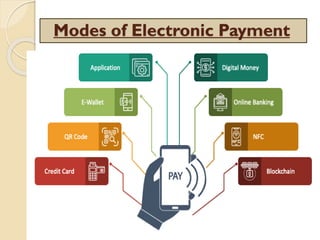
Modes of Electronic Payment
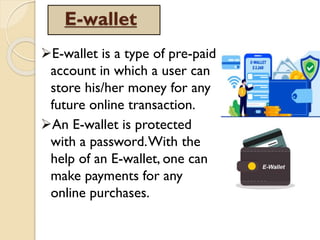
E-wallet
E-wallet is a type of pre-paid
account in which a user can
store his/her money for any
future online transaction.
An E-wallet is protected
with a password.With the
help of an E-wallet, one can
make payments for any
online purchases.
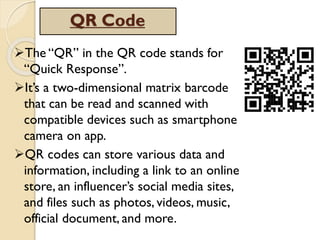
QR Code
The “QR” in the QR code stands for
“Quick Response”.
It’s a two-dimensional matrix barcode
that can be read and scanned with
compatible devices such as smartphone
camera on app.
QR codes can store various data and
information, including a link to an online
store, an influencer’s social media sites,
and files such as photos, videos, music,
official document, and more.
Credit Cards, Digital Money, Online Banking
Credit card is an electronic payment system
normally used for real transactions. Every
credit card account has a purchase limit set by
the issuing bank or the firm.
Digital money (of digital currency) refers to
any means of payment that exists in a purely
electronic form. One well-known form of
digital money is the crypto currency bit coin.
Online banking allows a user to conduct
financial transactions via the Internet.
Online banking significantly reduces the bank’s
operating cost by reducing reliance on a
branch network and officers greater
convenience .
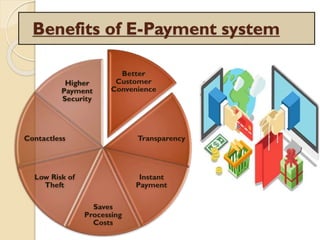
Benefits of E-Payment system
Better
Customer
Convenience
Transparency
Instant
Payment
Saves
Processing
Costs
Low Risk of
Theft
Contactless
Higher
Payment
Security
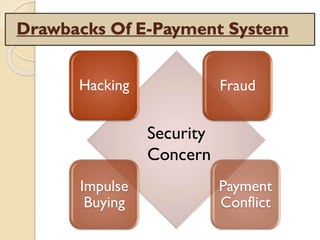
Drawbacks Of E-Payment System
Hacking Fraud
Impulse
Buying
Payment
Conflict
Security
Concern
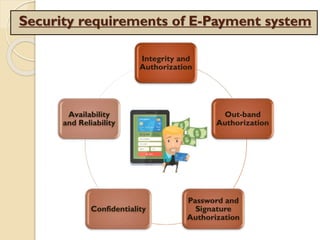
Security requirements of E-Payment system
Integrity and
Authorization
Out-band
Authorization
Password and
Signature
Authorization
Confidentiality
Availability
and Reliability
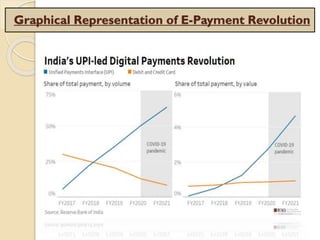
Graphical Representation of E-Payment Revolution
Payment Gateways
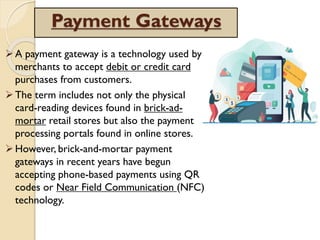
A payment gateway is a technology used by
merchants to accept debit or credit card
purchases from customers.
The term includes not only the physical
card-reading devices found in brick-ad-
mortar retail stores but also the payment
processing portals found in online stores.
However, brick-and-mortar payment
gateways in recent years have begun
accepting phone-based payments using QR
codes or Near Field Communication (NFC)
technology.
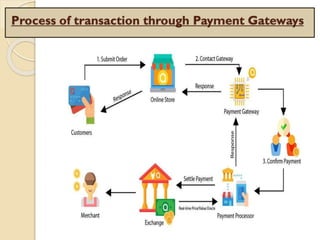
Process of transaction through Payment Gateways
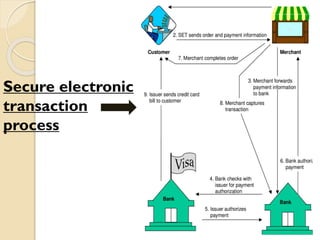
Secure ElectronicTransaction(SET)
Secure ElectronicTransaction (SET) is a system and
electronic protocol to ensure the integrity and
security of transactions conducted over the internet.
E-commerce websites implemented this early
protocol to secure electronic payments made via
debit and credit cards.
SET blocks out all personal details on the card,
preventing hackers and data thieves from accessing
or stealing the cardholder’s information.
The merchant also cannot see these personal details,
which are transferred directly to the credit card
company for user authentication and verification.
Secure electronic
transaction
process
Conclusion
A variety of service provides offer innovative methods
to pay in-person, and for transactions between two
parties in disparate locations. EPS are critically
important for e-commerce as they enable secure,
convenient transactions between buyer and sellers
regardless of their physical location or currency.
To provide their services, network rely on commercial
partnerships with domestic banks as well as
nontraditional partners such as fintechs to deliver
solutions that are locally relevant and accessible.
The successful application of the electronic payment
system is dependent on the way privacy and security
dimensions viewed by the customers as well as the
sellers are managed, which enhances the market
confidence of the electronic payment system.
Bibliography
www.researchgate.com
www.slideshare.com
www.academia.edu
Presentation2 edited.pdf

Presentation2 edited.pdf

  • 2.
    Name Registration Number VarshaJaiswal WRO0740110 MrunalVeshi WRO0736336 Aman Thakur WRO0808046 Saakshi Shetty WRO0752231 Khushi Singh WRO0809263
  • 3.
    Introduction The transfer ofpayment electronically is an alternate mode of paying payments to the payee; in such cases , the electronic payment system arises as the third party serves the payee and payer. In other words, we can say that e-payment is a type of service that serves the customer who buys the goods over the internet via online shopping portals available at their local countries or globally, and it adds value to the online shopping provider and increases the ratio of sell. Electronic payment systems are necessary to intimate the needed structure to ease payments. The electronic payment system is an important part of the future development of business and commerce.
  • 4.
    What is electronicpayment system?  E-payments are an electronic or digital way of transferring funds. Essentially , you can utilize electronic payment methods to transfer funds as an alter
  • 5.
    Application used forElectronic Payments E-payments are orchestrated by an electronic funds transfer (EFT), which is the process of transferring money from one bank account to another without any exchange by hand. Online payment methods that use EFT include:  Credit and debit cards  E-wallet  QR codes  Other applications used for online receipt and payments
  • 6.
  • 7.
    E-wallet E-wallet is atype of pre-paid account in which a user can store his/her money for any future online transaction. An E-wallet is protected with a password.With the help of an E-wallet, one can make payments for any online purchases.
  • 8.
    QR Code The “QR”in the QR code stands for “Quick Response”. It’s a two-dimensional matrix barcode that can be read and scanned with compatible devices such as smartphone camera on app. QR codes can store various data and information, including a link to an online store, an influencer’s social media sites, and files such as photos, videos, music, official document, and more.
  • 9.
    Credit Cards, DigitalMoney, Online Banking Credit card is an electronic payment system normally used for real transactions. Every credit card account has a purchase limit set by the issuing bank or the firm. Digital money (of digital currency) refers to any means of payment that exists in a purely electronic form. One well-known form of digital money is the crypto currency bit coin. Online banking allows a user to conduct financial transactions via the Internet. Online banking significantly reduces the bank’s operating cost by reducing reliance on a branch network and officers greater convenience .
  • 10.
    Benefits of E-Paymentsystem Better Customer Convenience Transparency Instant Payment Saves Processing Costs Low Risk of Theft Contactless Higher Payment Security
  • 11.
    Drawbacks Of E-PaymentSystem Hacking Fraud Impulse Buying Payment Conflict Security Concern
  • 12.
    Security requirements ofE-Payment system Integrity and Authorization Out-band Authorization Password and Signature Authorization Confidentiality Availability and Reliability
  • 13.
    Graphical Representation ofE-Payment Revolution
  • 14.
    Payment Gateways A paymentgateway is a technology used by merchants to accept debit or credit card purchases from customers. The term includes not only the physical card-reading devices found in brick-ad- mortar retail stores but also the payment processing portals found in online stores. However, brick-and-mortar payment gateways in recent years have begun accepting phone-based payments using QR codes or Near Field Communication (NFC) technology.
  • 15.
    Process of transactionthrough Payment Gateways
  • 16.
    Secure ElectronicTransaction(SET) Secure ElectronicTransaction(SET) is a system and electronic protocol to ensure the integrity and security of transactions conducted over the internet. E-commerce websites implemented this early protocol to secure electronic payments made via debit and credit cards. SET blocks out all personal details on the card, preventing hackers and data thieves from accessing or stealing the cardholder’s information. The merchant also cannot see these personal details, which are transferred directly to the credit card company for user authentication and verification.
  • 17.
  • 18.
    Conclusion A variety ofservice provides offer innovative methods to pay in-person, and for transactions between two parties in disparate locations. EPS are critically important for e-commerce as they enable secure, convenient transactions between buyer and sellers regardless of their physical location or currency. To provide their services, network rely on commercial partnerships with domestic banks as well as nontraditional partners such as fintechs to deliver solutions that are locally relevant and accessible. The successful application of the electronic payment system is dependent on the way privacy and security dimensions viewed by the customers as well as the sellers are managed, which enhances the market confidence of the electronic payment system.
  • 19.