Prepared by Mirzəyeva Fidan
What is Financial Technology – Fintech?
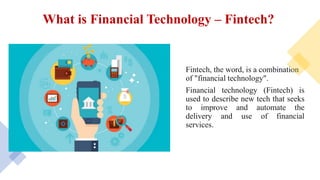
Fintech, the word, is a combination
of "financial technology".
Financial technology (Fintech) is
used to describe new tech that seeks
to improve and automate the
delivery and use of financial
services.
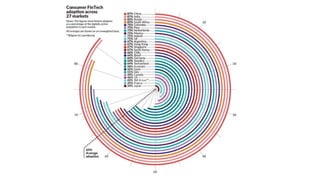
Global Fintech Adoption Index
• Global Fintech Adoption Index is used exploring how FinTech has
improved and expanded its offerings around the world, spurring
change across the financial services industry.
• The Global FinTech Adoption Index has been determined by EY Global
Financial Services since 2015.
• Only 27 countries are still involved in determining the index.
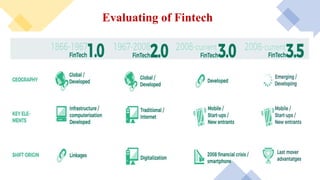
Evaluating of Fintech
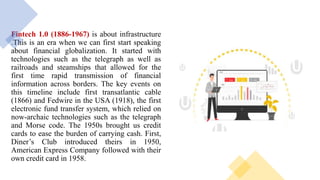
Fintech 1.0 (1886-1967) is about infrastructure
.This is an era when we can first start speaking
about financial globalization. It started with
technologies such as the telegraph as well as
railroads and steamships that allowed for the
first time rapid transmission of financial
information across borders. The key events on
this timeline include first transatlantic cable
(1866) and Fedwire in the USA (1918), the first
electronic fund transfer system, which relied on
now-archaic technologies such as the telegraph
and Morse code. The 1950s brought us credit
cards to ease the burden of carrying cash. First,
Diner’s Club introduced theirs in 1950,
American Express Company followed with their
own credit card in 1958.
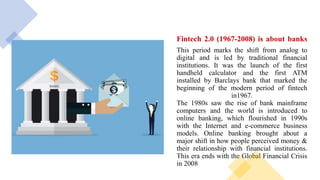
Fintech 2.0 (1967-2008) is about banks
This period marks the shift from analog to
digital and is led by traditional financial
institutions. It was the launch of the first
handheld calculator and the first ATM
installed by Barclays bank that marked the
beginning of the modern period of fintech
in1967.
The 1980s saw the rise of bank mainframe
computers and the world is introduced to
online banking, which flourished in 1990s
with the Internet and e-commerce business
models. Online banking brought about a
major shift in how people perceived money &
their relationship with financial institutions.
This era ends with the Global Financial Crisis
in 2008
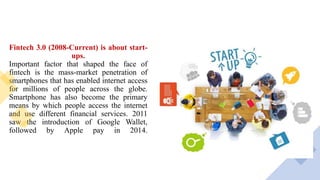
Fintech 3.0 (2008-Current) is about start-
ups.
Important factor that shaped the face of
fintech is the mass-market penetration of
smartphones that has enabled internet access
for millions of people across the globe.
Smartphone has also become the primary
means by which people access the internet
and use different financial services. 2011
saw the introduction of Google Wallet,
followed by Apple pay in 2014.
Fintech Users
Business-to-business (B2B), also called B-to-B, is a form of
transaction between businesses. Business-to-business refers to
business that is conducted between companies, rather than
between a company and individual consumer.
Businesses can easily get loans, financing and other financial
services through mobile technology. For example, Credibly,
Lendkey, BFS capital.
Fintech Users
B2C - Business to client or B2C
• Cash apps like PayPal, Paytm, Alipay, Apple Pay etc.
• Allow clients or customers to transfer money via the
internet or mobile technology.
Fintech Users
Consumer-to-consumer (C2C) fintech services.
This type of service is designed to help consumers interact with each other. One of the
best examples of these services is Venmo. Rather than trading cash or checks, consumers
can send money directly to each other, instantly and with no charge. Even Google has
made inroads in this space by allowing Gmail users to attach cash directly to emails.
Pros and cons of Fintech
Pros of Fintech
• Real-Time Data Collection
• Better Customer Service
• Helps in Decision Making
• Easier Payments
• Effective Interaction
Cons of Fintech
• Lack of Security
• No Uniform Standards
• Complex Networks
Sources
• https://www.e-zigurat.com/innovation-school/blog/evolution-of-
fintech/
• https://www.investopedia.com/terms/f/fintech.asp
• https://www.investopedia.com/terms/b/btob.asp
• https://americandeposits.com/what-is-fintech/
• https://www.business-money.com/announcements/the-pros-and-
cons-of-fintech/
Fintech.

Fintech.

  • 1.
  • 2.
    What is FinancialTechnology – Fintech? Fintech, the word, is a combination of "financial technology". Financial technology (Fintech) is used to describe new tech that seeks to improve and automate the delivery and use of financial services.
  • 3.
    Global Fintech AdoptionIndex • Global Fintech Adoption Index is used exploring how FinTech has improved and expanded its offerings around the world, spurring change across the financial services industry. • The Global FinTech Adoption Index has been determined by EY Global Financial Services since 2015. • Only 27 countries are still involved in determining the index.
  • 5.
  • 6.
    Fintech 1.0 (1886-1967)is about infrastructure .This is an era when we can first start speaking about financial globalization. It started with technologies such as the telegraph as well as railroads and steamships that allowed for the first time rapid transmission of financial information across borders. The key events on this timeline include first transatlantic cable (1866) and Fedwire in the USA (1918), the first electronic fund transfer system, which relied on now-archaic technologies such as the telegraph and Morse code. The 1950s brought us credit cards to ease the burden of carrying cash. First, Diner’s Club introduced theirs in 1950, American Express Company followed with their own credit card in 1958.
  • 7.
    Fintech 2.0 (1967-2008)is about banks This period marks the shift from analog to digital and is led by traditional financial institutions. It was the launch of the first handheld calculator and the first ATM installed by Barclays bank that marked the beginning of the modern period of fintech in1967. The 1980s saw the rise of bank mainframe computers and the world is introduced to online banking, which flourished in 1990s with the Internet and e-commerce business models. Online banking brought about a major shift in how people perceived money & their relationship with financial institutions. This era ends with the Global Financial Crisis in 2008
  • 8.
    Fintech 3.0 (2008-Current)is about start- ups. Important factor that shaped the face of fintech is the mass-market penetration of smartphones that has enabled internet access for millions of people across the globe. Smartphone has also become the primary means by which people access the internet and use different financial services. 2011 saw the introduction of Google Wallet, followed by Apple pay in 2014.
  • 9.
    Fintech Users Business-to-business (B2B),also called B-to-B, is a form of transaction between businesses. Business-to-business refers to business that is conducted between companies, rather than between a company and individual consumer. Businesses can easily get loans, financing and other financial services through mobile technology. For example, Credibly, Lendkey, BFS capital.
  • 10.
    Fintech Users B2C -Business to client or B2C • Cash apps like PayPal, Paytm, Alipay, Apple Pay etc. • Allow clients or customers to transfer money via the internet or mobile technology.
  • 11.
    Fintech Users Consumer-to-consumer (C2C)fintech services. This type of service is designed to help consumers interact with each other. One of the best examples of these services is Venmo. Rather than trading cash or checks, consumers can send money directly to each other, instantly and with no charge. Even Google has made inroads in this space by allowing Gmail users to attach cash directly to emails.
  • 13.
    Pros and consof Fintech Pros of Fintech • Real-Time Data Collection • Better Customer Service • Helps in Decision Making • Easier Payments • Effective Interaction Cons of Fintech • Lack of Security • No Uniform Standards • Complex Networks
  • 14.
    Sources • https://www.e-zigurat.com/innovation-school/blog/evolution-of- fintech/ • https://www.investopedia.com/terms/f/fintech.asp •https://www.investopedia.com/terms/b/btob.asp • https://americandeposits.com/what-is-fintech/ • https://www.business-money.com/announcements/the-pros-and- cons-of-fintech/