Payment Systems For Electronic
Commerce
2
Objectives
In this chapter, you will learn about:
• The basic functions of online payment systems
• The use of payment cards in electronic commerce
• The history and future of electronic cash
• How electronic wallets work
• The use of stored-value cards in electronic commerce
• Internet technologies and the banking industry
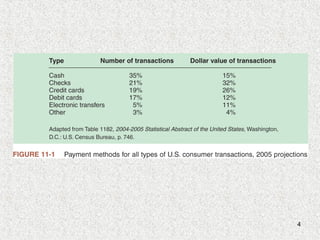
4
5
Online Payment Basics
• Scrip: Any substitute for currency which is not
legal tender, and is often a form of credit.
– For example…
• Digital cash minted by a company instead of by a
government (e.g., Linden Dollars)
• Gift certificates or gift cards
• Subway tokens or arcade tokens
6
Payment Cards
• The term payment card describes all types of plastic
cards used to make purchases
• Credit card
– Has a spending limit based on a user’s credit history
• Debit card
– Removes an amount from a cardholder’s bank account
– Transfers it to the seller’s bank account
• Charge card
– Carries no spending limit
– Amount charged is due at the end of the billing period
7
Advantages and Disadvantages
of Payment Cards
• Advantages:
– Widespread acceptance
– Usually have built-in security for merchants
• Disadvantage:
– Payment card service companies charge merchants per-
transaction fees and monthly processing fees
8
Payment Acceptance and
Processing
• Steps followed once a merchant receives a
consumer’s payment card information:
– Merchant authenticates payment card
– Merchant checks with payment card issuer
• To ensure that credit or funds are available
• Puts a hold on the credit line or the funds needed to
cover the charge
– Settlement of balance with the issuer
9
Open and Closed Loop Systems
• Closed loop systems
– Card issuer pays the merchants that accept the card
directly and does not use an intermediary
• Open loop systems
– Involve three or more parties (e.g., systems using Visa
or MasterCard)
10
Merchant Accounts
• To process payment cards for Internet
transactions an online merchant must set up a
merchant account
• New merchants must supply:
– Business plans
– Details about existing bank accounts
– Business and personal credit histories
11
Processing Payment Cards Online
• InternetSecure
– Provides secure payment card services
• First Data
– Provides merchant payment card processing services
with the following programs:
• ICVERIFY and WebAuthorize
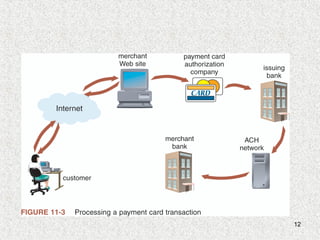
• Banks connect to an Automated Clearing House
(ACH) through highly secure, private leased
telephone lines
12
13
Electronic Cash
• Term that describes any value storage and
exchange system created by a private entity
that:
– Does not use paper documents or coins
– Can serve as a substitute for government-issued
physical currency
14
Micropayments and Small Payments
• Micropayments
– Internet payments for items costing from a
few cents to around $1
• Small payments
– Payments of less than $10
15
Privacy and Security of
Electronic Cash
• Concerns about electronic payment methods include:
– Privacy and security
– Independence
– Portability
– Convenience
• Advantages of electronic cash include being:
– Independent and portable
16
Holding Electronic Cash: Online
and Offline Cash
• Online cash storage
– Trusted third party is involved in all transfers of electronic cash
– Holds consumers’ cash accounts
• Offline cash storage
– Virtual equivalent of money kept in a wallet
– No third party is involved in the transaction
• Double-spending
– Spending electronic cash twice
17
Advantages and Disadvantages of
Electronic Cash
• Advantages of electronic cash:
– Transactions are more efficient
– Costs less than processing credit card transactions
• Disadvantages of electronic cash:
– No audit trail
– Money laundering and fraud
– Susceptible to forgery
20
Electronic Cash Systems
• CheckFree
– Largest ACH (Automated Clearing House) in the world
– Provides online payment processing services
• Clickshare
– Clickshare allows a consumer to have one account at a most-
trusted website and buy from other websites without having to
pass around a credit-card number, register or give out personal
information. One ID, one account, one bill.
21
Electronic Cash Systems
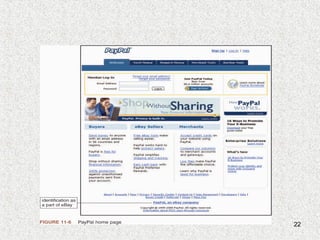
• PayPal
– Founding in 2000 and purchased by eBay in 2002
– Provides payment processing services to
businesses and to individuals
– Peer-to-peer (P2P) payment system
• Free payment clearing service for individuals
22
23
Electronic Wallets
• Hold credit card numbers, electronic cash,
owner identification, and contact information
• Give consumers the benefit of entering their
information just once
• Make shopping more efficient
24
Electronic Wallets
• Server-side electronic wallet
– Stores a customer’s information on a remote server
belonging to a particular merchant or wallet publisher
• Client-side electronic wallet
– Stores a consumer’s information on his or her own
computer
25
Microsoft .NET Passport
• An electronic wallet operated by Microsoft
• Passport consists of four integrated services:
– Passport single sign-in service (SSI)
– Passport Wallet service
– Kids Passport service
– Public profiles
26
Yahoo! Wallet
• Server side electronic wallet offered by Yahoo!
• Lets users store information about several major
credit and charge cards
• Many industry observers and privacy rights
activist groups are concerned about electronic
wallets
27
W3C Micropayment Standards
Development Activity
• Common Markup for Micropayment Per-Fee-
Links
– Standards developed by W3C Electronic
Commerce Interest Group (ECIG)
– Provide extensible and interoperable way to embed
micropayment information in a Web page
• Extensible system
– One that developers can add to (or extend) without
voiding any earlier work on the system
28
The ECML Standard
• Electronic Commerce Modeling Language is a
protocol that dictates how online retailers
structure and setup their checkout forms
– Proposed alternative standard that would replace
electronic wallet standards with a single standard
29
Stored-Value Cards
• Stored-value cards can be an elaborate smart
card with a microchip that records a currency
balance
• Common stored-value cards include:
– Prepaid phone, copy, subway, and bus cards
30
Magnetic Strip Cards
• Magnetic strip cards
– Cannot send or receive information
– Cannot increment or decrement value of cash
stored on the card
– Processing must be done on a device into
which the card is inserted
31
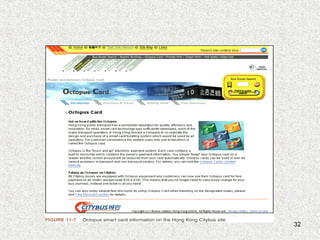
Smart Cards
• Stored-value cards that…
– Can hold private user data, such as financial facts
– Can store about 100 times more information than a
magnetic strip plastic card
– Safer than conventional credit cards
32
33
Smart Cards
• Smart Card Alliance:
– Promotes benefits of smart cards
– Promotes widespread acceptance of multiple-
application smart card technology
– Members include companies in banking, financial
services, computer technology, and healthcare
– Promotes compatibility among smart cards, card
reader devices, and applications
34
Internet Technology and the
Banking Industry
• Paper checks
– Used to make the largest dollar volume payments
• Check Clearing for the 21st Century Act (Check
21)
– Permits banks to eliminate the movement of physical
checks entirely
• That’s why Wal-mart returns your check to you after the
transaction is finished
35
Phishing Attacks
• Basic structure:
– Attacker sends e-mail messages to a large number of
recipients
– Message states that an account has been
compromised and the matter should be corrected
– Message includes a link
– User enters a login name and password, which the
perpetrator captures
– Once inside a victim’s account, the perpetrator can
access personal information
36
Phishing Attack
Countermeasures
• Most important step that companies can take
today is to educate Web site users
• Many companies contract consulting firms that
specialize in anti-phishing work
• Anti-phishing technique
– Monitor online chat rooms used by criminals
37
Summary
• Most popular forms of payment on the Internet
include:
– Credit cards
– Debit cards
– Charge cards (payment cards)
38
Summary
• Electronic cash is:
– A form of online payment
– Slow to catch on in the United States
– Especially useful for making micropayments
• Advantages of electronic cash:
– Portable, anonymous, and usable for international transactions
39
Summary
• Electronic wallets
– Provide convenience to online shoppers
– Eliminate the need to reenter payment card and shipping
information at a site’s electronic checkout counter
• Smart cards are intended to replace the collection of
plastic cards people now carry
• Phishing expeditions create a significant threat to
online financial institutions and their customers

Web payment system

  • 1.
    Payment Systems ForElectronic Commerce
  • 2.
    2 Objectives In this chapter,you will learn about: • The basic functions of online payment systems • The use of payment cards in electronic commerce • The history and future of electronic cash • How electronic wallets work • The use of stored-value cards in electronic commerce • Internet technologies and the banking industry
  • 3.
  • 4.
    5 Online Payment Basics •Scrip: Any substitute for currency which is not legal tender, and is often a form of credit. – For example… • Digital cash minted by a company instead of by a government (e.g., Linden Dollars) • Gift certificates or gift cards • Subway tokens or arcade tokens
  • 5.
    6 Payment Cards • Theterm payment card describes all types of plastic cards used to make purchases • Credit card – Has a spending limit based on a user’s credit history • Debit card – Removes an amount from a cardholder’s bank account – Transfers it to the seller’s bank account • Charge card – Carries no spending limit – Amount charged is due at the end of the billing period
  • 6.
    7 Advantages and Disadvantages ofPayment Cards • Advantages: – Widespread acceptance – Usually have built-in security for merchants • Disadvantage: – Payment card service companies charge merchants per- transaction fees and monthly processing fees
  • 7.
    8 Payment Acceptance and Processing •Steps followed once a merchant receives a consumer’s payment card information: – Merchant authenticates payment card – Merchant checks with payment card issuer • To ensure that credit or funds are available • Puts a hold on the credit line or the funds needed to cover the charge – Settlement of balance with the issuer
  • 8.
    9 Open and ClosedLoop Systems • Closed loop systems – Card issuer pays the merchants that accept the card directly and does not use an intermediary • Open loop systems – Involve three or more parties (e.g., systems using Visa or MasterCard)
  • 9.
    10 Merchant Accounts • Toprocess payment cards for Internet transactions an online merchant must set up a merchant account • New merchants must supply: – Business plans – Details about existing bank accounts – Business and personal credit histories
  • 10.
    11 Processing Payment CardsOnline • InternetSecure – Provides secure payment card services • First Data – Provides merchant payment card processing services with the following programs: • ICVERIFY and WebAuthorize • Banks connect to an Automated Clearing House (ACH) through highly secure, private leased telephone lines
  • 11.
  • 12.
    13 Electronic Cash • Termthat describes any value storage and exchange system created by a private entity that: – Does not use paper documents or coins – Can serve as a substitute for government-issued physical currency
  • 13.
    14 Micropayments and SmallPayments • Micropayments – Internet payments for items costing from a few cents to around $1 • Small payments – Payments of less than $10
  • 14.
    15 Privacy and Securityof Electronic Cash • Concerns about electronic payment methods include: – Privacy and security – Independence – Portability – Convenience • Advantages of electronic cash include being: – Independent and portable
  • 15.
    16 Holding Electronic Cash:Online and Offline Cash • Online cash storage – Trusted third party is involved in all transfers of electronic cash – Holds consumers’ cash accounts • Offline cash storage – Virtual equivalent of money kept in a wallet – No third party is involved in the transaction • Double-spending – Spending electronic cash twice
  • 16.
    17 Advantages and Disadvantagesof Electronic Cash • Advantages of electronic cash: – Transactions are more efficient – Costs less than processing credit card transactions • Disadvantages of electronic cash: – No audit trail – Money laundering and fraud – Susceptible to forgery
  • 17.
    20 Electronic Cash Systems •CheckFree – Largest ACH (Automated Clearing House) in the world – Provides online payment processing services • Clickshare – Clickshare allows a consumer to have one account at a most- trusted website and buy from other websites without having to pass around a credit-card number, register or give out personal information. One ID, one account, one bill.
  • 18.
    21 Electronic Cash Systems •PayPal – Founding in 2000 and purchased by eBay in 2002 – Provides payment processing services to businesses and to individuals – Peer-to-peer (P2P) payment system • Free payment clearing service for individuals
  • 19.
  • 20.
    23 Electronic Wallets • Holdcredit card numbers, electronic cash, owner identification, and contact information • Give consumers the benefit of entering their information just once • Make shopping more efficient
  • 21.
    24 Electronic Wallets • Server-sideelectronic wallet – Stores a customer’s information on a remote server belonging to a particular merchant or wallet publisher • Client-side electronic wallet – Stores a consumer’s information on his or her own computer
  • 22.
    25 Microsoft .NET Passport •An electronic wallet operated by Microsoft • Passport consists of four integrated services: – Passport single sign-in service (SSI) – Passport Wallet service – Kids Passport service – Public profiles
  • 23.
    26 Yahoo! Wallet • Serverside electronic wallet offered by Yahoo! • Lets users store information about several major credit and charge cards • Many industry observers and privacy rights activist groups are concerned about electronic wallets
  • 24.
    27 W3C Micropayment Standards DevelopmentActivity • Common Markup for Micropayment Per-Fee- Links – Standards developed by W3C Electronic Commerce Interest Group (ECIG) – Provide extensible and interoperable way to embed micropayment information in a Web page • Extensible system – One that developers can add to (or extend) without voiding any earlier work on the system
  • 25.
    28 The ECML Standard •Electronic Commerce Modeling Language is a protocol that dictates how online retailers structure and setup their checkout forms – Proposed alternative standard that would replace electronic wallet standards with a single standard
  • 26.
    29 Stored-Value Cards • Stored-valuecards can be an elaborate smart card with a microchip that records a currency balance • Common stored-value cards include: – Prepaid phone, copy, subway, and bus cards
  • 27.
    30 Magnetic Strip Cards •Magnetic strip cards – Cannot send or receive information – Cannot increment or decrement value of cash stored on the card – Processing must be done on a device into which the card is inserted
  • 28.
    31 Smart Cards • Stored-valuecards that… – Can hold private user data, such as financial facts – Can store about 100 times more information than a magnetic strip plastic card – Safer than conventional credit cards
  • 29.
  • 30.
    33 Smart Cards • SmartCard Alliance: – Promotes benefits of smart cards – Promotes widespread acceptance of multiple- application smart card technology – Members include companies in banking, financial services, computer technology, and healthcare – Promotes compatibility among smart cards, card reader devices, and applications
  • 31.
    34 Internet Technology andthe Banking Industry • Paper checks – Used to make the largest dollar volume payments • Check Clearing for the 21st Century Act (Check 21) – Permits banks to eliminate the movement of physical checks entirely • That’s why Wal-mart returns your check to you after the transaction is finished
  • 32.
    35 Phishing Attacks • Basicstructure: – Attacker sends e-mail messages to a large number of recipients – Message states that an account has been compromised and the matter should be corrected – Message includes a link – User enters a login name and password, which the perpetrator captures – Once inside a victim’s account, the perpetrator can access personal information
  • 33.
    36 Phishing Attack Countermeasures • Mostimportant step that companies can take today is to educate Web site users • Many companies contract consulting firms that specialize in anti-phishing work • Anti-phishing technique – Monitor online chat rooms used by criminals
  • 34.
    37 Summary • Most popularforms of payment on the Internet include: – Credit cards – Debit cards – Charge cards (payment cards)
  • 35.
    38 Summary • Electronic cashis: – A form of online payment – Slow to catch on in the United States – Especially useful for making micropayments • Advantages of electronic cash: – Portable, anonymous, and usable for international transactions
  • 36.
    39 Summary • Electronic wallets –Provide convenience to online shoppers – Eliminate the need to reenter payment card and shipping information at a site’s electronic checkout counter • Smart cards are intended to replace the collection of plastic cards people now carry • Phishing expeditions create a significant threat to online financial institutions and their customers